 The shortlist for the 2023 Walter Scott Prize for Historical Fiction has been announced today! Thanks to this prize, I have discovered lots of great books and authors over the last few years and always look out for the longlists and shortlists; in fact, trying to read all of the shortlisted titles since the prize began in 2010 is a personal project of mine (you can see my progress here).
From the longlist of twelve books which was revealed in February, I have managed to read four of them: The Romantic by William Boyd, These Days by Lucy Caldwell, Act of Oblivion by Robert Harris and The Second Sight of Zachary Cloudesley by Sean Lusk. I also have a few of the others waiting on my TBR. But did any of the books I’ve read make the shortlist? Let’s find out…
The 2023 Walter Scott Prize Shortlist
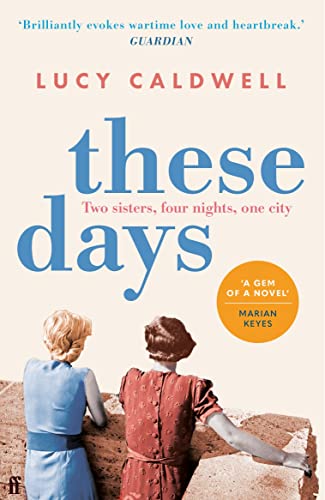 These Days by Lucy Caldwell (Faber)
Two sisters. Four nights. One City.
April, 1941. Belfast has escaped the worst of the war – so far. Following the lives of sisters Emma and Audrey – one engaged to be married, the other in a secret relationship with another woman – as they try to survive the horrors of the Belfast Blitz, These Days is an unforgettable novel about lives lived under duress, about family, and about how we try to stay true to ourselves.
*
 The Geometer Lobachevsky by Adrian Duncan (Tuskar Rock Press)
It is 1950 and Nikolai Lobachevsky, great-grandson of his illustrious namesake, is surveying a bog in the Irish Midlands, where he studies the locals, the land and their ways. One afternoon, soon after he arrives, he receives a telegram calling him back to Leningrad for a ‘special appointment’.
Lobachevsky may not be a great genius but he is not foolish: he recognises a death sentence when he sees one and leaves to go into hiding on a small island in the Shannon estuary, where the island families harvest seaweed and struggle to split rocks. Here Lobachevsky must think about death, how to avoid it and whether he will ever see his home again.
*
 Act of Oblivion by Robert Harris (Hutchinson Heinemann)
1660. Colonel Edward Whalley and his son-in-law, Colonel William Goffe, cross the Atlantic. They are on the run and wanted for the murder of Charles I. Under the provisions of the Act of Oblivion, they have been found guilty in absentia of high treason.
In London, Richard Nayler, secretary of the regicide committee of the Privy Council, is tasked with tracking down the fugitives. He’ll stop at nothing until the two men are brought to justice. A reward hangs over their heads – for their capture, dead or alive.
Act of Oblivion is an epic journey across continents, and a chase like no other. It is the thrilling new novel by Robert Harris.
*
 The Chosen by Elizabeth Lowry (Riverrun)
One Wednesday morning in November 1912 the ageing Thomas Hardy, entombed by paper and books and increasingly estranged from his wife Emma, finds her dying in her bedroom. Between his speaking to her and taking her in his arms, she has gone.
The day before, he and Emma had exchanged bitter words – leading Hardy to wonder whether all husbands and wives end up as enemies to each other. His family and Florence Dugdale, the much younger woman with whom he has been in a relationship, assume that he will be happy and relieved to be set free. But he is left shattered by the loss.
Hardy’s bewilderment only increases when, sorting through Emma’s effects, he comes across a set of diaries that she had secretly kept about their life together, ominously titled ‘What I Think of My Husband’. He discovers what Emma had truly felt – that he had been cold, remote and incapable of ordinary human affection, and had kept her childless, a virtual prisoner for forty years. Why did they ever marry?
He is consumed by something worse than grief: a chaos in which all his certainties have been obliterated. He has to re-evaluate himself, and reimagine his unhappy wife as she was when they first met.
*
 The Sun Walks Down by Fiona McFarlane (Allen & Unwin Australia)
In September 1883, a small town in the South Australian outback huddles under strange, vivid sunsets. Six-year-old Denny Wallace has gone missing during a dust storm, and the entire community is caught up in the search for him. As they scour the desert and mountains for the lost child, the residents of Fairly – newlyweds, landowners, farmers, mothers, artists, Indigenous trackers, cameleers, children, schoolteachers, widows, maids, policemen – confront their relationships with each other and with the ancient landscape they inhabit.
The colonial Australia of The Sun Walks Down is unfamiliar, multicultural, and noisy with opinions, arguments, longings and terrors. It’s haunted by many gods – the sun among them, rising and falling on each day in which Denny could be found, or lost forever.
*
 Ancestry by Simon Mawer (Little, Brown)
Almost two hundred years ago, Abraham, an illiterate urchin, scavenges on a Suffolk beach and dreams of running away to sea… Naomi, a seventeen-year-old seamstress, sits primly in a second class carriage on the train from Sussex to London and imagines a new life in the big city… George, a private soldier of the 50th Regiment of Foot, marries his Irish bride, Annie, in the cathedral in Manchester and together they face married life under arms. Now these people exist only in the bare bones of registers and census lists but they were once real enough. They lived, loved, felt joy and fear, and ultimately died. But who were they? And what indissoluble thread binds them together?
Simon Mawer’s compelling and original novel puts flesh on our ancestors’ bones to bring them to life and give them voice. He has created stories that are gripping and heart-breaking, from the squalor and vitality of Dickensian London to the excitement of seafaring in the last days of sail and the horror of the trenches of the Crimea. There is birth and death; there is love, both open and legal but also hidden and illicit. Yet the thread that connects these disparate figures is something that they cannot have known – the unbreakable bond of family.
*
 I Am Not Your Eve by Devika Ponnambalam (Bluemoose)
I Am Not Your Eve is the story of Teha’amana, Tahitian muse and child-bride to the painter Paul Gauguin. She shares her thougths as he works on one of his masterpieces, The Spirit of The Dead Keeps Watch, a work so important to Gauguin that it haunts his later self-portrait. As Teha’amana tells her story, other voices of the island rise: Hina goddess of the moon, a lizard watching from the eaves, Gauguin’s mask of Teha’amana carved from one of the trees.
Woven in are the origin myths that cradled Polynesia before French colonists brought the Christian faith. Distant diary entries by Gauguin’s daughter Aline – the same age as her father’s new ‘wife’ – recall the other hemisphere of his life. This is the novel that gives Teha’amana a voice; one that travels with the myths and legends of the island, across history and asks to be heard.
~
First of all, it’s unusual to have seven books on the shortlist! Recently there have been five or six and last year only four. I liked but didn’t particularly love either of the two I’ve read – These Days and Act of Oblivion – so I hope there’ll be something I enjoy more amongst the other five. I was disappointed not to see The Romantic on the shortlist as it was by far the best of the longlisted books I had read and probably my favourite book of 2022. However, I’m not entirely surprised as prize judges tend to go for books that are more ‘literary’, whereas I’m happy with good storytelling and strong characters. Anyway, well done to the seven shortlisted authors! I’ll see how many more of these I can read before the winner is revealed.
What do you think? Have you read any of these or would you like to read them?
The winner will be announced at the Borders Book Festival in Melrose, Scotland in June.


 She Reads Novels