The Champion by Elizabeth Chadwick

Considering how much I enjoy historical fiction, Elizabeth Chadwick is one of those authors I feel I should probably love. Until recently though, I had only tried to read one of her books – which I think was Lords of the White Castle – and couldn’t get into it at all. On a visit to the library a couple of weeks ago I decided it was time to give her another chance and as I don’t know much about any of her books, I chose this one almost at random.

The Champion is set in France, Wales and England towards the end of the 12th century. Our hero is Alexander de Montroi, a seventeen-year-old novice monk who runs away from the monastery after being abused by the sub-prior. Deciding to swap the religious life for the battlefield, Alexander asks his older brother, Hervi, to help him become a knight. He proves to be a skilled fighter and is soon an important member of Hervi’s camp, jousting and taking part in tourneys (tournaments).

It’s here that Alexander meets and falls in love with Monday de Cerizay, the daughter of Hervi’s friend and fellow knight. Despite having wealthy relatives in England, Monday has spent her whole life travelling around the tourney circuit. Having seen what this lifestyle has done to her parents, Monday longs to better herself. So when Alexander asks her to marry him, she panics and leaves the camp without letting him know where she is going. Years later, Monday and Alexander meet again and have to begin rebuilding their relationship all over again, despite the attempts of Monday’s rich and powerful grandfather to split them up – and the reappearance of Alexander’s sworn enemy, Eudo Le Boucher.

The medieval world Elizabeth Chadwick has created in The Champion is amazingly vivid and believable. The amount of detail she goes into when describing clothes, fabrics, food and drink etc is very impressive. In particular I thought the descriptions of the knights’ camps at the tourneys were very well written and felt realistic. Chadwick shows us the less glamorous side of a knight’s life: worrying about money, searching for a rich man to sponsor them in the tourneys, looking for work in the winter, as well as the constant travelling around from camp to camp, running the risk of being defeated in battle and losing their horse, their possessions or even their life.

There are a few real historical figures who appear in the book, including Richard Coeur de Lion (Richard the Lionheart), his brother John, Count of Mortain (the future King John of England) and the knight, William Marshal. But it’s not really necessary to be familiar with the history of this period, as the focus is very much on the fictional lives of Alexander and Monday. I liked Alexander from the beginning, though I wasn’t so fond of his brother Hervi (maybe because his first appearance in Chapter One doesn’t really endear him to the reader) but as the story progressed I loved watching his relationship with Alexander develop, playing the role of the protective older brother. In fact, I thought the male characters in this book were stronger overall than the female ones. I didn’t find Monday a very memorable character and I didn’t always agree with or understand her actions either.

Once I got into this book, I really enjoyed it. I didn’t think the romantic storyline was very original or imaginative, but the wonderful medieval setting more than made up for it. I feel more like giving Elizabeth Chadwick’s other books a chance now that I know I do enjoy her work and my failure with Lords of the White Castle was probably just a case of the wrong book at the wrong time. Any suggestions as to which one I should try next?

The Sandalwood Tree by Elle Newmark

This is my first book for the Transworld Book Group. I was immediately drawn to The Sandalwood Tree as I love historical fiction set in India – and I’m pleased to say that it didn’t disappoint me at all.

This novel consists of two storylines, both of which take place during an important period of India’s history. In 1947 we meet an American woman, Evie Mitchell, who has moved to India with her husband, Martin, and five-year-old son Billy. Martin, a historian, is planning to study the end of British rule and the process of Partition (the separation of Hindus and Muslims which led to the creation of Pakistan). As the Mitchells try to settle into their new life it becomes obvious that there are big problems in their marriage. Martin, who served in the US army during World War II, is still haunted by some of the things he experienced in Germany and is suffering from what we might now call post-traumatic stress disorder.

Soon after moving into their new house in the village of Masoorla, Evie discovers some old letters hidden behind a loose brick in the wall. The letters were written by two British women, Felicity Chadwick and Adela Winfield, who lived in the same house during the 1850s – a time of rising tension between the British and Indian people, leading to the Sepoy Rebellion of 1857. Evie is intrigued and begins to search for more information about the two Victorian women. As she slowly uncovers Felicity and Adela’s story through a series of letters, diaries and historical documents, she starts to see some similarities between her own life and theirs.

Elle Newmark’s descriptions of India are filled with colour and detail. Whether she’s writing about the food prepared by Habib, the Mitchells’ cook, a monkey swinging from the branches of a tree, or a perfume stall at the bazaar, her images really help to bring the book’s setting to life. Because most of the story is told from Evie’s perspective and she is new to India, seeing everything for the first time, we can experience all the sights, sounds and smells along with her. We also share Evie’s fascination with Adela and Felicity and we feel her frustration every time she attempts to address the problems with her marriage.

Reading The Sandalwood Tree is an excellent way to learn about India’s history and culture and Elle Newmark makes everything easy to understand. But it’s also a great story with a beautiful setting, fascinating plot and complex characters who grow and change over the course of the novel. The transitions between the two periods are handled perfectly, moving smoothly from Evie’s story to Felicity and Adela’s, and it was interesting to see the parallels and connections between them. I found I enjoyed both storylines equally – each one would have been strong enough to form a complete novel on its own, but it’s the way the two are interwoven that makes this book special.

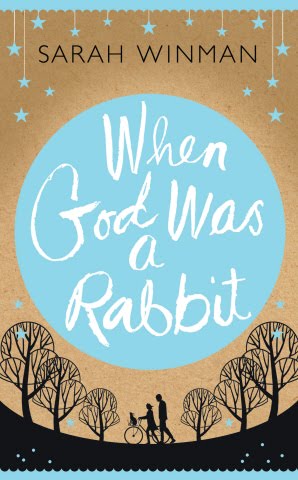
When God Was a Rabbit by Sarah Winman

When God was a Rabbit is the story of Eleanor Maud Portman (known as Elly) and is divided into two parts. In the first part, Elly tells us about her childhood growing up in England in the 1970s and introduces us to some of the important people in her life, including her older brother, Joe, her best friend, Jenny Penny – and a pet rabbit called God. We then jump forward fifteen years and rejoin Elly as an adult in the 1990s. Over the years the family experience more than their fair share of dramas and disasters, though there are some good times too. I don’t want to go into too much detail about what happens to them, but the Portmans’ lives are affected by murder, illness, kidnapping, child abuse and terrorism, to name just a few of the tragic events covered in the book.

I enjoyed When God was a Rabbit but I did think it had a few flaws. I often complain that books are too slow for me but if anything, the pace of this one was too fast. I felt that some of the things that happened to Elly and her family deserved to be explored in more depth, but instead the story moved quickly on to a new topic and a new tragedy – it was hard to believe that so many things could possibly happen to one family. I can appreciate that this is fiction and doesn’t have to be realistic, but I was still overwhelmed by the sheer amount of issues the book touches on.

I’m younger than Elly but a lot of the things from her childhood felt familiar to me too. I think for people of a certain age (especially those born around the time Elly was, in 1968) this is a book that could be enjoyed almost as much for the nostalgia and the memories as for the plot. Elly’s personal story is set against a backdrop of historical events including the Queen’s Silver Jubilee in 1977, John Lennon’s death in 1980 and the 9/11 tragedy in 2001. These events and others all affected Elly, either directly or indirectly, and again this is where I felt Sarah Winman was trying to pack too much into one novel.

I don’t want to sound too negative though, because I really was impressed by When God was a Rabbit. I loved the first half of the book and although the second half didn’t have the same feel of magic and innocence, I still found it compelling. I wanted to read on and find out what had happened in the intervening years and how the story would end for Elly, Joe, Jenny Penny and the others. Despite the whimsical title and cover, this book deals with some heavy themes and beneath the charm and humour there’s also a lot of sadness and poignancy. I often had tears in my eyes while I was reading but there were an equal number of scenes that made me smile (especially the school nativity play!). And although I had mixed feelings about this book, I thought the good points outweighed the bad. I would advise you to try it for yourself and see what you think!

The Flight of the Falcon by Daphne du Maurier

Having read most of Daphne du Maurier’s more popular books I’m now slowly working through her lesser known novels (though I’m saving Frenchman’s Creek for last as I’m expecting to love that one and want to have something to look forward to). Published in the 1960s, The Flight of the Falcon was one of her final novels and although I didn’t think it was one of her best, I did still enjoy it. If you’re new to du Maurier I would recommend reading some of her other books first, but this one is definitely worth reading too.

Our narrator, Armino Fabbio, works for Sunshine Tours and at the beginning of the book he is showing a group of British and American tourists the sights of Rome. By chance he becomes indirectly involved in the murder of an elderly peasant woman, who he believes he recognises as his childhood nurse, Marta. Deciding to visit Ruffano, the town of his birth, in an attempt to find out what had happened to Marta, Armino begins to uncover some shocking family secrets.

After Armino’s arrival in Ruffano (which is based on the real Italian city of Urbino), the story begins to revolve around the city’s university and the rivalry between the Arts students and the Commerce & Economics students. The battle between these two groups reaches its climax during the preparations for a festival re-enacting the final moments of the city’s fifteenth-century ruler, the evil Duke Claudio – also known as The Falcon.

As I think I’ve said every time I’ve written about a du Maurier book, one of the things I love most about her writing is the atmosphere she creates. In The Flight of the Falcon she succeeds in making Ruffano, with its medieval streets, historic churches and ducal palace, seem beautiful and picturesque but claustrophobic and forbidding at the same time. Whether she’s writing about Cornwall, Italy, France or any other part of the world, her settings always feel vivid and real.

Not everything about this book worked for me, though. I found I didn’t really care about the university politics and rival student groups, which formed such a big part of the plot. I was much more interested in Armino’s personal story. Armino himself is not the strongest of characters, but I was fascinated by his relationship with his elder brother, Aldo. And I hadn’t realised how many of du Maurier’s novels have male narrators! My Cousin Rachel, The Scapegoat, The House on the Strand, I’ll Never Be Young Again and now this one. Are there any others?

In October, Simon from Savidge Reads and Polly of Novel Insights are hosting a ‘Discovering Daphne’ season, so if you still haven’t read any of Daphne’s books that could be a good time to start.

Possession by A.S. Byatt

Possession is a literary mystery which follows two academics, Roland Michell and Maud Bailey, who are studying the lives of two fictional Victorian poets, Randolph Henry Ash and Christabel LaMotte respectively. When they discover new evidence that suggests the two poets knew each other and may even have been lovers, Roland and Maud begin working together to uncover the truth. Woven into the story are letters, poems, fairy tales and journal entries, all of which feel like authentic Victorian documents. The significance of these is not always immediately obvious but as Maud and Roland continue to find new clues regarding Ash and LaMotte, things slowly begin to make sense.

Possession is one of those books I feel I should have read long before now but never have, partly because I was afraid it might be too clever and intellectual for me. Now that I’ve finally read it I’m glad I got over my fear of it and decided to give it a try, because it wasn’t quite as difficult to read as I thought it would be and in fact was a very rewarding and enjoyable read. I did find it hard to get into at first and almost gave up a few times throughout the first 200 pages, but somewhere in the middle of the book I found myself becoming completely absorbed in the story and didn’t want to put it down.

I’m not a lover of poetry and was tempted to skip some of the longer poems, but although I did try to read them all I know I didn’t pick up on all the little references and metaphors they contained. I would need to read the whole book again to pick up on everything I missed the first time, but I found it such a challenge to read once I don’t think I’ll want to read it again, at least not in the near future.

I enjoyed following Maud and Roland on their physical journey, first around the North Yorkshire coast and then to Brittany, retracing the steps of Ash and LaMotte. This book made me wish I was also on the trail of an important literary mystery – I think it would be fascinating. It’s intriguing to think that an important part of someone’s life can become lost in the mists of time, and when rediscovered can completely change the way we think about them and their work.

As the book progressed, I had a better understanding of what the title ‘possession’ could mean and the various ways in which it could be interpreted. There’s the obvious interpretation of two people in love, but there’s also an intellectual possession – the possession of information, secrets and ideas. Then there are the physical possessions of the letters and writings, and the dispute over who should actually ‘possess’ them. There’s possession in a spiritual, ghostly sense. And the way we become possessed with the desire for knowledge and the wish to ‘possess’ our subject.

There are so many layers to this book that I would need to write a post twice as long as this one to be able to mention everything. There’s feminist symbolism, natural history, legends and mythology, the Victorian fascination with seances and spiritualists. And in addition to all this, Byatt creates an entire history for both Randolph Henry Ash and Christabel LaMotte, to the extent where they feel as if they could really have existed, as if they were real Victorian poets. I can’t imagine how much work must go into writing a novel like this; it’s very, very impressive and I can understand why it won the Booker Prize in 1990.

The Blank Wall by Elisabeth Sanxay Holding

Every time I pick up a Persephone book I’m amazed by the diversity of the books they publish. The Blank Wall, written by the American author Elisabeth Sanxay Holding and originally published in 1947, is completely different to the others I’ve read, in terms of both plot and overall feel.

The Blank Wall is a suspense novel set during World War II. Lucia Holley is living with her two teenage children and her father in their lakeside home, while her husband, Tom, is serving in the navy somewhere in the Pacific. Her daughter, Bee, has been having an affair with an older man who Lucia considers to be entirely unsuitable. Things quickly start to spiral out of control and Lucia finds herself involved in murder, blackmail and a series of other crimes, all of which she attempts to conceal from her family. But as she desperately tries to protect her loved ones and avoid a scandal, could Lucia actually be putting herself and others in danger?

With the story being told from Lucia’s perspective, we are given lots of insights into her thought processes as she tries to cope with the disruption to her previously peaceful life. I could really feel Lucia’s fear and panic as everything seemed to be closing in around her. I didn’t always understand her actions and there were times when I felt frustrated with her because some of her decisions were clearly silly and irrational, but it was an interesting study into the way a 1940s woman of Lucia’s class and background might have reacted. It was easy to see why Lucia felt under so much pressure. She was doing her best to take care of her family during wartime and provide meals for them despite rationing and shortages, as well as trying to solve their personal problems and keep them safe – while continuing to send letters to her husband assuring him that everything at home was fine.

The pages of The Blank Wall are filled with tension and suspense. The plot is exciting and fast-paced and I could never guess what might happen next. But apart from the thrilling plot, the other strength of this book is the skilful way Holding portrays the relationships between Lucia and the other characters, particularly with her daughter Bee, the housekeeper Sybil and one of the blackmailers, Martin Donnelly, with whom she starts to form a surprising friendship. And I haven’t read many stories of the American Home Front during the war, so this was another interesting aspect of the book for me. A great story and one of my favourite Persephones so far.

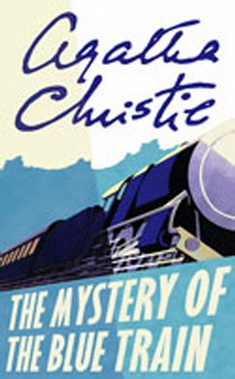
The Mystery of the Blue Train by Agatha Christie

Ruth Kettering is an American heiress who receives a set of valuable rubies as a gift from her father. Despite his warnings to keep them somewhere safe, Ruth takes the jewels with her on a trip to Nice. During her journey through France on the famous Blue Train, Ruth is found strangled to death in her compartment – and the case containing the rubies has disappeared. Hercule Poirot, who also happens to be travelling on the same train, promises to help Ruth’s father solve the crime and identify the killer. Suspicion falls first on Ruth’s husband, Derek Kettering, whom she had been about to divorce, and then on the mysterious Comte de la Roche. Is one of them the murderer?

I grabbed The Mystery of the Blue Train from the library shelf without really knowing anything about it. A bit of research now tells me it’s one of Agatha Christie’s less popular Poirot novels and now that I’ve read it I think I can see why. It was written quite early in her career and at a troubled time in her personal life, and apparently the author herself was unhappy with it. The book does have all the elements that should have added up to a classic Christie novel (a rich heiress, a journey on a luxury train, jewel thieves, the South of France – and Hercule Poirot himself, of course) but while I did enjoy it, I still felt there was something missing.

Compared to the other Agatha Christie books I’ve read, which admittedly isn’t all that many, this one was much longer and seemed to take a while to really get started (the actual crime doesn’t take place until about 100 pages into the book). There was a very long wait before Poirot made his first appearance and instead we spend a lot of time being introduced to other characters, which would have been okay had I liked these characters, but I found them a bit stereotypical, from the American millionaire to the French count to the old antiques dealer.

There were also a few sub-plots that I felt didn’t really add much to the story, although I did enjoy the dialogue between Poirot and Katherine Grey, a young woman he meets on the train who becomes involved in the murder investigation. The mystery itself kept me guessing, though I think there were probably enough clues to be able to work out at least part of the solution, if you were paying more attention than I was! The Mystery of the Blue Train was entertaining in places but is probably my least favourite Christie novel so far.