The Princess of Cleves by Madame de Lafayette

First published in French in 1678, The Princess of Cleves (or La Princesse de Clèves to give it its French title) is considered to be one of the first psychological novels. The story is set in the previous century (between 1558 and 1559), which also makes it an early example of the historical fiction novel.

Newly arrived at the court of Henri II, the beautiful Mademoiselle de Chartres catches the eye of the Prince of Cleves and they are soon married. The new Princess of Cleves does not love her husband, but she likes and respects him and for a while it seems that might be enough…until she meets and falls in love with the Duc de Nemours. The rest of the book explores the Princess’s conflicting emotions, as she becomes torn between her passionate love for the Duc and her desire to stick to her morals and do what she believes is right. Eventually the Princess faces an important decision, but the choice she makes is maybe not what you would expect and it’s left to the reader to make up their own mind whether they agree with her actions or not.

This book was of particular interest to me because earlier this year I read Queens’ Play by Dorothy Dunnett, which is set at the French court in the middle of the 16th century. The Princess of Cleves is set at the same court during the same period and so it was filled with names I recognised. The title character and her mother are fictional but the others are real historical figures: Henri II and his wife Catherine de’ Medici, Diane de Poitiers (the Duchess de Valentinois), the Constable de Montmorency, the Mareschal de St. Andre, the Prince of Conde, the Vidame of Chartres, the Duke de Guise and his brothers, as well as the Dauphin and his wife, Mary Queen of Scots. I think the fact that I was already familiar with these characters made the opening pages of this book slightly less overwhelming than they might otherwise have been! And luckily, only a few of the people mentioned play an important part in the story, so it’s not necessary to keep track of all of them.

If you can get past the first section, which is little more than a long list of names and descriptions of the relationships between the various courtiers, the story does start to pick up. It all appears to be very accurate historically, although not much attention is given to the important historical events of the period – this is a character driven story with the focus on the actions of the Princess, her husband and the Duc de Nemours. The court of France at that time was known for being frivolous, decadent and rife with romantic intrigue and gossip, and the author manages to capture these aspects of court life. However, having read about the background to the novel, it seems Madame de Lafayette was also commenting on the behaviour and structure of the court of her own time, Louis XIV, which I know less about so am not sure how similar or different the two courts were.

The Princess of Cleves is not a book I would recommend if you’re looking for an entertaining read with an exciting plot, but if you enjoy French literature and history or if you’re interested in the development of the early novel then I think it’s definitely worth reading. It’s a short novel and doesn’t take too long to read, though it does require some concentration, especially at the beginning. I found the writing very dry, though maybe that’s my own fault for reading the free version from Project Gutenberg rather than searching for a better translation. As I’m not able to read it in its original French, which would obviously be the best option, I’d appreciate any opinions as to which translation I should try if I decide to re-read the book at some point in the future.
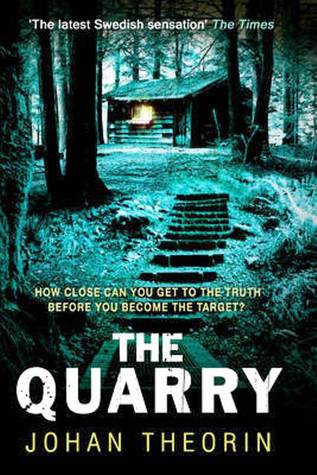
The Quarry by Johan Theorin

This is the third in Johan Theorin’s Öland Quartet, a series of four crime novels set on the Swedish island of Öland. Each book in the series is set during a different season, with the changes in weather and landscape affecting the mood and atmosphere of the story. I loved the first two books, Echoes from the Dead and The Darkest Room, so I was looking forward to my third visit to Öland. I couldn’t wait to meet my favourite character, Gerlof Davidsson, again and to find out what life on the island was like during the spring months.

In The Quarry, Gerlof is now eighty-three years old and, deciding he doesn’t want to spend the remainder of his life in the residential care home he’s been living in, he moves out and returns to his old cottage in the village of Stenvik. Once back in his own home, he finds some of his late wife’s old diaries written while he was away at sea many years earlier. What he discovers in the diaries could be connected to the story of Vendela Larsson, who has recently moved into a luxury house nearby with her husband, Max. Vendela grew up on the island listening to her father’s tales of myths and legends, and returning to Öland as an adult she finds herself wondering whether the elves and trolls she believed in as a child might really exist.

Meanwhile, Gerlof and Vendela also have another new neighbour: Per Mörner, a divorced father, who has inherited his uncle’s cottage beside an abandoned quarry. Per is looking forward to spending the Easter holidays there with his two children, but he has to change his plans when his daughter becomes seriously ill and his father, Jerry, is almost killed in an arson attempt. Per has barely spoken to Jerry for years but feels obliged to help him, and when he begins to investigate he becomes drawn into his father’s sordid past.

“If you like Stieg Larsson, try a much better Swedish writer” it says on the back cover of this book. I can’t comment on that as I’ve never read Stieg Larsson and am not an expert on Swedish crime fiction, but I would certainly be happy to recommend Theorin’s Öland novels. They are all standalone stories and with the exception of Gerlof, they have different characters so can be read in any order, though I would suggest leaving The Quarry until you’ve read the previous two as I found this one the weakest book of the three.

I still love Gerlof and enjoyed being reacquainted with him. I can only hope that I’m as independent, alert and intelligent as he is when I’m in my eighties! I also liked Per, who was doing his best to deal with his various problems including his daughter Nilla’s illness and his difficult relationship with Jerry. And as usual, the descriptions of the island of Öland are beautifully written. This book is set in the spring, as the last of the winter snows are melting away, so the story is not quite as dark as the first two but there’s still a feeling of loneliness and isolation. The translator, Marlaine Delargy, deserves a word of praise for not losing any of the atmosphere or sense of place.

So why didn’t I enjoy this book as much as the others in the series? The reason, I think, was that Vendela’s story, filled with folklore and magical stories of battles between elves and trolls, didn’t really work very well with the other main storyline. Although I was interested in the fates of both Vendela and Per, I thought their stories could have been the subjects of separate books rather than being combined in the same novel and because of this, I found The Quarry less satisfying than Echoes from the Dead and The Darkest Room (the best of the three, in my opinion). I was disappointed after loving the first two so much, but that won’t stop me reading more Johan Theorin books in the future.

September Reading Summary

I never know how to begin writing these monthly posts, so without further ado I’ll just go straight into my summary of September’s reading.

I started the month with the new Philippa Gregory book, The Kingmaker’s Daughter, fourth in her Cousins’ War series, telling the story of the Wars of the Roses through the eyes of some of the important female figures from the period. This one is narrated by Anne Neville, daughter of the Earl of Warwick and wife of Richard III. Not my favourite book in the series, but still one that I enjoyed reading.

I was already familiar with Anne Neville’s story before reading The Kingmaker’s Daughter, but I also read two books in September that introduced me to some historical figures I knew little or nothing about. In The Conductor by Sarah Quigley I met the Russian composer Dmitri Shostakovich and learned about the circumstances that surrounded the composition of his Leningrad Symphony. And in Melanie Benjamin’s The Autobiography of Mrs Tom Thumb I found out what life was like for Mercy Lavinia Warren Bump, who measured only two feet eight inches tall.

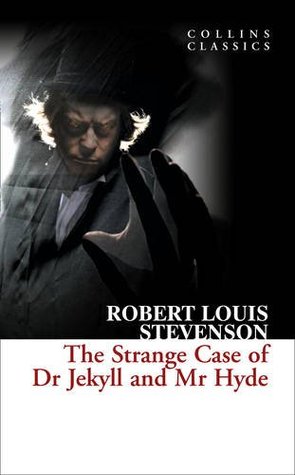
I also read three books for R.I.P. VII. The first was The Strange Case of Dr Jekyll and Mr Hyde by Robert Louis Stevenson. I haven’t had time to write about the other two yet: The Quarry by Johan Theorin and The Seance by John Harwood. The Seance, which felt like a Victorian sensation novel, was a book I had expected to enjoy and I did, though I didn’t like it quite as much as John Harwood’s other book, The Ghost Writer. The Quarry is the third in a planned quartet of crime novels set on the Swedish island of Oland, but although I loved the first two in the series, this one was a slight disappointment – I’ll explain why when I post my review.

Back to historical fiction, and another book I still need to post my thoughts on is Wolf Hall by Hilary Mantel. I started reading it in August as part of a readalong, but fell behind with the schedule after the first couple of weeks. I did still manage to finish it before the end of September and was very impressed. I can see exactly why it has been so successful. Finally, anyone who has been following my blog for a while will know that I’m currently working my way through Dorothy Dunnett’s House of Niccolo series. Yesterday I finished the fourth in the series, Scales of Gold, and although I did enjoy the previous three, this one was the best so far for many reasons, not least the wonderful Timbuktu setting and the shocking cliffhanger ending!

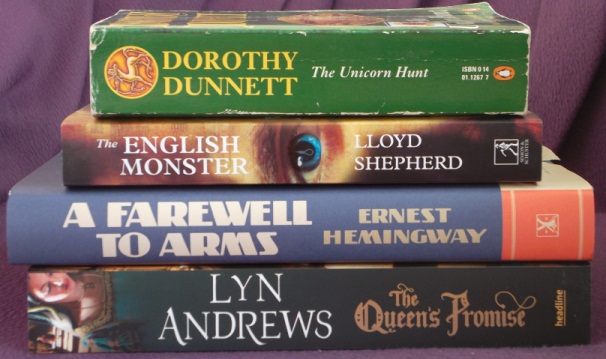
Newly acquired books

The Unicorn Hunt by Dorothy Dunnett
The English Monster by Lloyd Shepherd
A Farewell to Arms by Ernest Hemingway
The Queen’s Promise by Lyn Andrews

Apart from the top one, which I bought myself so I can continue with the House of Niccolo, the other three are review copies.

Clarissa Group Read

I haven’t posted any updates on my progress with the group read of Samuel Richardson’s Clarissa since March, but I am still reading it and am finally beginning to catch up after coming close to abandoning it earlier in the year. I’m reading the Kindle version which is in nine volumes and have just started volume seven, so I think I will probably be able to finish it before the end of December as scheduled.

I hope you all had a good September and enjoy your reading in October!