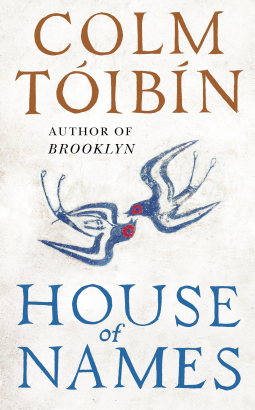
House of Names by Colm Tóibín

After talking recently about my desire to read more fiction set in Ancient Greece, I was pleased to have the opportunity to read Colm Tóibín’s new novel House of Names. It retells the tragic story of the House of Atreus, described in Aeschylus’ famous trilogy, the Oresteia. Not being very familiar with this story, I had no problem following the plot of the novel, but couldn’t help wondering how different my experience would have been if I was already more well-versed in the Greek classics.

House of Names begins in dramatic style with Agamemnon sacrificing his eldest daughter, Iphigenia. In return the gods will bring about a change in the wind which will allow his army to sail to Troy. Iphigenia’s mother, Clytemnestra, is forced to witness the terrible scene – made even worse by the fact that she had believed she was coming to watch her daughter’s wedding, not her murder. The first section of the novel is narrated by Clytemnestra and I thought it was wonderful, vividly describing the moment of the sacrifice and perfectly capturing the agony and heartbreak of a mother at the loss of her child and the bitter fury of a wife at the treachery of her husband. Angry and grieving, Clytemnestra returns to Mycenae to await her husband’s return from Troy and her chance to take revenge:

Her screams as they murdered her were replaced by silence and by scheming when Agamemnon, her father, returned and I fooled him into thinking that I would not retaliate. I waited and I watched for signs, and smiled and opened my arms to him, and I had a table here prepared with food. Food for the fool! I was wearing the special scent that excited him. Scent for the fool!

But what effect will Clytemnestra’s next actions have on her two remaining children, Orestes and Electra? We don’t have to wait long to find out as sections written from the perspective of each of those characters follow. Orestes’ is told in the third person and describes his kidnapping from the palace of Mycenae and his later escape with the help of two other boys, Leander and Mitros. Together, far from home and away from their families, Orestes and his friends must find a way to survive into adulthood. His sister Electra, meanwhile, pushed aside after Iphigenia’s death, watches Clytemnestra and her lover Aegisthus and begins to plot a revenge of her own…

This has been a difficult review for me to write as I still can’t quite decide what I thought of House of Names! I loved the powerful opening section of this novel but, two weeks after finishing the book, that’s the only part that has really stayed with me. The Orestes and Electra sections, although I found them interesting at the time, felt strangely detached and emotionless. The writing style helped to create an eerie, otherworldly feel at times, but it came at the expense of the passion and intensity I would have preferred from a story like this.

I do think that my lack of knowledge of the Oresteia and the fate of the House of Atreus could have been an advantage rather than a disadvantage as far as this book is concerned. I’ve read several other reviews that mention being confused by Tóibín’s decision to change so many details of the story, such as the use of the character of Leander to fill the role of Pylades, but not being familiar with the original I didn’t even notice things like this. Maybe I should have an attempt at reading the Oresteia itself one day. Does anyone know of a good translation to read?

As for Colm Tóibín, I’m looking forward to reading more of his work. Brooklyn is the only other one of his novels that I’ve read and the two couldn’t be more different. Which of his books do you think I should try next?

Thanks to Penguin for providing a copy of this book via NetGalley for review.

My Commonplace Book: May 2017

A selection of words and pictures to represent May’s reading

My Commonplace Book

commonplace book
Definition:
noun
a notebook in which quotations, poems, remarks, etc, that catch the owner’s attention are entered

Collins English Dictionary

~

When you are young you are too busy with yourself – so Caroline thought – you haven’t time for ordinary little things, but, when you leave youth behind, your eyes open and you see magic and mystery all around you: magic in the flight of a bird, the shape of a leaf, the bold arch of a bridge against the sky, footsteps at night and a voice calling in the darkness, the moment in a theatre before the curtain rises, the wind in the trees, or (in winter) an apple-branch clothed with pure white snow and icicles hanging from a stone and sparkling with rainbow colours.

Vittoria Cottage by DE Stevenson (1949)

~

Mata Hari

“Tell me where you learned to dance.”

“Java.” I paint the picture for him. Gamelan orchestras playing in the night. White orchids floating in private pools. Parties so lavish the queen of Holland might have attended. “There was a woman who danced at these affairs. Mahadevi.” I describe how she taught me to dance and I can see him struggling to decide whether or not I’m telling the truth. But he doesn’t say anything. He must believe me.

Mata Hari by Michelle Moran (2016)

~

She loved her country, Botswana, which is a place of peace, and she loved Africa, for all its trials. I am not ashamed to be called an African patriot, said Mma Ramotswe. I love all the people whom God made, but I especially know how to love the people who live in this place. They are my people, my brothers and sisters. It is my duty to help them to solve the mysteries in their lives. That is what I am called to do.

The No. 1 Ladies’ Detective Agency by Alexander McCall Smith (1998)

~

With a conscious effort, he brought his focus back to the present. He had decided long ago that dwelling on the past was for fools. You could not go back and change your actions, so why go over and over your mistakes in your memory? Because he was a fool. A sentimental fool, who was getting old. He smiled at the thought.

The Serpent Sword by Matthew Harffy (2015)

~

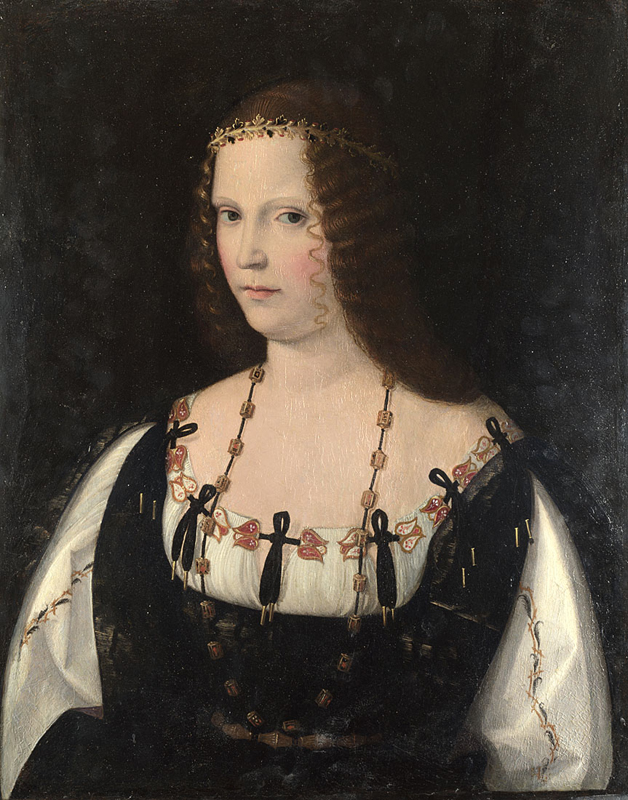
Possible portrait of Lucrezia Borgia.

How else to explain the chaos strewn in our wake, the ravaged lives, the sacrificed innocence and spilled blood? How else to justify the unexpected trajectory of my own life, forever wandering the labyrinth of my family’s ruthless design?

There can be no other reason. Infamy is no accident. It is a poison in our blood.

It is the price of being a Borgia.

The Vatican Princess by CW Gortner (2016)

~

“So I ask you,” said the boy. “Here I am on this rock. Am I the same boy as the one on land? Do the same codes apply if you’re wholly, entirely alone?”

The Winter Isles by Antonia Senior (2015)

~

Below her, gentle flower filled gardens sloped down to the lake in three terraces, with paths, steps and benches strategically placed between the three. The lake itself was the most gloriously shining silver she’d ever seen. All memory of the previous day’s car journey, with its terrifying hairpin bends, deep ravines, and nauseating bumps, was instantly washed away. Rising up behind the lake, and surrounding it, was a tapestry of green velvet, the tea bushes as symmetrical as if they’d been stitched in rows, where women tea pickers wore eye-catching brightly coloured saris, and looked like tiny embroidered birds who had stopped to peck.

The Tea Planter’s Wife by Dinah Jefferies (2015)

~

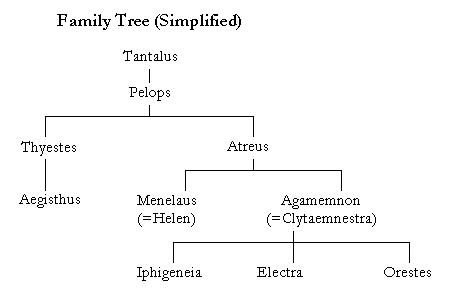
House of Atreus family tree

I know as no one else knows that the gods are distant, they have other concerns. They care about human desires and antics in the same way that I care about the leaves of a tree. I know the leaves are there, they wither and grow again and wither, as people come and live and then are replaced by others like them. There is nothing I can do to help them or prevent their withering. I do not deal with their desires.

House of Names by Colm Tóibín (2017)

~

The gift of independence once granted cannot be lightly taken away again.

I, Claudius by Robert Graves (1934)

~

I sit up straight and clasp my hands, my heart soaring at the thought of it, to see London; to pass through these walls, to be free. “From my window I often think I should dearly love to sprout wings and rise above the rooftops and see beyond the buildings, the city and the river. I should like to see whence the moon rises. I want to go where the sun sets.”

Song of the Sea Maid by Rebecca Mascull (2015)

~

Fumata nera (black smoke) from the Sistine Chapel

Conclave. From the Latin, con clavis: ‘with a key’. Since the thirteenth century, this was how the Church had ensured its cardinals would come to a decision. They would not be released from the chapel, except for meals and to sleep, until they had chosen a Pope.

Conclave by Robert Harris (2016)

~

Favourite books read in May: The Tea Planter’s Wife, Song of the Sea Maid and Conclave