 Welcome to my monthly post on all things historical fiction. For my first Musings post of the year, I am looking back at the historical fiction I read in 2024 and have put together my usual selection of charts and lists! I have kept most of the same categories I’ve used for the previous eight years so that it should be easy to make comparisons and to see if there have been any interesting changes in my reading patterns and choices (here are my posts for 2023, 2022, 2021, 2020, 2019, 2018, 2017 and 2016).
Before I begin, just a reminder that I do actually read other genres but for the purposes of this post I haven’t included those books in these stats!
~
Time periods read about in 2024:
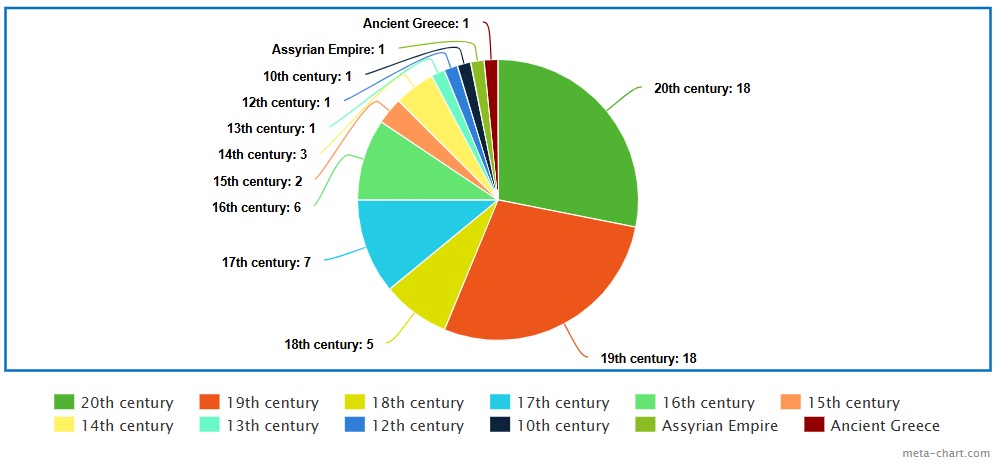
The 19th and 20th centuries are almost always the top two periods I read about and last year I read an equal number of books set in each of them.
The books I read with the earliest settings were Babylonia by Costanza Casati (set in the Assyrian Empire in the 9th century BC) and The Voyage Home by Pat Barker (set in Ancient Greece).
~
35% of the historical fiction authors I read in 2024 were new to me.
This is about the same as the last few years; apart from in 2019, when I read 54% new authors, I do tend to stick mainly to authors I already know and love.
Here are three historical novels I read by new-to-me authors in 2024:
The Bone Hunters by Joanne Burn
The King’s Witches by Kate Foster
The Fraud by Zadie Smith
~
I read 3 historical novels in translation in 2024
If I had included books from all genres, I would have had a much longer list of translated works read in 2024, but these are just the historical ones. Two Japanese and one Welsh!
Silence by Shūsaku Endō (Translated from Japanese by William Johnston)
The Life of Rebecca Jones by Angharad Price (Translated from Welsh by Lloyd Jones)
The Meiji Guillotine Murders by Futaro Yamada (Translated from Japanese by Bryan Karetnyk)
~
Publication dates of historical fiction read in 2024:
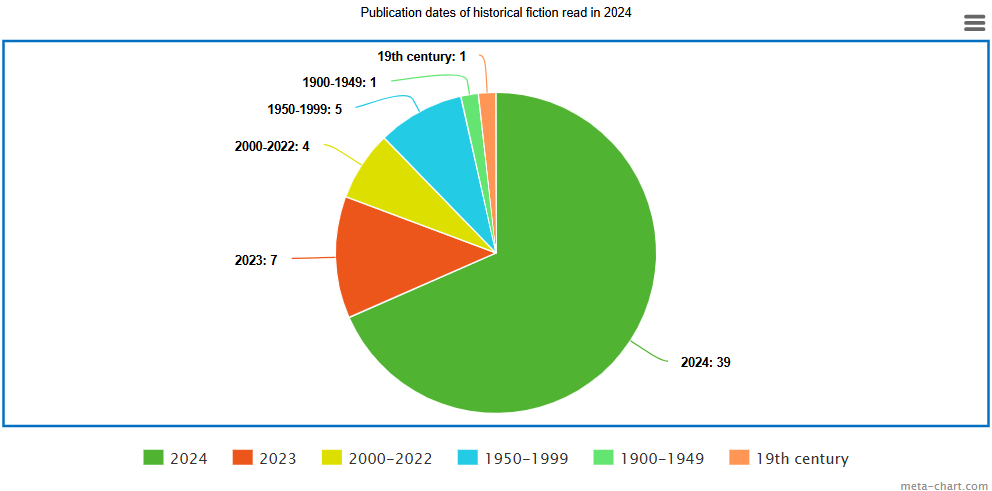
Again, most of the historical fiction books I read were new releases, which I know is due to my use of NetGalley. I do have lots of older books on my own shelves and am hoping to read more of them in 2025, but I say that every year so we’ll see!
The oldest historical fiction novel I read in 2024 was The Trumpet-Major by Thomas Hardy (published in 1880 and set during the Napoleonic Wars).
~
14% of my historical reads in 2024 were historical mysteries.
This is about the same percentage as in previous years. Here are three I enjoyed reading in 2024:
The Bells of Westminster by Leonora Nattrass
A Case of Mice and Murder by Sally Smith
Cabaret Macabre by Tom Mead
~
I read historical fiction set in 24 different countries in 2024:
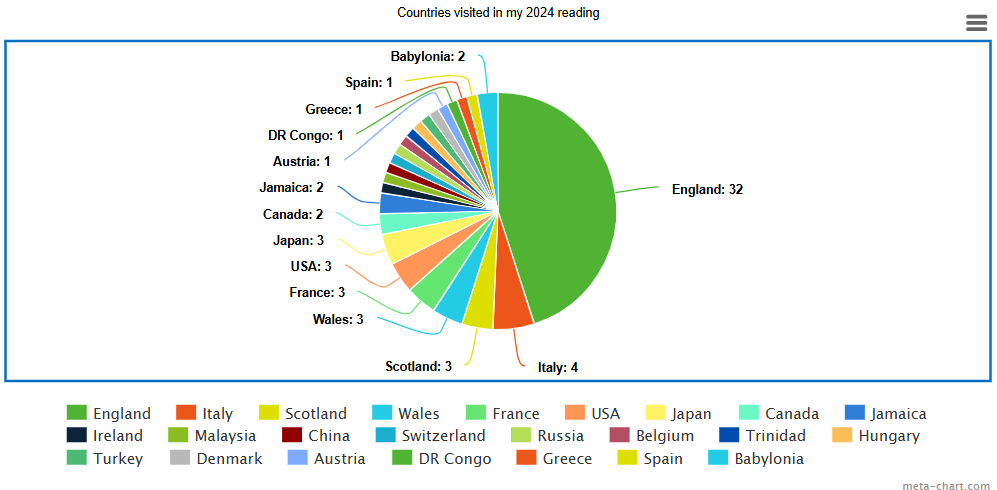
This is an improvement on 2023 when I read about 17 countries. England still dominates, but I’m pleased to have read about such a wide variety of other countries as well, even if there were just one or two books set in each. I’ve included Babylonia as a country here, although it was actually an ancient state located in modern day Iraq, Iran and Syria.
~
Four historical men I read about in 2024:
St Cuthbert (Cuddy by Benjamin Myers)
Lord Edward Fitzgerald (The Ballad of Lord Edward and Citizen Small by Neil Jordan)
Llewelyn ap Gruffydd (The Reckoning by Sharon Penman)
Somerset Maugham (The House of Doors by Tan Twan Eng
Four historical women I read about in 2024:
Claire Clairmont (Clairmont by Lesley McDowell)
Elizabeth Bathory (The Nightingale’s Castle by Sonia Velton)
Lady Mary Wortley Montagu (A Woman of Opinion by Sean Lusk)
Berengaria of Navarre (The Lost Queen by Carol McGrath)
~
What about you? Did you read any good historical fiction last year? Have you read any of the books or authors I’ve mentioned here and have you noticed any patterns or trends in your own reading?
 She Reads Novels
It’s really difficult to pinpoint what counts as an historical novel in my reading, Helen – I suppose it may indicate any time period that predates the author’s own lifetime, but I can see that this ‘rule’ mightn’t work if the narrative’s action overlapped the author’s own time period.
In The Order of the Day Éric Vuillard, who was born in 1968, wrote about the war years – so that would count, and so would Ishiguro’s An Artist of the Floating World: though notionally set in 1948,.a scant half dozen years before the author’s birth, it looks back to 1930s Japan and drew from his parents’ memories as well as those of the young Kazuo of his early years in the country.
But is Evie Woods’ The Lost Bookshop, with its dual timeline of present and past, a historical fiction or merely a fantasy masquerading as one? I guess with new titles from NetGallery which touch on, say, the 20th century, there’s every chance that authors will be writing about historical matters they’ve researched rather than times they’ve experienced themselves.
Now, the Assyrians, that’s a different matter!
I don’t think there’s any one ‘correct’ way to define historical fiction, but the Walter Scott Prize states that the book should be set 60 years prior to the publication date. I use that as a rough guideline, but I don’t stick rigidly to it and would take the author’s age into consideration as well. Dual timelines are more complicated, but I would usually include them as well, as long as about half of the book at least is set in the past.
Very helpful, Helen, thanks!
I read some very good historical fiction in 2024 – Michener’s Hawaii, The Bell in the Lake, Measuring the World, The Covenant of Water stood out particularly. I have not read any of the books or authors you mention! (Except Thomas Hardy, but not that book.) I’d especially like to read A Tale of Mice and Murder and The Bells of Westminster, but my e-library doesn’t have them, sadly.
24 different countries is a good result. I would like to read so widely. I’m also hoping to read more books in translation next year.
I enjoyed The Bell in the Lake, but haven’t read any of those other books, although I do want to read The Covenant of Water – I loved Abraham Verghese’s first novel.
Gosh, Helen, do you keep track of this information as you go, or do you have to compile these numbers at the end? It looks like a lot of work. Also, don’t you most of the time read books set in the 19th and 20th centuries? It seems like there are lots more of them than books set in other periods. I bet if I compiled mine, I would have similar century numbers.
I haven’t read any of the books you mentioned except Silence and The House of Doors.
Huh, I just went to see if I could generate a list of historical novels I read last year in The StoryGraph, and I can, which would make it easier. However, it is wrongly categorized some of the books written around the WWII time as historical that are not. That makes me wonder if it would leave out some that are.
I am busy filing tickets about the mistakes in this list now. It would be interesting to make my own list and compare. I might do that.
I keep a list of all the books I read for the Historical Fiction Reading Challenge throughout the year and make a note of the settings and time periods. It makes it much easier to put this post together at the end of the year. And yes, I read 18 books set in the 20th century and 18 set in the 19th century, so those two were equal with the other centuries a long way behind.
Oh, that’s a good idea.
Well, that was interesting. I went through the books, and the app I use had about a third of them miscategorized as historical when they were written about a time during the cognizant author’s lifetime.
You obviously can’t rely on those lists being accurate, then. That seems like a lot of mistakes!
It sure does. Someone there is categorizing historical novels as anything from the past.
That’s really disappointing! I like StoryGraph but it has some issues.
Yes, and it could use some more functionality.
I just became a librarian on SG so I can now correct some of the book information. You can let me know about those instead of filing a ticket if you want.
That’s nice. I applied but was turned down. OK, I’ll let you know!
Strange. I have no idea what their criteria are. I’m there as lory_enterenchanted if you want to connect.
Yes, I even have worked in libraries before and my whole career was a writer and editor.
Hi Helen
Just wanted to say again how much I enjoy reading your posts and reviews. Thank you so much for your thought and effort.
I read a lot of crime and romantic fiction but historical fiction seems often to be the most satisfying genre for me.
Last year I read “The Maiden” by Kate Foster and am now looking forward to reading “The King’s Witches” after reading your review.
My favourite historical read was “The Square of Sevens” by Laura Shepherd Robinson. Though I enjoyed her previous two novels, “Blood Sugar” and “Daughters of the Night”, I wasn’t sure that I would like her latest one. However, I found it a real tour de force and I loved it.
I also enjoyed “Down a Dark River” by Karen Odden. It might have been one of your recommendations (?). As I also love crime novels, it worked on both counts for me.
Have you read anything by Stella Riley? Her historical quintet set at the time of the English Civil Wars is fantastic. The historical background is very detailed, vibrant and totally believable. I also enjoy her historical romances but they are a lot lighter. After reading French and German literature for my degree (admittedly a long time ago) and after having to read set texts for the book groups I led as a public librarian, I now read purely for pleasure and sometimes a romance fits the bill.
Another new-to-me author last year was Karen Swan. She has written a trilogy (soon to be quartet) about the evacuation of St Kilda. They are part crime novels and part love stories but again the historical setting is really interesting.
Following your round-up of the year I have found some new authors and titles to add to my TBR list. I am especially looking forward to trying Karen Maitland, Anne O’Brien and Susanna Kearsley.. I love keeping up with what is being published but am also relishing the opportunity to go back and read some of the older titles I did not manage to read while I was working.
Wishing you all the best for the New Year
Jill
>
Thanks for your comment, Jill – and Happy New Year, if it’s not too late to say it!
The Square of Sevens is great, isn’t it? It was one of my favourite books of the year when it was published in 2023 and I’m looking forward to her next one. The Karen Odden book wasn’t my recommendation, though – I’ll have to investigate that one!
I did start to read one of Stella Riley’s books, The Marigold Chain, because I’d heard it was a homage to Dorothy Dunnett’s Lymond Chronicles, which I love, but I found it so similar, even down to lines of dialogue, that I couldn’t finish it. I know a lot of people like her books, though, so maybe I’ll try a different one.
I’m glad my round-up posts have helped you find some new authors to add to your TBR! I hope you enjoy them and whatever else you decide to read this year.
I don’t know how long the period is between when you read something and when you review it. When you are tracking for Historical Fiction Reading Challenge, do you track for the year by your reviews or your actual reading? I tend to go by my reviews posted, because that’s when they are listed for Historical Fiction Reading Challenge. But that may be a couple months after I actually read them.
I’m having this problem now with keeping track for Nonfiction November. I already mentioned some of the books in last NN that I am reviewing this month, because I read them way back a few months ago.
Maybe it’s not so much an issue for you because you’re reviewing closer to reading?
I’m asking because I decided to keep a spreadsheet of my historical fiction reading for this year, but if I go by my posts, then some of them will be for last year. See the problem?
I track by my actual reading, but sometimes there’s a short overlap into the new year. For example, I read The Voyage Home by Pat Barker in December and I’m reviewing it tomorrow so I included that one in last year’s challenge. That will be my final book for the 2024 challenge.
I make an exception if the book won’t be published until the following year. I read a couple of review copies in December that aren’t published until February so my posts are scheduled for then and I’ll include them in the 2025 challenge instead. I suppose there’s not a right or wrong way to do it.
That makes sense.
I’m always impressed by the variety in your historical fiction reading, both in countries and time periods. I think I probably read less historical fiction than usual last year, not deliberately but just the way it worked out. But when I do, it’s almost always set in Britain and either fairly recent – 19th, 20th century – or Tudor!
The Tudor period is always well represented in my reading as well, but earlier periods not so much – which I think is a reflection of the books that are being published, rather than a deliberate decision.
This is all amazing but in particular must be the quantity of countries you’ve covered, just great!
Thank you! I’m really happy to have visited so many countries through my reading – although in some cases only a small part of the book was set in those places and I would like to read about them in more depth.
I read seventeen historical fiction titles last year, with a smattering from my regular authors (Bernard Cornwell, Richard Harris, a few others) but with quite a few new authors. I found one medieval series I really liked early in the year, by Wayne Grant; I think he was aiming for a teen audience since it was fairly PG. My historical fiction is almost always military-oriented, but I read quite a few books which weren’t: The Hazelbourne Ladies Flying Club, for instance, and Rachel Joyce’s “Miss Benson’s Beetle”.
I also read the Hazelbourne Ladies last year and enjoyed it, but haven’t read Miss Benson’s Beetle, although I’ve read some of Rachel Joyce’s other books. I’ve never come across the Wayne Grant series – I’ll have to investigate!
It’s always so interesting to see stats such as these!
Yes, I’m always interested to see what people have been reading – and to look for patterns and themes in my own reading.
Hi Helen, I don’t have any as detailed stats as you, however I know I also read historical-mystery the most and books sets in England. And while I haven’t read any of the books you mention in this post, I do know we read a couple of the same new historical releases this year.
Blessings, Jessica 💌
I’ve been trying to read more books set in other countries, but I think England will probably always be in first place. I hope you enjoy whatever new historical fiction you read this year, Jessica!