Girl with a Pearl Earring by Tracy Chevalier

Girl with a Pearl Earring Set in the 1660s, Girl with a Pearl Earring is narrated by Griet, the sixteen-year-old daughter of a tile painter who lives in Delft in the Netherlands. When her father is left unable to work after being blinded in an accident, he arranges for Griet to become a maid in the household of the artist Johannes Vermeer. Settling into her new job, Griet soon finds that coping with the cleaning, washing and dusting are the least of her worries; she also has to learn to deal with the hostility of Vermeer’s wife, the cruelty of one of their young daughters and the jealousy of the family’s other servant, Tanneke. And why is Tanneke jealous? Because Griet has been given the job of dusting Vermeer’s studio – a room rarely entered by the rest of the household. As the months go by, Griet watches painting after painting slowly take shape on Vermeer’s easel, but when she discovers that she herself is going to be the subject of his next portrait she senses that the fewer people who know about it the better…

Having read two of Tracy Chevalier’s other books, Remarkable Creatures and The Virgin Blue, it seemed silly that I still hadn’t read Girl with a Pearl Earring. Now that I’ve read it I can see why it’s her most famous novel. The thing I found most striking about the book is that the writing style actually feels like one of Vermeer’s paintings: clear and detailed and true to life. I am not an expert on Vermeer (or any other artist, to be honest) but this was something that I noticed almost immediately and was very impressed by. If you’re not familiar with Vermeer’s work I highly recommend searching for an image of each painting as it is referred to in the book – I can promise that it will add to your appreciation of the story and of Chevalier’s writing.

This book is set in a time and place that I know very little about and I loved the descriptions of 17th century Delft. Most of Griet’s time is devoted to carrying out her duties within the Vermeer home, but she also has plenty of opportunities to visit other areas of the town – buying meat for the family at the meat market, going to church, visiting her brother at the tile factory where he is an apprentice, or spending time with her parents and the young butcher they hope she will marry. I have never been to Delft but by the time I finished this book I felt I could almost picture what it would have been like to live and work there in the 1660s. The religious aspect of the book – the tensions between the town’s Catholic and Protestant people – was also handled well, showing us the distrust and suspicion that existed between the two communities.

Although there is a romantic element to the story it is quite understated. We are in no doubt as to how Griet feels about Vermeer – it’s noticeable that while she thinks of other people by name, Vermeer is always ‘he’ or ‘him’ and this instantly sets him apart from all the other characters in the story. However, Griet is very slow to admit to herself the significance he has in her life. The romantic aspect of the book is quiet and subtle and lacks drama and passion, as does the rest of the story, but I didn’t have a problem with that. I enjoyed following Griet’s everyday life – shopping at the market, chopping vegetables, dusting the studio – and I enjoyed learning about Vermeer’s work and painting techniques. I didn’t need drama.

But despite finding so much to like about this book, there were also some things that I didn’t like. With the exception of Griet, I thought most of the other characters felt more like stereotypes than fully developed characters. And while I did find the writing style very effective, there seemed to be a distance between the narrator and the reader; the books that I really love are the ones where I can share in the characters’ hopes and fears, where I can laugh with them and cry with them – but I didn’t feel any of that with this book. Still, of the three Chevalier novels I’ve now read, this is my favourite so far and I’m looking forward to trying some of her others.
Dark Aemilia by Sally O’Reilly

Dark Aemilia Dark Aemilia is a fictional account of the life of Aemilia Lanyer, one of several women whose names have been suggested as possible candidates for the ‘Dark Lady’ of Shakespeare’s sonnets. She was also one of the first women in England to have a book of poetry published.

Born Aemilia Bassano, the illegitimate daughter of a Venetian musician at the court of Elizabeth I, Aemilia becomes the mistress of the much older nobleman Lord Hunsdon. When she discovers that she is pregnant, she is forced to leave court and is married off to another court musician, Alfonso Lanyer. However, the father of her child (according to Sally O’Reilly) is probably not Hunsdon, but a young playwright by the name of William Shakespeare.

Aemilia first meets Shakespeare at a performance of The Taming of the Shrew where she confronts him over his negative portrayal of women in the play. Not the best of starts to their relationship, but a brief affair follows – despite the fact that Shakespeare is already married. Aemilia finds a kindred spirit in William, a man who shares her love of poetry, literature and the theatre, before their affair comes to an end after a misunderstanding. Aemilia resigns herself to life away from court with Alfonso Lanyer and her beloved baby boy, Henry, but she is reunited with Shakespeare during an outbreak of plague in London. And when Henry becomes seriously ill, Aemilia is prepared to do anything to save his life.

My feelings about Dark Aemilia are very mixed. I would like to be able to say that I loved it, but that wouldn’t be true; in fact I came very close to abandoning it several times during the first half of the book. I felt that I was reading about nothing but Aemilia’s love affairs and at the risk of sounding like a prude, I thought the language was unnecessarily vulgar. I don’t always have a problem with that sort of thing, but in this case I didn’t feel that it was adding anything to the story. I kept reading, though, and somewhere in the middle of the book I found that I was finally being drawn in. The language remained bold and lively (and appropriate to the Elizabethan setting) but not as explicit as it was earlier on in the novel and the plot moved away from Aemilia’s love life to focus on other storylines.

As Sally O’Reilly states in her author’s note, the real Aemilia would not have been a feminist in the modern sense of the word, but her surviving poetry (such as the poem Eve’s Apology in Defense of Women) shows that she felt strongly about the roles of men and women. The fictional Aemilia speaks up on behalf of the female sex whenever she can, challenging the views of the men around her. As an intelligent and talented woman, she doesn’t have the opportunities that would have been open to her if she had lived today and she finds it very difficult to gain any recognition for her work. This leads to an interesting interpretation of the question of who actually wrote the plays attributed to Shakespeare – there’s no evidence that Aemilia had any involvement in them, but Sally O’Reilly’s theories work in the context of this novel.

Aemilia is a fascinating character and I was left wanting to know more about the real woman. William Shakespeare, though, is not really shown in a very good light and the portrayal of his romance with Aemilia didn’t feel completely convincing to me. They didn’t actually have many scenes together and when they did meet I didn’t sense much love or passion between the two of them – not until very near the end. There were other characters in the book who interested me more than Shakespeare did; I was particularly intrigued by Simon Forman, the astrologer who was said to have cured himself of the plague. And this is where I need to mention another aspect of Dark Aemilia: black magic and the occult. I won’t spoil the story by telling you exactly how this is woven into the plot, but I think this will be something you’ll either love or hate!

While I did have my problems with Dark Aemilia, in the end my lasting impression of the book is of the wonderfully vivid portrayal of Elizabethan England. The writing is very atmospheric and there are some great descriptions of dark, dirty streets, crowded marketplaces, the sights and sounds of the Globe Theatre, the frozen River Thames in winter and a London ravaged by plague. I’m pleased I persevered and followed Aemilia’s story through to the end and I would happily read more books by Sally O’Reilly.

I received a copy of this book from NetGalley for review.

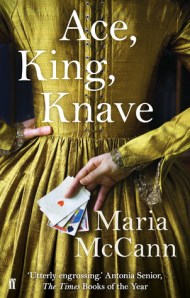
Ace, King, Knave by Maria McCann

Ace King Knave In Ace, King, Knave, Maria McCann takes us on a journey into the heart of 18th century London and introduces us to two very different women.

Quiet, plain and suffering from what her parents call ‘a little weakness’, Sophia Buller is thrilled when she receives a proposal of marriage from the handsome, charismatic Edmund Zedland. Leaving the Buller family estate behind, Sophia accompanies her new husband to Bath and then to London, but quickly discovers that married life is not quite as she’d hoped. Disappointed to find that their new house is in a disreputable area of town and that Edmund spends a lot of his time away from home collecting debts, Sophia is left feeling unhappy and disillusioned, with only the servants for company.

Betsy-Ann Blore is a woman of an entirely different background and social class. A former prostitute, she now makes her living from selling gin and stolen goods, while her partner, Sam Shiner, has gone into the ‘resurrection’ business with Betsy-Ann’s brother, Harry. Sam’s new career has made him feel miserable, dirty and increasingly dependent on drink, leaving Betsy-Ann dreaming of how life used to be – and maybe could be again – with her previous lover, the cardsharp Ned Hartry.

Two different women living different lives…but could Sophia and Betsy-Ann have more in common than you might think? Ace, King, Knave is a very entertaining and enjoyable novel set in a world of fraud and deception, where nothing is as it seems and outward appearances can be very misleading. Although the two storylines are kept separate from each other at first, there is a connection between the two – a connection which becomes obvious to the reader long before either Sophia or Betsy-Ann discovers the truth about the men they love.

While neither of these women’s lives bears any resemblance to my 21st century life, I initially found it easiest to empathise with Sophia, thrown into a bewildering situation which she is completely unprepared and unequipped to deal with. Sophia compares herself once or twice with Clarissa Harlowe (from Samuel Richardson’s Clarissa) and I thought this was a good comparison, although her story is not exactly the same as Clarissa’s. Betsy-Ann, though, is a stronger character – not surprisingly, as she’s had to learn to survive in a dangerous world of thieves, pickpockets, gamblers and grave robbers – and she quickly became my favourite of the two. Sophia and Betsy-Ann are the novel’s two main viewpoint characters, but some of the story is also told from the perspective of the Zedlands’ young black servant, Fortunate , or Titus as he is renamed. At first I thought these sections of the book felt a bit superfluous, other than to give us an idea of how unpleasant life was for a black person in 18th century London, but by the end of the novel I understood Fortunate’s significance to the story.

Sophia’s narrative and Betsy-Ann’s each have a distinct feel and the author has chosen language appropriate to each woman’s upbringing and social position. Betsy-Ann, Sam Shiner and the other inhabitants of London’s underworld use a style of 18th century slang known as ‘cant’. This slang is very like the ‘flash’ used in Lyndsay Faye’s Timothy Wilde mysteries and also has some similarities to the language found in Georgette Heyer’s Georgian and Regency novels, so I already understood some of the words and phrases. I still found myself constantly turning to the glossary at the back of the book, though, as there were a lot of words I wouldn’t have known otherwise (an ‘autem mort’, for example, is a wife and ‘Romeville’ is a nickname for London). The more refined Sophia and her friends use occasional French expressions such as comme il faut and partie de plaisir and while these are still in use today, they are listed in the glossary too if you need help translating them.

This is Maria McCann’s third novel and although I still haven’t got round to her first, As Meat Loves Salt, I did read her second, The Wilding, which is set just after the end of the English Civil War. This novel, Ace, King, Knave has quite a different feel, as well as having a very different setting, and I enjoyed it a lot more than The Wilding. It reminded me of the Victorian sensation novels I love, despite being set in a slightly earlier time period, and also of novels such as Sarah Waters’ Fingersmith. The only thing that disappointed me was the ending; I had expected a more revenge-oriented conclusion to the novel and I think that would have been more satisfying than the ending we actually got. Other than that, I loved this book and now I must go back and read As Meat Loves Salt!

The Lost Souls of Angelkov by Linda Holeman

The Lost Souls of Angelkov Linda Holeman is an author I discovered by chance five years ago when I picked up one of her books, The Moonlit Cage, in the library. I enjoyed it and went on to read two more of her novels, In a Far Country and The Saffron Gate, which I also loved. All three are long, engrossing historical fiction novels with fascinating settings including 19th century Afghanistan and India and 1930s Morocco. The Lost Souls of Angelkov was published in Canada in 2012 and I was disappointed to find that it was not being published in the UK…but Traverse Press came to the rescue a few weeks ago when they contacted me with the news that an ebook version is now available to UK and US readers.

The Lost Souls of Angelkov is set in Russia in 1861, the year serfdom is abolished by Tsar Alexander II. The emancipation of the serfs leads to huge changes in Russian society as the serfs try to adapt to their new freedom while their former owners struggle to manage their huge estates with nobody to work the land. One of these landowners is the fictional Count Konstantin Mitlovsky who owns the estate of Angelkov in the Province of Pskov.

One day the Count and his young son, Mikhail (Misha), are out riding when they are attacked by a group of Cossack horsemen. Ten-year-old Misha is kidnapped and Konstantin himself is wounded. As the Count’s health deteriorates, it is left to his wife, Antonina, to take control of the situation and continue the search for their missing child. Antonina, however, is an alcoholic and seeks comfort in drink, finding it difficult to cope with what has happened. And so she turns to the only two people she feels she can trust – her maid, Lilya, and the estate steward, Grisha, neither of whom are quite what they seem…

I’m so pleased that I’ve now had the opportunity to read The Lost Souls of Angelkov, because I enjoyed it as much as the other Linda Holeman books I’ve read. I wasn’t sure I was going to like it at first, though. Antonina is a very flawed character (as are most of the others in the novel) and I found her reactions to her son’s kidnapping very frustrating! On the other hand, people don’t always behave the way we would like or expect them to and as the story progressed I started to become aware of the reasons for Antonina’s behaviour. In an arranged marriage to a man old enough to be her father, her married life has been unhappy and lonely, and because of the lack of freedom available to women of her time she is unable to pursue her dream of playing the piano professionally. As I learned more about Antonina’s background I began to understand and have sympathy.

The stories of not only Antonina but also Grisha and Lilya unfold gradually through flashbacks and this helps to explain the complex relationships between the three of them. I think getting to know these three characters and discovering the truth about their pasts was actually a lot more interesting than the storyline of Misha’s kidnapping! There were a few coincidences that I couldn’t quite believe and I also found the ending a bit dissatisfying (not all of the characters had the happy endings I was hoping for), but The Lost Souls of Angelkov was still a great read. I didn’t have much previous knowledge of Russian serfdom and the challenges facing the serfs and landowners after emancipation, so I loved that aspect of the story.

I hope I won’t have to wait too long for a chance to read Linda Holeman’s next book, but meanwhile I should go back and read The Linnet Bird, the only one of her earlier novels I haven’t read yet.

Thanks to Traverse Press for sending me a copy of this book for review.

Roseblood by Paul Doherty

Roseblood It’s 1455 and England is heading towards civil war. Henry VI is still on the throne but he is a weak ruler and there are many who think he is not fit to be King. The Duke of York believes his claim is stronger than Henry’s and with the support of some of England’s most powerful noblemen he is determined to win the crown for himself. The scene is set for the period of history that will become known as the Wars of the Roses.

In Roseblood we meet two men who are on opposite sides of the conflict. Simon Roseblood is a Lancastrian, loyal to Henry VI and his wife, Margaret of Anjou. As the owner of a busy London tavern, Roseblood is in an ideal position to be able to obtain information and intelligence that will help the Lancaster cause. But while Roseblood is doing all he can in support of his king, he also has business of a more personal nature to attend to. Five years earlier, his brother, Edmund Roseblood, was murdered during a rebellion led by Jack Cade. Simon has reason to believe that the men responsible were members of the mysterious gang known only as LeCorbeil and he knows he must find a way to avenge his brother’s death.

Amadeus Sevigny is the nephew of the Sheriff of London and clerk to Richard, Duke of York. As a loyal Yorkist, Sevigny is in direct opposition to Simon Roseblood and they are first drawn together when Sevigny tries to frame Roseblood for a crime he didn’t commit – only to discover that Roseblood is his equal when it comes to plotting and scheming. Their paths cross again in a race to hunt down a man who possesses information which would be damaging to both Lancaster and York, but it could be Roseblood’s daughter, Katherine, who holds the key to bringing their rivalry to an end. And throughout all of this, LeCorbeil wait in the background for their chance to complete their destruction of the Roseblood family…

I have read a lot of novels set during the Wars of the Roses (it’s one of my favourite periods of history) but Roseblood is not like any of the others I’ve read and is actually quite a difficult book to describe. It’s a mixture of history, mystery and intrigue with a large cast of colourful characters – many with Dickensian names such as Candlemas, Wormwood and Skulkin. It’s an unusual novel and not really what I’d expected at all! While I found it confusing at the beginning (we are given a lot of historical information in the opening sections, and being thrown straight into one of Sevigny’s schemes and Roseblood’s attempts to thwart it, I struggled to follow exactly what was happening) I eventually found myself drawn into this fascinating, complex story.

Although the novel is set at the beginning of the Wars of the Roses and historical figures such as Henry VI and the Duke of York do make brief appearances, the focus is always on the lives of the fictional characters. Much of the story is told from the perspectives of Roseblood and Sevigny, but there are also some chapters which give us the points of view of Roseblood’s son, Raphael, and daughter, Katherine. I didn’t find Raphael very interesting, but I thought Katherine, with her obsession with Arthurian legend and her imaginary friend, Melisaunde, was a much more memorable character.

Doherty seems to be an author who knows London well – not just London as it is today but as it was in medieval times too – and each location, whether it’s a marketplace, a church or a tavern, is described in minute detail. It was actually a bit too descriptive for me at times – almost like walking down a busy street and having your senses assailed by so many sounds, sights and smells that you start to feel overwhelmed – but I’m sure other readers will love the level of detail he goes into. I was certainly left with the impression that he had thoroughly researched every aspect of both the setting and the time period, which is obviously a good thing!

I’m surprised that I’ve never come across Paul Doherty before, as he appears to have written a huge number of historical novels, many of them mysteries, under several different pseudonyms. I would like to try more of his books, though as there are so many I have no idea where I should start. I’ll also be looking out for a sequel to Roseblood – the way it ended with so much still unresolved, I’ll be disappointed if there isn’t one!

Thanks to Headline for providing a review copy via NetGalley.

Sisters of Treason by Elizabeth Fremantle

Sisters of Treason This is Elizabeth Fremantle’s second historical fiction novel. I read her first book, Queen’s Gambit, last year and was quite impressed by it, so I’ve been looking forward to reading this one. It didn’t disappoint me – I actually found it a more compelling and enjoyable book than the first. Although Fremantle’s books are set in Tudor England, a very popular choice with historical fiction authors, it would seem that she’s trying to write about some of the lesser known female figures of the period, which is very refreshing. Queen’s Gambit was the story of Henry VIII’s sixth wife, Katherine Parr, who is usually given less attention than some of the other wives, while her next novel – due to be published next year – is going to be about Penelope Devereux and should be really fascinating.

This book, Sisters of Treason, is the story of Katherine and Mary Grey – the two younger sisters of Lady Jane Grey, the ‘nine-day queen’. The novel opens in 1554 with Jane being beheaded, having been deposed by her cousin, Mary Tudor, after only nine days on the throne of England. Jane is dead before our story really begins but she remains a constant presence in the lives of both Katherine and Mary Grey who are unable to escape the taint of treason. Under the reigns of first Queen Mary and then Queen Elizabeth I – neither of whom have a child of their own to name as heir – the Grey sisters have a strong claim to the throne, which means they will never be allowed to live their lives in peace.

Following Jane’s execution, the family of Katherine’s husband, Henry Herbert, decide to distance themselves from the Greys. Katherine is heartbroken when her marriage to Henry is annulled but she does find love again with Edward Seymour, the brother of her best friend Jane (referred to in the novel as Juno to distinguish her from the other Janes in the story). Queen Elizabeth is furious when she learns of their relationship and Katherine soon discovers just how difficult life can be for those who go against the Queen’s wishes.

The youngest Grey sister, Mary, was born with a form of spinal curvature which has affected her growth and as she is unlikely to be able to have children she is seen as less of a threat than Katherine. However, she is forced to undergo degrading experiences such as sitting on Queen Mary’s knee and being treated as a sort of pet or baby. Later, when Elizabeth takes the throne, although Mary is not in as much danger as Katherine, she still finds that the Elizabethan court is not a pleasant place to be.

Sisters of Treason is narrated by both Katherine and Mary (my favourite character) in first person present tense. This is something I don’t usually like but I thought it worked well here. There’s also a third viewpoint character – Levina Teerlinc, a friend of Frances Grey, the girls’ mother. In her position as a portrait painter who produces miniatures of various important court figures, Levina gives us a different perspective on some of the things that happen in the book.

As well as being the story of the Grey sisters, the novel also takes us through some of the major events of Queen Mary’s and Queen Elizabeth’s reigns. While both Queens can be cruel and treat their Grey cousins very badly, they are not just portrayed as complete monsters with no depth to their characters. Instead, the author tries to give some possible reasons for their behaviour and shows us the pressures they are under as female rulers in a male-dominated society.

They sit in silence for a moment, and something occurs to Levina that she had not fully realized until she articulated it – that for Elizabeth politics come before everything. That is how it must be if you are Queen regnant, your passions shut away in a box buried deep beneath the ground. It makes her think of her predecessor Mary Tudor, who struggled so with that concept, and she surprises herself with a pinch of sympathy for these women who have to fashion a cold, hard face to show to the world.

I have read a few other novels about the Grey sisters (The Nine Day Queen by Ella March Chase and Alison Weir’s Innocent Traitor and A Dangerous Inheritance) but I still don’t think they get a lot of coverage in historical fiction compared to other figures from the Tudor period. Many people will have heard of Lady Jane Grey but may not be aware that she had two sisters and something that I liked about this book is that by beginning with Jane’s execution, Elizabeth Fremantle avoids re-telling Jane’s more famous story and instead concentrates on the other Grey sisters. However, Katherine and Mary never forget what happened to Jane and her influence on their lives is still very strong; Katherine inherits Jane’s Greek New Testament in which she has written “it shall teach you to live and learn you to die” and Mary often asks herself what Jane would do in certain situations. As Mary says to Levina near the end of the novel:

“In the scheme of a life, it is not the duration of something but its impact that is important.”

Thanks to the publisher for providing a review copy via NetGalley.

The Second Duchess by Elizabeth Loupas

The Second Duchess The Second Duchess is a fascinating historical novel set in Renaissance Italy and narrated by Barbara of Austria, the second wife of Alfonso d’Este, the Duke of Ferrara. The recent tragic death of the Duke’s first Duchess, Lucrezia de’ Medici, has never been satisfactorily explained and many people think she may have been murdered by the Duke himself. Listening to these rumours, Barbara doesn’t know what to believe. Determined to discover the truth she decides to investigate, but it seems that whoever killed Lucrezia doesn’t like Barbara asking questions. Will Alfonso’s second duchess meet the same fate as his first?

Although the back cover of this book promised “conspiracy, intrigue and murder”, I was still surprised that the story had such a strong mystery element. I have never read anything about Lucrezia de’ Medici’s death before and enjoyed watching Barbara trying to piece the facts together. Despite the gossip suggesting that Lucrezia was poisoned by the Duke, Barbara soon discovers that there are plenty of other people at court and beyond who may also have wanted the first duchess dead. With lots of possible suspects and clues that are only revealed slowly throughout the novel, it’s not easy to guess the truth. Today historians believe Lucrezia probably died of natural causes, but the mystery Elizabeth Loupas weaves around her death feels plausible and makes a great story!

I think another of the things I liked about this book was that the ‘romance’, if you can even call it that, is very subtle and understated. At twenty-six, Barbara has a mature and realistic outlook on life and she is aware that her marriage has been made for political reasons. She doesn’t expect to instantly fall in love with Alfonso and is prepared to work at their relationship, trying to get to know and understand him. Of course, this would be a lot easier if she could just find out whether or not he’s a murderer! Barbara is portrayed as an intelligent and courageous woman, not beautiful like Lucrezia but with a grace and dignity of her own, and never seeming too modern or out of place in a sixteenth century setting.

Alfonso, Duke of Ferrara is an intriguing character and I could never quite decide whether I liked him or not. He commits an act of violence near the beginning of the book that made me think not, but as the story progressed I started to have more respect for him. Both Barbara and the Duke feel like realistic people of their time period and don’t always behave as we might like them to behave, but I actually found that very refreshing as so many authors try to give modern day sensibilities to their historical characters. As for Lucrezia, although she is dead before the novel begins, she is still a very strong presence and we do have the opportunity to hear her point of view – in a very unconventional way. Lucrezia’s passionate, vengeful voice contrasts nicely with the style of Barbara’s narration and gives us a different perspective on the story.

I also loved all the descriptions of the court of Ferrara: the clothes, the food, the interiors of the churches and palazzi, the hunts, banquets and pageants – I particularly liked reading about the Festival delle Stelle with costumes and mechanical devices representing the signs of the Zodiac. Finally, I should mention that this novel is inspired by Robert Browning’s poem, My Last Duchess. The poem is included at the end of the book and I recommend reading it as it adds another layer to the story. I also found it interesting to search for more information and pictures of the main characters in the novel after I finished reading, as they are all historical figures I previously knew nothing about. Portraits of the beautiful young Lucrezia, the dark, enigmatic Duke, and our heroine Barbara can all easily be found online.

I enjoyed The Second Duchess and really liked the way Elizabeth Loupas writes, which is maybe not surprising as she lists two of my favourite authors (Mary Stewart and Dorothy Dunnett) among her influences. This is the first of her books that I’ve read but I’ll certainly be looking out for her others.

I received a copy of this book from the publisher for review.