Larkswood by Valerie Mendes

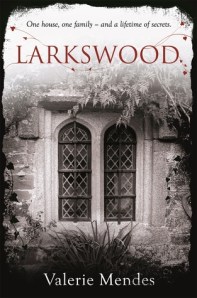
Larkswood - Valerie Mendes “One house, one family and a lifetime of secrets” it says on the front cover of Larkswood, a new novel from Valerie Mendes set in England in 1896 and 1939. The house is Larkswood House, a mansion in the Hampshire countryside, the family are the Hamiltons (three generations) and the secrets…well, obviously I’m not going to tell you those, but will leave you to discover them for yourself if you choose to read this book.

In 1939, Louisa Hamilton is in London for the Season with her parents and sister, Milly. Louisa has just turned seventeen and is preparing for her ‘coming out’, but she can’t help thinking that it’s all very silly and boring; she would much rather be at home reading Jane Austen. The day after she attends her first ball, she becomes ill with glandular fever and is sent to Larkswood, her grandfather’s house, to recuperate.

Edward Hamilton, Louisa’s grandfather, has just returned home from India where he has lived for the last forty-two years, haunted by the memory of the tragic events of the summer of 1896. As Louisa regains her strength at Larkswood and starts to form a bond with Edward, she begins to uncover the truth about what happened all those years earlier. Louisa’s story, unfolding in the months leading up to the beginning of the Second World War, alternates with the story of Edward and his two sisters, Cynthia and Harriet.

It was the striking front cover that first drew me to this book, so I was pleased to find that the story inside was enjoyable too. I guessed most of the novel’s big secrets before the truth was revealed, but that wasn’t really a problem and the fun was in wondering when Louisa would find out and what she would do with the knowledge. I did find some of the language used in the dialogue quite irritating – the working class characters seemed to finish almost every sentence with “that’s for certain sure” and generally sounded a bit stupid, I thought – but not so irritating that it spoiled the rest of the novel for me. The plot was entertaining enough that I could enjoy the book while still being aware of its flaws.

Away from the novel’s central storyline, I also enjoyed reading the letters sent to Louisa by her sister Millicent (or Silly Milly, as Louisa calls her) who is still in London spending her days in a whirlwind of parties and dances. Milly’s letters are fun to read but also give some insights into the war preparations in London as they appear to a shallow, self-absorbed young woman who doesn’t want the good times to end. I was reminded here of The Last Summer by Judith Kinghorn – a different war and a very different plot, but a similar setting and atmosphere.

I understand that Valerie Mendes has written several books for young adults, but this is her first historical novel for adults. I’ll be hoping for more!
A Tale of Two Cities by Charles Dickens

A Tale of Two Cities When I decided to take part in the Classics Club Spin last month, in which a book would be chosen for me from a list of twenty, A Tale of Two Cities was not one of the titles I was hoping would be picked. I have to be in the right mood to want to read Dickens and I wasn’t really in that mood. Expecting it to be a long and boring read, I thought it would be a good idea to start immediately so that I would have a chance of being finished by the end of December…

I actually finished it within a week and despite my lack of enthusiasm when the spin number was announced, A Tale of Two Cities is one of the best books I’ve read this year!

The novel is set before and during the French Revolution; Paris and London are the two cities of the title. The story begins with Doctor Manette being released from the Bastille after eighteen years as a political prisoner. Reunited with his daughter, Lucie, and returning with her to England, the lives of the Manettes become entwined with the lives of two young men who are both in love with Lucie. One of these is Charles Darnay, a former French aristocrat, and the other is Sydney Carton, an English lawyer. We follow these characters and others as they return to France where they become caught up in the dramatic events of the French Revolution – and the scheming of wine shop owner, Monsieur Defarge, and his sinister wife, who is never seen without her knitting!

This is the sixth Dickens novel I’ve read and my favourite so far. I find it interesting that everyone who reads Dickens has different favourites and least favourites; there doesn’t seem to be one book that is universally regarded as his best. I think part of the reason I loved this book so much was that in many ways it was very different from the others I’ve read but I know that some readers will probably dislike it for that same reason, so it’s really a matter of personal opinion.

One of the things that struck me about this book was the absence of humour, in comparison to the other Dickens novels I’ve read – and as Dickens and I don’t usually share the same sense of humour, this was definitely a positive thing for me! Of course, the French Revolution is a serious subject, so the more serious tone of the writing was quite appropriate. I also thought the characters felt more realistic and well-rounded than usual (if there is a comedy character in the novel, it’s probably Jerry Cruncher). My favourite character, which probably won’t surprise anyone else who has read this book, was Sydney Carton – although I didn’t fall in love with him until the last few chapters. I hadn’t guessed when we first met him that he would turn out to be so heroic and self-sacrificing.

I was also impressed by how tightly plotted the book is. The focus stays firmly on the main storyline which makes it easy to follow, unlike Bleak House or Our Mutual Friend which have more complex structures with lots of subplots and lots of long descriptive passages. In A Tale of Two Cities, everything feels relevant and helps to move the story forward. The novel begins with some of the most famous lines in literature (It was the best of times, it was the worst of times…) and closes with some that are almost as well known (It is a far, far better thing that I do, than I have ever done; it is a far, far better rest that I go to than I have ever known). I’ve seen those final lines quoted many times before but out of context they didn’t mean much to me; now that I know who and what they refer to they have much more significance. I don’t want to say too much and spoil the story for anyone who hasn’t read it yet, but the ending is heartbreaking. This is the first Dickens novel that has made me cry!

The Classics Club spin was a success for me this time, then. I do have some other Dickens novels on my Classics Club list and feel much happier about reading them now!

The King Must Die by Mary Renault

The King Must Die After my post on The Odyssey last Friday, I’m staying with an Ancient Greece theme again this week – but in the form of historical fiction this time.

Beginning with his childhood in Troizen, The King Must Die tells the story of Theseus, a story which I’m sure will already be familiar to many readers. Theseus lives with his mother but has never known the true identity of his father, believing him to be the god Poseidon. When he succeeds in raising a boulder to reveal his father’s sword, Theseus learns that he is actually the son of Aigeus, the King of Athens, and sets off for Athens to find him. After an eventful journey during which Theseus becomes King of Eleusis, he arrives in Athens and meets his father at last. But when King Minos of Crete demands that fourteen young people are sent to him to train as bull-dancers, Theseus makes the decision to become one of the fourteen…and finds himself facing the Minotaur in the Labyrinth of the Palace of Knossos.

Mary Renault is an author I’ve been wanting to read for a long time and I became even more interested when I noticed that on the back covers of my Vintage editions of the Lymond Chronicles by Dorothy Dunnett, it says that Dunnett’s writing ‘inspires comparisons with Mary Renault and Patrick O’Brian’. I’ve now read some of Patrick O’Brian’s books and enjoyed them (though not as much as Dunnett) so it seemed a good idea to try Mary Renault too. However, I’ve been hesitant because, as I explained in my Odyssey post, mythology and Ancient Greece are not subjects that really appeal to me. It was finally making it to the end of The Odyssey a few weeks ago that gave me the motivation to pick up The King Must Die at last.

I was curious to see how this book could be described as historical fiction, as a story with a plot involving Poseidon and the Minotaur sounded more like mythology to me. Having read the novel, I now understand that The King Must Die is not simply a re-telling of the Theseus myth but a more realistic recreation of his life, portraying Theseus as a real human being rather than a character from Greek mythology. Most of the essential elements of the myth are here, but they are cleverly incorporated into the historical setting and given logical, plausible explanations.

My favourite part of the book was the section describing Theseus’s adventures in Knossos as a bull-dancer, learning new skills and techniques, and bonding with the other members of his team. I also enjoyed learning about the different customs and rituals of the various cultures and communities Theseus visits on his journey, including the Hellenes, the Minyans and the Cretans. There’s a fascinating author’s note at the end of the book in which Mary Renault explains how she was able to link parts of the Theseus legend to historical fact.

While I did enjoy this book, I do feel disappointed that I didn’t love it as much as I had hoped to. There was nothing specific that I disliked about the book or that I could say didn’t work for me; I certainly couldn’t fault the quality of the writing or the amount of research that must have gone into recreating Theseus’s world. It’s probably just that, as I’ve mentioned, I’m not particularly drawn to this subject or setting. I do still want to read the second half of Theseus’s story in the sequel, The Bull from the Sea!

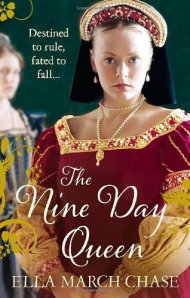
The Nine Day Queen by Ella March Chase

The Nine Day Queen When King Edward VI dies unmarried and childless in 1553, there are several claimants to the throne. One of these is Lady Jane Grey, who has Tudor blood through her mother, Frances Brandon, a niece of Henry VIII’s. Finding herself at the centre of a plot by her parents and the Duke of Northumberland (the father of her husband, Guildford Dudley), Jane becomes Queen of England…but only for nine days. Deposed by Edward’s Catholic half-sister, Queen Mary, Jane is imprisoned in the Tower of London and eventually beheaded. The story of Jane’s short reign and tragic fate forms part of this historical fiction novel by Ella March Chase, but this is not just Jane’s story – it’s also the story of her two younger sisters, Katherine and Mary.

On the same day that Jane married Guildford Dudley, Katherine was married to Henry Herbert, son of the Earl of Pembroke, but after Jane’s downfall the Herberts want to break their ties with the Grey family, so Katherine and Henry’s marriage is annulled. Later, Katherine falls in love with Edward Seymour but their secret romance incurs the wrath of the new queen, Elizabeth I, and Katherine finds that her own life could be in danger. Although the youngest Grey sister, Mary, is not such a central part of her parents’ plotting (possibly because she suffers from what sounds like a severe form of spinal curvature), she is still affected by Jane’s death and Katherine’s misfortunes. This fictional account of the Grey sisters is a great introduction to Mary and Katherine for those of us who know very little about them!

I had a good idea of what I could expect from The Nine Day Queen, having read another book last year by this author, The Virgin Queen’s Daughter, which I enjoyed. I knew it wouldn’t be a particularly ‘literary’ historical novel (you can probably guess that from the cover, though it’s not always fair to make assumptions) but not as light and fluffy as some. I can’t really say much about the accuracy of the book as I’ve only read one other novel about Lady Jane Grey (Innocent Traitor by Alison Weir) and no non-fiction beyond the few brief paragraphs she is usually given in books about the Tudors. As far as I could tell the story does stick to the basic facts, with some obvious inventions, as you would expect in a book that is fiction rather than non-fiction – and the author does use her Author’s Note at the end to explain where she has deviated away from the known facts.

The sisters are given such different personalities – Jane is sensible, studious and a devout Protestant, Katherine warm, compassionate and pretty, and Mary outspoken and impulsive – and with each girl narrating her own chapters of the book, the opportunity was there for the author to develop a different narrative voice and style for each of them. I was disappointed that she didn’t make the most of this opportunity and the voices of the three girls were very similar, so much so that there were times when I found it hard to tell who was narrating the chapter I was reading and had to look back at the chapter heading to remind myself.

I did like the fact that the story was told from the perspective of all three Grey sisters, though, and I was surprised to find that Jane’s death comes not near the end of the book as you might expect, but in the middle. The focus is then on Katherine and Mary for the remainder of the novel and I thought this was good because while Jane’s story is well known, the other two sisters have been largely forgotten by history and it was nice to have an opportunity to learn more about them both. Another thing that was surprising was the portrayal of the two queens, Mary I and Elizabeth I. In a reversal of what you would usually expect, Mary is portrayed as kind and considerate whereas Elizabeth comes across as spiteful and vindictive. They both felt more like caricatures than realistic characters to me, but it was interesting to see such a different perspective!

Are there any other books anyone can recommend on Lady Jane Grey and her sisters, either fiction or non-fiction? I’ve just received a copy of the new Elizabeth Fremantle novel, Sisters of Treason, from Netgalley so will be interested to see how that one compares.

Note: This book has also been published under the title Three Maids for a Crown.

The Herbalist by Niamh Boyce

The Herbalist by Niamh Boyce The Herbalist is set in a small unnamed town in Ireland in the 1930s and tells the story of four women whose lives are affected by the arrival of a stranger – a travelling herbalist who appears from nowhere one day and begins selling his lotions and tonics in the marketplace. Nobody knows anything about the herbalist or his history and initially they are suspicious, but slowly he starts to cast a spell over the women of the town, including sixteen-year-old Emily. Lonely and vulnerable after losing her mother, Emily convinces herself that she and the herbalist are in love, but when she makes a shocking discovery she finds herself with a difficult decision to make.

Another of our main characters is Carmel, who runs a small shop in the town. Having suffered a recent tragedy, Carmel is depressed and insecure and she feels that the only person who understands is the herbalist. Her brother, a teacher, suggests she should find an assistant to help her in the shop and recommends a former student, Sarah, for the job – but how will Carmel react to Sarah’s arrival?

We also follow Sarah, who is having problems of her own. The night before she leaves home to start her new job, her beloved aunt Mai throws a party for her and something that happens at that party will have a big impact on Sarah’s future. Finally, there’s Aggie, a ‘woman of ill repute’ and a fortune-teller. Aggie is an outsider, but through watching and listening to what is going on around her she seems to know more about the herbalist than anyone else in the town. The stories of Emily, Carmel and Sarah are told in alternating chapters, with occasional contributions from Aggie, and gradually the truth about the herbalist is revealed.

I was very impressed with this book and found it hard to believe that it’s Niamh Boyce’s first novel! The writing is beautiful, the setting and the characters feel completely believable and the story itself is fascinating – inspired by true events, according to the author’s note at the front of the book.

Something I found particularly intriguing was the fact that two of the women’s stories are told in the third person (Carmel’s and Sarah’s) and two in the first person (Emily’s and – in question and answer format – Aggie’s). The only problem with this was that while Emily and Aggie both have distinctive narrative voices of their own, the other two feel very similar. One way in which the use of multiple viewpoints works very well in this novel, though, is that it allows us an opportunity to see things from the perspectives of women from different social backgrounds whose lives are confined by the class system of their small, narrow-minded community.

The herbalist himself remains a mysterious, shadowy figure and although he is at the centre of everything that is happening throughout the novel, the focus is always on the female characters and the various ordeals they are going through. I should mention that this is not a happy story and really delves deeply into the darker side of life in 1930s Ireland. I would like to be able to tell you more about some of the issues the book raises, but then I would be giving away the herbalist’s secrets!

I loved The Herbalist and hope there will be more books from Niamh Boyce in the future.

I received a copy of this book from Penguin Ireland for review.

The Firebird by Susanna Kearsley

The Firebird Nicola Marter has a special talent, but it’s one that she doesn’t like to admit to – by touching an object she is able to see the history of the other people who have held that same object in the past. When a woman brings a wooden carving of a Russian firebird into the art gallery where Nicola works, asking for a valuation, Nicola is faced with a dilemma. The woman claims that the firebird was given to one of her ancestors by Empress Catherine of Russia and when Nicola holds the carving in her hands she knows that this is the truth, but unless she can find a way to prove it the carving is worth nothing.

Nicola decides to find out all she can about the history of the firebird but as her own psychic abilities are not strong enough, she enlists the help of an old boyfriend, Rob McMorran. Rob shares her special gift of psychometry, but while Nicola tries to keep hers a secret, Rob is happy for everyone to know about his powers. This difference in attitude is the reason they ended their relationship several years earlier, but Nicola knows that Rob is the only person who can help her now. Together they trace the path of the firebird from Slains Castle in Scotland to a convent in Belgium and finally to eighteenth century St Petersburg, and along the way they unravel the story of a young girl called Anna and learn how the Empress’s wooden firebird came to be in her possession.

This book surprised me because based solely on the synopsis, I’d expected to be learning about Russian history, but instead the focus is on Scottish history, particularly the Jacobites (the supporters of the deposed King James VII of Scotland – and II of England – and his heirs). I’ve read other historical fiction novels about the Jacobite Risings and always find it a sad subject to read about; the Jacobites were so devoted to their cause and so hopeful of success, but we know that all their efforts would only end in tragic failure. Yet somehow, in all my previous reading about the Jacobites, I had missed the fact that as well as looking to France and Spain for support, there was also a community of Jacobites working in Russia. It was interesting to read the author’s note at the end of the book and find out a bit more about the historical aspects of the story, including which of the eighteenth century characters really existed and which were fictional.

I often see Susanna Kearsley compared to Mary Stewart and in this book, the telepathic connection between Nicola and Rob reminded me of the one between Bryony and her secret lover in Stewart’s Touch Not the Cat, who could also read each other’s minds and communicate without words – though of course Nicola and Rob have the additional ability of being able to see into the past and watch the actions of people who lived many years ago. I loved following Anna’s story (especially in the earlier chapters set in Scotland and Ypres) but I also enjoyed the contemporary storyline and the interactions between Rob and Nicola. The transitions from one time period to another were smooth and natural and I thought the balance between the two felt right.

The Firebird is a sequel to Sophia’s Secret (or The Winter Sea depending on which country you’re in) and the character of Rob has also appeared in another Kearsley book, The Shadowy Horses. I haven’t read either of those two books yet, though that didn’t seem to be a problem as we are given all the background information we need early in the novel. I’m still looking forward to going back and reading them both, even if I’ve done things in the wrong order!

Hungry Hill by Daphne du Maurier

“I have cursed your father tonight, and your brother, and now I curse you, John Brodrick,” he cried, “and not only you, but your sons after you, and your grandsons, and may your wealth bring them nothing but despair and desolation and evil, until the last of them stands humble and ashamed amongst the ruins of it, with the Donovans back again in Clonmere on the land that belongs to them.”

Hungry Hill Hungry Hill is the story of five generations of the Brodricks, a family of rich landowners who live at Clonmere Castle in Ireland. It begins in 1820 when ‘Copper John’ Brodrick decides to open a copper mine on Hungry Hill, land which once belonged to the Donovan family, who have been feuding with the Brodricks for many years. As soon as Morty Donovan hears about the new mine he becomes determined to destroy it and places a curse on Copper John and his descendants.

Hungry Hill, as you can probably tell from the brief summary I’ve given, is a very dark and depressing novel. Its pages are filled with deaths, accidents, illnesses and every sort of bad luck you could imagine. As we move down through the generations we meet characters such as the lazy, irresponsible ‘Greyhound John’, wild and beautiful Fanny-Rosa Flower and spoiled, selfish Johnnie, and we watch as they suffer one tragedy after another, sometimes not entirely undeserved.

It’s not unusual for a du Maurier book to be dark and depressing, but this one is particularly relentless in its portrayal of utter misery, unhappiness and despair. It’s true that most of the characters are very flawed and often bring their misfortunes on themselves (I disliked a few of them so much I wasn’t sorry at all when they came to an unpleasant end!) but it was still frustrating and painful to see them making such huge mistakes. There are also some good, decent people who become caught up in the Brodricks’ web of disaster and it’s very sad to see them suffering too.

Although this is historical fiction, the story has that strangely timeless feel that so many of du Maurier’s books have. We know that it’s the nineteenth century (dates are given in the section headings) but the historical events of the time don’t play any significant part in the novel; the potato famine, the Crimean War and other important events are barely mentioned or alluded to at all. Similarly, although it’s not difficult to work out that the book is set in Ireland, I don’t think the name ‘Ireland’ is ever specifically used – there are just vague references to ‘this country’ or ‘over the water’. This story of a cursed family could almost have been set in any time and any place. And maybe that is the point, because the themes of the novel are universal: coping with the loss of a parent or a spouse, addictions to gambling or alcohol, unemployment and poverty, and whether we have the right to spoil natural beauty in the name of progress.

This is not one of my favourite du Maurier novels and I can’t imagine that I would want to read it again – once was enough for me – but I still enjoyed it (if enjoyed is the right word for such a bleak and unhappy story). I would recommend it not just to du Maurier fans but also to anyone looking for a good, well written family saga similar to Susan Howatch’s Penmarric or Cashelmara.