King Hereafter by Dorothy Dunnett

King Hereafter “Then she said, ‘Thorfinn!’ quickly, and moved to him; but had hardly got to his side before he loosed his fingers and thumbs and plunged them down to the mattress like spear-points.
‘No! Macbeth. Macbeth. Macbeth!’ The name reached her like sling-shot.
Groa said, ‘They are the same man. I should know. I married both.’”

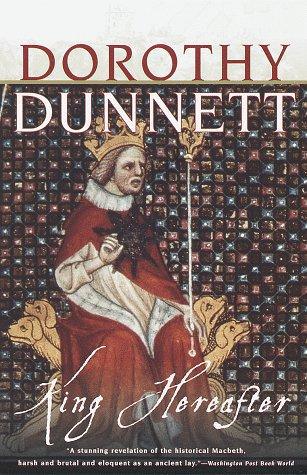
I couldn’t wait to read this book having loved Dorothy Dunnett’s Lymond Chronicles and House of Niccolo series so much when I read them last year. King Hereafter, her only standalone historical novel, is set in eleventh-century Orkney and Scotland (known at that time as Alba) and is based around the idea that Macbeth, the historical King of Alba, and Thorfinn, Earl of Orkney, were the same person – Macbeth being Thorfinn’s baptismal name. Whether that might be true or not, the case she puts forward in this book is very convincing and obviously the result of an enormous amount of research. The novel follows Thorfinn throughout his entire life and along the way there are battles, both on land and at sea, fires, storms, births, deaths, political intrigue and even a race across the oars of a longboat. We also meet other historical figures of the time including King Canute and Lady Godiva – but at the heart of the story, for me, is Thorfinn’s love for his wife, Groa.

I loved this book, although the combination of unfamiliar history, complex politics and intricate relationships between the characters meant that it required a huge amount of concentration and a lot of referring to the centre pages of the book which contained three maps of Orkney, Alba and England, and two family trees. I would have been completely lost without these maps and charts; I found myself consulting them constantly – and even then there were some relationships that still weren’t quite clear to me. Added to the fact that my edition of the book had 880 pages (not the same as the one pictured here, by the way), it seemed to take me nearly as long to read this one book as it did to read the entire Lymond Chronicles! That’s not necessarily a bad thing, though, when a book is as good as this one is.

Before I go any further I should point out that King Hereafter is not a retelling of Shakespeare’s Macbeth and there is really very little resemblance between Dunnett’s story and Shakespeare’s, although she does quote from the play in the section headings and there are some references to events that are also in the play, such as ‘Birnam Wood coming to Dunsinane’. Some of the basic plot points are the same – yes, Thorfinn/Macbeth becomes King of Alba after the death of King Duncan, for example, but the circumstances surrounding Duncan’s death are very different from the murder Shakespeare describes. And thankfully, Groa is a far more likeable character than Lady Macbeth. The three witches don’t appear either, though instead we have Groa’s son, Lulach, and his prophecies (I suspect that to really be able to make any sense of most of Lulach’s cryptic comments you need to know how the rest of the story is going to play out and to be familiar with some of the historical sources too).

I loved Thorfinn from his very first appearance. I could see some similarities between Thorfinn and Dunnett’s other heroes, Lymond and Nicholas, but in other ways he is quite different. This is the moment we meet him for the first time as a child, seen through the eyes of his foster father, Thorkel Fostri:

“Not the complaining Earl Brusi. Not the lovely young Rognvald his son. But a scowling juvenile, thin as a half-knotted thong, with a monstrous brow topped by a whisk of black hair over two watering eyes, thick as acorns.
It raised one arm and called. Its voice had not even started to break.

‘Thorfinn,’ said Thorkel, and the word itself was a groan. Here in Norway, here in Nídarós, here on King Olaf’s jetty was the child-Earl of Caithness and Orkney. His foster-son.”

We soon see that Thorfinn’s unattractive exterior hides a shrewd brain, great physical ability, wit, courage and, although we are told that he never laughs, a wry sense of humour too. He is capable of all the plotting, scheming and negotiating that is necessary to keep up with the ever-changing rivalries and alliances between various leaders, while also dealing with the threats from England, Norway and Denmark and trying to do what is best for his people of Orkney, Caithness, Moray and the rest of Alba. As with Lymond and Nicholas we are rarely given the privilege of getting inside Thorfinn’s head; instead we see him mostly from the perspective of the people around him, which can be either insightful or misleading depending on how well these viewpoint characters understand him.

Groa is a great character too and is now one of my favourite female characters in all of Dunnett’s novels. The story of how she and Thorfinn come to love and understand each other is beautifully written and it was wonderful to watch their relationship develop over the course of the novel. Apart from the relationship between Thorfinn and Groa, the other one I found particularly fascinating and complex was the relationship between Thorfinn and his nephew, Rognvald. The encounters between the two of them throughout the first half of the book provided what, for me, were some of the most dramatic and exciting scenes in the book.

Thorfinn does have a lot of ambition, but unlike Shakespeare’s Macbeth, it’s not because he’s looking for personal glory or has been encouraged by his ruthless Lady; his ambition is to improve life in his lands and give his people a strong ruler, uniting the disparate, diverse tribes of Orkney and Alba under a common religion and common laws. On the subject of religion, I did get very confused somewhere in Part 3, where Thorfinn visits Pope Leo in Rome. Actually, a lot of the religious aspects of the story in general confused me and that’s something I would attempt to understand better on a re-read. I tried not to worry too much about the things I couldn’t understand on this first read and instead concentrated on getting to know Thorfinn, Groa and the other characters, and enjoying the beautiful writing. The descriptions of the landscapes of Orkney and Alba are so vivid and evocative. This is one that I particularly loved:

They entered Loch Bracadale with the sunrise, rose-coloured oars laying darkling folds on the rose-tinted pool of the fjord. A dusting of guillemots, asleep on the water, roused and dived with almost no sound, leaving pink and verdigris rings on the surface. A charcoal rock needled with cormorants became suddenly bare, and from the shore came the scalloped cry of an oyster-catcher, joined after a moment by others. Then the longships slid past, and the sounds died away.

Although the Lymond Chronicles are still my favourites, I can definitely see why some people would consider this Dorothy Dunnett’s best book. It’s amazingly detailed and well-researched, as well as being a very powerful and emotional story. The only problem with reading a book like this is that when you know there can only be one outcome to the story and that there’s no chance of a happy ending, it makes the build-up to the conclusion difficult to read. The end of Thorfinn’s story was inevitable but still heartbreakingly sad.

I’m sorry I don’t have any more of Dunnett’s historical novels to look forward to, but I will try her Johnson Johnson mystery series at some point – and like all of Dunnett’s books I’m sure re-reading King Hereafter in the future will also be a rewarding experience!

The Memory of Lost Senses by Judith Kinghorn

The Memory of Lost Senses The Memory of Lost Senses begins in 1911 in the peaceful country village of Bramley when the Countess Cora de Chevalier de Saint Leger moves into the big house on the hill known as Temple Hill. The countess is a mysterious and secretive person; she’s an elderly woman now but there are hints that she has led an exciting and eventful life.

Two other people have come to spend the summer with Cora at Temple Hill – one is her grandson, Jack, and the other is Sylvia, a novelist who is planning to write Cora’s biography. But despite having been Cora’s friend for many years, Sylvia finds it harder than she expected to get the countess to confide in her. Instead it’s their young neighbour, Cecily Chadwick, who comes closest to discovering the truth about Cora’s past – and in the process she is able to help Jack make sense of his own family history.

Having enjoyed The Last Summer, Judith Kinghorn’s first novel, I was really looking forward to reading this one. When it arrived with its beautiful cover image and promise of a story involving “a house on a hill, a woman with a past, and a lifetime of secrets waiting to be told” I was even more excited.

I was pleased to find that this second book was as beautifully written as her first. Kinghorn is so good at writing about this era and bringing a bygone age back to life. I loved her descriptions of long, hot summer days in the Hampshire village of Bramley and the glimpses we get of the expatriate communities of Paris and Rome where Cora spent much of her life are vividly described too.

And yet I didn’t love this book the way I loved The Last Summer. I think the problem I had was that I found the first half of the book difficult to follow; there was so much moving back and forth in time and I struggled to keep track of the names of Cora’s various husbands and children. I appreciate that the nature of the novel meant that the details of Cora’s past could only be revealed very gradually, but I felt that too much was being kept hidden from the reader for too long and unfortunately this made the story too slow for me.

Although I found The Memory of Lost Senses a bit disappointing in comparison to The Last Summer I still think Judith Kinghorn is a great writer and I’ll be looking out for more books from her in the future.

Lady of the English by Elizabeth Chadwick

Lady of the English Despite my love of historical fiction and interest in medieval history, I only discovered that I liked Elizabeth Chadwick’s books relatively recently. I had previously tried one of her books and couldn’t get into it, so had dismissed her as not for me, but decided to give her another chance a couple of years ago and am glad I did as I’ve loved everything I’ve read by her since then. When it comes to the medieval period, she and Sharon Penman are two of the best authors I’ve found.

Lady of the English is the story of two women: Empress Matilda, the daughter and heir of King Henry I, and her stepmother, Queen Adeliza of Louvain. In 1125, following the death of her husband, the German Emperor, Matilda returns to England where she sees her father again after an absence of many years and meets his second wife, Adeliza, for the first time. Adeliza is about the same age as Matilda and the two soon become close friends despite their very different characters – Matilda is a strong, proud woman while Adeliza has a warmer, gentler personality.

Then Matilda’s father arranges for her to marry Geoffrey, Count of Anjou and she has to leave England behind again. It’s not a happy marriage – with Matilda being more than ten years older than the fourteen year old Geoffrey, they have little in common and Geoffrey is resentful and violent – but they do have three sons together. When Henry I dies with no other heirs (his only legitimate son had died in the sinking of the White Ship in 1120), his nephew Stephen of Blois claims the throne, ignoring the fact that before his death the King had made his barons swear to support Matilda as their queen. With Matilda and Geoffrey vowing to win back both England and Normandy for their eldest son, the future Henry II, civil war breaks out – and for Adeliza, whose second husband William d’Albini, 1st Earl of Arundel, is a loyal supporter of Stephen’s, life is about to become very complicated.

Lady of the English is possibly my favourite Elizabeth Chadwick novel so far. I was already familiar with some of the basic facts surrounding Matilda, Stephen and this period of history, but most of the story was new to me. Chadwick includes enough information on politics and battles to give you a good understanding of what’s going on, but the focus is always on the characters and the complex relationships between them. I’ve never read about Adeliza before and I thought it was a good idea to tell part of the story from her perspective as well as from Matilda’s, particularly as the two women were so different.

I really liked Adeliza and could sympathise with her position, torn between love for her second husband and loyalty to her stepdaughter, who she believes to be the rightful ruler of England. Chadwick also does a good job of showing how Adeliza becomes frustrated and heartbroken at her inability to have children with the King and her failure to fulfil what she sees as her duty to provide him with a male heir. I imagine there probably isn’t as much factual information available on Adeliza’s life as there is on Matilda’s, so I think Chadwick has done well to fill in the gaps and create such a believable, well-developed character. Matilda was not as easy to like, though I think that was probably the point, and despite her sharp tongue and often hard exterior, there was something about Matilda’s personality that inspired loyalty and made powerful men (not only her half-brother, Robert of Gloucester but also men such as Brian Fitzcount of Wallingford) decide to support her claim rather than Stephen’s.

I loved this book and enjoyed getting to know both of these fascinating ‘ladies of the English’! This is only the fourth Elizabeth Chadwick book I’ve read and I’m pleased I still have lots of her older books to explore as well as looking forward to her forthcoming trilogy on Eleanor of Aquitaine.

The River of No Return by Bee Ridgway

The River of No Return If you met Nick Davenant you would probably think he was a normal, unremarkable young man, enjoying life in 2013 as the owner of a dairy farm in Vermont, whose biggest worry is a visit from the cheese inspector. But once, Nick Davenant was Lord Nicholas Falcott, Marquess of Blackdown, an English aristocrat who fought in the Napoleonic Wars.

With an enemy soldier about to kill him on a Spanish battlefield one fateful day in 1812, Nick jumps forward almost two hundred years into the future and finds himself waking up in the twenty-first century. Here he learns that he is now a member of ‘the Guild’, a secret society of time travellers like himself. With the help of the Guild, Nick is able to adapt to modern life and accepts that there can be “no return”. Then one day Nick receives a letter from the Guild summoning him to London, where he is informed that they are going to break their own rules and send him back to his own time on a very special mission…

Back in the nineteenth century again, Nick meets his old friend, Julia Percy, who lives at nearby Dar Castle. In Nick’s absence Julia’s grandfather, the fifth Earl of Darchester, has died and her greedy, brutal cousin Eamon has become the new Earl. Grandfather had a very unusual ability: he could manipulate time, and Julia appears to have inherited this special gift. And when she discovers that Eamon is searching for the Talisman, an object he believes will give him the power to control time, Julia decides not to tell anybody about her secret talent.

I’ve always enjoyed books with a time travel element and The River of No Return is one of the most original and imaginative I’ve read for a long time. This is a time travel novel where the manipulation of time forms a big part of the plot – jumping forwards in time, jumping backwards in time, freezing time, speeding time up and slowing time down. However, after Nick’s initial jump into the future and then back again, which all takes place during the first third of the novel, we don’t actually see much movement between the centuries. The majority of the story is set in Regency England, a world where people travel by horse and carriage, where girls look forward to going to London for the Season, and where the Corn Bill is being debated in Parliament. As a fan of historical fiction who enjoys reading about the Regency period, I was very happy about this and in fact, it wasn’t until Nick left the modern day behind and returned to the past that I really found myself being pulled into the story.

The book did feel a bit too long and I thought there were too many lengthy conversations about the mechanisms of time travel, but overall, after a slow start, I thought this was a great debut novel – not purely science fiction, fantasy, romance or historical fiction, but a mixture of all four. The ending felt very abrupt and left me wanting to know more, so I hope Bee Ridgway is planning a sequel. I would happily read more of Nick and Julia’s adventures.

I received a copy of this book from the publisher via Netgalley for review.

She Rises by Kate Worsley

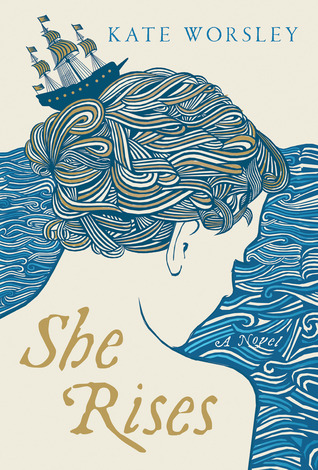
She Rises She Rises begins in 1740 when Louise Fletcher, a young dairymaid from Essex, is offered a position as lady’s maid in a sea captain’s house in Harwich. Louise has never been more than a few miles away from home, so arriving at the Handleys’ prosperous household in the busy port town is like entering a different world. As Louise settles into her new job and gets to know her selfish, spoiled young mistress Rebecca Handley, she also decides to see if she can find out what happened to her brother, Luke, who went away to sea and has never been seen or heard from again.

In the other main thread of the story we learn how Luke was pressed into the Royal Navy from a tavern in Harwich and found himself taken aboard the warship, the Essex. Luke has never been on a ship this size before and soon discovers that life at sea is harsh and dangerous. Things improve when he is befriended by an older, more experienced seaman, Nick Stavenger, but still Luke wants nothing more than to escape and get back home to the girl he loves.

Louise’s story and Luke’s are told in alternating chapters and both narratives have a distinctive voice and style of their own. Luke’s is in the present tense and is filled with nautical terminology and slang; Louise’s is addressed to a mysterious ‘you’ – though we don’t have to wait long before we learn who ‘you’ is. Having finished the book, I think I can see why Kate Worsley chose to write the story in this way, but I’m not a fan of unusual or experimental writing styles in general and couldn’t help thinking that it made the book harder to read than it really needed to be!

The book was so atmospheric, though! The chapters set at sea felt realistic and gave me a good idea of how hard life could be for a pressed man in the navy, though as usual I struggled with all the references to mizen yards, main-topsails and other seafaring terms. But the descriptions of eighteenth century Harwich were particularly vivid: the labyrinths of dark alleys and smugglers’ tunnels, the smell of fish, the sailors standing in tavern doorways, the way the streets become flooded with sea water when the tide rises.

So, there were some aspects of this book that I loved and others that I didn’t like very much. I found it too slow at the beginning, but when Louise’s and Luke’s stories finally come together, the effect is amazing. I had been starting to get impatient, wondering how the two of them would be linked, but when it happened it was definitely worth waiting for! Things that had confused me earlier suddenly made perfect sense and some of the revelations in the final section of the book made me want to go back and read earlier chapters again.

She Rises reminded me of Sarah Waters, particularly Tipping the Velvet, due to the way both authors deal with themes such as gender and identity within a historical setting – so I wasn’t surprised to read that Sarah Waters was Kate Worsley’s mentor. As a first novel this was a very clever and ambitious book and although I had too many problems with it to be able to say that I loved it, I will be hoping for more books from Kate Worsley in the future.

Meeting Katherine de Valois

I have read two historical fiction novels recently both on the subject of the fifteenth century French princess, Katherine of Valois, the wife of King Henry V of England. The Forbidden Queen by Anne O’Brien and The Agincourt Bride by Joanna Hickson both tell Katherine’s story but in very different ways and as I’ve read them so close together, I thought it would be interesting to combine my reviews into one post.

The Forbidden Queen Let’s start with The Forbidden Queen by Anne O’Brien, my favourite of the two books. The novel is narrated by Katherine herself and covers most of the significant events of her life. The youngest daughter of King Charles VI of France and his wife, Isabeau of Bavaria, Katherine is married to Henry V several years after the English victory over the French at the Battle of Agincourt in 1415. Queen Isabeau has agreed to a settlement with Henry that would make him heir to the throne of France in place of Katherine’s own younger brother, the Dauphin.

When Henry dies just a few years into their marriage, Katherine falls in love with his cousin, Edmund Beaufort – but does Edmund love her in return or is he more interested in the power he would gain as husband of the Queen Dowager? It’s not until Katherine gets to know her Welsh Master of Household, Owen Tudor, that she finally has a chance of true happiness.

This is quite a romance-based novel, but maybe that’s to be expected as Katherine sadly didn’t seem to have much of a part to play in politics or in the reign of her son, the young Henry VI. O’Brien did such a good job of making me see how Katherine was desperate for love and affection and how disappointed she was when she realised that she was going to get neither of these from the King. Henry V was not portrayed as a cruel or deliberately unkind husband, just one who was insensitive and indifferent, and it was so sad when Katherine realised the true nature of the man she was married to. But while I could have a lot of sympathy for the young, naïve Katherine I did start to wish that, as she got older, she would become more mature and independent. It was sad and frustrating to see her making the same mistakes again and again, looking for love where there was obviously none.

Although Katherine sometimes irritated me, I did like her. I also thought O’Brien’s characterisation of the three very different men in Katherine’s life was very well done: the distant, preoccupied King, interested only in battle strategies and military campaigns; the charismatic but ambitious and untrustworthy Edmund Beaufort; and the proud, quiet Welshman Owen Tudor. This is the first Anne O’Brien book I’ve read and I was quite impressed with the overall quality of her writing and her ability to tell a good story.

I received a copy of this book from Netgalley for review.

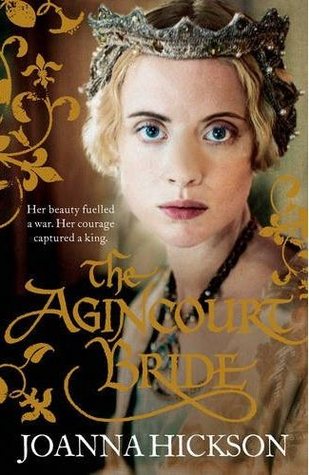
The Agincourt Bride Now for The Agincourt Bride by Joanna Hickson. In this book, the author has used the alternative spelling, Catherine, rather than Katherine, so I have done the same in this review. This is actually the first of two volumes and covers only the early part of Catherine’s life, from her childhood until shortly after her marriage to Henry. The sequel, The Tudor Bride, is due out later this year.

This novel is narrated by Catherine’s nursemaid, Guillaumette Dupain (known as Mette). Mette, the daughter of a baker, is brought to the royal household to act as wet nurse for the baby Catherine, having recently had a stillborn child of her own. With Catherine neglected and ignored by her parents, Mette becomes almost like a mother to the princess. They are separated during Catherine’s years in the convent at Poissy but are reunited when Catherine is thirteen. Despite the attempts of others to part them again, Mette is devoted to Catherine and manages to stay with her, becoming her Mistress of the Wardrobe and her friend and confidante.

While both this book and the one above are at the lighter end of the historical fiction range (as you would probably expect from the cover designs and titles) this one was a bit too light for me. I also thought it was too long and I’m not sure there was really enough material for a book this length focusing on only the first years of Catherine’s life. Mette’s own personal story didn’t interest me much; her main function in the novel is to provide the perspective of someone close to Catherine, and there have been so many historical fiction novels published in recent years narrated by a conveniently placed servant that I think it’s becoming boring and formulaic. Seeing Catherine only through Mette’s eyes, I couldn’t engage with her the way I did in Anne O’Brien’s book and as a result I didn’t like this version of Catherine very much.

Joanna Hickson does go into a lot of depth in areas of Catherine’s early life that O’Brien didn’t have time to explore. I was intrigued by the storyline involving John the Fearless, Duke of Burgundy, who is portrayed here as a violent monster and I would be interested to know if there’s any evidence that he really behaved like this. We also get to know Catherine’s brothers and sisters much better than in the O’Brien book. None of them are particularly endearing characters, but Mette, having known them all since they were children, displays an amazing amount of patience and understanding with each of them. Their mother, Isabeau, comes across as completely selfish and heartless, and their father, Charles VI, suffers from a mental illness that causes him to believe he is made of glass and will shatter if anyone touches him. I got a real feeling for the sadness and loneliness Catherine and her siblings may have experienced as children, and could also see how France had been left in a vulnerable position without strong leadership.

The Agincourt Bride ends as Catherine travels to England for her coronation. It’s quite an abrupt ending, but presumably the next book is going to pick up the story from this point.

Having read both of these novels I’m glad to have had the opportunity to learn about a period of history I previously knew very little about. If you only want to read one book about Catherine (or Katherine) of Valois, I would say read The Forbidden Queen as it covers Catherine’s whole life and I enjoyed it a lot more than The Agincourt Bride. I would be happy to read more books by Anne O’Brien but I’m not sure about Joanna Hickson yet and will have to decide whether or not I want to continue with The Tudor Bride.

Heading Out to Wonderful by Robert Goolrick

Heading Out to Wonderful “When you’re young, and you head out to wonderful, everything is fresh and bright as a brand new penny, but before you get to wonderful, you’re going to have to pass through all right. And when you get to all right, stop and take a good, long look, because that may be as far as you’re ever going to go.”

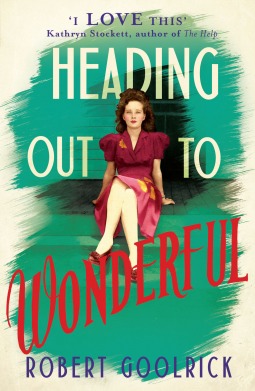
Heading Out to Wonderful is set in Brownsburg, Virginia, a small town where people live quiet, peaceful lives, where everyone goes to church on a Sunday and where no crime has ever been committed. Then one day in 1948, a stranger, Charlie Beale, arrives in the town with a suitcase full of money and another containing a set of butcher’s knives. Deciding that Brownsburg is where he wants to stay, Charlie gets a job working for the butcher, Will Haislett, and soon settles into his new life, getting to know Will, his wife Alma, and their five-year-old son, Sam. He and Sam become particularly close friends, with the little boy accompanying Charlie everywhere he goes.

Things begin to change when Charlie meets the beautiful Sylvan Glass. Sylvan is not like the other women in Brownsburg – she models herself on the Hollywood actresses she admires so much, wearing lipstick, earrings and glamorous dresses – and Charlie is instantly drawn to her. But Sylvan is the wife of the town’s richest man, Boaty Glass, and it’s obvious from the beginning that her relationship with Charlie can only lead to trouble. And when Sam, who is never far from Charlie’s side, witnesses something he really shouldn’t have seen, his loyalty to Charlie will be tested.

I really enjoyed the first half of this book. From the very first chapter there is an atmosphere of mystery. Who is narrating this story? Who is Charlie Beale and where did he come from? Where did he get his money? We learn almost nothing about his background – and maybe that’s the point, as he has come to Brownsburg to start a new life – but we still can’t help wondering what might have happened in his past. Other characters are intriguing too; one of my favourites was the dressmaker, Claudie Wiley. Claudie and Sylvan become friends due to their shared love of pretty clothes, but Claudie fears that it will never be a true friendship because this is Virginia in the 1940s and she is black while Sylvan is white.

In the second half, the tone of the novel becomes a lot darker. I thought I knew where things were heading, but it turned out I was wrong: what actually happened was more shocking and more devastating than I had expected. It’s the combination of the idyllic setting and the feeling of impending disaster that makes this novel so unsettling and causes what seems at first to be a pleasant, gentle story to become something else entirely.

This book wasn’t perfect – there were things that I didn’t understand, actions that didn’t make sense and storylines that could have been developed further – but overall I was impressed and I really liked Robert Goolrick’s writing style. Although the pace was slow, the story was compelling and I loved the portrait Goolrick painted of a small 1940s town and the people who lived there. My verdict is not quite ‘wonderful’ but definitely more than just ‘all right’!

I received a copy of this book from the publisher for review.