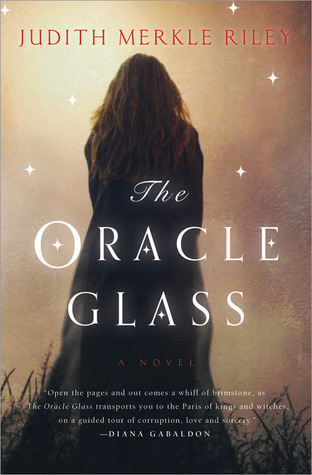
 Set in Paris during the reign of Louis XIV, The Oracle Glass combines historical fiction with the supernatural to tell the story of Genevieve Pasquier and her involvement in one of the darkest episodes in French history, the Affair of the Poisons.
When her father and grandmother die under suspicious circumstances, fifteen-year-old Genevieve runs away from home and is rescued by the notorious witch, La Voisin. From an early age Genevieve has had the ability to read people’s fortunes by looking into water, and with La Voisin’s help she transforms herself into the mysterious Marquise de Morville, a fortune-teller who claims to be one hundred and fifty years old. Genevieve plans to use her powers to achieve two goals – to make the handsome Andre Lamotte fall in love with her, and to take revenge on the people who have wronged her in the past. But as she becomes more involved in the intrigues of the Sun King’s court, she begins to learn that she has stumbled into a dangerous world of magic and murder and that La Voisin, the Shadow Queen, is at the centre of a circle of witches, poisoners and abortionists.
The Oracle Glass was a wonderful, magical read. After a slow start, I soon began to look forward to picking up the book and escaping for a while into Judith Merkle Riley’s recreation of 17th century Paris. Not knowing anything about this period of history, I was surprised to discover that many of the characters I’d assumed were fictional were actually real people: Madame de Montespan, for example, the King’s mistress who frequently visits the Marquise de Morville to have her fortune told, La Reynie, chief of the Paris police, and the sorceress La Voisin herself. A lot of the events described in the story, including the eventual fates of some of the characters, were also true and in a way, I’m glad I didn’t know anything about these people as it meant I never had any idea what was going to happen next.
Genevieve, or the Marquise de Morville, is a wonderful character with a warm and engaging narrative voice and through her eyes we are shown how difficult life could be for a young single woman trying to make an independent living for herself in the 17th century. What makes her such an interesting character is that she is so flawed; she makes mistakes, does things that are wrong or stupid, and although she is intelligent she can also be very naïve.
There’s no real attempt to make the dialogue sound authentic – and Genevieve’s narrative voice sometimes feels very modern – but although this often irritates me in other books, I think there’s a certain type of historical fiction where it doesn’t matter too much and this is an example of that type: a book designed to be fun and entertaining, with plenty of humour to offset the darker themes. And yet the depiction of Paris in the 1600s does still feel vivid and real; I loved the descriptions of carriage rides through the snow-covered streets and the court of Louis XIV, the Sun King, is also very well portrayed. My only criticism is that at over five hundred pages I really don’t think the book needed to be quite so long and there were a few sections, especially in the middle, that seemed to drag.
Judith Merkle Riley is an author I’ve heard about but have never had the opportunity to read until now – I believe some of her books have been out of print for a long time but I’m glad to have finally had the chance to read The Oracle Glass and would certainly be interested in reading her other novels after enjoying this one so much!
I received a copy of The Oracle Glass through Netgalley courtesy of Sourcebooks




 She Reads Novels