A Little Trickerie by Rosanna Pike

This was surprisingly good! A few pages in, I started to wonder if I’d made a mistake in choosing to read this book – the writing style was very unusual and I thought I was going to find it irritating – but once I settled into the story I fell in love with the narrator and was gripped all the way to the end.

The novel is set in the early Tudor period, during the reign of Henry VII, and begins with the death of Tibb Ingleby’s mother. Tibb has never known a home of her own; she and her mother have lived the life of vagabonds, moving from one place to another to escape the consequences of her mother’s con tricks or relationships with unsuitable men. Now, left alone in the world with her newborn baby sister to care for, Tibb sets off across the countryside with one aim in mind: to one day have her own roof over her head at last.

Tibb soon finds that making your own way in life as a young woman in 16th century England is not easy. She gets herself into trouble now and then and despite her wish to settle down in one place, she is forced to stay on the move. Along the way she meets a multitude of people including a troupe of travelling performers, a villainous farmer and even royalty. There’s also Ivo, a young man who, like herself, is an outcast who doesn’t feel he can conform to society’s expectations. She and Ivo become close friends and although most of the novel is narrated by Tibb herself, Ivo provides us with an occasional second perspective.

Tibb’s narrative style, as I’ve said, is unique and takes a while to get used to. She seems unaware of the correct words to describe things – a balding head becomes a ‘thinning-on-top-head’, being naked is ‘wearing a no-clothes outfit’, an empty room is a ‘sad nothing-in-it room’, all of which make sense but are not what other people would say. It fits with her portrayal as an illiterate, unsophisticated, naive young woman, but at the same time she’s certainly not stupid and I would have thought that with age and experience her language would have improved, yet she sounds the same at the end of the book as she does at the beginning. Still, the unusual narrative voice didn’t annoy me as much as I thought it would and I did love Tibb. One scene in the middle of the book even brought tears to my eyes, I was so emotionally invested in her story.

I had assumed Tibb was an entirely fictional character, so I was surprised to learn that she was inspired by a real-life woman known as the Holy Maid of Leominster who, like Tibb herself, engaged in fraud and ‘trickeries’ (although at least in Tibb’s case, she acted with the best of intentions). I really enjoyed this book and will look out for more by Rosanna Pike.

Thanks to Fig Tree for providing a copy of this book for review via NetGalley.

Book 40/50 for the Historical Fiction Reading Challenge 2024
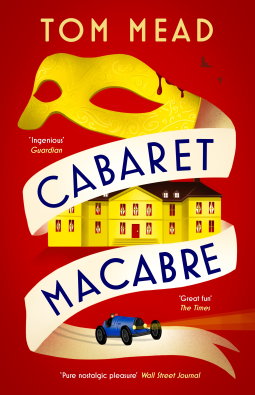
Cabaret Macabre by Tom Mead

After enjoying the first two books in Tom Mead’s Joseph Spector mystery series, Death and the Conjuror and The Murder Wheel, I was pleased to see that he had written a third one. I think this might even be my favourite of the three! If you haven’t read any of them, you could start here if you wanted to; although there are some references to Spector’s earlier cases, there are no spoilers and all three mysteries work perfectly as separate standalones.

It’s December 1938 and retired magician Joseph Spector has been approached by the wife of Sir Giles Drury, a prominent judge, who wants him to identify the sender of some threatening letters. She believes the culprit may be Victor Silvius, who attacked her husband nine years earlier and has been confined in a private sanatorium ever since. Having noted Spector’s involvement in solving the recent Dean case (described in The Murder Wheel), she hopes he will be able to find out who is behind the letters.

Coincidentally, Spector’s friend Inspector Flint of Scotland Yard has had a visit from Caroline Silvius, sister of Victor Silvius. Caroline believes someone is trying to murder her brother and she’s convinced that person is Sir Giles Drury. With Spector and Flint both investigating the same situation from opposite sides, it’s inevitable that their paths will cross. Arriving at Marchbanks, the Drurys’ country estate, during a period of heavy snow, both men are baffled when a member of the family is found dead under very unusual circumstances. Can they solve the mystery before another murder takes place?

I really enjoyed Cabaret Macabre. It’s very cleverly plotted, with not one but two locked room style murders for Flint and Spector to investigate, but unlike the previous book, which I found too complicated, this one was easier for me to follow. That doesn’t mean it was easy to solve, however, because it certainly wasn’t! I had no idea how the murders were carried out or who was responsible for them, even though the clues were all there in the text. Tom Mead really is a master of this type of mystery and it’s easy to see the influence authors like John Dickson Carr and Agatha Christie have had on his work.

The book has a large number of suspects (and also potential victims) including Sir Giles, his wife and their four sons and stepsons, Victor and Caroline Silvius and an assortment of servants at Marchbanks. There’s also another murder case – or was it suicide? – from nine years earlier (the source of the animosity between Victor and Sir Giles), which could provide the key to what’s happening in the present. It’s impressive that Mead manages to pull all of this together without leaving any obvious holes in the plot. What I particularly love about this series, though, is the idea of a former magician becoming an amateur detective and using his special knowledge of illusions and deceptions to solve crimes and assist the police. Although Spector is still something of a mystery himself and reveals very little of his past or his private life, I think he’s a great character and the perfect partner for the more practical, less imaginative Inspector Flint.

If you haven’t tried a Joseph Spector book yet and are a fan of Golden Age mysteries, I do recommend them; this one and the first one, in particular, have quite an authentic 1930s feel, as well as being fun and entertaining. I’m hoping there’ll be more!

Thanks to Head of Zeus for providing a copy of this book for review via NetGalley.

Book 39/50 for the Historical Fiction Reading Challenge 2024

This is book 20/20 of my 20 Books of Summer 2024.

Yes, I have completed my 20 Books of Summer list with nearly a week to go! I’ll be looking back at my 20 books and my experience with this year’s challenge in a special post at the end of the month.

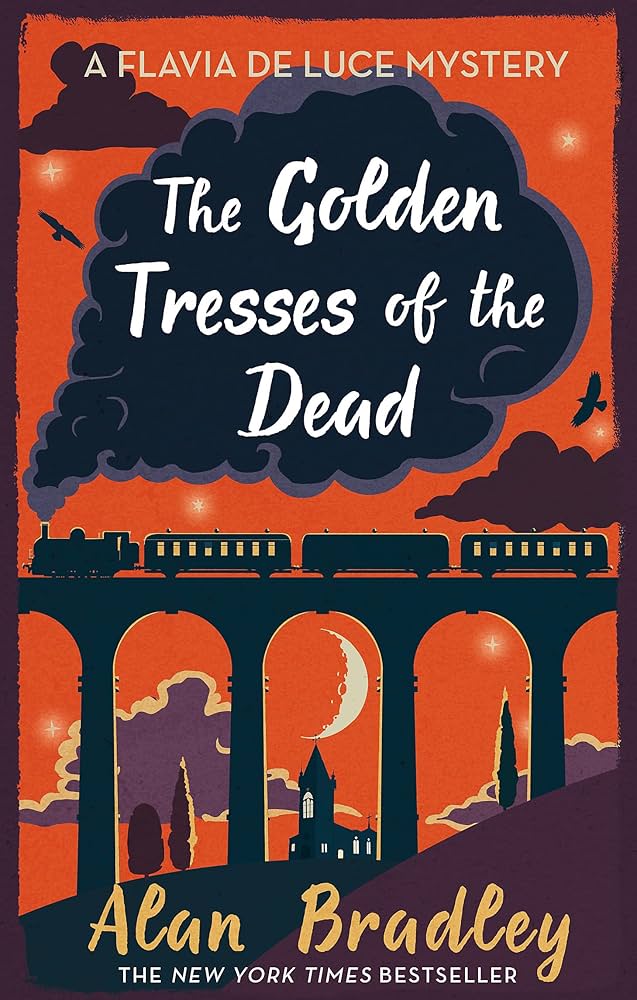
The Golden Tresses of the Dead by Alan Bradley

I had thought this book, published in 2019, was going to be the last in Alan Bradley’s Flavia de Luce series, so I hadn’t rushed to read it, thinking that once I had I would have no more to look forward to. Then I discovered that there’s actually another book coming in September – which will be the eleventh in the series – and decided to pick this one up now in preparation.

The Golden Tresses of the Dead begins in 1952 with our twelve-year-old heroine Flavia de Luce attending the wedding of her elder sister, Ophelia (known as Feely). I won’t tell you who she’s marrying, in case you haven’t reached this point in the series yet – or haven’t started at all. Everything is going well, apart from the usual naughtiness of Flavia’s annoying little cousin, Undine, but when Feely steps forward to cut into her wedding cake she screams in horror. There’s a human finger inside the cake! As Feely retreats to her room to recover from the shock, Flavia whisks the finger away to her laboratory so she can examine it and try to identify its owner.

The next day, Arthur W. Dogger & Associates, the new detective agency Flavia has formed with her father’s friend and manservant Dogger, receives its first client. A Mrs Prill is trying to track down some stolen letters and wants Flavia and Dogger to help. When they begin investigating, however, they discover that Mrs Prill hasn’t been entirely honest with them. Are the letters really missing – and could there be any connection with the severed finger in the cake?

As I’ve come to expect from the Flavia de Luce books, The Golden Tresses of the Dead (the title comes from Shakespeare’s Sonnet 68) is a quick, entertaining read; I did enjoy it, but it’s not one of the strongest and I think if I didn’t know there was another book on its way, I would have been disappointed with this one as a conclusion to the series. In general, I think the earlier books are more fun and have more charm than the later ones, so if you still haven’t tried one I would recommend going back to the beginning and starting with The Sweetness at the Bottom of the Pie.

Although this book has many of the same elements as most of the others in the series – it’s set, as usual, in and around the small English village of Bishop’s Lacey in the 1950s; Flavia still gets around on her trusty bicycle, Gladys; she still loves chemistry and conducting experiments in her fully equipped laboratory – there are also some differences. Feely leaves for her honeymoon early in the book and Flavia’s other sister, Daffy (Daphne), is tucked away working on her memoirs and only makes one or two brief appearances. The relationship between Flavia and her two sisters is one of the things that has always fascinated me about the series, so I was sorry that it’s not really explored any further here. We do see a lot of Undine, but I’ve never liked her and she doesn’t make up for the absence of Feely and Daffy! Also, as hinted at in the previous book, The Grave’s a Fine and Private Place, crime-solving is no longer a solitary activity for Flavia and she forms a new partnership with Dogger. It works well – Flavia does most of the trespassing, risk-taking and hunting for clues, but Dogger, with the benefit of age and life experience, knows how to interpret those clues. I’ve always loved him and was pleased to see him take such a prominent role in this book.

The mystery itself is complex, involving potential grave-robbing, poisonous plants and two missionaries who may not be quite what they seem, and I’ll admit that I found it confusing and didn’t really understand how everything tied together. I wondered if I just hadn’t been paying enough attention and had missed something, but looking at other reviews it seems that a lot of people had similar problems. This is not a favourite Flavia de Luce book, then, and I’m glad it’s not how the series ends! I’m looking forward to reading book eleven, What Time the Sexton’s Spade Doth Rust, and am hoping it will be better than this one.

Book 38/50 for the Historical Fiction Reading Challenge 2024
The Hazelbourne Ladies Motorcycle and Flying Club by Helen Simonson

I enjoyed Helen Simonson’s previous two novels, Major Pettigrew’s Last Stand and The Summer Before the War, but we seem to have had a very long wait for her third one. Eight years, in fact! Was it worth waiting for? I think so.

Although there’s not really any connection with The Summer Before the War, this book could easily have been titled ‘The Summer After the War’. It’s set in a small English seaside town in 1919, the year after the end of World War I. Now that the men have been returning from the front, Constance Haverhill has had to give up her wartime job running a farm and estate and is now at a loose end. Reluctantly contemplating work as a governess, she is given a temporary respite when a family friend asks her to accompany her elderly mother to Hazelbourne-on-Sea for the summer. Working as a lady’s companion is not really what Constance has in mind, but she agrees and soon she and Mrs Fog are settling into the hotel that will be their home for the next few months.

Everything changes for Constance when she meets Poppy Wirrall, a young woman from a wealthy local family who has started a motorcycle club for ladies so that they can use the skills they gained during the war. Some of the women are mechanics, while others are using their motorcycles to provide a taxi service for Hazelbourne residents. Constance is intrigued, particularly when Poppy decides to buy a damaged Sopwith Camel fighter plane so that, once it’s been restored, the club can begin training women pilots in addition to their other services. Poppy herself has never flown a plane, but she knows who will be the perfect instructor: her brother Harris, a former fighter pilot who returned from the war missing a leg and has been sinking into depression ever since.

The Hazelbourne Ladies… is a fascinating portrayal of life in the aftermath of the war. The War Practices Act, which is referred to in the novel, means that men returning from war must be given their jobs back – jobs which have been filled by women during their absence. It’s easy to have sympathy for women like Constance and her new friends who had, at least in some ways, experienced a greater degree of equality during the war that seems to be being eroded again in peacetime. Simonson also explores a different but equally frustrating situation through the story of Harris, whose disability has left him feeling useless and unwanted.

Another interesting character is Klaus, originally German but now a naturalised British citizen, who is working as a waiter at the hotel and is worried for his safety and position due to the general anti-German sentiment of the public. Although most of the novel is written from the perspectives of Constance and Harris, we do occasionally hear from Klaus as well, adding another layer to the story. I felt that the book was a bit longer than it really needed to be and it took me a while to become fully absorbed in it, but once I did I found it a perfect summer read.

Thanks to Bloomsbury Publishing for providing a copy of this book for review via NetGalley.

This is book 18/20 of my 20 Books of Summer 2024.

Book 37/50 for the Historical Fiction Reading Challenge 2024
A Court of Betrayal by Anne O’Brien

I enjoyed Anne O’Brien’s last two novels, about the Pastons – one of England’s most influential families in the 15th century, who left behind a collection of correspondence known as the Paston Letters – and I wondered if she would continue to write about them in a third novel. However, with A Court of Betrayal she has chosen to tell a very different story: the story of Johane de Geneville.

Johane (or Joan) de Geneville is not a well known historical figure and most people have probably never heard of her, but as the wife of Roger Mortimer, 1st Earl of March, she played a part in an important and eventful period of English history. Having been imprisoned for leading a revolt against King Edward II, Mortimer escaped to France where he joined forces with Edward’s estranged queen, Isabella, and together they led a successful invasion of England in 1326. With Edward forced to abdicate and his young son crowned in his place, Mortimer and Isabella effectively ruled the country for several years. The Stone Rose by Carol McGrath, The She-Wolf by Maurice Druon and Isabella by Colin Falconer are just a few of the novels I’ve read that cover this period, but the focus is always firmly on Isabella, Edward and Mortimer. What was Johane doing while all of this was happening and how did she feel about it? These are the questions Anne O’Brien sets out to explore in A Court of Betrayal.

The novel is written in the first person from Johane’s perspective and I found her much more likeable and sympathetic than some of O’Brien’s other heroines. Throughout the course of the novel, as the title would suggest, she experiences and witnesses betrayal of many kinds, but the most significant for Johane personally is the betrayal she faces at the hands of her own husband. The marriage between Johane and Roger Mortimer is portrayed as a happy one at first. Although it was an arranged marriage, which was normal amongst the medieval nobility, there seems to be genuine love and affection between them and they go on to have twelve children together. This all changes when Mortimer begins an affair with Isabella and makes no real attempt to hide it, either from Johane or from the public – and even insists on Isabella being accepted as a guest in Johane’s home. I feel bad that, despite having read about the Mortimer/Isabella relationship before, I’ve never really given any thought to the fact that Roger had a wife!

With the story being told from Johane’s point of view, there’s a limit to the things she sees and experiences for herself (particularly as she spends large chunks of the novel imprisoned or under house arrest) and information often comes to her via other people. This doesn’t make the novel boring, however; there’s always something happening in Johane’s personal life and it’s still interesting to read about the political developments happening elsewhere even if we’re not seeing them at first-hand. Like most periods of history, this one has its fair share of controversies, mysteries and other matters on which historians have never been able to agree – how and when did Edward II die, for example, and what was the nature of his relationships with his favourites, Piers Gaveston and Hugh Despenser? O’Brien has her opinions on these things and incorporates them into the plot. It’s all very fascinating, whether you’ve read about this period before or not.

Although I haven’t read all of Anne O’Brien’s books yet, I have read a lot of them and I think this is one of her best. I’ve discovered that her next novel, due in 2025, is going to be set during the Wars of the Roses and will tell the stories of Margaret of Anjou and Anne, Countess of Warwick. Something to look forward to!

Thanks to Orion for providing a copy of this book for review via NetGalley.

Book 36/50 for the Historical Fiction Reading Challenge 2024

In the Upper Country by Kai Thomas

In the Upper Country came to my attention earlier this year when it was shortlisted for the Walter Scott Prize and as I’ve been looking out for historical fiction set in Canada (see my Historical Musings post from last year) it’s one I was particularly interested in reading.

The novel opens in 1859 in Dunmore, Ontario, a fictional town settled by people fleeing slavery in the American South. It is home to Lensinda Martin, a young black journalist who works for a local newspaper. When an old woman who has recently arrived in Dunmore through the Underground Railroad kills a slave hunter and is arrested, Lensinda is sent to interview her in jail. The old woman insists that if she’s going to tell her story, Lensinda must tell one in return and so, over the course of several days, the two women begin to exchange tales.

The stories they tell reveal not only how the old woman came to be in Dunmore and to kill a man, but also the journeys of other slaves and the significance of all of this on Lensinda’s own life. They also explore the connections between the Black and Indigenous communities of North America – something which Kai Thomas in his author’s note points out is usually ignored in other novels about slavery. It’s certainly not a subject I know much about, so I found that aspect of the book interesting.

Although Dunmore is not a real place, Thomas explains that it’s inspired by similar towns that did exist, such as North Buxton, Ontario. It had never occurred to me that there were whole towns settled by slaves in Canada; in fact, everything I’ve previously read about the Underground Railroad has focused more on how the slaves manage to escape and begin their journey rather than on what happens to them after they reach their destination. It’s a book with lots of interesting themes and topics, then – and it’s always good when you reach the end of a novel feeling that you’ve learned something new.

On a more negative note, the structure of the book didn’t work very well for me at all. There were too many different stories, too many different voices and I found it difficult to follow what was happening and engage with the characters. I almost abandoned it several times because I just couldn’t get into the flow of the writing, but I kept going and did manage to finish it. I don’t regret reading it, but for me it was definitely more of an educational book than an enjoyable one!

This is book 17/20 of my 20 Books of Summer 2024.

Book 35/50 for the Historical Fiction Reading Challenge 2024
The Briar Club by Kate Quinn

Kate Quinn’s new novel, The Briar Club, begins with a murder in a Washington, D.C. boarding house on Thanksgiving, 1954. We don’t know who the victim is – that will be revealed later on – but it does seem that the killer is likely to be one of the seventeen people gathered in the kitchen waiting to be interviewed by the police. To get answers, we have to go back to the day four years earlier when Grace March arrives at Briarwood House and agrees to take the tiny apartment in the attic…

Grace is just one of several women living in the house, all of whom are hiding secrets and in some cases are not quite what they seem. There’s Nora, who works at the National Archives and is in love with a gangster; Bea, a former baseball player forced to give up her dreams; Claire, who is desperately trying to save to buy her own home; Fliss, an Englishwoman with a baby and an absent husband; unhappy, spiteful Arlene whom nobody likes; and Reka, an elderly Hungarian refugee. The novel unfolds through a series of interlinked short stories each focusing on one of these women, interspersed with chapters describing the aftermath of the Thanksgiving murder. The latter are narrated by Briarwood House itself, because the house knows better than anyone else what has been going on within its walls!

I enjoyed The Briar Club, but found some of the women’s stories much more engaging than others. Nora’s story came first and was completely gripping, which maybe raised my expectations too high for the rest of the book. By the time I reached Bea’s section in the middle, I was starting to get bored, although things did pick up again later on. Despite the brief chapters about the murder that are scattered throughout the book, I think anyone who starts to read this expecting a mystery novel or a thriller will be disappointed – but if you like character-driven novels with a slower pace it will probably be more to your taste. Speaking of taste, food and drink play a big part in the story, with each character sharing some of their recipes with us! So if you want to know how to make Bea’s ragù, Arlene’s candle salad or Claire’s potato pancakes, the instructions are all in the book (and even if you’re not a cook, I recommend skipping to the end of each recipe where you’ll find a suggestion for a suitable song to accompany the meal).

Although each woman in the house has her own individual story to tell, they all get together for weekly social gatherings in Grace’s attic room (the ‘Briar Club’ of the title) and over the years most of the women begin to form close bonds. A very different kind of relationship that also develops is between the women of the Briar Club and the two children of their landlady, Mrs Nilsson. Pete Nilsson gets a chapter of his own, but I particularly loved seeing how his younger sister, Lina, grows in confidence (and improves her baking skills) due to the friendship and support of the Briar Club. The novel also provides us with a snapshot of life in America in the early 1950s, with a focus on McCarthy and the fear of communism.

The Briar Club was an enjoyable read overall, but I would have preferred some of the women’s stories to be cut short or left out altogether. So far, The Rose Code is still my favourite of the three Kate Quinn books I’ve read (the other is The Diamond Eye).

Thanks to HarperCollins for providing a copy of this book for review via NetGalley.

This is book 16/20 of my 20 Books of Summer 2024.

Book 34/50 for the Historical Fiction Reading Challenge 2024