Review: The Book of Fires by Jane Borodale

Agnes Trussel is a seventeen year old girl whose life is thrown into turmoil when she discovers she is pregnant and runs away to London to start a new life.  In London she is lucky enough to find employment as an assistant to the firework maker John Blacklock but as she desperately tries to hide her pregnancy from everyone around her, she starts to realise that she’s not the only one with secrets…

When I first heard about this book last year I was immediately interested in reading it but eventually decided to give it a miss – until I saw that it had been shortlisted for the Orange Award for New Writers.  Of course, being shortlisted for an award doesn’t guarantee that a book will be good, but it does usually mean that there will at least be something different or special about it that makes it worth reading.

Well, it was worth reading, but I did also have a few problems with the book – the first being that it’s written in the first person present tense.  There have been a few books written in the present tense that I’ve enjoyed, but usually I find it distracting – and that was the case here.  I also found it difficult to connect to any of the characters, even Agnes herself.  It wasn’t that they were badly drawn or uninteresting – Cornelius Soul the gunpowder seller, Mrs Blight the housekeeper and the mysterious Lettice Talbot wouldn’t be out of place in a Dickens novel – I just couldn’t engage with them or care about them very much.  When I read historical fiction I like to feel as if I’ve been transported back in time and as if I’m there experiencing things along with the characters.  Unfortunately I didn’t feel any of that with this book.

The plot itself was interesting enough.  I struggled with the opening chapters -which described the slaughter of a pig in an unnecessary amount of detail – but after that, when Agnes arrived in London I started to enjoy the story more.


Picture by Jon Sullivan in the public domain

The descriptions of firework making were fascinating.  It was particularly interesting to learn about the early experiments and research that would eventually lead to the discovery of coloured fireworks.

“You imagine colours vividly,” he says.
“I do, sir.” I reply. “It is…almost as though I feel them as a sense of touch or taste when I am looking.”
He looks up at me beside him. I am startled to see how his eyes are tight with excitement. A hope flares up in me.
“Have you attempted a blue, Mr Blacklock?” I whisper.

Despite the negative points I mentioned above, I kept on reading to the last page because I wanted to know how the story ended – and I was rewarded with a surprising ending that I hadn’t been expecting.  In fact, the final few chapters were great and made me glad I’d persevered with the book.

Would I recommend it?  I’m not sure – there are much better historical fiction novels out there in my opinion – but if it appeals to you then give it a try and see what you think.
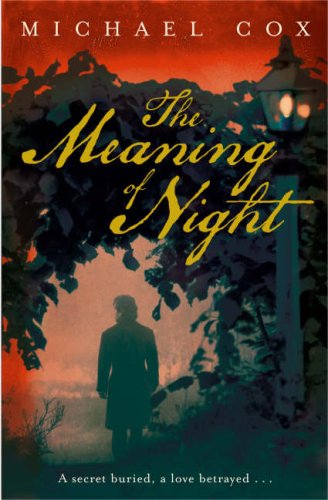
Review: The Meaning of Night by Michael Cox

I was intending to read this book when it was first published four years ago, but for some reason I didn’t and forgot all about it until I noticed it in the library recently.  I’m glad I finally got round to it, even if I’m late as usual!

The plot will be a familiar one to anyone who has read a lot of Victorian fiction – it’s a story of love, betrayal and deceit, revolving around a lost inheritance and a childhood rivalry. A vast country estate, a beautiful, mysterious heroine, and the dark, foggy streets of 19th century London combine to make this a clever imitation of the Victorian sensation novel.

In a similar way to The Unburied which I reviewed earlier this month, the book is presented as a genuine 19th century manuscript, complete with an ‘Editor’s Preface’ and numerous footnotes. The use of footnotes, which seemed to appear on almost every page, reminded me of Susanna Clarke’s Jonathan Strange & Mr Norrell. However, whereas in Jonathan Strange the footnotes really added something to the story, providing us with fascinating anecdotes about the history of magic, in The Meaning of Night they served very little purpose – other than to give the book a scholarly feel. Overall though, this was one of the best written of all the novels of this type that I’ve read so far and I was impressed by the author’s use of language and writing style to make this feel like an authentic 19th century novel.

The narrator, Edward Glyver, is really quite a horrible person. In the first chapter – in fact, in the first sentence (so this is not a spoiler) – he confesses to murder:

“After killing the red-haired man, I took myself off to Quinn’s for an oyster supper.”

He also cheats on the woman who loves him, develops an obsession with his enemy, Phoebus Rainsford Daunt – and becomes increasingly dependent on opium, making him an unreliable narrator at times. Is he a character deserving of our sympathy, then? Definitely not – and yet, I was rooting for him throughout the story, wanting him to right the wrongs that had been done to him, which is a testament to Michael Cox’s writing skills.

The only thing that really disappointed me about this book was the ending. I can’t say too much about it without spoiling the story for you, but the ending left me feeling dissatisfied – I had been hoping for a few more plot twists.

This book won’t be to everyone’s taste – if you simply don’t like intricately plotted Victorian or Victorian-style novels you’ll want to avoid this one. However, fans of Charles Dickens or Wilkie Collins will probably enjoy this book, as they were clearly two of Michael Cox’s influences (many of the characters have Dickensian names such as Phoebus Daunt, Fordyce Jukes and Josiah Pluckrose). It should also appeal to readers of Sarah Waters, Charles Palliser or other writers of neo-Victorian fiction. In particular, I found it very similar to Palliser’s The Quincunx, though slightly less complex and intellectually demanding.

Recommended

Genre: Historical Fiction/Pages: 608/Publisher: John Murray/Year: 2006/Source: Library book

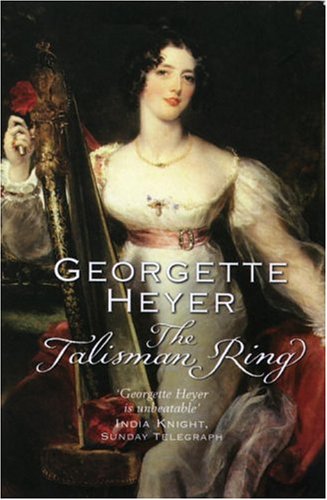
Review: The Talisman Ring by Georgette Heyer

Before I started blogging I had never considered reading Georgette Heyer, but after seeing how popular she is with so many other bloggers I knew I would have to give her a try. I’m glad I did – and I’m glad I chose to begin with The Talisman Ring because I really enjoyed it.  I could describe this book in one word: fun!

Lord Lavenham’s dying wish is that his great-nephew Sir Tristram Shield will marry his granddaughter Eustacie de Vauban.  However, Tristram is a sensible, practical man in his thirties while Eustacie is a romantic, passionate girl of eighteen – and neither particularly wants to marry the other.  Eustacie would prefer to marry her other cousin, Ludovic, but there’s just one problem: Ludovic is a fugitive, wanted for murder.  With the help of Sarah Thane, Tristram and Eustacie begin a search for the talisman ring that will prove Ludovic’s innocence.  This is all part of a thrilling adventure involving smugglers, excisemen, the Bow Street Runners and a Headless Horseman!

I enjoyed the witty dialogue and the way all the characters interacted with each other, particularly the relationships between Tristram and Sarah, and Eustacie and Ludovic.  Even the minor characters were well drawn and fun to read about. One of my favourites was Sir Hugh Thane, Sarah’s brother, who appeared completely oblivious to what was going on around him and was more interested in the contents of the Red Lion’s cellar.

I thought Eustacie was very over the top and as a result, not very realistic, but I can appreciate that Heyer had intended her to be an amusing, entertaining character. I preferred the book’s other heroine, Sarah Thane, who was more down to earth and composed – though like Eustacie, she longs to have some excitement in her life…

“I thought it too good to be true,” said Miss Thane. “If there is one thing above all others I have wanted all my life to do it is to search for a secret panel! I suppose,” she added hopefully, “it would be too much to expect to find an underground passage leading from the secret panel?”

The Talisman Ring has a bit of everything: mystery, adventure, history, romance and comedy. In general I prefer my historical fiction to be more serious, but I still enjoyed this book and am looking forward to reading more of Heyer’s work. I have a couple of her other books waiting to be read, so it will be interesting to see what I think of them.

Recommended

Genre: Historical Fiction/Pages: 320/Publisher: Arrow/Year: 2005 (originally published 1936)/Source: Library book

Review: Under a Blood Red Sky by Kate Furnivall

Unfortunately I was unable to finish this book – which is not something that happens to me very often. I hadn’t heard of Under a Blood Red Sky (also published under the title The Red Scarf) until I saw it in the library and I thought I’d give it a try as I love historical fiction set in Russia.   It sounded interesting:

Anna and Sofia are two women who meet whilst imprisoned in a Soviet labour camp in the 1930s and become best friends. When Anna becomes ill, Sofia comes up with a daring plan to run away from the camp and find help. Anna has told her about a childhood friend, Vasily, who is now living under an assumed name in the town of Tivil. After successfully escaping, Sofia heads for Tivil to look for Vasily and ask him to return to the camp with her to save Anna.

However, right from the beginning of the book I felt we were being asked to accept things that weren’t plausible.  The whole plot was just too far-fetched for me.  The other (bigger) problem I had with this book was that I couldn’t connect with any of the characters. Although they were constantly putting their lives at risk and facing unimaginable horrors under Stalin’s communist regime, I found I didn’t really care what happened to them. Sofia was one of those model heroines – beautiful, brave, intelligent and perfect. Everybody seemed to be captivated by her and I couldn’t really understand why. She just didn’t feel like a real person to me. Of course, there were some situations that even Sofia couldn’t deal with – that’s where the gypsy Rafik came in, using mesmerism and mind-control to overcome obstacles.  I thought the whole magical aspect of the book seemed a bit out of place.

I tried to keep reading, thinking the book might get better but when I found I was almost halfway through and still wasn’t enjoying it, I decided not to waste any more time on it and put it down with a sigh of relief. I’m glad I had borrowed this book from the library instead of spending money on it – at least I didn’t lose anything apart from a couple of days when I could have been reading something else.

Genre: Historical Fiction/Pages: 512/Publisher: Sphere/Year: 2008/Source: Library book

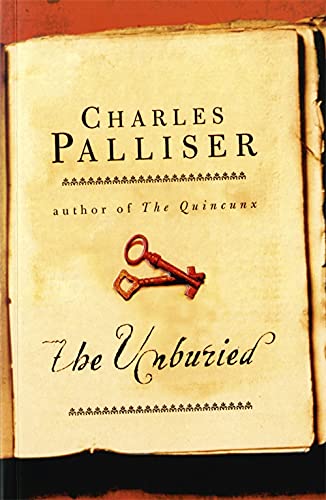
Review: The Unburied by Charles Palliser

The title of this book may suggest a horror story complete with zombies and vampires, but The Unburied is actually a scholarly murder mystery which reminded me of The Name of the Rose by Umberto Eco or An Instance of the Fingerpost by Iain Pears.  I wanted to read it because a few years ago I read another Charles Palliser book, The Quincunx, which I really enjoyed.  Like The Quincunx, this one is set (mostly) in Victorian England.  It begins with a mock ‘Editor’s Foreword’ in which we are told that we are about to read an account which will throw new light on the controversial Thurchester Mystery.  This account, known as The Courtine Account, forms the bulk of the book.

Dr Edward Courtine, a historian from Cambridge University, has been invited to spend the week before Christmas with Austin Fickling, an old friend from his student days who is now teaching at a school in the cathedral city of Thurchester.  He and Austin haven’t seen each other since they parted on bad terms twenty years ago, and Courtine is eager to renew their friendship.  He also has another reason for wanting to visit Thurchester – he has been studying King Alfred the Great and has learned that an ancient manuscript detailing the events of Alfred’s reign may be available in Thurchester Library.

On the night of Courtine’s arrival he hears the story of a murder that took place in the cathedral two centuries earlier.  Courtine is fascinated, but as he begins to investigate he becomes involved in another murder mystery – and discovers Austin’s true motive for inviting him to Thurchester.

As the main narrator of the book, I found Courtine very irritating, but at the same time I felt slightly sorry for him.  For such an obviously intelligent person he was completely lacking in perception, constantly saying the wrong things, missing important clues and failing to notice people behaving suspiciously.  Sometimes he would tell us that he was beginning to form a theory or that an idea had occurred to him, but he didn’t let us know what it was.  This was good in one way, as it encouraged me to work things out for myself, but it also annoyed me because I was already finding it difficult enough to keep all the threads of the story straight.

Although the town of Thurchester and its community are vividly depicted, I didn’t find any of the characters particularly memorable.  The fact that some of them had similar names (Slattery, Sheldrick, Sisterton for example) didn’t help.  There is actually a character list at the back of the book but I was trying not to look at it in case I came across any spoilers.  As for the plot, it’s so intricate you really need to read this book in as few sittings as possible so you don’t forget any important details.  There seemed to be a constant stream of unexplained deaths and forged documents, with at least three separate mysteries from different eras all running parallel to each other – and different characters giving different versions of what may or may not have happened.   I wished I had been taking notes from the beginning.

This is a very atmospheric book with lots of gothic elements, from the freezing fog that accompanies Courtine’s arrival in Thurchester to the obligatory ‘ghost’ supposedly haunting the cathedral.  It would have been a good book to read in front of the fire on a cold winter’s night.  In spite of the slow pace the book was relatively quick to read and although it was certainly confusing, I did enjoy it, especially when the various mysteries began to unravel towards the end.  Not as good as The Quincunx, though – if you’ve never read a Charles Palliser book before, try that one first.

Genre: Historical Fiction/Mystery/Publisher: Phoenix/Pages: 389/Year: 1999/Source: My own copy purchased used

Review: O, Juliet by Robin Maxwell

When Juliet Capelletti meets Romeo Monticecco at a masked ball, they instantly fall in love. There’s only one problem: the Capelletti and the Monticecco are families at war. Oh, and Juliet’s father is already planning to marry her to another man. Does this sound familiar? It should, because it’s a retelling of Shakespeare’s Romeo and Juliet – the most famous love story of all time.

The storyline is basically the same as Shakespeare’s but Robin Maxwell has made the story her own by adding some interesting twists and variations; for example she uses 15th century Florence as the setting rather than Verona and has her Romeo and Juliet mixing with real historical figures such as Lucrezia Tornabuoni and Cosimo de’ Medici. Also, while the events of Shakespeare’s play take place in less than a week, Maxwell’s story covers a longer period, making the pace feel more realistic and allowing her to spend more time fleshing out the early stages of Romeo and Juliet’s romance and Romeo’s attempts to reconcile their feuding families.

Although Jacopo Strozzi, the man Juliet is promised to, is a stereotypical villain (cruel and spiteful with yellow teeth and stinking breath), most of the other characters are well drawn. Maxwell’s Juliet is the daughter of a wealthy silk merchant and is portrayed as a strong, intelligent woman who enjoys writing her own poetry in the style of her beloved Dante Alighieri. The charming, romantic Romeo, son of an olive grower, is another Dante fan and it’s their mutual love of the poet that helps to bring them together. Throughout the book Romeo and Juliet frequently quote from Dante, as well as sharing their own poetic efforts with each other. I thought this was a nice touch and the fact that they had a common interest made their relationship more believable, rather than it just being love at first sight.

I wish I could say that I loved this book, but I didn’t – I thought it was good, without being exceptionally good. As the story started building towards its tragic climax I just didn’t feel as emotionally affected by it as I expected to. However, there were plenty of things I did like about the book, for example the way it was structured, with most of the story being told from Juliet’s viewpoint interspersed with the occasional chapter from Romeo’s point of view. The fact that the plot unfolds within a real historical setting makes the story feel convincing. I haven’t read many books set in Renaissance Italy, so this was another aspect of the book that I enjoyed – the descriptions of Florence are full of detail and imagery. Finally – and I don’t normally mention this in my reviews – the front cover is gorgeous! I would recommend O, Juliet to lovers of historical romance or to anyone who is intrigued by the thought of reading a new take on a classic tale.

Genre: Historical Fiction/Pages: 338/Publisher: New American Library/Year: 2010/Source: Won in giveaway

Review: In a Far Country by Linda Holeman

Linda Holeman really deserves to be better known. Her books seem to be difficult to find outside the UK and Canada which is sad because she’s such a good writer. Last year I read The Moonlit Cage and enjoyed it so much I couldn’t wait to read another of her historical fiction novels. In a Far Country is part of a trilogy with The Linnet Bird and The Moonlit Cage, but they are all stand-alone books and can be read in any order.

In a Far Country is set in British-ruled India in the late 19th century and tells the story of Pree Fincastle, the daughter of two British missionaries living on an isolated mission near Lahore. Left alone and penniless after her parents’ tragic deaths, Pree sets off to look for her childhood friend, Kai, the only person she can turn to for help.

I found this book difficult to get into at first. Holeman spent a lot of time setting the scene and introducing us to Pree and her parents, so that the story didn’t really begin until around 150 pages into the book. From this point onwards, though, the pace picked up and I was hooked. I really liked the character of Pree. Since the book is told in the first person from her point of view, we get to experience all her emotions as she grows up at the lonely, impoverished mission house and as her life is turned upside down by the deaths of her parents.

The only criticism I have of both this book and The Moonlit Cage is that I just don’t feel enough connection to the male characters. I think Linda Holeman writes female characters much better than she does male. I found that Kai remained cold and aloof throughout the entire book and considering Pree loved and trusted him enough to turn to him when she was in trouble, I didn’t feel much warmth, passion or humour coming from him at all. This was almost exactly the same reaction I had to David Ingram in The Moonlit Cage.

However, one of Holeman’s strengths is in her wonderfully evocative and colourful descriptions of the places she’s writing about. She chooses just the right words to convey the sights, sounds and smells of India. If you had never read a book set in India before, this would probably be a good introduction.

Despite the length of this book, it was surprisingly quick to read. Perfect if you’re looking for a big, heartbreaking historical fiction novel to lose yourself in for a few days.

Highly Recommended

Genre: Historical Fiction/Pages: 640/Publisher: Headline Review/Year: 2008/Source: My own copy bought used