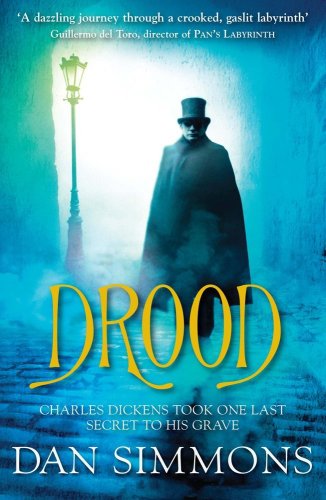
Review: Drood by Dan Simmons

I think I liked the idea of this book more than the book itself. A gothic mystery/horror story set in Victorian London, featuring Charles Dickens and narrated by Wilkie Collins sounded like exactly the kind of book I would enjoy. Unfortunately it didn’t quite live up to its fascinating premise and I was left with mixed feelings about it.

Drood is told in the form of a memoir written by Wilkie Collins (a close friend and collaborator of Charles Dickens, as well as being the author of The Woman in White, The Moonstone and many other novels and plays) and addressed to an unknown reader in the future – that is, to us.

The story begins with the Staplehurst Rail Disaster of 1865, when the train on which Charles Dickens is travelling crashes, sending most of the carriages plummeting over a viaduct into the riverbed below. Luckily Dickens is in one of the few carriages that doesn’t fall. As he helps to rescue people from the wreckage, he encounters a mysterious figure dressed in a black cape who introduces himself only as ‘Drood’. In the days following the train crash, Dickens becomes obsessed with finding Drood and discovering his true identity. With the reluctant help of Wilkie Collins, Dickens begins a search for Drood which leads them through the dark alleys and underground catacombs of London.
Interspersed with the Drood storyline are long passages in which we learn about the family life and living arrangements of both Dickens and Collins, how much they earned for their various novels, their walking tour of Cumberland in 1857, the details of Wilkie’s laudanum addiction, the story of the Swiss chalet given to Dickens by his friend Charles Fechter, Dickens’ interest in mesmerism and every other piece of biographical information you could possibly want to know. Simmons also incorporates some genuine historical letters and quotes which adds some authenticity to the book. I can see why some readers might find this boring, but I enjoyed these sections – I thought the descriptions of Dickens’ reading tours were particularly fascinating.

Simmons has attempted to imitate Wilkie Collins’ narrative style (including the Victorian habit of talking directly to the reader) but I felt that he didn’t get it quite right. He also uses a lot of words and phrases that just sound either too modern or too American to me (the real Collins or Dickens would have walked on the pavement rather than the sidewalk, for example). This is only a small complaint though, as overall, Dear Reader, I thought his style was quite convincing.

I do like the way the book takes us through the process of researching and writing The Moonstone. However, some important plot points are given away so if you haven’t already read The Moonstone and think you might want to, then I would suggest you read it before you begin Drood. It might also be a good idea to read The Mystery of Edwin Drood first (I didn’t and kept wishing I had). Another thing I liked about the book was the way Simmons deliberately tries to confuse and mislead the reader – at several points in the novel we are made to wonder whether something we’ve just read is real or an illusion.

This journey through the cemeteries, opium dens and underground sewers of London is a good atmospheric read for a cold dark night, but I was slightly disappointed by it and despite reading all 775 pages I still can’t decide whether I enjoyed it or not! However, it will almost certainly leave you wanting to learn more about Dickens and Collins and their works, which can only be a good thing. If you like this type of book I would also recommend The Quincunx by Charles Palliser – another book set in Victorian England and written in a 19th century style.
Before I come to the end of this review I would just like to say a few words in defence of poor Wilkie Collins, who happens to be one of my favourite authors. Simmons clearly doesn’t rate Wilkie as a writer (I saw an interview where he described him as ‘mediocre’) and in Drood, the character is portrayed as a not very talented, second-rate author who is consumed with jealousy of the more successful Dickens and becomes increasingly bitter and unlikeable as the book goes on. I admit I’m biased because I’ve absolutely loved every Wilkie Collins book I’ve read; he was a much better writer than Drood suggests and definitely not mediocre, at least in my opinion!

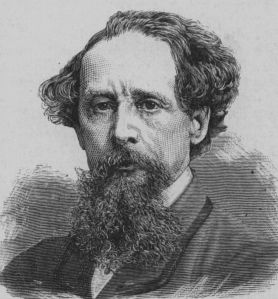
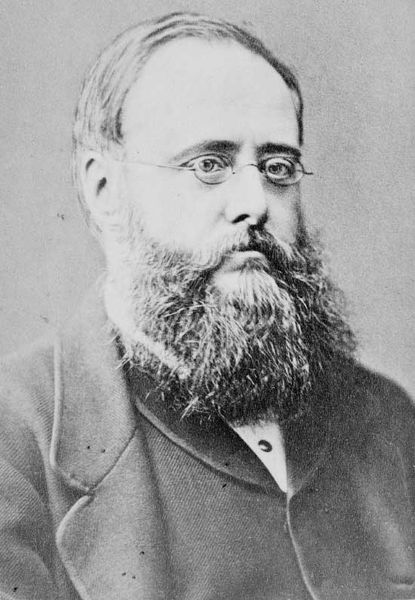
*Pictures of Charles Dickens (top) and Wilkie Collins (bottom) both in the public domain

Genre: Historical Fiction/Horror/Pages: 775/Publisher: Quercus Fiction/Year: 2009/Source: My own copy bought new

Review: Alice I Have Been by Melanie Benjamin

I had been reading so many good reviews of Alice I Have Been that when I won a copy from The Book Whisperer I couldn’t wait to read it and see if it deserved its reputation. I’m happy to say that it did.

Before I read this book, I knew Alice Liddell was the girl who inspired Alice’s Adventures in Wonderland, but that was all I knew about her. I also knew that Lewis Carroll’s real name was Charles Lutwidge Dodgson and that he was an Oxford mathematics professor, but that was all I knew about him. Alice I Have Been is the story of how Alice’s relationship with Dodgson and the book he wrote changed her life forever.

The 19th century is one of my favourite historical periods and it was interesting to read about Alice’s life as the daughter of the Dean of Christ Church, mixing with the upper classes of Victorian society. Mr Dodgson was a friend of the Liddell family, who enjoyed visiting the three little girls – Ina, Alice and Edith – and taking photographs of them. The relationship between Alice and Dodgson was slightly disturbing, but the overall impression I got of him was of a shy, lonely man who felt more comfortable with children than with adults – and didn’t want those children to grow up. When Alice was eleven, an incident occurred that caused a rift between Dodgson and the Liddells – in real life, this is a mystery that has never been solved. Melanie Benjamin gives one possible explanation but states in her author’s note that this is her own interpretation and not necessarily the truth, leaving us to wonder exactly what really did happen.

I had no idea Alice Liddell had such an eventful adult life or that she was romantically involved (though maybe not to the extent the book suggests) with Queen Victoria’s youngest son, Prince Leopold – until hints of the scandal in her past came back to haunt her.

This book is a clever mixture of fact and fiction. I always think a sign of a good historical fiction novel is when it inspires you to find out more about the people you’ve been reading about. There’s a lot of information about Charles Dodgson available online, including some of his photographs (a few of which are reproduced in the book). It was interesting to read about seven year-old Alice posing for Dodgson as a gypsy girl, then being able to look at the actual picture itself. I also wanted to find out more about John Ruskin, who is portrayed quite negatively in the book.

Now I want to go and read Alice in Wonderland again to see if I feel differently about it now that I know the story behind it.

Recommended

Genre: Historical Fiction/Pages: 345/Publisher: Random House/Year: 2010/Source: Won in giveaway

Review: Whistling in the Dark by Tamara Allen

Whistling in the Dark is a heartwarming and poignant historical romance set in New York in the aftermath of World War I. It’s the story of two men, both damaged by the war in different ways, who are drawn together first by fate, then by friendship and finally by love.

Sutton Albright, son of a rich Kansas businessman, has just been expelled from college and, too ashamed to face his parents, travels to New York to look for work. Here he meets Jack Bailey, who is desperately trying to keep his late parents’ struggling novelty shop afloat. Jack has come up with the idea of advertising on the radio (which is still a very new invention) and is looking for someone to provide the music for his broadcasts. Well, guess who just happens to be a talented classical pianist?

This is a very well written book and Tamara Allen does a fantastic job of portraying New York City in the early 20th century. I had no problem at all in forming a mental picture of Bailey’s Emporium, Ida’s restaurant, Jack’s apartment and the other locations we visit. It was interesting to read about the early days of radio broadcasting, the emerging jazz scene, prohibition and all the little period details that the story touches upon. In Jack and Sutton – very different people in terms of both background and personality – she has also created two characters that I really liked and cared about.

The book was just the right length to allow the author to take her time developing the characters and building up the different layers of the plot, without the story dragging at all. Recommended.

Genre: Gay Historical Romance/Pages: 340/Publisher: Lethe Press/Year: 2009/Source: Won from LibraryThing Member Giveaways

Review: The Far Pavilions by M. M. Kaye

The term ‘sweeping epic’ is used so often it’s become a cliché, but it’s actually an accurate description of The Far Pavilions. M. M. Kaye takes us on a journey across 19th century India and Afghanistan, during which we witness some of the major turning points in the history of those two countries.

Ashton Pelham-Martyn is born in India, the son of British professor Hilary Pelham-Martyn and his wife Isobel. When both of his parents die within a few years of each other, the four year-old Ash is brought up by Sita, the wife of his father’s Hindu groom, unaware that he is not actually Indian. Several years later, after Sita’s death, Ash learns the truth about his birth and is sent to school in England. Eventually he returns to India to serve in the British army, but finds that his loyalties are torn between his Indian friends and the members of his regiment. The Far Pavilions is the story of Ash’s struggle to find his identity.

At the heart of the story is a forbidden romance between Ash and the Hindu princess, Anjuli. However, that’s only one aspect of the book. Non-romance fans will enjoy the action and adventure, descriptions of military life or simply learning more about 19th century British-ruled India. Most of the battles and other historical events mentioned in the book did actually take place and several of the characters, such as Walter Hamilton and Louis Cavagnari, were real historical figures – you may find it interesting to do some research as you read.

Of all the historical fiction books I’ve read, this is one of the most detailed and well researched. Whilst reading this book I’ve learned a huge amount about 19th century British India, from the names of mountains and rivers, details of battles and mutinies, facts about Hindu and Islamic culture, right down to the various types of flora and fauna. We encounter a large number of Indian words and phrases (most are explained either directly in the text or in the glossary at the back of the book) which feels natural and adds to the authenticity of the story. M. M. Kaye spent a lot of time living in India which explains how she was able to write so convincingly about the country and its people. It’s also interesting that although the author was British, she uses various characters in the novel to explore conflicting opinions on whether British rule was a good or a bad thing for India.

At more than 950 pages it does sometimes feel as if the book will never end, but that’s not necessarily a bad thing because it’s one of those books that pulls you into the story so much that you don’t really want to reach the last page and leave behind the characters you’ve spent so much time with. However, the main storyline comes to a natural end at around page 700 and the book could easily have finished at this point in my opinion. The final 200 or so pages deal with the Second Anglo-Afghan War which is still interesting to read about but could have been the subject of a separate book.

The Far Pavilions is one of my all-time favourite historical fiction novels.

Highly Recommended

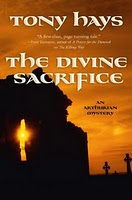
Review: The Divine Sacrifice by Tony Hays

The Divine Sacrifice is the second in a series of historical mysteries set in Arthurian Britain. Don’t miss my interview with author Tony Hays.

My review:

When an elderly monk is found murdered in his cell at the abbey of Ynys-witrin, King Arthur’s counselor Malgwyn ap Cuneglas is asked to investigate. On their arrival at the abbey, however, Malgwyn and Arthur are surprised to find that St Patrick is also about to arrive from Hibernia in order to root out heresy in the monastery. Is there a connection between the death of old Elafius and the presence of St Patrick at the abbey? As Malgwyn begins to unravel the mystery he discovers something which could threaten not only Arthur but the future of the country.

The Divine Sacrifice can be enjoyed on different levels as an Arthurian story, a historical fiction novel and a murder mystery, although it’s the combination of all three that makes the book so compelling. I have read a lot of mysteries and a lot of historical fiction but this book really stands out as something new and different.

I love the character of Malgwyn, who is one of the most unusual detectives I’ve ever encountered in a book. As one of the other characters in the novel observes, he’s an ‘uncommon man with an uncommon clarity of vision’. We also meet Arthur, Guinevere, Merlin and others who will be familiar to anyone with even a basic knowledge of Arthurian legend, athough they are not depicted in the way you might expect. It’s important to understand that this is not a retelling of the famous Arthur legends – it’s actually an original historical mystery with elements of the legends cleverly woven into the story. Arthur is shown here as a powerful leader who is working to unite the warring tribes of post-Roman Britain.
The mystery unfolds at just the right pace and there are enough twists in the story to keep the reader guessing all the way to the end. Tony Hays has obviously done a lot of research on his subject and is able to portray life in 5th century Britain in a realistic and convincing manner, meaning that I came away from the book feeling I knew a little bit more about the time period than I did before.

Although I hadn’t read the first book in the series, The Killing Way, the author provided enough background information relating to the events of the first book that I was quickly able to pick up the threads of the story and understand what was going on. However, I enjoyed The Divine Sacrifice so much I now want to go back and read The Killing Way and I’ll look forward to more books in this series in the future.

Recommended

Genre: Historical Mystery/Pages: 304/Publisher: Forge/Year: 2010/Source: Won ARC in giveaway

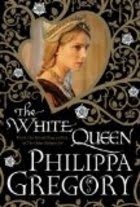
Review: The White Queen by Philippa Gregory

Philippa Gregory is best known for her Tudor court novels, but with The White Queen she moves further back in time to the Plantagenets and the Wars of the Roses.

Elizabeth Woodville is twenty seven when she meets and falls in love with King Edward IV. Following a private wedding, Elizabeth becomes Queen of England and finds herself caught up in the ongoing battles between the House of Lancaster and the House of York. Amidst all the politics, intrigue and betrayal, Elizabeth’s concern is for the future of her children – in particular her two royal sons who will become the famous ‘Princes in the Tower’, a mystery which remains unsolved to this day.

The book is written in the first person present tense which I found slightly irritating, though not enough to stop me from enjoying the book. The use of present tense does help the reader to feel as if they are experiencing events along with Elizabeth, so it works in that sense, but my personal preference is definitely for past tense. There are a few passages where the viewpoint temporarily changes to the third person in order to describe battles which Elizabeth doesn’t witness but which are an important part of the storyline. I often find battle scenes boring, but these are well written and go into just the right amount of detail.

I found the story itself quite suspenseful and exciting – it probably helped that although I read a lot of historical fiction novels, I haven’t read many about the War of the Roses, so only had a vague idea of what was going to happen. Of course, this meant that I wasn’t sure exactly which parts of the book were based on fact and which parts were the invention of the author. In her note at the end of the book, Gregory mentions that there’s not much information available about the period, therefore there are some areas where she felt free to use her imagination.

If you’re not very familiar with the historical background, you’ll need to concentrate to be able to keep track of all the battles, changes of allegiances and numerous claimants to the throne. The family tree provided at the front of the book is not very helpful – it’s incomplete and really needed to show at least one more generation, as it ends before some of the important characters in the story were even born.

I found it difficult to warm to the character of Elizabeth but could feel sympathy for her, especially towards the end of the book. Richard III was also portrayed quite sympathetically – nothing like the evil hunchback in Shakespeare’s play! I would have liked to have seen his relationship with Elizabeth more thoroughly explored in the book – there was no real explanation for why she distrusts him so much, other than that she’s had dreams and premonitions that something bad will happen to her sons in the Tower. On the subject of the Princes in the Tower, the book explores an interesting theory, which may or may not be true – it would be nice to think that it was.

Interspersed with the main story is the tale of Melusina, the water goddess, from whom Elizabeth and the female members of her family are said to have descended and from whom they claim to have inherited magical powers.
Magic and mythology are recurring themes throughout the book. Elizabeth and her mother Jacquetta’s witchcraft skills are used as an explanation for several key historical events – for example, they whistle up storms to defeat their enemies at sea. This aspect of the story became quite repetitive and just didn’t appeal to me much. Sometimes it felt as if there were references to Melusina, water, rivers, the sea etc on almost every page!

The book ends abruptly, but that’s not surprising since The White Queen is the first in a trilogy called The Cousins’ War and will be followed by The Red Queen and The White Princess which will focus on Margaret Beaufort and Elizabeth of York respectively.

I would recommend The White Queen if, like me, you don’t have much knowledge of the Wars of the Roses and are looking for an enjoyable and relatively easy to understand introduction to the period. For those of you with a lot of background knowledge, I think there should still be enough new ideas to keep you interested.

Recommended

Genre: Historical Fiction/Pages: 417/Publisher: Simon & Schuster/Year: 2009/Source: My own copy bought new
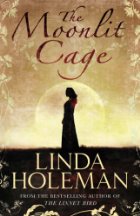
Review: The Moonlit Cage by Linda Holeman


“I have always been told I was wicked…”

This is the first book I’ve read by Linda Holeman and it was good enough to make me want to read more of her work.
I love books that help me to learn about other times and other places: in The Moonlit Cage, Holeman introduces us to life in 19th century Afghanistan. Not being an expert in Afghan history or culture, I have no idea how accurate her descriptions are, but the book seems very well-researched to me. A glossary of unfamiliar Dari and Pashto words is included at the back of the book, but I didn’t feel the need to refer to this very often as most of the words were explained as we encountered them in the text.
 
 The story is narrated by Darya, a young Afghan girl. All her life Darya has refused to conform to others’ expectations and secretly dreams of one day finding freedom. When her father’s second wife, Sulima, puts a curse on her, Darya is forced to leave her village and is sold into marriage with the son of a nomadic chief. However, when her husband learns about the curse and threatens to kill her, she runs away again. As she escapes through the Hindu Kush mountains, she meets David Ingram and begins a journey which takes her first to India and then to London.
 

I really enjoyed this book and found it difficult to put down. The first two thirds, which took place in Afghanistan and India, were fascinating, though I didn’t like the way the storyline developed after Darya’s arrival in England. The only other problem I had with the book was that while Darya was an interesting, likeable character, I found David Ingram, as the hero of the story, quite boring and two-dimensional.I admired the way Darya’s strength and courage helped her to survive all kinds of pain and abuse.

After reading the first couple of chapters I decided that this book would count towards the Women Unbound reading challenge. Throughout the entire story, Darya constantly questions why she has to behave in a certain way just because she’s a woman and challenges the belief that daughters are worthless and only sons are of value.
 
I knew nothing about this book until I found it in the library (on the “H” shelf next to Khaled Hosseini’s The Kite Runner which coincidentally is also set in Afghanistan) so I was surprised by how good it was. I would recommend it to anyone who enjoys long historical fiction novels…but you can prepare to be saddened and shocked by Darya’s story.
 
Recommended
Genre: Historical Fiction/Pages: 544/Publisher: Headline Review/Year: 2006/Source: Library book