The House of Doors by Tan Twan Eng

I loved Tan Twan Eng’s The Garden of Evening Mists but his latest novel, The House of Doors, sounded less appealing and I only decided to read it when I saw it had been longlisted (and then shortlisted) for this year’s Walter Scott Prize. Now that I’ve read it, I have mixed feelings about it; there was a lot to like and admire, but it definitely didn’t captivate me the way The Garden of Evening Mists did.

The House of Doors weaves the fictional story of Lesley and Robert Hamlyn around a real life visit in 1921 by the author William Somerset Maugham to Penang, Malaysia – or Malaya, as it was still known at the time. Lesley has spent her whole life in Malaya, while her husband Robert was born in Britain and moved to Penang as an adult. Maugham, referred to as Willie throughout the novel, is an old friend of Robert’s and has come to stay with them at their home, Cassowary House. Leaving his wife behind in England, he is accompanied by Gerald, his lover and secretary.

At first Lesley is not very happy about having visitors and it takes her a while to warm to Willie, but she eventually finds herself confiding in him and sharing with him stories about her past. She tells him about her involvement with Sun Yat Sen, the Chinese revolutionary who came to Penang to raise funds, and about her friend, Ethel Proudlock, who was charged with the murder of a man. Some of the things Willie hears and experiences during his time with the Hamlyns will later find their way into his fiction.

The book is beautifully written, which I had expected from my previous experience of Tan’s work, and the descriptions of Penang itself are particularly lovely and evocative. I can only think of one or two other novels I’ve read set in Malaysia, but it’s a setting I love and I enjoyed revisiting it through Tan’s descriptive writing. The book deals almost entirely with British characters and we learn a lot about the colonial lifestyles and attitudes of the time, but although Tan Twan Eng himself is a Malaysian author, if you’re hoping for a Malaysian perspective you won’t really find that here. Through the Sun Yat Sen storyline, we are given a little bit of insight into Chinese revolutionary politics, but again we see this from Lesley’s point of view, through her interactions with Sun Yat Sen and his associates.

The plot moves quite slowly, maybe because so much of the story is told in the form of flashbacks. At times I was bored, but one part of the book that I did find gripping was the Ethel Proudlock storyline. It’s based on a real murder case which I knew nothing about before reading this novel, so I had no idea what the outcome was going to be. Maugham used the case as the inspiration for his 1927 play The Letter, which was made into a film starring Bette Davis. There are references to other Maugham stories, novels and plays throughout the book as well, but they meant very little to me because I haven’t read any of his work apart from The Painted Veil. I think if I’d had more familiarity with Maugham’s writing it’s possible that I would have been able to get more out of this book. I had similar experiences with Colm Tóibín’s The Magician and Damon Galgut’s Arctic Summer, novels about Thomas Mann and E.M. Forster respectively (I haven’t read much of their work either and was left with the feeling that I’d missed something).

The House of Doors wasn’t a huge success with me, then, but the setting and the beautiful writing made it worth reading. The Walter Scott Prize winner is due to be announced later this week and of the shortlisted titles I’ve read so far, My Father’s House by Joseph O’Connor is still my favourite with this one second above Kevin Jared Hosein’s Hungry Ghosts. Maybe the winner will be one of the three I still haven’t read!

Book 21/50 for the Historical Fiction Reading Challenge 2024
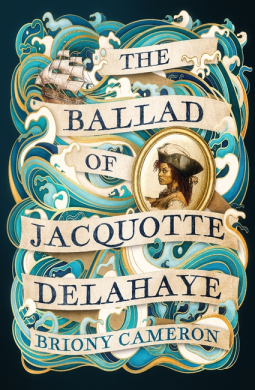
The Ballad of Jacquotte Delahaye by Briony Cameron

The Ballad of Jacquotte Delahaye is an unusual novel because it’s based on the ‘true story’ of someone who may or may not have actually existed! One of a very small number of 17th century female pirates, Jacquotte Delahaye is not mentioned in any contemporary sources and appears in writing, possibly for the first time, in the 1940s in stories by Léon Treich, a French fiction writer. However, she has become part of pirate folklore and although her existence hasn’t been proved, it hasn’t been disproved either. In this new novel, Briony Cameron has taken the few ‘facts’ about Jacquotte that have found their way into the legends – such as her place of birth and the colour of her hair (red, leading to the nickname Back from the Dead Red) – and imagined a story around them.

At the beginning of the book, twenty-year-old Jacquotte is living in the town of Yáquimo, Santo Domingo, in 1655. As the daughter of a Frenchman exiled to the Caribbean for treason, all Jacquotte knows about her mother is that she was a free black woman who died after giving birth to her younger brother. When her father is implicated in another treasonous plot, Jacquotte’s world falls apart and she is forced to flee the island. Her life of piracy begins when she is captured by the brutal Captain Blackhand and finds herself an indentured servant aboard his ship, but eventually Jacquotte will become a pirate captain in her own right, with her own ship and crew to command.

There’s also a romantic element to the novel, with Jacquotte falling in love with Teresa, wife of the Governor of Yáquimo, but this was one of my least favourite aspects of the book. They seemed to rush into things very quickly, with no time for the reader to see their feelings for each other developing and I felt that the relationship lacked emotional depth. In fact, apart from Jacquotte herself, I thought all of the characters in the book lacked depth – the good characters were very good and the bad ones were very bad, with little in between. I would describe this as much more of a plot-driven book. Although it takes a while to get started, once Jacquotte is at sea there’s lots of action, with sea battles, fight scenes and all the swashbuckling adventure you would expect from a pirate novel.

Sadly, despite the fascinating protagonist, I wasn’t very impressed with this book. I did enjoy the first section, which describes Jacquotte’s life in Yáquimo and the events that lead to her becoming a pirate, but as I read on I felt I was reading the author’s fantasy of how she would have liked 17th century society to have been, rather than how it actually was. I don’t think many people in the 1650s had such progressive ideas on race, gender and sexuality, however nice it is to imagine that they did! If you’re not too bothered about historical accuracy and just want to read an entertaining story, then you’ll probably enjoy The Ballad of Jacquotte Delahaye, but it wasn’t really for me. On a more positive note, I liked the descriptions of the various ports Jacquotte and her crew visit as they sail around Hispaniola, Jamaica and Tortuga, which is the closest I’ll get to visiting the Caribbean this summer!

Thanks to Piatkus for providing a copy of this book for review via NetGalley.

Book 20/50 for the Historical Fiction Reading Challenge 2024

This is book 2/20 of my 20 Books of Summer 2024.

Hungry Ghosts by Kevin Jared Hosein

This is a book I would probably never have chosen to read if it hadn’t been nominated for this year’s Walter Scott Prize, but although I didn’t love it, for reasons I’ll explain below, it’s a book I’m glad I’ve read. For a start, it’s set in Trinidad and I’ve only ever read one other novel set there – Fortune by Amanda Smyth, which was also shortlisted for the same prize a few years ago – and it was good to have the opportunity to learn more about the history and culture of that country.

The story takes place in the 1940s in and around Bell Village in central Trinidad. Thirteen-year-old Krishna Saroop lives with his parents in a sugarcane estate barrack, a ramshackle building with a leaking roof that is home to four other families. On a hill above the village is the Changoor farm where Dalton Changoor and his wife Marlee live in comparative luxury and where Krishna’s father, Hansraj – known as Hans – works on the land. When Dalton disappears without explanation one day, Marlee feels uneasy about being alone and asks Hans to stay on the estate overnight as a night watchman – and Hans agrees, grateful for the extra money she offers him in return. But as the days go by with no sign of Dalton coming home, Hans finds himself becoming increasingly attracted to Marlee and spending less and less time with his own wife and son.

Kevin Jared Hosein uses the disappearance of Dalton Changoor to explore the stories of Hans and Marlee and also Krishna and his mother Shweta, left behind in their squalid home while Hans spends his nights on the farm. Shweta is dreaming of a better life and at first is happy for Hans to take Marlee’s money in the hope that they can use it to buy a house of their own, but she changes her mind as she discovers that her husband is slipping away from her. However, Marlee is only one part of the problem; the relationship between Shweta and Hans has already been strained by the death of their first child, the ‘hungry ghost’ of the title.

If you think this sounds like a bleak novel, that’s because it is. I found it relentlessly miserable. Everyone has had an unhappy childhood, an unhappy marriage or both. We see people being abused, assaulted, blackmailed, murdered…even the animals don’t escape unscathed; there are some very graphic descriptions of the death of Dalton Changoor’s abandoned dogs, so be warned. I don’t usually have a problem reading books that tackle uncomfortable or challenging subjects, but I do like there to be at least a glimmer of hope and optimism and this particular book didn’t seem to have any. I don’t think there was a single character in the book that I actually liked.

Although I struggled to cope with the misery and sadness, obviously other people have enjoyed this book much more than I did and I would agree that it’s beautifully written. Kevin Jared Hosein was born in Trinidad and brings his island to life through his descriptions of the landscape, the birds and animals, the food, clothing and housing. He also captures the language and the speech patterns of the Trinidadian people and through the story of the Saroop family, who are of Indian descent, he explores the differences between the Hindu and Christian communities on the island. I can understand why it was shortlisted for the Walter Scott Prize and the fact that I didn’t like it probably means it’s going to win!

Book 18/50 for the Historical Fiction Reading Challenge 2024
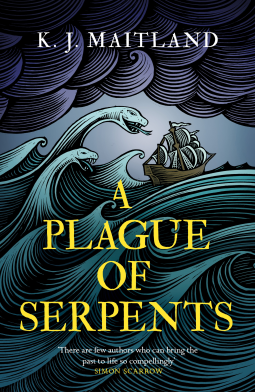
A Plague of Serpents by KJ Maitland

This is the fourth and final book in the Daniel Pursglove series by KJ Maitland (who has also published under the name Karen Maitland). Although I’ve done my best to avoid spoilers in this review, I wouldn’t recommend starting with this book anyway; the plots are complex and there are lots of characters to keep track of, so this is a series that should really be read in order, beginning with The Drowned City and moving on to Traitor in the Ice and Rivers of Treason.

This fourth novel, A Plague of Serpents, is set in the spring of 1608. It’s been three years since the Gunpowder Plot of 1605, a failed attempt on the life of King James I of England and VI of Scotland by Catholic conspirators. One of the escaped conspirators, a man known only as Spero Pettingar, remains unidentified and uncaptured, but Daniel Pursglove is still on his trail. The King’s man, Charles FitzAlan, who released Pursglove from Newgate Prison on the condition that he would hunt down Spero Pettingar in return, is growing impatient; the longer Pettingar remains on the loose, the longer the King’s life remains at risk.

In search of answers, Daniel infiltrates a secret group of Catholics known as the Serpents who are plotting another assassination attempt. However, he has also become aware of a second group, the Wyverns, who are planning to use the Serpents as pawns and then seize control of the throne for themselves. To make things even more dangerous for Daniel, there are people within both factions who know too much about him and are prepared to threaten and blackmail him to get what they want.

Unlike the previous three novels, which took us to Bristol, Sussex and Yorkshire respectively, this one is set in London and while floods, frosts and thaws played a big part in those three books, the natural environment is less significant in this one. Instead of extreme weather conditions, this time the public have an outbreak of plague to deal with. I’ve always found the plague an interesting topic to read about, even more so since our own recent pandemic, but it doesn’t actually form a very big part of the book despite the title and prologue which made me think otherwise! Other than that, Maitland does her usual excellent job of creating an immersive and believable 17th century world. Rather than breaking the flow of the story to explain the meanings of terms and phrases, she saves these for a glossary at the end of the book, so if you want to know what a bene-feaker is, what a palterer does or what a cracknel tastes like, you’ll have your chance to find out.

The characters in the novel are a mixture of real and fictional; some, like Robert Cecil, are well known historical figures, but others are more obscure – I was surprised to find that the brothel-keeper Donna Britannica Hollandia really existed! With this being the last in the series, the storylines for the characters who have been with us for several books are wrapped up in one way or another and I was pleased to see that my theory about one particular character was proved correct.

Although I did enjoy A Plague of Serpents, I felt that it, like the earlier books, was far more complicated than it really needed to be. With several different groups of conspirators and others at court working with or against each other for their own purposes, it was difficult at times to remember who was on which side and who knew what. Otherwise, this was a perfect ending to the series and I will be interested to see whether Maitland continues to write historical mysteries/thrillers like these or goes back to the kind of standalone historical novels she wrote earlier in her career.

Thanks to Headline Review for providing a copy of this book for review via NetGalley.

Book 17/50 for the Historical Fiction Reading Challenge 2024

The Household by Stacey Halls

Urania Cottage in Shepherd’s Bush, London, was a home for ‘fallen women’ founded in 1846 by Charles Dickens and Angela Burdett-Coutts. Their vision was to provide a safe place for young women to rehabilitate after serving prison sentences or working on the streets as prostitutes. At Urania Cottage they would receive an education and the opportunity to train as domestic servants, enabling them to start new, more respectable lives overseas. In her latest novel, The Household, Stacey Halls imagines the stories of some of these women.

During the period covered in the novel, there are many young women staying at Urania Cottage, but Halls chooses to focus on two of them. One is Martha who, while trying to rebuild her own life at the cottage, is also worrying about her sister, Emily, who has disappeared. As Martha grows more desperate about Emily, she is driven to make a decision she may later regret. The other is Josephine, who had expected a close friend to accompany her to Urania Cottage. When the friend never arrives, Josephine must decide whether to continue participating in the scheme or leave in search of happiness elsewhere.

Dickens himself is mentioned now and then but always stays in the background, never becoming an actual character in the novel. Angela Burdett-Coutts, on the other hand, has a much larger role. We meet Angela as a woman in her early thirties who several years earlier inherited a fortune from her banker grandfather, making her one of England’s wealthiest people. She is becoming known as a philanthropist and Urania Cottage is one of her first big projects.

Angela’s privileged lifestyle means she struggles to truly understand the needs of the women at the cottage, but she and Dickens both enter into the project with the best intentions. However, despite Angela’s wealth and position she still has problems of her own to deal with – such as being stalked by Richard Dunn. She had thought she was safe from Dunn when he was sent to prison for four years, but now he’s been released early and is on her trail again. As I read, I wondered whether this was a fictitious storyline, but I looked it up and found that, yes, Richard Dunn was a real person and did obsessively pursue Angela Burdett-Coutts as described in the book. It seems that other parts of the novel I had assumed were invented were also based on historical fact; after finishing the book I was interested to learn that many of the incidents described as happening at Urania Cottage were taken from Dickens’ letters to Angela and even inspired his own David Copperfield.

The Household is fascinating in many ways, yet it’s probably my least favourite of Stacey Halls’ books. The separate stories of Angela, Josephine and Martha never quite blend together properly and give the novel a disjointed feel. I found the first half very slow and although there’s a twist towards the end that I hadn’t seen coming, it happens too late to really change the way I felt about the book overall. Still, I’m pleased to have had the opportunity to learn about life at Urania Cottage and will look forward to whatever Stacey Halls writes next.

Thanks to Manilla Press for providing a copy of this book for review via NetGalley.

Book 16/50 for the Historical Fiction Reading Challenge 2024
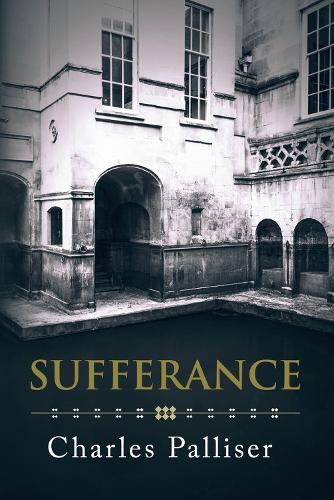
Sufferance by Charles Palliser

Charles Palliser is probably best known as the author of The Quincunx, a long and twisty Dickensian novel which I read and loved years ago, but he has also written five more books including The Unburied and this new one, Sufferance.

Sufferance is a strange novel as none of the characters are named – not even the narrator – and we are not told where or when the story is set. However, it’s obvious enough that we are reading about an occupied European city during the Second World War and at the start of the novel, the Enemy has divided the city into Western and Eastern Zones. We also know that our narrator is a respectable, law-abiding man who works for the government and has a wife and two teenage daughters.

When the narrator’s youngest daughter brings a friend home from school and explains that the girl’s parents have become trapped in the other zone, unable to return to their house, he thinks he is doing the right thing by inviting her to stay with them until her parents come back. He doesn’t expect it to be for long – and it seems that the girl’s parents are wealthy people, who might repay the family for their kindness when they return. Unfortunately, a series of government announcements makes it clear that the girl belongs to a ‘protected community’, who are gradually having their rights taken away and are being closely monitored by the Enemy occupiers.

As the weeks and months go by with no news of the girl’s parents, our narrator and his wife become increasingly anxious and afraid. What will happen if the authorities discover that they are sheltering one of the protected community? To make things worse, the girl has proved to be a selfish, manipulative person who seems ungrateful for the help she has been given and completely unaware of the danger all of them are facing. Tensions within the family start to build as they struggle to agree on how to deal with the situation, but things are only going to get worse the longer they wait.

This is an excellent novel; the vagueness surrounding names, dates and places, which I could have found irritating in another book, is used very effectively here to create a sinister, unsettling atmosphere. Although the historical parallels are very obvious, we are left with the impression that the things described could happen anywhere, at any time and to anybody. The sense of fear and desperation felt by the narrator comes across very strongly, as with the introduction of identity cards, rationing and new laws regarding the girl’s community, he becomes aware that he is committing a crime.

Sufferance is a fascinating exploration of how each decision we make can have serious consequences and how quickly things can spiral out of control. I loved it and really must find time to re-read The Quincunx!

Thanks to Guernica Editions for providing a copy of this book for review via NetGalley.

The Fraud by Zadie Smith

When I saw this year’s longlist for the Walter Scott Prize, one of the books I was most interested in reading was The Fraud. I haven’t read any of Zadie Smith’s other books, but the subject and setting of this one sounded appealing to me.

At the heart of the novel is a real-life court case in which a man many believe to be Arthur Orton, a butcher’s son from London, claims to be Roger Tichborne, the missing heir to a baronetcy thought to have died in a shipwreck in 1854. The ‘Claimant’, as he becomes known, is immediately identified as Roger by his mother, but the rest of the Tichborne family insist that he’s an imposter. The dispute goes on for several years and captures the imagination of the public, with people travelling for miles to come and watch the case play out in court. Two of the people following the proceedings with interest are Sarah Ainsworth and Eliza Touchet, who are central characters in Smith’s novel.

Eliza Touchet is a cousin by marriage of the novelist William Harrison Ainsworth and has lived with him as his housekeeper – and occasional lover – since the 1830s, while also growing close to his first wife, Frances. By the time of the Tichborne trial several decades later, William has been widowed and married again, this time to Sarah, his former maid. Sarah is obsessed with the Tichbornes and convinced that the Claimant is telling the truth and it is she who persuades Eliza to accompany her to court. Here Eliza finds herself drawn not to the supposed Sir Roger, but to one of the key witnesses – Andrew Bogle, an elderly black man who was Roger’s uncle’s servant and is one of the few people to speak up in support of the Claimant.

The novel moves backwards and forwards in time between the 1830s and 1870s, with the story unfolding through a series of very short chapters, sometimes only a page or two long. I wasn’t really a fan of this structure, as it made it difficult to become fully immersed and keep track of what was happening. And there’s a lot happening! As well as the coverage of the Tichborne trial, there’s a long digression into the early life of Andrew Bogle as a slave on a plantation in Jamaica, discussions of the Victorian literary scene and domestic details of life in the Ainsworth household. There were too many separate storylines for one book and some of them didn’t really seem to lead anywhere or integrate with the others. Having said that, I still found things to enjoy and my overall feelings about the book are probably slightly more positive than negative!

Most of the people who appear in The Fraud really existed, although not necessarily as Zadie Smith describes them. Eliza Touchet, for example, was a real person but died much earlier than she does in the novel and wouldn’t have been around by the time of the Tichborne case, so while there’s a lot to learn from this book it’s worth remembering that it’s not all factually correct. I did find it interesting to read about the life and work of William Harrison Ainsworth, whose books were hugely popular at the time – particularly Jack Sheppard, one of the ‘Newgate novels’ Claire Harman discusses in her true crime book, Murder by the Book – but have largely been forgotten today. Smith explores Ainsworth’s rivalry with Charles Dickens, as well as allegations that he stole some of the ideas for his novels from his illustrator, George Cruikshank. Is it just the Tichborne Claimant who is the ‘fraud’ of the title or could it also be Ainsworth himself?

Although there were parts of The Fraud that I enjoyed, I think there was really enough material here for two or three books and I ended up feeling overwhelmed. Maybe a different Zadie Smith book would have been a better starting point for me after all.

Book 15/50 for the Historical Fiction Reading Challenge 2024