House of Names by Colm Tóibín

After talking recently about my desire to read more fiction set in Ancient Greece, I was pleased to have the opportunity to read Colm Tóibín’s new novel House of Names. It retells the tragic story of the House of Atreus, described in Aeschylus’ famous trilogy, the Oresteia. Not being very familiar with this story, I had no problem following the plot of the novel, but couldn’t help wondering how different my experience would have been if I was already more well-versed in the Greek classics.

House of Names begins in dramatic style with Agamemnon sacrificing his eldest daughter, Iphigenia. In return the gods will bring about a change in the wind which will allow his army to sail to Troy. Iphigenia’s mother, Clytemnestra, is forced to witness the terrible scene – made even worse by the fact that she had believed she was coming to watch her daughter’s wedding, not her murder. The first section of the novel is narrated by Clytemnestra and I thought it was wonderful, vividly describing the moment of the sacrifice and perfectly capturing the agony and heartbreak of a mother at the loss of her child and the bitter fury of a wife at the treachery of her husband. Angry and grieving, Clytemnestra returns to Mycenae to await her husband’s return from Troy and her chance to take revenge:

Her screams as they murdered her were replaced by silence and by scheming when Agamemnon, her father, returned and I fooled him into thinking that I would not retaliate. I waited and I watched for signs, and smiled and opened my arms to him, and I had a table here prepared with food. Food for the fool! I was wearing the special scent that excited him. Scent for the fool!

But what effect will Clytemnestra’s next actions have on her two remaining children, Orestes and Electra? We don’t have to wait long to find out as sections written from the perspective of each of those characters follow. Orestes’ is told in the third person and describes his kidnapping from the palace of Mycenae and his later escape with the help of two other boys, Leander and Mitros. Together, far from home and away from their families, Orestes and his friends must find a way to survive into adulthood. His sister Electra, meanwhile, pushed aside after Iphigenia’s death, watches Clytemnestra and her lover Aegisthus and begins to plot a revenge of her own…

This has been a difficult review for me to write as I still can’t quite decide what I thought of House of Names! I loved the powerful opening section of this novel but, two weeks after finishing the book, that’s the only part that has really stayed with me. The Orestes and Electra sections, although I found them interesting at the time, felt strangely detached and emotionless. The writing style helped to create an eerie, otherworldly feel at times, but it came at the expense of the passion and intensity I would have preferred from a story like this.

I do think that my lack of knowledge of the Oresteia and the fate of the House of Atreus could have been an advantage rather than a disadvantage as far as this book is concerned. I’ve read several other reviews that mention being confused by Tóibín’s decision to change so many details of the story, such as the use of the character of Leander to fill the role of Pylades, but not being familiar with the original I didn’t even notice things like this. Maybe I should have an attempt at reading the Oresteia itself one day. Does anyone know of a good translation to read?

As for Colm Tóibín, I’m looking forward to reading more of his work. Brooklyn is the only other one of his novels that I’ve read and the two couldn’t be more different. Which of his books do you think I should try next?

Thanks to Penguin for providing a copy of this book via NetGalley for review.
The Vatican Princess by CW Gortner

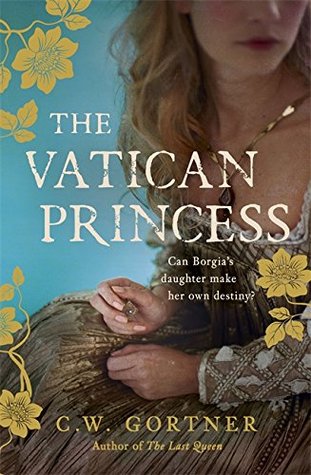
Since putting together my recent post on historical fiction covers, I seem to be feeling more critical than usual of the covers of the books I read.  I really don’t like this one as not only is it (almost) one of the faceless women covers I highlighted, but there’s nothing about it to suggest the darkness and intrigue usually associated with the Borgias.  Fortunately, though, I did enjoy the book – with a few reservations.  

Set in Renaissance Italy, The Vatican Princess is narrated by Lucrezia Borgia – seductive, manipulative and a well-known poisoner.  Or was she?  Actually, in this version of the Borgia story, she is none of those things.  CW Gortner is very sympathetic to Lucrezia’s situation, portraying her as a vulnerable young woman used by various members of her family to their own advantage and to further their own ambitions.  The novel opens in 1492, with Lucrezia’s father, Rodrigo Borgia, bribing his way to the papal throne as Pope Alexander VI (the second book I’ve read this month featuring a papal conclave).  Lucrezia is only twelve years old but that’s old enough to be useful to her father in securing political alliances and, with this in mind, Rodrigo marries her off to Giovanni Sforza, Lord of Pesaro.   

Lucrezia’s marriage to Giovanni is not a happy one and although it will eventually be annulled and she will marry again – twice – this period of her life forms the largest portion of The Vatican Princess.  It’s a very eventful period and one with plenty of mysteries and controversies, providing endless possibilities for an author to explore.  Why did Lucrezia enter confinement in the Convent of San Sisto while the annulment of her marriage was negotiated?  Did she have a secret son?  Who murdered her brother, Juan?  And was Lucrezia really involved in an incestuous relationship with her other brother, Cesare?  Gortner offers answers, or at least theories, to all of these questions, while showing Lucrezia in a generally very positive light and suggesting that she had much less control over her own fate than is often thought.    

As our narrator, Lucrezia is engaging and easy to like, but I couldn’t help feeling that she was a little bit too innocent and too good to be true – and this made her less interesting to read about than she should have been.  I thought the ambitious Rodrigo was portrayed well, but Cesare needed more complexity and Juan was purely evil with no nuances to his character at all.  However, I was intrigued by the other main female characters in the book: Lucrezia’s mother, Vannozza; the Pope’s mistress, Giulia Farnese; and Lucrezia’s sister-in-law, Sancia of Aragon.  I would be interested in reading more about all of these women, as they have not featured very heavily in the few other fictional accounts of the Borgias that I’ve read so far.       

This is the second novel I’ve read by CW Gortner and although I did enjoy it (and always love a Renaissance Italy setting), I preferred the other one, The Last Queen, which was about Juana of Castile.  I would like to read more of his books, but I don’t really feel drawn to his Tudor mystery series – published as Christopher Gortner – or his recent novels on Marlene Dietrich and Coco Chanel, so that would leave either The Queen’s Vow (about Isabella of Castile) or The Confessions of Catherine de’ Medici.  Have you read either of those?  Which should I read first?     

As for the Borgias, maybe I’ll have another attempt at reading Blood and Beauty by Sarah Dunant soon.  I struggled to get into it the first time but am happy to try again!

The Empress of Hearts by E. Barrington

The Empress of Hearts was originally published in 1928 and was one of several historical novels written by E. Barrington (a pseudonym of Elizabeth Louisa Moresby, who also wrote under the name Lily Adams Beck).  It is described on the cover as “a romance of Marie Antoinette”, but I think that description is slightly misleading.  Marie Antoinette does appear in the novel as a major character, but the focus is really on the scandal known as The Affair of the Diamond Necklace which was thought to be a factor leading to the French Revolution.    
  
The story centres around a diamond necklace created by the Parisian jewellers Boehmer and Bassenge, commissioned by Louis XV of France in 1772 as a gift for his mistress, Madame du Barry.  However, by the time the necklace is ready to be sold to the King, Louis has died and du Barry has been sent away from court.  Boehmer and Bassenge hope the new Queen, Marie Antoinette, will wear it instead, but when her husband, Louis XVI, offers to buy it for her, she refuses, unwilling to appear extravagant and frivolous when the money could be better spent on other things.  Enter Jeanne de la Motte, an ambitious young woman who sees an opportunity to make herself rich and acquire the necklace for herself in the Queen’s name.  The ensuing scandal will damage Marie Antoinette’s reputation and discredit the French monarchy in the eyes of the public:        

Marie Antoinette rose from her chair and moved toward the inner room, holding herself together with an effort so tense that for the moment grace was dead and she moved with stiff, short steps like an old woman. At the door she turned: “Did I not tell you that there would be no need for poison? They will kill me with calumny.”

As you would expect with a book from the 1920s, the writing style is rather different from most modern historical fiction novels; it is more formal and more detailed but, unfortunately, it is also quite dry.  Although I had heard of the Diamond Necklace Affair before, I hadn’t read about it in any depth, so I found The Empress of Hearts an interesting read from that perspective, but as a work of fiction it is less effective – like the other novel I’ve read by Barrington, Glorious Apollo, it would probably have worked better as non-fiction.  We are given large amounts of factual information and as a result the plot moves very slowly and lacks the drama, excitement and tension that should have been present given the subject of the story. 

The characters are not the most vibrant and life-like either, although they had the potential to be fascinating, particularly Jeanne, as the villain of the novel, and Cardinal de Rohan, another prominent figure implicated in the plot.  I was intrigued by the role the Italian occultist Alessandro Cagliostro plays in the story – in reality, it seems that although he was arrested and questioned, it’s uncertain how much involvement he actually had in the Affair – but again, I think there were missed opportunities here.

I’m aware that Alexandre Dumas also wrote a novel about the Affair of the Diamond Necklace – The Queen’s Necklace.  As a fan of Dumas, I’m looking forward to reading it and seeing how he approaches the same subject.

The Tea Planter’s Wife by Dinah Jefferies

I’ve been falling behind with Dinah Jefferies’ novels; after reading her first, The Separation, back in 2014, she has since had another three books published, none of which I had read until picking up The Tea Planter’s Wife a few weeks ago.  I regret not reading it sooner, because I loved it and am now desperate to read her other two, The Silk Merchant’s Daughter and Before the Rains.    

The Tea Planter’s Wife is set in Ceylon (the former name for Sri Lanka) in the 1920s and 30s, and begins with the arrival of newly married Gwendolyn Hooper who has come from England to join her husband, Laurence, on his tea plantation. Gwen is only nineteen years old and barely really knows her husband, a widower much older than herself.  Settling into married life proves to be more difficult than she’d expected, particularly as she also has to get used to a whole new culture and climate.  It doesn’t help that Laurence’s sister Verity comes to live with them and makes it obvious that she resents Gwen marrying her brother.  To make matters worse, Gwen is convinced that Laurence is trying to hide the truth surrounding the death of his first wife, Caroline.   

Feeling lonely and neglected, Gwen is grateful for the friendship of Savi Ravasinghe, a Sinhalese portrait painter, and is mystified as to why Laurence seems to disapprove of him so much.  Then something happens which makes Gwen think that Laurence was right to distrust Savi – and which throws her already troubled life into even more turmoil. 

With its evocative setting and aura of mystery and secrecy, this is a wonderfully atmospheric novel with an almost gothic feel at times.  Throughout the first half of the novel, in particular, I was constantly reminded of one of my favourite books, Daphne du Maurier’s Rebecca: the naive, inexperienced young woman; the mysterious older husband who becomes increasingly distant as soon as the wedding is over; the first wife who, even in death, still casts a shadow over the household.  The similarities lessened as the story continued, though, and more themes and elements were introduced.

Ceylon, as it was known then, is a country I know very little about, so I found it interesting to read of the racial and political tensions between the various groups of people who live on the island – the Sinhalese, the Tamils and the British planters.  With Gwen being a newcomer and unfamiliar with the way of life, we see things through her eyes and share her experiences as she tries to adapt to her new home.  Gwen finds the living standards of the plantation workers particularly difficult to accept and her well-meaning attempts to improve things for them often get her into trouble.  And yet this doesn’t feel to me like an author simply projecting her own modern views onto a character from a bygone time, as often happens in historical fiction, but more a way of showing that Gwen was a decent person who wanted to help in any small way she could, with a natural sympathy for children, the sick and the vulnerable, whatever their colour or status in society.

The setting plays an important part in the story, but so do the people, the decisions they make and the ways in which they communicate – or fail to communicate – with each other.  This is the sort of book where you find yourself becoming frustrated with the characters because they just won’t tell each other the truth…but at the same time you understand why they feel they can’t! 

Having enjoyed The Tea Planter’s Wife so much I’m pleased that I still have two more books by Dinah Jefferies to read.  I just need to decide which one to read next!

The Valentine House by Emma Henderson

The Valentine House surprised me. Having read Emma Henderson’s first novel, Grace Williams Says It Loud, in 2011, I had expected this new one, her second, to be something similar. Instead, what I found was something completely different. Grace Williams was a moving, thought-provoking story of a young girl in a 1950s mental institution; The Valentine House is probably best described as a family saga set in the French Alps.

The house referred to in the title is Arete, a large chalet in the mountains overlooking the village of Hext. It was built by a British mountaineer, Sir Anthony Valentine, in the 19th century and is used as a summer home by successive generations of his family. Our story begins in 1914 when Mathilde, a teenage girl from a farm in the valley, goes to work for the Valentines. Mathilde is an ‘Ugly’, the term given to the unattractive young women who make up Arete’s workforce, specially chosen by Sir Anthony’s wife, Lady C, as being less likely to catch her husband’s eye. Spending her summers at the house, Mathilde gets to know the Valentine family, particularly Daisy, a girl the same age as herself who becomes gradually wilder and more unstable as the years go by.

Decades later, in the summer of 1976, Sir Anthony’s great-great-grandson George is visiting Arete with several of his cousins. Even though Sir Anthony is long gone, his legacy lives on in the Alpine Club which he created to entertain the younger members of the family, and George and his cousins continue to carry out Club activities such as the outdoor physical challenges known as ‘Paideia’. Mathilde is still there too, an elderly woman now, but as much a part of Arete life as she has ever been.

The Valentine House is a dual time period novel: a chapter set in 1976 and written from George’s perspective is followed by one narrated by Mathilde and set earlier in the century. Eventually the two begin to converge and secrets which have been kept hidden from the reader (and from some of the characters) start to be revealed. What is the truth behind the disappearance of Margaret, Sir Anthony’s daughter, whose visits to Arete came to an abrupt stop many years ago? Mathilde is sure that if she could only find out what happened to Margaret everything else that has puzzled her about the Valentines would begin to make sense. Although some of the plot twists and revelations could probably be predicted, I didn’t even try to guess – I just relaxed and let the story take me in whichever direction it wanted to go, which meant I was kept in suspense until the various Valentine mysteries started to unfold.

I did struggle at times to keep track of all the characters and how they were related to each other. This is probably not surprising, as there are five generations of the family featured in the novel; drawing a simple family tree helped to solve the problem, although I wish I’d had the sense to do it at the beginning of the book instead of when I was already halfway through!

I think what I loved most about The Valentine House was the setting; I haven’t been to the area of France described in the book – the Haute-Savoie – but I would like to as Emma Henderson makes it sound beautiful. And this is a good place for me to mention that Sir Anthony himself has a unique way of describing the Alpine mountains and valleys, which you’ll discover in the opening paragraph of the novel. If you find that the language he uses makes you blush, don’t worry – this does not reflect the style of writing throughout the rest of the book!

Although I found both threads of the story very enjoyable, it usually seems to be inevitable with dual timeline novels that readers will have a preference for one storyline over the other and in my case it was the one narrated by Mathilde. And it was Mathilde whose story lingered on in my mind for days after finishing the book.

Now I’m wondering what Emma Henderson’s third book will be about. I hope there’s going to be one!

The Shadow Queen by Anne O’Brien

Anne O’Brien’s new novel, The Shadow Queen, tells the story of Joan of Kent, wife of the Black Prince and mother of the future King Richard II of England. Although Joan wasn’t actually a queen, she was never far from the throne – as cousin to Edward III, she had Plantagenet blood, and through her husband, Edward’s eldest son Edward of Woodstock (the name ‘the Black Prince’ was given to him later), she was both Princess of Wales and Princess of Aquitaine. When Richard acceded to the throne at the age of only ten, in her position as the king’s mother she was able to have some influence on the early years of his reign. In some ways, then, she could be considered to be a sort of ‘shadow queen’, as the title suggests.

Despite all of this, however, Joan is probably best known for her beauty – she would later become known to history as the Fair Maid of Kent – and for the scandals caused by her three marriages. The novel opens in 1340, with twelve-year-old Joan learning that a marriage has been arranged for her with Will Montagu, heir to the Earl of Salisbury. Joan doesn’t dislike Will and under different circumstances this would have been a good match. Unfortunately, though, Joan is not free to marry anyone – she has already undergone a secret marriage with Thomas Holland, a minor knight who departed shortly after the wedding to fight for the king. Forced to admit the truth, Joan is horrified when her mother insists that her marriage to Will must go ahead anyway. She faces a long and difficult battle if she is ever to prove the validity of her first marriage and to win the right to live with the man she considers her true husband.

Around half of the novel is devoted to Joan’s relationships with Thomas and Will and the challenges involved in disentangling Joan’s first two marriages and deciding who should be her rightful husband. This seemed to go on for a very long time, but I appreciated that it was necessary to give the reader an understanding of the gossip and rumour that surrounded Joan in the early part of her life and how important it was that, when she eventually married the King’s heir, Edward of Woodstock (Ned, as he is called in the novel), her reputation should be clear of any taint.

The other half of the novel follows the years of Joan’s marriage to Ned, their time as Prince and Princess of Aquitaine and, when back in England, Joan’s efforts to ensure that their son Richard will be named successor to the throne. I don’t think it’s a spoiler – as it’s a well-known historical fact – to say that Ned’s life is cut short by illness and as he is outlived by his father, he never has the opportunity to become king himself. I couldn’t help thinking how different things might have been if he had lived and Edward III had been succeeded by a grown man rather than a ten-year-old boy; what we know of the Black Prince suggests that although he was a good soldier he wouldn’t necessarily have made a good king, but still the whole course of history could have been changed. I liked the way Anne O’Brien portrayed him and I enjoyed reading about his relationship with Joan. There was a lot of love between them, but it wasn’t love at first sight – more a love that developed slowly between two people who had known each other from childhood – and, at least on Joan’s part, there was also a certain amount of ambition involved.

Joan herself is portrayed as a strong, proud and courageous person who does her best to take control of her own life, though always within the confines of what it is possible for a medieval woman to do. I’m not sure that I particularly liked her, as she does sometimes come across as a little bit self-absorbed and lacking in judgement, but I did find her a convincing and well-drawn character. I was intrigued by her prickly, hostile interactions with Edward III’s much maligned mistress, Alice Perrers – I know Alice was the subject of one of Anne O’Brien’s earlier novels, The King’s Concubine, which I haven’t read yet, and now I’m curious to see how she approaches Alice’s character in that book.

The Shadow Queen is an interesting, enjoyable novel, if a bit too long and drawn-out in places. I couldn’t help comparing it to the only other novel I’ve read on Joan of Kent – A Triple Knot by Emma Campion – and I think this is definitely the better of the two books.

The Gustav Sonata by Rose Tremain

“So you see,” she said, “you have to be like Switzerland. Do you understand me? You have to hold yourself together and be courageous, stay separate and strong. Then, you will have the right kind of life.”

Switzerland is well known for its neutrality during the Second World War but, as we see in Rose Tremain’s The Gustav Sonata, even remaining neutral didn’t mean that Switzerland and its people completely escaped the effects of war. The Gustav Sonata explores some of these effects, as well as looking, on a more personal level, at other meanings of neutrality and of courage, separateness and strength.

The novel is divided into three parts, presumably to resemble the movements of a sonata. The first is set just after the war, in 1947, and introduces us to Gustav Perle, a five-year-old boy who lives in the fictional Swiss town of Matzlingen with his mother, Emilie. Gustav’s best friend at kindergarten is Anton Zwiebel, but when he brings Anton home one day, he is confused by Emilie’s reaction. It’s obvious that she disapproves of Anton, but why? Is it because he is Jewish – and if so, what is her problem with Jews? These questions won’t be answered until later in the book, but in the meantime we continue to follow Gustav and Anton throughout their childhoods and into their teens.

As Gustav spends more and more time with the Zwiebel family, he becomes aware of how different Anton’s life is from his own; he senses that Anton’s parents really seem to care about their son’s future, unlike his own mother who can be so cold and distant. Anton, however, is having trouble of his own – as a talented musician he dreams of a career as a concert pianist, but his ambitions look set to be threatened by his debilitating stage fright.

In the second section of the book, we go back in time to the 1930s and the early days of Emilie’s relationship with Gustav’s father, Erich Perle. At last we can begin to understand Emilie’s behaviour and the reasons for her animosity towards Anton’s family. Finally, for the third part of the novel, we return to the stories of Gustav and Anton, who are now middle-aged men, and we find out what has been happening to them in the intervening years. I don’t always like books which jump around in time like this, as they can sometimes seem disjointed, but Rose Tremain handles the structure very well. My only slight criticism is that I thought the Gustav and Anton we meet in part three feel too similar to the Gustav and Anton from part one – I found both characters convincing as children but not so convincing as adults.

I particularly enjoyed the wartime section in the middle of the book, dealing with the relationship between Emilie and Erich and showing how a decision made by the Swiss government changed both of their lives. As I’ve said, the neutral stance taken by Switzerland during the war is only one type of neutrality examined in this novel – there’s also the neutrality of one person towards another (‘staying separate and strong’) and the question of how far it is possible to remain neutral when faced with a moral dilemma which requires a choice to be made. I’m sure we can all think of times in our own lives when doing nothing was as bad or worse than doing something!

This is the third Rose Tremain novel I’ve read, the others being Restoration and its sequel Merivel. I found the writing style and overall tone of this one very different from the other two, which reflects the very different subject and setting. The Gustav Sonata is one of the shortlisted titles for this year’s Walter Scott Prize for Historical Fiction. Of the books I’ve read from the list so far, this isn’t my favourite, but I did enjoy it and won’t be at all disappointed if it wins.