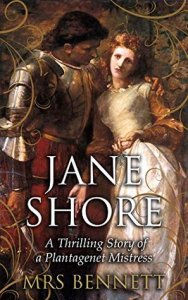
Jane Shore: The Merry Mistress

jane-shore Elizabeth Shore, known as Jane, was a mistress of King Edward IV of England and said to be “merry in company, ready and quick of answer”. She often appears in fiction set during the Wars of the Roses as a minor character – depending on the book, either as a bad influence or a comfort to Edward in his declining health, and a possible conspirator against his brother, Richard III – but several novels have also been written specifically about Jane. I have read two recently and am combining my reviews into one post.

The first of the two books is an old one, written in the 19th century by Mary Bennett, a truly ‘forgotten’ author if ever there was one. She’s so forgotten that I’ve struggled to find any biographical information at all about her (the Database of Victorian Fiction has a paragraph) and can’t even find a definite publication date for Jane Shore – I think it could have been 1869. It seems that Bennett had quite a few novels published, though, so she must have had some level of success at the time.

As Jane was a relatively unimportant historical figure, there is still a lot that we don’t know about her today; obviously even less would have been known in Bennett’s day and fewer sources would have been available to her in researching her book.  Bennett refers to Jane as the daughter of Mr Winstead and the wife of Matthew Shore, ‘the goldsmith’,  while most modern novels give Jane’s father’s name as John Lambert and her husband’s as William Shore, not a goldsmith but a mercer.  It’s difficult for me to comment on the historical accuracy of Jane Shore, then, as it depends on which sources the author had to work from – and it could be that what was considered accurate then is not considered accurate now.

Bennett’s Jane is portrayed, in typical Victorian style, as an innocent, virtuous young woman at the mercy of the king, his friend Will Hastings, and several other men who want to steal her away from her father and husband. She is the sort of person who has things happen to her rather than making them happen herself, which means she is not the most interesting of characters to read about. In fact, I didn’t feel that any of the characters in this novel ever came to life on the page or seemed like real people at all.

The book is entertaining in parts – mainly when the action switches to Wales and the story of two fictional characters, Nesta Llewellyn and the musician Leolin – but very tedious in others and certainly wouldn’t be the best introduction to Jane Shore’s life.  Having read it, I understand now why Bennett is a forgotten author!
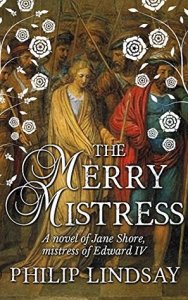
the-merry-mistressAfter reading the Mary Bennett book, I remembered that I had also received The Merry Mistress by Philip Lindsay from NetGalley a while ago, along with another book of his, The Devil and King John. I had mixed feelings about the King John book so was a bit apprehensive about reading this one. I’m determined to get my NetGalley shelf up to date, though, so I decided to give The Merry Mistress a try anyway.

The first thing to say is that this book couldn’t be more different from the Bennett one! Lindsay’s Jane is a much more forceful personality who decides what she wants out of life and then goes and gets it. I expect the fact that this novel was published more recently – in the 1950s – will have something to do with that. But despite Jane making a point of telling us that she expects no rewards or favours from the king in return for becoming his mistress and that she always does her best to help the poor and needy, I didn’t think she was a particularly likeable or sympathetic character. She uses her beauty to get her own way or to manipulate the men around her and I found her quite a shallow, controlling person.

The story is narrated by Jane herself, beginning as she is forced to walk through the streets of London dressed in her kirtle as public penance for her part in the conspiracy between Will Hastings and the Woodvilles. Jane then looks back on her life, starting with her unhappy marriage to the mercer William Shore and then taking us through her romances with Edward IV, Hastings and Thomas Grey, the Marquess of Dorset. Lindsay ignores other possible facets of Jane’s character to focus almost exclusively on her relationships with the men in her life. I appreciate that Jane was a royal mistress, after all, and not famous for much else, but I still felt that this book needed something more.

Things do become more interesting and more compelling in the final third of the novel, when Edward’s death throws the court and the country into disarray once more after several years of relative stability. However, this is very much Jane’s story, so politics are pushed into the background apart from when they touch directly on Jane’s life. Still, I thought The Merry Mistress was a much better novel than Mary Bennett’s Jane Shore. My personal recommendation, though, would be to skip both of these and read Royal Mistress by Anne Easter Smith instead!
The Unseeing by Anna Mazzola

the-unseeingIt’s Christmas 1836 and Hannah Brown is looking forward to her wedding to James Greenacre. However, the marriage will never take place; instead, Hannah is brutally murdered and in the weeks that follow, the parts of her dismembered body are discovered in various locations around London. Her fiancé, Greenacre, is arrested and found guilty – but although he admits to disposing of the body, he claims that Hannah was already dead when he found her. This makes no difference to the judge and jury and Greenacre is sentenced to hang, along with his mistress, Sarah Gale, who is accused of concealing the murder.
Sarah had been living with Greenacre as his housekeeper before being asked to leave so he could marry Hannah. She insists that she knew nothing about the murder and Greenacre also denies that she had any involvement, but this is not enough to save her. As she sits in a cell in Newgate Prison, Sarah’s only hope is the petition she has submitted asking for clemency. The lawyer appointed by the Home Secretary to look again at Sarah’s case is Edmund Fleetwood, young, idealistic and principled. After speaking to Sarah and hearing her talk about her life, Edmund is convinced that she should be freed, but how can he prove it? And is it possible that he is becoming too emotionally involved in the case to be able to see the facts clearly?

Anna Mazzola’s debut novel, The Unseeing, is based on a true crime; the Edgware Road Murder, as it became known, really did take place and James Greenacre really was found guilty and was sentenced to death. Sarah Gale was also arrested, but I won’t tell you what her eventual fate would be. I didn’t know and that meant I was kept in suspense wondering what would happen to her. It’s important to remember, though, that this is fiction and not everything in the book is taken from historical fact – which could explain why some of the developments towards the end of the novel didn’t completely convince me.

Edmund Fleetwood, who plays such a major role in the novel, is a fictional character and the author has created a fictional story for him running alongside Sarah’s. I thought the two stories worked well together – I did like Edmund and I shared his frustration as Sarah repeatedly refused to provide any information which could have helped her defence – but there were times when I felt I was being distracted from the central plot and I just wanted to get back to Sarah in the Newgate. The portrayal of prison life is one of the novel’s strong points and reminded me of other prison-based historical novels such as Antonia Hodgson’s The Devil in the Marshalsea and Sarah Waters’ Affinity.

The most interesting aspect of the book, though, is the exploration of what it meant to be a woman accused of a crime in the 19th century: the unfairness of the law, the way in which evidence against a woman was considered, the possible bias that could arise from a verdict being reached by an all-male jury, and whether the punishments handed out were in proportion to the crime. The fact that many of these women had children – like Sarah’s little boy, George – added another complication. Sarah is lucky enough to have a sister, Rosina, who takes care of George while she is in prison, but what will happen to him if the worst happens and she can never come home?

The Unseeing is an interesting blend of fact and fiction; I did enjoy it, but I felt that there wasn’t enough to make this book stand out from others of its type. I couldn’t quite love it, but I liked it and will be looking out for more from Anna Mazzola.

Thanks to Sourcebooks Landmark for providing a review copy via NetGalley.

The Echo of Twilight by Judith Kinghorn

the-echo-of-twilight It’s 1914 and Pearl Gibson, a young woman in her twenties, is about to take up a new position as lady’s maid. Her new employer, Ottoline Campbell, has estates in Northumberland and Scotland, which means Pearl will have to leave London and move north. She’s prepared to do this, however, because it’s not as if she has much to leave behind – her relationship with her boyfriend, Stanley, already seems to be fizzling out, and she has no other friends or family. Her mother killed herself just after Pearl’s birth and Pearl was raised by a great-aunt who is also now dead.
Spending the summer at Delnasay, the Campbells’ house in the Scottish Highlands, Pearl gradually settles into her new job and her new life. Although the other servants view her as proud and superior at first, she slowly wins them over, and at the same time she starts to form a close friendship with Ottoline. It seems that both Pearl and Ottoline are hiding secrets and as the bond between them strengthens, they begin to confide in each other more and more.

Meanwhile, the trouble which has been brewing in Europe throughout the year has escalated into war and the family return to England, hoping they will be safe at Birling Hall, their other estate in Warkworth, Northumberland. Ottoline’s two sons, Billy and Hugo, both enlist and are soon on their way to France, while Pearl also has someone to pray for: Ralph Stedman, an artist with whom she embarked on a new romance during her time in Scotland and who has also gone to war. All of this takes place just in the first half of the novel; there are plenty of other surprises and revelations to follow as Pearl and Ottoline learn more about each other – and as the war progresses, changing the lives of all of our characters forever.

Pearl, the novel’s narrator, is an interesting and complex character. I was intrigued by her habit of pretending to be other people, introducing herself to strangers as Tess Durbeyfield, Mrs Gaskell and even Ottoline Campbell herself…anybody but Pearl Gibson. I was happy, though, that by the end of the novel we’d had a chance to get to know the real Pearl. Ottoline was also a fascinating character, but I felt that she remained more of an enigma.

The Echo of Twilight is Judith Kinghorn’s fourth novel. I loved her first, The Last Summer, was slightly less impressed by the second, The Memory of Lost Senses, and haven’t yet read her third, The Snow Globe. This one sounded appealing to me as it is set during the same time period as The Last Summer – and although the stories are quite different, the two books do share some similar themes. The impact of war, not just on those who are fighting in it, but also on the people left behind, is an important part of both novels. We see how, with so many young men lost from the British workforce, women had to take on what would previously have been considered ‘jobs for men’, and how, once the war was over, the social structure had changed so much that the running of large estates like Delnasay and Birling tended not to be sustainable.

The Echo of Twilight is an easy read – the sort where the pages seem to fly by effortlessly – and a beautifully written one. Although I wasn’t entirely convinced by the romance at the heart of the novel and didn’t sense a lot of chemistry there, there were enough other aspects that I did like to make up for that. It’s not just a romance; it’s also a lovely, moving story about a young woman trying to find her place in the world.

Thanks to the publisher Canelo for providing a review copy via NetGalley.

First of the Tudors by Joanna Hickson

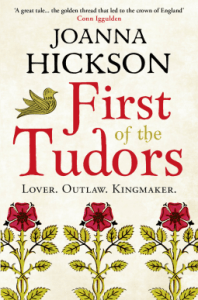
first-of-the-tudors Yes, I’ve been reading yet another Wars of the Roses novel! One of the things I’m enjoying about reading so many books set in the same time period is seeing the variety of ways in which different authors choose to approach the same subject as they search for a new angle and some fresh insights. In First of the Tudors, Joanna Hickson takes us right back to the early days of the conflict and the beginnings, more or less, of the Tudor dynasty to tell the story of Jasper Tudor, uncle of the future Henry VII.
As the sons of Welshman Owen Tudor and Henry V’s widow, Catherine of Valois, Jasper and Edmund Tudor are half-brothers to Henry VI, who is King of England as the novel opens in 1451.  Being closely related to royalty but with no real claim to the throne for themselves, Edmund and Jasper are welcomed to court by Henry who rewards them with lands and titles, making Edmund Earl of Richmond and Jasper Earl of Pembroke. Edmund also wins the hand in marriage of Margaret Beaufort, which is seen as a great accomplishment as Margaret, despite being little more than a child, has royal blood and is one of England’s richest heiresses.

When Edmund dies at Carmarthen Castle in 1456, possibly of bubonic plague, he leaves Margaret pregnant with his child. The baby, when it is born, is named Henry and is taken into Jasper’s care (before later being placed in the custody of the Yorkist William Herbert). As the years go by and Henry grows into a man, Jasper is occupied with looking after his estates, trying to keep the peace in Wales and supporting his brother the king as unrest grows and the country heads towards civil war. Based closely on historical fact, we see all of this through Jasper’s eyes, as he narrates his own story in his own words.

But there’s also a fictional story, built around the idea that Jasper had a cousin, Sian (or Jane) Hywel, who became his mistress. There is no historical basis for this, but it is known that Jasper did have illegitimate children, so I have no problem with Joanna Hickson inventing the character of Jane, especially as she makes clear in her author’s note which parts of the novel were factual and which weren’t. However, I felt that too much time was devoted to Jane – she narrates around half of the book – and I would have preferred to concentrate more on Jasper and the other historical figures. This is just my personal opinion, though, and I’m sure other readers will like the domestic scenes and the love story more than I did.

I’ve always found Jasper Tudor intriguing, maybe partly because he tends to be overshadowed in historical fiction by other, more well-known characters. I had been looking forward to seeing him take centre stage for once, but I didn’t really find his portrayal in this novel entirely convincing. I can’t quite explain why, other than to say that his narrative voice was almost identical to Jane’s and that I could never fully believe in him as a 15th century man. I did like the portrayal of Margaret Beaufort, however, which made her seem slightly more endearing than in other fictional portrayals I’ve read! I also enjoyed the focus on Wales, the descriptions of the Welsh castles and the Welsh people who played a part in this fascinating period of history – one secondary character whom I found particularly interesting was the poet Lewys Glyn Cothi.

First of the Tudors ends abruptly, leaving the feeling that there is much more of this story still to come, and the author’s note confirmed what I had already expected: there will be a sequel and Henry Tudor will take more of a central role in that one. If you’ve never read Joanna Hickson before you may also be interested in The Agincourt Bride and The Tudor Bride, which tell the story of Catherine of Valois, or Red Rose, White Rose, the Wars of the Roses from Cicely Neville’s perspective.

Thanks to the publisher HarperCollins for providing a review copy via NetGalley.

Accession by Livi Michael

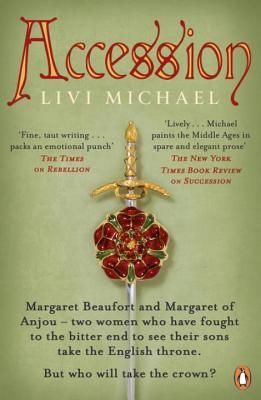
accession Having followed the stories of Margaret Beaufort and Margaret of Anjou throughout the early stages of the Wars of the Roses in Livi Michael’s Succession and Rebellion, we come at last to the third book in the trilogy, Accession, which covers what is, in my opinion, the most interesting part of the period – Edward IV’s final years, the troubled reign of Richard III and Henry Tudor’s victory at the Battle of Bosworth.

The novel opens in 1471, shortly after the Battle of Tewkesbury which has secured the throne of England for the Yorkist king, Edward IV. Despite her best efforts, the Lancastrian queen, Margaret of Anjou, has had to admit failure: her armies have been defeated, her husband – the late King Henry VI – is dead, and her son, the Prince of Wales, on whom all her hopes rested, has been killed. Margaret, whose role in our story is almost over, is placed in the custody of Alice Chaucer, Duchess of Suffolk, where she will remain for the next few years.

For Margaret Beaufort, however, all is not lost. Although her son, Henry, the remaining Lancastrian heir, is still in exile in Britanny with his uncle, Jasper Tudor, Margaret is slowly preparing the ground for his return. The first stage in her plan is to marry again and the husband she has in mind – her fourth – is Thomas Stanley, a man who has become an expert at navigating through dangerous political waters and who has no qualms about changing sides between York and Lancaster whenever he believes the time is right to do so. Just the sort of man, she hopes, who has the power and the influence to help turn her dreams into reality.

I think Accession is probably my favourite of the three books in this trilogy. Although the writing feels a little bit dry on occasions – more like non-fiction than fiction – the story is still compelling, even for someone who has read about these historical figures and events many times before! As in the previous two books, Livi Michael incorporates excerpts from contemporary chronicles of the period to tell part of the story, which is a method I have found both unusual and very effective. The use of the chronicles helps to set these novels apart from others that I’ve read on the Wars of the Roses.

Another thing I appreciate about this trilogy is that Livi Michael has avoided making her characters into heroes or villains, instead giving each of them a mixture of good points and bad points – and that includes her two protagonists, neither of whom are very easy to like. Margaret Beaufort in particular is portrayed as ambitious, scheming and manipulative – but always with the best interests of her son at heart. Almost everyone in this novel appears to be out for what they can get…and yet there are little touches of humanity too: Margaret Beaufort feeling sorrow at the death of Queen Anne, for example, despite having secretly been working against Anne’s husband, Richard; or Henry Tudor recognising the sacrifices made for him over the years by his uncle Jasper.

As for Richard III, he is no more of a hero or a villain than any of the other characters in the novel. Whenever I read a book which covers Richard’s reign, I look forward to seeing how the author will choose to tackle the mystery of the Princes in the Tower, and I’m pleased to say that I was happy with the approach taken in Accession! It wasn’t quite what I’d expected, but I found it convincing and a little bit different from the theories given in other novels I’ve read.

I’ve enjoyed reading all three books in Livi Michael’s trilogy and will continue to read about this period of history as I never seem to get bored with it!

Thanks to Penguin for providing a copy of this book for review.

His Bloody Project by Graeme Macrae Burnet

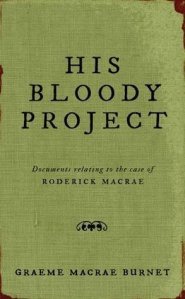
his-bloody-project This novel by Scottish author Graeme Macrae Burnet attracted a lot of attention after being shortlisted for the Man Booker Prize last year.  Of all the books on the list, I remember thinking that this sounded like the one I would be most likely to enjoy, so I had a lovely surprise when I received a nice hardback copy from my sister for Christmas.

His Bloody Project is fiction but presented so convincingly as non-fiction that there were times when I wondered if I’d misunderstood and I was actually reading a true story after all!  Subtitled Documents relating to the case of Roderick Macrae, the case in question is that of a triple murder committed in August 1869 in Culduie, a remote village in the Scottish Highlands.  In his preface, the author explains that he came across the documents contained in this book while researching his own family history at the Highland Archive Centre in Inverness. 

Following a collection of statements given by the residents of Culduie, we proceed to the longest section of the book: Roderick Macrae’s memoir which he was instructed to write by his advocate, Andrew Sinclair, during his imprisonment at Inverness Castle awaiting his trial.  Roderick, only seventeen at the time of his arrest, never tries to deny that he killed his neighbour, Lachlan Mackenzie, and two other members of the Mackenzie family – we know this right from the beginning of the book – but what we don’t know is what caused him to do such a thing.  Roderick’s memoir provides some insights, giving some background information on what life was like in Culduie and describing the events leading up to the murders.

Next, we have the opportunity to read the medical reports on each of the three murder victims – and this is the first real indication we get that maybe Roderick has not been entirely honest with us.  A study by a doctor who visited Roderick in prison follows, raising and answering questions about the prisoner’s state of mind, and finally we arrive at the trial itself.  As judge, jury and spectators try to understand the motive behind the crime, witnesses are called who give statements both to confirm Roderick’s own account and to contradict it.  A verdict is finally reached, but whether it is the right one or not is up to each individual reader to decide. 

While I was reading Roderick’s own story, I had a lot of sympathy for him and I was so angry with Lachlan Mackenzie (or Lachlan Broad, as he is usually known) that I could understand why Roderick felt driven to take revenge.  However, when I read the rest of the documents, particularly the report of the court proceedings, I began to wonder how much Roderick had omitted from his memoir and whether Lachlan Broad’s actions were really as provocative as they had at first seemed.

Another interesting aspect of the novel is the portrayal of life in a tiny Scottish community in the middle of the 19th century.  Roderick Macrae’s mother dies in childbirth just before the events described in the novel, leaving Roderick and his siblings alone with their father, a crofter trying to earn his living from the land.  Culduie (a settlement of only nine houses) and the surrounding villages are the property of the Laird, who rules through his factor and a network of local constables.  Lachlan Broad is elected the constable for Culduie and this is what brings him into conflict with the Macraes.

The writing style and the language used throughout the novel feels appropriate for the time period and increases the sense of authenticity; as I’ve said, at times I could almost have believed I was reading genuine historical documents.  Dialect is used sparingly and a glossary is provided if you need to look up any unfamiliar Scots words (there were a few that were new to me, but these were mainly the names of farming implements such as croman and cas chrom).  Maybe Roderick’s narrative voice isn’t entirely convincing given his age, but we are told that he is an exceptionally bright, intelligent boy – and the author does address this issue in the preface too.

I loved His Bloody Project; although it’s not a traditional crime novel and there’s never any mystery surrounding the identity of the murderer, it’s the sort of book that leaves you with more questions at the end than you had at the beginning.  I think a re-read might be necessary at some point!    

The Phantom Tree by Nicola Cornick

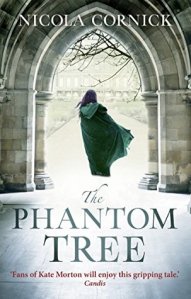
the-phantom-treeI have always found the concept of time-travel fascinating – and equally fascinating are the number of ways in which various authors choose to approach the subject when writing time-travel fiction.  The Phantom Tree is one of many dual time period time-slip novels I have read over the last few years, but I found it refreshingly different in that it deals not with the usual idea of a modern day character going back in time but a woman from the past coming forward to the present time.

The name of our time traveller is Alison Bannister (or Banastre, as she was known in her previous life) and she has been trapped in the 21st century for ten years, unable to find a way to get back.  We first meet Alison walking through the streets of Marlborough one day just before Christmas.  Stopping to look through the window of an art gallery, she is surprised to see a painting of a woman she once knew.  Investigating further, she learns that this is apparently a newly discovered portrait of Anne Boleyn – but she’s sure it isn’t; it’s Mary Seymour, who lived with Alison at Wolf Hall in the 1500s.  To complicate things further, the historian hoping to build his career around the discovery of Anne Boleyn’s portrait is Adam Hewer, Alison’s ex-boyfriend.  Without telling him the truth about her journey through time, how can she convince him that he’s wrong?   

The historical sections of the novel are written mainly from Mary Seymour’s perspective.  Unlike Alison, who is fictional, Mary is a real historical figure – but one whose story has been lost in the mists of time.  Mary is the daughter of Henry VIII’s sixth wife, Katherine Parr, and Thomas Seymour, whom Katherine married following Henry’s death.  Katherine dies shortly after giving birth and Thomas is executed a year later, leaving Mary an orphan in the care of the Duchess of Suffolk.  Mary disappears from historical records in 1550, but Nicola Cornick suggests that she was sent to live with her Seymour cousins at Wolf Hall.  This allows plenty of scope to create a storyline for Mary which is both imaginary and historically plausible.         

Of the two time periods, I found the sections set in the past more interesting – in particular, I enjoyed the supernatural elements of Mary’s story.  Almost from the moment she arrives at Wolf Hall rumours begin to circulate that she is a witch, especially after she has a vision which seems to come true.  She also has a telepathic connection with a secret friend called Darrell and this reminded me instantly of Mary Stewart’s Touch Not the Cat, (which may have been intentional, as Darrell’s nickname for Mary is ‘Cat’). 

The present day story was enjoyable too, though.  I couldn’t help thinking that Alison had adapted remarkably quickly to modern life, which wasn’t at all convincing, but otherwise I was kept entertained by her attempts to find a gateway back to her own time and to decipher a set of clues sent by Mary through the centuries.   

The Phantom Tree does require disbelief to be suspended on many occasions, which I know is not something that appeals to all readers, but I think anyone who likes reading time-slip novels by authors like Susanna Kearsley or Barbara Erskine should find plenty to enjoy here.  I will now be looking out for Nicola Cornick’s previous book, House of Shadows!

Thanks to the publisher for providing a copy of this book via NetGalley for review.