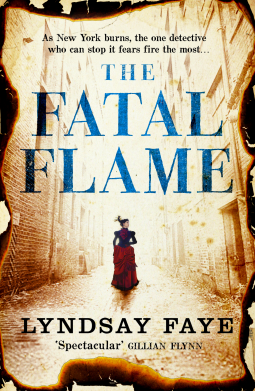
 Since reading The Gods of Gotham, Lyndsay Faye’s first novel to feature New York ‘copper star’ Timothy Wilde, I’ve been looking forward to each new book in what I’d hoped would be a long series. I was disappointed to discover that it’s actually a trilogy and The Fatal Flame is the last we’ll see of Tim and his friends – but pleased to have had the chance to read what has been a very enjoyable set of books.
Timothy’s story began in 1845 when his home in Manhattan was destroyed by fire and his brother, Valentine, helped him find work as a copper star in the newly formed New York City Police Department (the name comes from the copper stars the officers wore to identify themselves). In The Gods of Gotham you can read about the early days of Timothy’s career and how his crime-solving skills gained him a position as one of the NYPD’s first detectives, while the second book, Seven for a Secret, followed his investigations into a gang of ‘blackbirders’ (people who hunted down runaway slaves and returned them to slavery in the south). Ideally, these two books should be read before The Fatal Flame as there are some recurring characters and storylines, but it’s not essential.
In this third and final book, set in 1848, a mysterious arsonist appears to be targeting properties belonging to the unscrupulous politician and businessman Robert Symmes. The main suspect is one of his former employees at the New American Textile Manufactory, a woman with a grudge. But as Tim begins to dig deeper into Symmes’ business dealings and his treatment of his female workers, things quickly become much more complex than they seemed at first – especially when Tim’s brother, Valentine, announces that he will be running against Symmes in the next election. Meanwhile, Mercy Underhill, the fascinating, eccentric woman Timothy loves, has returned from London and it’s not long before she befriends Dunla Duffy, a young Irish girl who could hold the key to the mystery.
Most of the other characters we got to know in the previous novels are also back again in this one, including Bird Daly, Silkie Marsh, Jim Playfair and Elena Boehm. With this being the end of the trilogy, the personal story of each character is brought to a close, in one way or another – I would have hoped for a happier ending for one or two of them, but was satisfied with the way most of their stories concluded. I’ve particularly enjoyed watching the relationship between Timothy and Valentine (my favourite character) develop throughout the three books and I loved their scenes together in this book, especially towards the end.
I have mentioned in my posts on the previous two Timothy Wilde books the use of flash (the language of the criminal underworld) and how it adds to the atmosphere and authenticity of the story. Each novel includes a glossary which translates the flash terminology, although by the time you reach the third book in the series you’ll find yourself relying on it less and less (and the meaning can often be worked out from the context anyway). In this book, we see flash being used for the purpose for which it was originally intended – as a secret language to enable the speakers to hold a conversation that is unintelligible to anyone else who may be listening.
Another of the highlights of this trilogy has been seeing how Lyndsay Faye brings to life the New York City of the 19th century and tackles some of the important issues facing the people who lived there during that period. I have hinted at two of the main themes in The Fatal Flame already: political corruption and the exploitation of female employees (particularly Irish immigrants). Sometimes, though, Timothy’s attitudes towards the injustices of 19th century life make him feel slightly unconvincing as a man of his time, which is really my only criticism of the book and of the trilogy as a whole.
The language, the setting, the atmosphere and, most of all, Tim and Val Wilde – I’ve found so much to enjoy in these three novels! Now I’m wondering what Lyndsay Faye will be writing next.
Thanks to Headline for providing a copy of this book for review.


 She Reads Novels