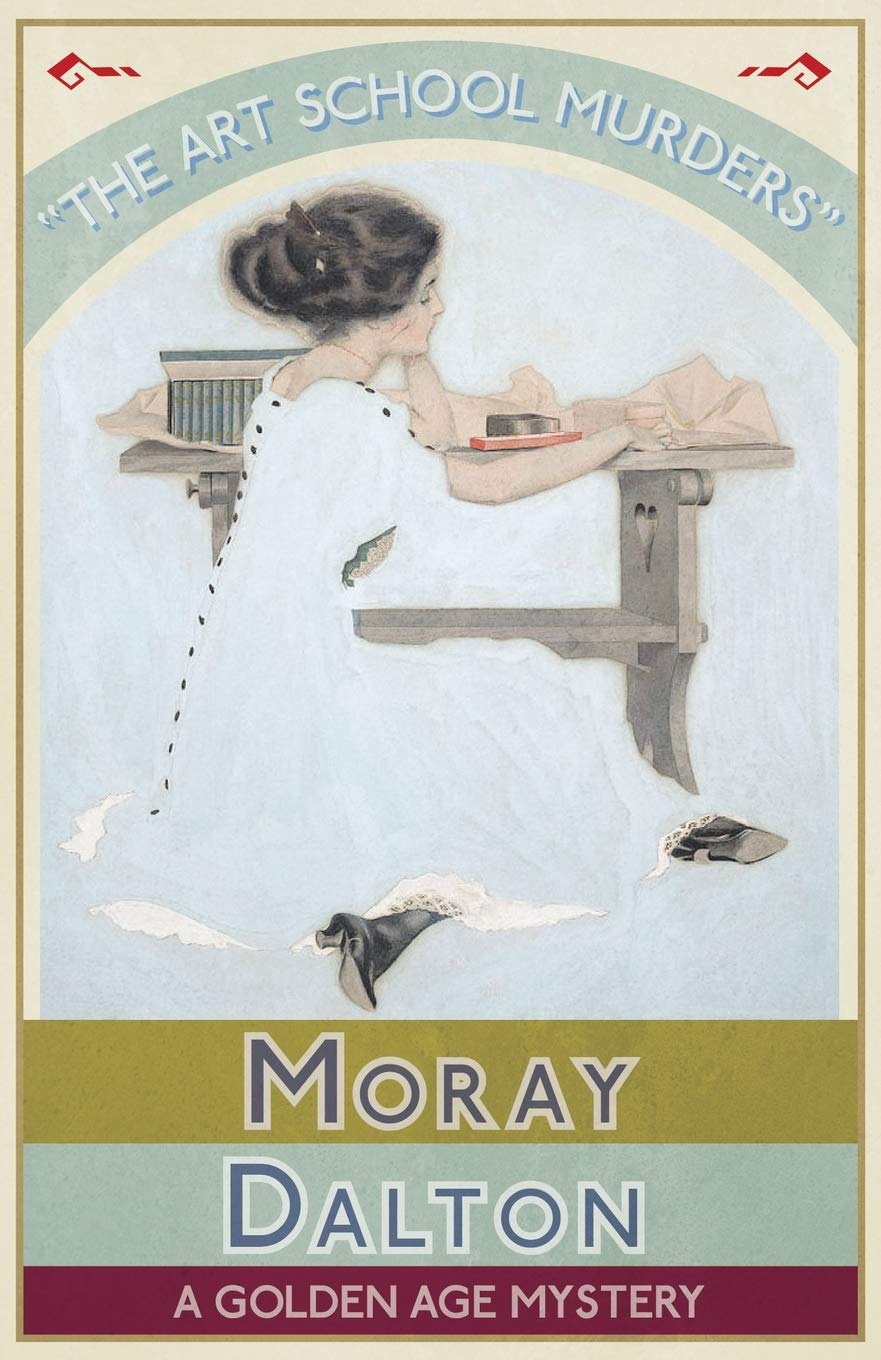
The Art School Murders by Moray Dalton – #DeanStreetDecember25

Dean Street Press December is back, hosted again by Liz of Adventures in Reading, Running and Working From Home. The rules are simple – just read and write about at least one book published by Dean Street Press during the month of December! I have several DSP books on the TBR and decided to start with a detective novel by Moray Dalton, a new author for me although I’ve seen other bloggers give her books very positive reviews.

The Art School Murders opens with the murder of Althea Greville, an artists’ model who has been employed to pose for the students at Morosini’s School of Art. Althea had briefly worked at the school the year before, causing a stir and capturing the hearts of many of the young male students, but on arriving for her second engagement she appeared very different: old, tired and desperate for money and opportunities. When the caretaker’s wife finds Althea’s body behind a screen in the life classroom one November morning, Inspector Hugh Collier of Scotland Yard is called in to investigate.

Assisted by Sergeant Duffield, Collier begins to question the staff and students, looking for any clues that will point him towards the murderer. That same evening, however, another girl from the art school is found dead in the darkened balcony of a cinema. Convinced that she must have been silenced by Althea’s killer to prevent her from giving information to the police, Collier now has two murders to solve – and if he doesn’t hurry, the killer could strike again.

The Art School Murders is the tenth of fifteen books featuring Hugh Collier, but it works perfectly as a standalone and it’s definitely not necessary to have read any of the previous books – although, having enjoyed this one, I will be doing so now! I liked Collier as a detective; he may not be as interesting as a Poirot or a Holmes, but he’s polite, good-natured and intelligent, handling his investigations with fairness and compassion.

Originally published in 1943, this book uses the war as a backdrop very effectively. The story is set in a village a short drive away from London, and nightly blackouts are in force, making it easier for crimes to be committed under the cover of darkness. It’s November, when the days are short and the nights are long, and Dalton makes good use of this to show what it’s like walking through the streets at dusk when the light you would normally see shining from windows is blacked out and invisible.

I enjoyed this book as much or more than some of the Golden Age mysteries I’ve read by better known authors. My only criticism is that the solution seemed to come out of nowhere and I doubt many people would have guessed the culprit based on the information we are given, but otherwise Dalton held my interest from beginning to end. It’s sometimes hard to know why some authors fade into relative obscurity while others remain popular, so well done to Dean Street Press for rescuing Moray Dalton’s books and making them available to a new audience!

The Christmas Clue by Nicola Upson – #NovNov25

I’m sure most of us are familiar with the board game Cluedo (or Clue, if you’re in America), but do you know who invented it? I didn’t, but thanks to Nicola Upson’s new novel, The Christmas Clue, I now know that it was invented in the 1940s by Anthony and Elva Pratt, a married couple from Birmingham. Upson tells the story of the game’s creation while also imagining a fictional murder mystery for the couple to solve.

It’s Christmas 1943 and Anthony and Elva are on their way to the Tudor Close Hotel in Rottingdean on the south coast of England. Although he’s currently working in a weapons factory, Anthony is a pianist and before the war he and Elva regularly provided entertainment for hotels, both of the musical sort and also hosting murder mystery events. They’ve been invited to host one of these at the Tudor Close over the Christmas weekend but, on arriving at the hotel, they quickly discover that the war has made things more challenging than usual – there are no actors available to play the various roles in the game and interact with the guests, so the Pratts are going to have to come up with a new format.

Before the game even begins, however, the couple find themselves with a real mystery to investigate. Stopping at their old friend Miss Silver’s shop in the town to collect a box of cigars for Anthony’s Christmas present, they discover Miss Silver’s body in the storeroom apparently beaten to death. The dead woman’s sister works at the Tudor Close and as Anthony and Elva look for more connections, they start to suspect that the killer could be one of the guests staying at the hotel.

The Christmas Clue is a very short book (novella length at 140 pages), but despite its shortness, Upson manages to create a satisfying murder mystery – I found some of the developments a bit far-fetched, but it was fun to read overall, despite taking a darker turn towards the end. I liked the hotel setting, although Elva and Anthony find it very different from their memories of visiting before the war: shortages of staff, no money for decent Christmas decorations, and a group of Canadian soldiers billeted nearby.

I’ve learned some interesting little facts about the game of Cluedo, both from the book itself and from feeling inspired to look things up while reading. For example, the name Cluedo is a pun on Ludo, another popular board game – which is less well known in America (though Parcheesi is similar) and that’s why the name was simplified to Clue. If Elva and Anthony had their way, it would have been called Murder at Tudor Close and was originally supposed to include additional rooms, weapons and characters. Elva was a talented artist and designed the artwork for the board.

This is the first book I’ve read by Nicola Upson, mainly because most of her other novels are mysteries where the sleuth is the real life author Josephine Tey. I’ve never felt entirely comfortable with the recent trend for using real people as detectives – and of course, Upson is doing the same in this book with Anthony and Elva Pratt. I wondered how the Pratts’ family might feel about it, so I was pleased to read Upson’s acknowledgments at the end where she says she has been in contact with Anthony and Elva’s daughter, Marcia Lewis, who gave her best wishes to the project. I think she can certainly be happy with the way her parents are portrayed in this book – they seem like a really lovely couple!

Thanks to Faber & Faber for providing a copy of this book for review via NetGalley.
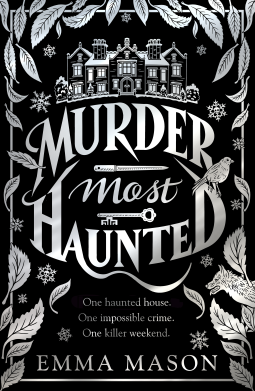
Murder Most Haunted by Emma Mason

Fifty-five-year-old Midge McGowan is retiring after thirty years as a police detective and her colleagues have given her a very unusual retirement gift: a ticket to spend the weekend before Christmas in a haunted house. The reason? The tour company, Haunting Holiday Excursions, is run by a former police officer, John Rendell, and HR get discounted tickets. Midge doesn’t want to go, especially as it will mean leaving behind her wife, Bridie, who is having chemotherapy, but Bridie persuades her that she’ll be fine for a few days and that it will be a good experience for Midge.

Soon, Midge finds herself getting off the bus at Atherton Hall with a small group of other guests: Dr Mortimer and his invalid wife, Gloria; Noah, who hosts a paranormal podcast; and Rona, a pop star in remission from a drug addiction. The bus driver, Harold, also ends up staying at the Hall with them after heavy snow leaves the roads impassable and cuts them off from the rest of the world. Almost as soon as they arrive, the guests begin to experience sightings of the White Lady of Atherton Moor drifting around the grounds of the estate, although not everyone believes they have truly seen a ghost. When their host, Rendell, is found dead in the bath, however, they have to decide whether ghosts are the culprits or whether there’s a human killer on the loose.

This is the book I thought A Ghost Hunter’s Guide to Solving a Murder was going to be! Unlike that other book (which was good, but not as advertised), this one has an actual ghost hunter in it, in the form of Noah who arrives with his cameras and recording equipment hoping to get new material for his podcast. The book also has an interesting and unusual detective character in Midge, who is quickly dismissed – sometimes very cruelly – by the others as an overweight, middle-aged woman with no fashion sense and no social skills. It was great to see her come into her own and find her own identity away from the slightly overpowering Bridie.

Apart from Midge, the other characters feel like stereotypes at first: Noah, the ‘woke’ young person who clashes with Harold, the racist, sexist older man; Rona, the shallow pop star with a wild lifestyle; the domineering doctor and his fragile wife who takes to her bed at the first sign of danger. However, most of these people turn out to have secrets or hidden depths and aren’t quite what they appear to be on the surface.

The murder mystery element of the book is interesting; Midge never seriously considers Noah’s theory that ghostly activity is responsible, but even she has to admit that there are some spooky similarities between the murders taking place in the present and those described in an old diary belonging to the Atherton family doctor. My only criticism is that I found the killer and the motive too easy to guess, so wasn’t surprised at all when the solution was revealed. Still, this was an entertaining novel and the good news is that it’s the first in a series, with the second Midge McGowan mystery coming next year!

Thanks to Bantam for providing a copy of this book for review via NetGalley.
Book 5 for RIP XX

A Ghost Hunter’s Guide to Solving a Murder by F. H. Petford

Twenty-two-year-old Alma Timperley is stunned when she learns that her Aunt Gladys has died, leaving her hotel in Cornwall to Alma in her will. The news comes as a particular surprise as Alma didn’t even know that Gladys existed in the first place! Still, she accompanies her lawyer, James Nascent, to Falmouth on the Cornish coast to inspect her inheritance and likes what she sees. The Timperley Spiritualist Hotel overlooks the town below and has a very special clientele. The people who come to stay are hoping to make contact with loved ones beyond the grave and their reservation fee includes three sessions with one of the hotel’s two mediums, George Weaver and Valentine Wragge.

Alma has always believed she has psychic abilities herself, so she’s intrigued and decides to immediately take ownership of the hotel. She soon finds that she has more than ghosts to worry about, however, because it’s 1914 and war has recently broken out with Germany. Why has a book written in German been hidden inside a cooking pot in the hotel kitchen? And who turned on a light in the tower, guiding an enemy Zeppelin in from the shore? Is someone in the hotel spying for the Germans?

This is the first book in a planned series of novels starring Alma Timperley and based on this one I’ll definitely be looking out for more. It wasn’t really what I’d expected, though; the title and cover gave me the impression this would be a humorous cosy mystery set in a haunted house, but it’s actually something very different. There’s no ghost hunting (unless you count mediums trying to contact spirits) and there’s not really a mystery either. The identity of the German spy – referred to as Excalibur – is revealed to the reader very early in the book and although Alma and the police don’t know who it is, I would have preferred to be kept in suspense as well, wondering who it was.

Despite the book not really being as advertised – which is a shame, as it seems to have resulted in the book receiving worse reviews than it deserves – I still enjoyed it. I particularly loved the Cornish setting: Petford does a great job of bringing Falmouth to life, with its bay and harbour and local landmarks such as Pendennis Castle, which played a part in the town’s defences during the war, and the King’s Pipe, a chimney used to burn tobacco illegally smuggled into the country. We also learn a lot about PK Porthcurno, once the world’s largest telegraph station where many cables from overseas came ashore and now a museum open to the public.

I think this book has a lot to offer, as long as you approach it as historical fiction about German spies in the First World War and not a ghost story or a detective novel. It covered some aspects of the war I hadn’t read much about before and it held my interest from beginning to end. I liked Alma and her friends and hope to meet them again soon.

Thanks to Hodder & Stoughton for providing a copy of this book for review via NetGalley.
Book 4 for RIP XX

Murder at the Black Cat Cafe by Seishi Yokomizo

Translated by Bryan Karetnyk

Over the last few years, Pushkin Press have been publishing Seishi Yokomizo’s Kosuke Kindaichi mysteries in new English translations. This is the latest, but I found it different from the previous ones in several ways.

First, where the other books are full-length novels, Murder at the Black Cat Cafe is a novella (this edition also includes another short story, Why Did the Well Wheel Creak?, to make the book more substantial). Yokomizo’s detective, Kosuke Kindaichi, plays a prominent role in the first story, but a very small one in the second – in fact, I wouldn’t really call that one a Kindaichi mystery at all as he only appears right at the end. Both stories belong to the type Yokomizo refers to in the prologue as ‘faceless corpse’ mysteries – in other words, where the murder victim has had their face destroyed so they can’t be identified.

The other main difference is in the setting. Usually the Kindaichi mysteries are set in rural Japan – a small village, a country house, a remote island – but Murder at the Black Cat Cafe has a city setting: Tokyo’s red-light district, an area known as the Pink Labyrinth. First published in 1947, the story takes place just after the war and begins with a policeman on patrol discovering the faceless body of a woman in the garden of the Black Cat Cafe, an establishment owned until very recently by the Itojimas, who have just sold it and moved away. Beside the corpse is the body of a black cat, which has also been killed. It’s assumed that the cat is the famous mascot of the Cafe – until the Cafe’s black cat emerges alive and well. Where did the other cat come from and who is the dead woman?

I enjoyed the post-war urban setting, but with the second story, Why Did the Well Wheel Creak?, we are back on more familiar ground with a family living in a remote village. The patriarch, Daizaburo, has two sons – one legitimate and one illegitimate – who are almost identical apart from their eyes. When both young men go to war and only one returns alive, having lost both eyes, questions begin to be asked. Is this man who he says he is or could he be pretending to be his brother?

Both of these stories, then, feature mistaken or stolen identities and people who may or may not be impostors and both have enough twists and turns to keep the reader guessing until the truth is revealed. The first one was probably the stronger mystery, but I did enjoy the second one as well and liked the way the story unfolded through letters sent from a sister to her brother. I’m already looking forward to the next Kindaichi book, She Walks at Night, coming next year.

Thanks to Pushkin Vertigo for providing a copy of this book for review via NetGalley.
Book 2 for RIP XX

One, Two, Buckle My Shoe by Agatha Christie

This month’s theme for the Read Christie challenge is ‘medical professionals’ and One, Two, Buckle My Shoe is the perfect choice as it begins with the murder – or could it be suicide? – of a dentist. His name is Mr Morley of Queen Charlotte Street, London, and our old friend Hercule Poirot just happens to be attending an appointment on the day of Morley’s death. It seems that Poirot has a fear of visiting the dentist, but despite being nervous and preoccupied he still has his powers of observation and notices a young man in the waiting room who ‘looks like a murderer’. Learning of Mr Morley’s death later that day, however, it seems that the young man is not the only suspect. All of the patients who attended appointments in the hours before the body was discovered are under suspicion, along with the dentist’s family and servants.

Poirot works with Chief Inspector Japp of Scotland Yard in the early stages of the investigation, but when Japp uncovers information to suggest that Morley’s death was a suicide, Poirot is not satisfied. Too many things don’t make sense. Why, for example, did Morley’s secretary receive a fake telegram summoning her to an aunt in Somerset, ensuring that she would be absent from work on the day of the death? Poirot decides to continue investigating on his own, but it’s only when he begins to question whether he’s fallen into a trap that he is able to solve the mystery.

One, Two, Buckle My Shoe was published in 1940 and was the final Poirot novel to feature Inspector Japp. I do like the books where Poirot has someone else to work with and discuss some of his theories with, whether that’s Japp or (preferably) Captain Hastings. It’s also one of several Christie novels with titles based on nursery rhymes (Hickory Dickory Dock, Five Little Pigs and A Pocket Full of Rye are some of the others). Christie uses lines from the One, Two, Buckle My Shoe rhyme as the chapter titles and each line has some relevance to the events of the story – for example, in the first chapter we see a buckle fall off a woman’s shoe as she steps out of a car, although we won’t understand the significance of that until much later.

Published during the war, there are strong themes of political and financial instability and people with different views of how the world should move forward. One of the suspects, Alistair Blunt, is a prominent banker; another, Howard Raikes, is a political activist from America; and a third, Mr Barnes, worked for the Secret Service. However, this is only one part of the story and the book never becomes excessively concerned with politics. There are other suspects and other clues and motives as well and although I couldn’t solve the mystery myself, I enjoyed seeing Poirot explain it all in the denouement!

The Read Christie theme for September is ‘religious figures’ and the recommended title is At Bertram’s Hotel, which I’ve read relatively recently. I’ll wait to see what other options they suggest before deciding if I’ll take part.

Book 19/20 for 20 Books of Summer 2025.

No Life for a Lady by Hannah Dolby

I added to this to my TBR last year after some reviews of the sequel, How to Solve Murders Like a Lady, caught my eye. I always prefer to start at the beginning if possible, so decided to read this one first – and I’m pleased to say I loved it and will be moving on to the second book soon!

The novel is set in Hastings in 1896 and introduces us to Violet Hamilton who, at twenty-eight and still unmarried, looks like becoming an ‘old maid’. She’s not interested in any suitor her father pushes into her path and has more important things on her mind – like finding out what happened to her mother, who disappeared from Hastings Pier ten years earlier. Violet decides to hire a private detective, Frank Knight, but his methods and attitude leave a lot to be desired. As Benjamin Blackthorn, the town’s only other detective, insists that he has given up sleuthing and is happy selling furniture instead, Violet feels she has no choice other than to take matters into her own hands and try to investigate herself.

Violet’s story is told with a lot of warmth and humour. She’s a very likeable heroine: intelligent and resourceful, but also endearingly naïve and innocent, which can lead to some amusing situations and misunderstandings. There’s also some sadness, as the disappearance of her mother all those years ago has clearly had a huge impact on her life and she feels that no one else, not even her father, cares about trying to discover the truth. The mystery element of the novel reaches a climax with some dramatic scenes towards the end, but for the most part I would describe this as a gentle, charming book.

I loved watching Violet’s relationship with Mr Blackthorn develop, as she persists in trying to persuade him to take on her case and he continues trying to refuse. Eventually she convinces him to let her begin working for him as a typist, certain that once she’s established herself in his furniture shop he won’t be able to resist getting involved in the investigation. I found it easy to predict what was going to happen there, but I didn’t mind as I liked Benjamin as much as I liked Violet! It’s interesting, though, that at first Violet is sure she needs a man to do the detecting for her, but as the book progresses it begins to occur to her that maybe she has what it takes to become a Lady Detective in her own right.

If you’re looking for an entertaining read with a mixture of mystery, romance and comedy, I can’t recommend this book highly enough. I thought it had a similar feel to AJ Pearce’s Dear Mrs Bird, so if you enjoyed that book maybe you would enjoy this one too. I’m looking forward to reading the sequel!

Book 18/20 for 20 Books of Summer 2025.