The House at Devil’s Neck by Tom Mead

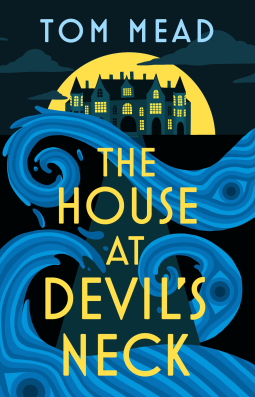
This is the fourth book in Tom Mead’s Joseph Spector mystery series, but if you haven’t read any of them, don’t worry – they all stand alone and if you wanted to start here, that wouldn’t be a problem. The books are set in the 1930s and are written in the style of Golden Age ‘locked room’ or ‘impossible crime’ novels, with the influence of John Dickson Carr being particularly strong. The series features two detectives: a professional one – Inspector Flint of Scotland Yard – and an amateur one – Joseph Spector, a retired magician.

The House at Devil’s Neck begins in August 1939 with a group of people boarding a coach, ready for a trip to Devil’s Neck, a supposedly haunted house. The house, which can be reached by a causeway at low tide, has a long and dramatic history, but was most recently used as a convalescent home for wounded soldiers during the Great War. The current owner has now opened up the house to tourists and the first party is about to arrive. The guests include Madame la Motte, a medium, and her companion Imogen; a ‘ghost hunter’, Francis Tulp; and a magician – Joseph Spector. No sooner have they reached Devil’s Neck and settled into their rooms, however, than one of the party is found dead.

Back in London meanwhile, Inspector Flint is investigating what appears to be a suicide. The victim is Rodney Edgecomb, a man who, many years earlier, was involved in a high-profile inheritance dispute following the sinking of the Titanic. The circumstances of his death lead Flint to believe this is murder rather than suicide. When he eventually discovers links between Edgecomb and the house at Devil’s Neck, Flint and Spector are able to team up once again to solve the mystery.

I won’t go into the plot in any more detail because it’s such a complex one with so many twists I’m impressed that Tom Mead managed to keep track of it all himself! The murder methods are also very complicated, but the solutions do make sense once Spector explains them. As with his other books, Mead inserts a brief chapter towards the end to warn us that the solution is coming in case we want a chance to try to solve the mystery for ourselves. I think the average reader would find that very difficult – I certainly had no chance at all of solving it! – but the clues are all there and there are references at the end linking back to where you can find them in the text.

What interested me more than the mystery itself was the setting. The descriptions of the house at Devil’s Neck – ‘a hulking shape, a creature waiting at the valley’s nadir’ – are very atmospheric, as the guests arrive in pouring rain and the house quickly becomes cut off from the mainland by the rising water. The house’s history is also fascinating and allows Mead to explore the fate of wounded soldiers and how those left with permanent disabilities struggled to integrate back into society. Spiritualism, the tricks used by mediums and methods of ghost hunting are also subjects touched on in the book.

I loved most of this novel, until I started to feel lost near the end as it became more and more complex! I think the first and third books – Death and the Conjuror and Cabaret Macabre – are still my favourites.

Thanks to Head of Zeus for providing a copy of this book for review via NetGalley.

Book 17/20 for 20 Books of Summer 2025.

A Case of Life and Limb by Sally Smith

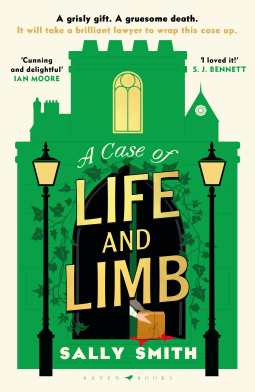
If, like me, you enjoyed meeting Sir Gabriel Ward KC in last year’s A Case of Mice and Murder, you’ll be pleased to hear that he’s back again with another mystery to solve in A Case of Life and Limb! The book is again set in 1901 in and around London’s Inner Temple, one of the four Inns of Court, where Sir Gabriel lives and carries out his work as a barrister. It’s not necessary to have read the first book before this one, but I would highly recommend reading both anyway!

Early in the novel, Gabriel is approached by Topsy Tillotson, the latest young star of the London theatrical scene, who is determined to sue a tabloid newspaper for libel. Reluctant to accept the case at first, Gabriel ends up agreeing to represent her, feeling that Topsy doesn’t deserve to have her reputation tarnished by unscrupulous journalists. However, Gabriel soon finds that he’ll have to divide his time between this and another, more sinister, case…one which really is ‘a case of life and limb’.

Sir William Waring, Master Treasurer of the Inner Temple, has received a very unpleasant gift on Christmas Eve: a severed hand, presented in a box with a card asking Can I give you a hand? Gabriel happens to be visiting the Treasurer when the box is opened and, due to his previous success at mystery solving, Waring asks him to investigate. As the Temple is outside the jurisdiction of the City of London, Waring hopes the crime can be solved internally without involving the police, but when more body parts start arriving, Gabriel enlists the help of his friend, Constable Wright.

These two separate cases unfold in parallel, largely separate but intersecting now and then, and I enjoyed following both. The mystery surrounding the body parts gives Gabriel a chance to further develop his skills as a detective and the reader a chance to learn more about the residents of the Inner Temple, some of whom we met in the first novel and others who are newly arrived. I particularly loved getting to know Delphinium, the Temple cat! The Topsy Tillotson storyline, like the one involving Millie the Mouse in the previous book, takes Gabriel into the wider world outside the confines of the Temple and allows Smith to explore some of the social issues of the time – in this case, the double standards and prejudices affecting women working in certain professions and the ethical responsibilities of journalism.

I think, though, that it’s Gabriel himself who makes these books such a delight to read. He’s a genuinely nice person who is very easy to like, but he also has some eccentricities and signs of obsessive-compulsive behaviour which have restricted his social opportunities. In the first book there were some hints that he was starting to gain confidence and live a less isolated life; this continues in this second book as his friendship with Constable Wright grows stronger and he spends more time with people of other classes and backgrounds such as Topsy and her colleagues. It’s always good to see a character develop as a series progresses. I can’t wait for a third book as I’m sure it will be just as much fun as the first two!

Thanks to Raven Books for providing a copy of this book for review via NetGalley.

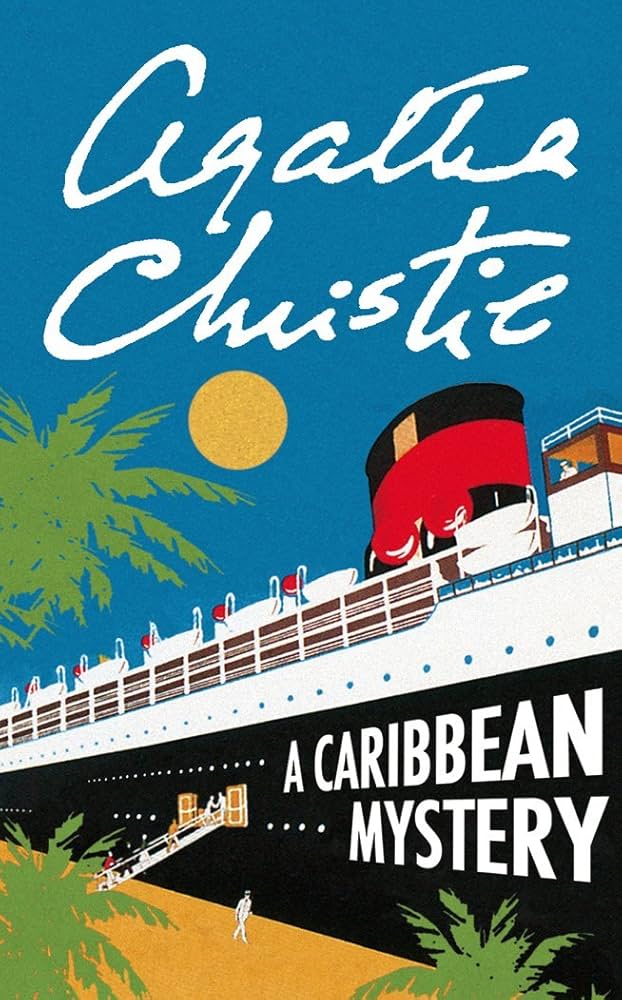
A Caribbean Mystery by Agatha Christie

This month for the Read Christie 2025 challenge, the theme is ‘amateurs’ and although I’ve read the suggested title, Crooked House, quite recently, there were some alternatives that I haven’t already read – including this one, A Caribbean Mystery. Published in 1964, it’s one of the later entries in the Miss Marple series and not one that had really appealed to me; Miss Marple belongs in St Mary Mead and it seemed incongruous to put her in a Caribbean setting! Now that I’ve read it, though, I can say that although it’s maybe not one of my absolute favourite Christie novels, I did really enjoy it.

You may be wondering why Miss Marple is in the Caribbean. Well, it seems she has been ill and her nephew Raymond has paid for her to spend some time recuperating in the sun on the island of St Honoré. Miss Marple is grateful, of course, and is enjoying the warmth and the scenery, but she’s also beginning to feel bored – every day is the same as the one before and nothing ever really seems to happen! This all changes when she falls into conversation with Major Palgrave, an elderly man staying at her hotel, who tells her a story about a man who got away with murder several times. He asks her if she wants to see a picture of a murderer but as he begins to dig out the snapshot, he suddenly stops abruptly and changes the subject as other people approach.

The next day, Major Palgrave is found dead in his room. High blood pressure is blamed, but Miss Marple is convinced he’s been murdered and that there’s some connection with the photo he was about to show her. To add to her suspicions, the photo now seems to have disappeared from the Major’s belongings. It seems likely that the murderer is one of the other guests, but which one? The most likely suspects seem to be the Dysons, Greg and Lucky, and their friends Edward and Evelyn Hillingdon, two nature loving couples who often travel together and who had been walking up the beach towards Major Palgrave as he told Miss Marple his story. But there are others who can’t be ruled out, including the Kendals, who own the hotel; Canon Prescott and his sister; and Mr Rafiel, an old man confined to a wheelchair, visiting the island with his masseur and his secretary.

I found this a very enjoyable mystery; it’s not one of Christie’s more complex plots but there’s some clever misdirection to send the reader along the wrong track. The first murder takes place early in the novel and the story continues to unfold at a steady pace after that, so it held my interest from beginning to end. Miss Marple also plays a big role, in contrast to some of the other books where we see very little of her. This time, she’s present for the entire novel, interacting with the suspects and victims and sharing her thoughts and deductions with the people she believes she can trust. As usual, people underestimate Miss Marple, dismissing her as a ‘fluffy old lady’, but in time some of them come to see that there’s far more to her than meets the eye!

Some of the characters in this book reappear or are referred to again in the later novel Nemesis, published in 1971. I read that one a few years ago, so it was nice to see how those characters were originally introduced and how Miss Marple gained her nickname ‘Nemesis’. I should probably have read the two books in the correct order as it also meant that I could quickly discount those two recurring characters as serious suspects, but it didn’t really matter. Now I’m looking forward to reading Christie’s memoir Come, Tell Me How You Live for Read Christie in July!

Book 4/20 for 20 Books of Summer 2025.

A Schooling in Murder by Andrew Taylor

I love Andrew Taylor’s books and over the last few years I’ve been enjoying his Marwood and Lovett series, set in the 17th century in the aftermath of the Great Fire of London. His new novel, A Schooling in Murder, is not part of the series and leaves that setting behind entirely, taking us instead to the 1940s and a girls’ school near the border of England and Wales.

The novel has a very unusual narrator and when I sat down to write this review I wondered if it would be possible to avoid giving away too much about her. However, the publisher’s own blurb reveals her secret, as do most of the other reviews I’ve seen (and to be fair, she tells us herself in the first chapter anyway): Annabel Warnock is a ghost. In life, she was a teacher at Monkshill Park School for Girls, until being pushed into the river from the Maiden’s Leap, a clifftop viewing point on the Gothick Walk, part of the school grounds. Who pushed her? Annabel doesn’t know, but she’s determined to find out.

As a ghost, Annabel is able to move freely around Monkshill Park – although places she never visited while alive are inaccessible to her – but she can’t be seen or heard by anyone else. This naturally makes investigating her murder very difficult, especially as her colleagues don’t even know she’s dead since her body was never washed up. It seems that the only person who can help is Alec Shaw, Annabel’s replacement – referred to simply as a ‘Visiting Tutor’ to appease parents worried about the school employing a man to teach their girls. Although she can’t speak directly to Alec, Annabel finds a very imaginative way to communicate with him, which was one of my favourite aspects of the book!

As well as the mystery element of the book, we also learn a lot about life in a 1940s girls’ boarding school. Andrew Taylor does a good job of portraying the rivalries and complex relationships that form when groups of teenage girls – and groups of teachers – are living together in a close-knit community. There are occasional references to the war, which is in its closing stages as the book begins in May 1945, but Monkshill Park feels largely sheltered from the outside world, so although the war touches the lives of the characters in various ways it doesn’t form a big part of the story.

The descriptions of the school and its landscape are very detailed, so I was interested to read in Taylor’s author’s note that he based it on Piercefield, a now ruined house and estate near Chepstow in Wales, and that in its fictional guise of Monkshill Park it also formed the setting for his earlier novel, The American Boy. I should have remembered that as The American Boy is my favourite of all the Andrew Taylor books I’ve read!

Although it was interesting to watch a victim trying to solve their own murder, I felt that there was a distance between the characters and the reader, which I suppose is inevitable when your narrator can only watch and observe rather than interact directly with the people around her. Maybe because we’re only seeing them from Annabel’s unique perspective, most of the characters also seem particularly unpleasant! Possibly for these reasons, I didn’t enjoy this quite as much as some of Taylor’s other books, but it was imaginative and different and I’m looking forward to whatever he writes next.

Thanks to Hemlock Press for providing a copy of this book for review via NetGalley.

Book 3/20 for 20 Books of Summer 2025.

Traitor’s Legacy by S.J. Parris

I know S.J. Parris’s Giordano Bruno historical thrillers, set in Elizabethan England, are very popular, but I’ve only read one of them – Sacrilege – and wasn’t particularly impressed. When I saw that she’d started to write a new series, of which Traitor’s Legacy is the first, I thought it would be a good opportunity to give her another try. As it turned out, this is actually a spin-off featuring some of the same characters (but not Bruno himself, although he is mentioned once or twice).

Traitor’s Legacy is set in the winter of 1598 and follows Sophia de Wolfe, formerly an agent of the Queen’s spymaster, Sir Francis Walsingham. Now Walsingham is dead and Secretary of State Robert Cecil has stepped into his role. It’s Cecil who summons Sophia when a girl’s body is found in the foundations of a building site with a scrap of paper tucked inside her clothing. The paper contains a message written in a cipher used by Sophia during her time as a spy, suggesting that someone is trying to link her to the murder. But who would want to do that and how could the secret cipher have fallen into anyone else’s hands?

The girl is quickly identified as Agnes Lovell, a wealthy heiress and a ward of the powerful nobleman Sir Thomas North, who had been planning to marry her to his son, Edmund. It’s possible that the murder could have been committed for political reasons – North had gained a reputation for corruption during a recent military campaign in Ireland – but there also seems to be a connection with the ambitious Earl of Essex, the Queen’s favourite courtier. However, things take a more personal turn for Sophia when suspicion falls on her own illegitimate son, Tobie. Sophia will do whatever it takes to clear his name, but this is made more difficult by the fact that Tobie himself has no idea that she is his mother!

Having only read one of the Giordano Bruno novels, I’m not sure how much we actually learn about Sophia in that series. I vaguely remember her from Sacrilege and presumably she’s in some of the other books as well. It’s definitely possible to follow what’s happening in this book without any prior knowledge, but I did feel there was a lot of backstory I wasn’t familiar with and had to pick up as I went along. I didn’t find Sophia entirely believable as a 16th century woman, but not wildly anachronistic either and she’s aware of the limitations placed on her by society. I liked her as a character and enjoyed following her investigations. She’s assisted by Anthony Munday, a playwright and another former spy, sometimes working together and sometimes separately which helps the story to move along.

Many of the characters in the book are people who really existed; I’ve already mentioned some of them, but we also meet others including Thomas Phelippes, Cecil’s cryptographer, and Frances Devereux, wife of the Earl of Essex. Through the character of Anthony Munday, the novel also touches on Elizabethan London’s theatrical world and the rival groups of actors, the Lord Chamberlain’s Men and the Admiral’s Men. There’s a lot going on, then, but the plot, although complex, is easy enough to follow and I gradually became gripped by it. I enjoyed this book and am looking forward to meeting Sophia and her friends again as the series progresses.

Thanks to Hemlock Press for providing a copy of this book for review via NetGalley.

The Edinburgh Murders by Catriona McPherson

This is the second book in Catriona McPherson’s new mystery series set in 1940s Edinburgh, but if you haven’t read the first one (In Place of Fear) it shouldn’t be a problem as both books also work as standalone novels. Those of you who have read In Place of Fear will remember that it introduced us to Helen Crowther, a welfare officer (formally a ‘medical almoner’) in the newly formed National Health Service. This second novel again follows Helen as she carries out her duties for the NHS and becomes embroiled in another mystery.

The novel opens with Helen taking a patient to the public bath house on Caledonian Crescent. As she helps the woman to wash herself, they become aware of a disturbance in one of the men’s cubicles. A man has been found boiled to death in a bath of scalding hot water – but how? Why would he continue to lie there as the water got hotter and hotter? And how could it have reached such a high temperature anyway? Even more worrying for Helen is the fact that she has spotted her father, Mack, at the baths, but when she speaks to him at home later, he tries to deny that he was there. As the bodies of more men are found around Edinburgh, all killed in equally unusual, gruesome ways, Helen becomes convinced that her father knows more about the deaths than he’s admitting to.

When I reviewed In Place of Fear, I mentioned that the mystery only formed a small part of the book, with more focus being on the historical element and the work of an almoner in the NHS. This book is the opposite – the mystery is much stronger, with the first murder discovered in the opening chapter and several more following soon after. The murders are carried out using imaginative methods and are obviously linked in some way, so Helen needs to decide exactly what the link is in order to identify the killer. It’s quite a dark book, but although the descriptions of the murders are unpleasant, they’re not too gory or graphic.

As with the first novel, there’s a great sense of time and place, bringing the atmosphere of Edinburgh’s Fountainbridge area to life. McPherson uses a lot of dialect and there’s a glossary at the front for those readers who need help with the Scottish words and phrases. I found that there was less time spent describing Helen’s welfare work, though, which was one of the things I thought was particularly interesting in the first novel. Still, I enjoyed meeting her again, as well as the other recurring characters such as the two doctors she works for and her younger sister, known as Teenie. There’s also the beginnings of a possible romance for Helen with her friend Billy, who works at the morgue and helps her investigate the mystery and I’ll look forward to seeing how this develops in the next book.

I still haven’t read any of Catriona McPherson’s other novels, although she seems to have written a lot of them! I should probably investigate while I’m waiting for a third Helen Crowther book.

Thanks to Hodder & Stoughton for providing a copy of this book for review via NetGalley.

Marble Hall Murders by Anthony Horowitz

I’ve been waiting for this book for five years and here it is at last: the third (and it seems, final) book in Anthony Horowitz’s Susan Ryeland series. Apparently we have the actress Lesley Manville to thank for the fact that it’s been written at all – after starring as Susan in the recent BBC adaptations of Magpie Murders and Moonflower Murders, she told Horowitz she was desperate for a chance to play the character for a third time! If you haven’t read the previous two books I would recommend at least reading Magpie Murders before this one (there’s a note at the start of the book to warn us that it does contain spoilers).

In Marble Hall Murders, Susan is back in England having separated from Andreas and left him behind in Crete. Now working as a freelance editor, she attends a meeting with the publisher of Causton Books, Michael Flynn, who suggests an exciting new project to her. Three new continuation novels of the Atticus Pünd mystery series have been commissioned and as Susan had worked on the original novels with the late author Alan Conway, she’s the obvious choice to edit the new books as well. She agrees to take the job, but when she hears that Eliot Crace will be writing the novels, she’s less enthusiastic. Eliot’s previous novels were failures and the man himself she remembers as unpleasant and unreliable. That was a long time ago, though, so maybe things have changed.

When Susan receives a manuscript from Eliot containing the first part of the first continuation novel, Pünd’s Last Case, it’s much better than she expected and perfectly captures Alan Conway’s writing style. However, Susan quickly spots another similarity. Like Alan before him, Eliot appears to be putting coded messages into the book: anagrams, characters based on his own family members – and maybe even clues to a twenty-year-old real life crime.

Pünd’s Last Case is set in 1955 in the South of France where private detective Atticus Pünd and his assistant, James Taylor, are investigating the death of Lady Margaret Chalfont, an Englishwoman who drank poisoned tea just before her lawyer was due to arrive to discuss her will. The culprit seems obvious, but Pünd is sure there’s more to the situation than meets the eye. As Susan reads the manuscript and watches Pünd’s Last Case unfold, she becomes convinced that Eliot is drawing parallels with the death of his own grandmother, the world-famous children’s author Miriam Crace. Hoping to find out more, she travels to Miriam’s former home, Marble Hall, now a popular tourist attraction, where she discovers that although Eliot may want the truth about his grandmother made public, everyone else wants it to remain a secret!

I enjoyed this as much as the first two books. As usual, the Pünd story is so good I would have happily read it as a standalone without the framing story around it. I liked Pünd’s relationship with Frédéric Voltaire, the police detective from Paris who is conducting the official investigation, and I loved the French setting – although Susan Ryeland doesn’t and wants Eliot Crace to switch it back to England. She has her reasons for this, as she’s looking at the book from the perspective of an editor as well as a reader (something which gives Horowitz lots of opportunities to explore various aspects of the editing and publishing process). The mystery surrounding Miriam Crace and her family is also fascinating. She’s a fictional character but surely inspired by Enid Blyton – an author whose books (in Miriam’s case a series called The Little People) have delighted generations of children, but who is considered cold and unloving by her own children and grandchildren.

I picked up on some of the clues in both the Atticus Pünd story and the contemporary one before Susan did, but there was still a lot that I didn’t guess and the solutions to both mysteries weren’t quite what I’d expected. I was happy with the way the book ended, but also sorry if this really is the final one! I do love Horowitz’s Daniel Hawthorne series as well, so I hope there’ll at least be more of those on the way. Meanwhile, I’ll look forward to the TV adaptation of Marble Hall Murders, having enjoyed the first two!

Thanks to Century for providing a copy of this book for review via NetGalley.