Death Comes as the End by Agatha Christie

This month’s prompt for Read Christie 2023 is a murder method: ‘a fall from height’. I’ve missed the previous two months of the challenge as I’ve been reading other things, but I decided to take part in this one as the suggested title – Death Comes as the End – was one I hadn’t read before and which has always sounded particularly intriguing to me.

First published in 1944, Death Comes as the End is the only historical novel Christie wrote. Unlike her other books, which are all set in the 20th century, this one takes place in Ancient Egypt, a setting that would have been familiar to Christie through her interest in archaeology. I’ve seen it described as the first full-length historical mystery, although I’m not sure if that’s true.

The novel is written mainly from the perspective of Renisenb, a young widow who, following her husband’s death, has returned to her family home by the Nile. Her father Imhotep, a mortuary priest, is away on business in the north, but Renisenb is reacquainted with the other members of the household: her older brothers Yahmose and Sobek and their wives; her younger stepbrother, Ipy; her grandmother, Esa; and several of the family’s servants, including Henet, the housekeeper and Hori, the scribe. There are already some tensions simmering below the surface, but when Imhotep returns with a new concubine, Nofret, things become much worse.

Nofret is a bitter, spiteful woman who seems determined to cause trouble for everyone else. She attempts to manipulate Imhotep into disinheriting his three sons and her plan seems to be working – until Nofret herself is found dead at the bottom of a cliff. As nobody had liked her, there are plenty of suspects, but the situation quickly becomes more complex when more deaths occur. Some of the family believe that Nofret’s spirit is taking her revenge, while others are convinced that a human hand is behind the murders. Renisenb isn’t sure what to think or who to trust, but she knows that if the murderer isn’t caught soon, her own life could be in danger.

I really enjoyed this book, although I felt that the absence of a detective made it difficult for the reader to solve the mystery as there’s no discussion of clues or questioning of witnesses to point us in the right direction. I’m sure you could still correctly identify the murderer if you were paying attention, though; looking back, there are two moments in particular that hint at who the culprit is, but I didn’t pick up on either of them while I was reading. The pool of suspects is considerably narrowed down by the end of the book as well – there’s such a high body count it started to remind me of And Then There Were None. There’s also a romantic element to the novel and although it only forms a small part of the story, I was pleased with the way it was resolved at the end. I would have made that choice myself!

I was surprised to read in Christie’s foreword that “Both places and time are incidental to the story. Any other place at any other time would have served as well.” On the one hand, I can see what she means, because the plot, the characters, and the relationships between the family members are very much what you would expect to find in one of her 20th century country house mysteries. On the other, it seems a strange thing to say because why choose a particular setting if any other would have done just as well? In any case, much as I love her Poirot and Miss Marple novels, I enjoyed being transported back to Thebes in 2000 BC for this one – it was something different and unusual!

This is book 9/20 of my 20 Books of Summer 2023
This is book 30/50 for the 2023 Historical Fiction Reading Challenge.
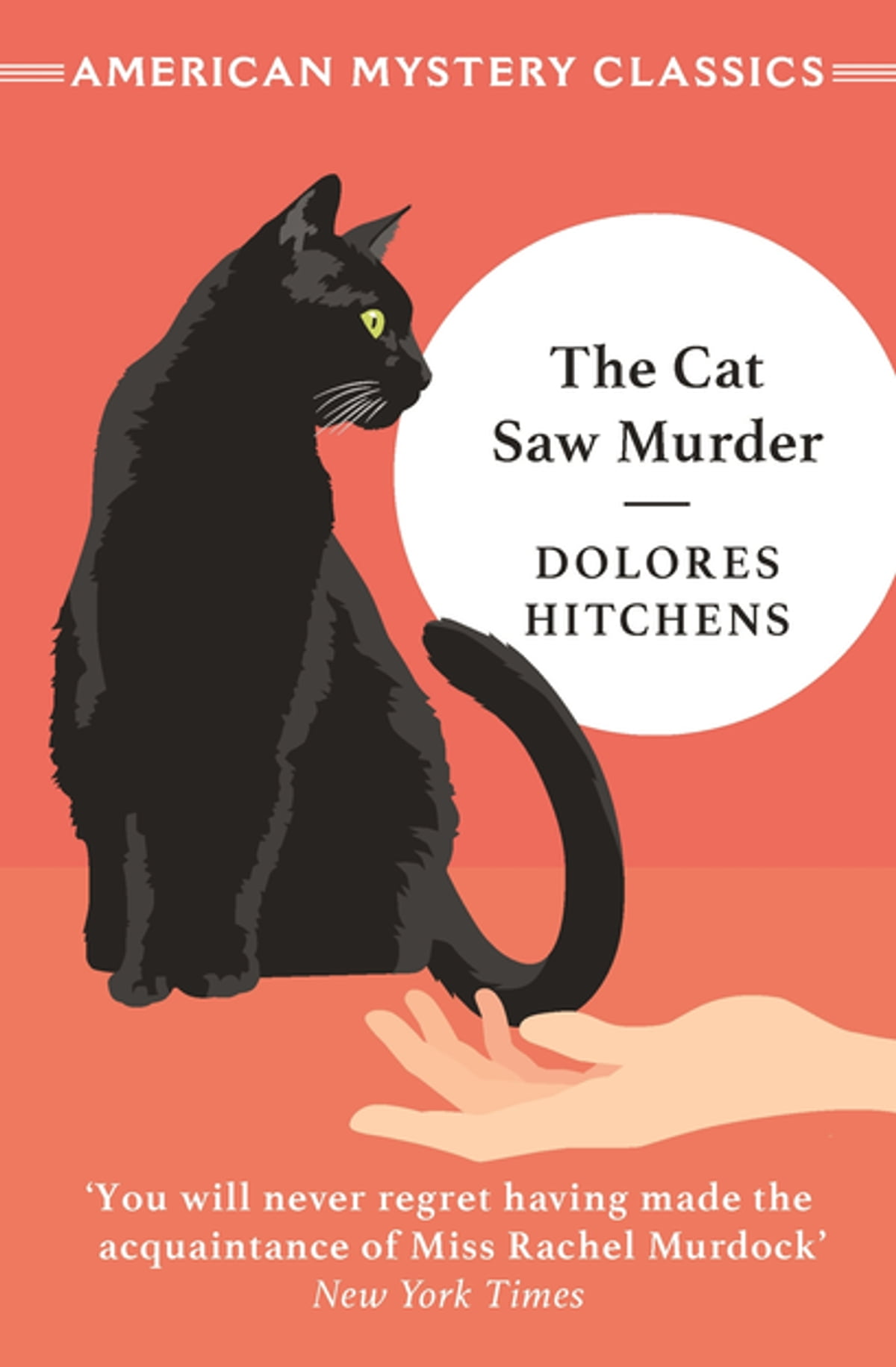

The Cat Saw Murder by Dolores Hitchens

This week, Mallika of Literary Potpourri is hosting Reading the Meow, a celebration of books featuring cats. When this event was first announced, I wasn’t sure if I had anything suitable; The Life and Opinions of the Tomcat Murr by ETA Hoffmann would have been perfect, if I hadn’t just read it last year. Then I came across a whole series of books with cats in them (or in the titles, at least): Dolores Hitchens’ Rachel Murdock mysteries, some of which have now been reissued as part of the American Mystery Classics imprint. The Cat Saw Murder, originally published in 1939, is the first and I hoped it would be a good choice for Reading the Meow.

The novel begins with elderly Miss Rachel Murdock going to stay with her adopted niece, Lily Sticklemann, who lives at Breakers Beach near Los Angeles. Lily has hinted that she’s in trouble and needs advice, so Miss Rachel has packed her case and set off by train to see if she can help. Her less adventurous sister Jennifer has stayed behind, but Miss Rachel is accompanied by Samantha, the black cat who once belonged to their other sister, Agatha. Agatha was an eccentric woman and on her death she left her fortune to the cat, meaning that Samantha is now a wealthy heiress in her own right. After meeting Lily and discovering that she is having financial difficulties, Miss Rachel becomes concerned for Samantha’s safety, suspecting that Lily has her eye on the cat’s inheritance. However, Lily herself is the one who is murdered – and it seems that Samantha may have been a witness.

There are plenty of suspects – Lily lives in a boarding house, Surf House, and is murdered in her bedroom, which means all of the other residents of the building immediately come under suspicion. Several also have a motive for the crime, as Lily owes gambling debts to some of them and is thought to have been romantically involved with another. Although this is not a locked-room mystery exactly (we know that the bedroom door opens and closes more than once during the night of the murder), it does share many elements of that kind of mystery, but thankfully never becomes too concerned with the puzzle-solving aspects at the expense of the characters and motives.

Miss Rachel is a great character; I found her very endearing and quite similar to Agatha Christie’s Miss Marple in many ways, although she’s more agile and energetic for her age than Miss Marple is and spends a portion of the book searching rooms and crawling around in the attic. She has a good relationship with the detective investigating the murder, Lieutenant Mayhew, and they both contribute, in their different ways, to the solving of the mystery.

The plot feels slightly disjointed at times and there are some confusing shifts between past and present tense (the book seems to be narrated by someone at an unspecified future date looking back on Mayhew and Miss Rachel’s first case), but otherwise I really enjoyed this book and it did turn out to be a good choice for Reading the Meow. Samantha the cat, although not the main focus of the story, does have a substantial part to play and provides some intriguing clues. The second book in the series is The Alarm of the Black Cat and I think I’ll be tempted to read it soon!

This is book 1/20 of my 20 Books of Summer 2023

Inquest by Henrietta Clandon

Inquest is one of four Henrietta Clandon mysteries available from Dean Street Press. Many of you will have heard the sad news earlier this year of DSP publisher Rupert Heath’s death, but it has been confirmed that the titles currently in print will still be available as long they have the copyrights. I loved the first Clandon novel I read, Good by Stealth, so I thought I would read another one while I still had the opportunity.

Henrietta Clandon was a pseudonym of John Haslette Vahey, a Northern Irish author who also wrote under several other names, most often Vernon Loder. Inquest, originally published in 1933, was the first of his books under the Clandon name. I’ve never read anything else he has written, so I don’t know how much difference there is between the various pseudonyms in terms of writing style or topics.

The novel opens six months after the death of William Hoe-Luss, an English businessman believed to have been poisoned by consuming deadly mushrooms during a house party in France. Now his widow, Marie Hoe-Luss, has assembled all of the original guests – with the addition of Dr Soame, William’s physician – for another house party at Hebble Chase, her estate in England, where she plans to hold a sort of informal ‘inquest’ into her late husband’s death. However, when one of the guests breaks their neck falling from a high window, it seems that the killer may have struck again.

Although the police do eventually arrive on the scene, most of the sleuthing in the book is done by Dr Soame, who also narrates the whole novel. He’s an interesting choice of narrator as his medical knowledge and previous experience as a police surgeon means he works alongside the detectives at times, while also being one of the party, mixing with the suspects. Soame already knows some of the guests through his position as the Hoe-Luss family doctor, but others are new to him which allows the reader to get to know them along with Soame.

I enjoyed the first half of the book, which introduces the characters as they arrive at the estate for Marie’s inquest – an assortment of friends, family members, business partners and former lovers, which means there are plenty of tensions, entanglements and motives for murder. They aren’t the most pleasant bunch of people, but that’s common in Golden Age mysteries so not unexpected and not too much of a problem! However, I felt that later in the book, after the second death takes place, the plot became unnecessarily complicated and I began to struggle to keep everything straight in my mind.

I really wanted to love this book, so I’m disappointed that I didn’t. It’s a good, solid mystery novel, apart from getting a bit confusing towards the end, but there’s nothing to make it stand out from other similar books in the genre, unlike Good by Stealth, which was unusual, witty and clever. I’m not sure whether I’ll read the other two Henrietta Clandon books – I suspect I’ve already read the best one – but maybe I’ll try a Vernon Loder at some point.

Murder is Easy by Agatha Christie

April’s theme for the Read Christie 2023 challenge is poison, but I have read all of the suggested titles on the official challenge page, some quite recently. As I missed taking part last month, I decided to read the book I had planned to read in March instead – Christie’s 1939 novel Murder is Easy. There’s a new BBC adaptation coming later this year and I always prefer to read before watching, if possible!

Murder is Easy is one of the Christie novels that stars neither of her most famous detectives, Poirot or Miss Marple – although it does feature another of her recurring characters, Superintendent Battle. However, even he doesn’t appear until very near the end and plays no part in actually solving the mystery. Instead, almost the entire novel is written from the perspective of Luke Fitzwilliam, a retired police officer and amateur detective.

At the beginning of the novel, Luke has just returned to England from India and is taking a train to London, where he finds himself sharing a carriage with an old lady who introduces herself as Miss Pinkerton. She confides in him that she is on her way to Scotland Yard to report a serial killer in her village. Miss Pinkerton believes that this person – whom she doesn’t name – has murdered at least three people already and has chosen as their next victim the village doctor, Dr Humbleby. Luke assumes she has an overactive imagination, but the next day he reads in the newspaper that a Miss Pinkerton has been hit by a car and killed crossing the road outside Scotland Yard – and when news of the death of Dr Humbleby in the village of Wychwood-under-Ashe follows, he becomes convinced that she was telling the truth after all.

Determined to find out more, Luke heads for Wychwood, where he stays with a friend’s cousin, Bridget Conway, who happens to be engaged to the local lord of the manor. Luke is posing as an author researching a new book on witchcraft and superstition, but Bridget guesses the real reason for his visit and together they begin to investigate the recent deaths.

I really enjoyed this book and for once I correctly identified the murderer, though more through instinct than because I had spotted any particular clue. There are plenty of suspects ranging from the solicitor Mr Abbot and the late Dr Humbleby’s younger partner, Dr Thomas, to the widower Major Horton and the antiques dealer Mr Ellsworthy, who dabbles in black magic. We are told that the village of Wychwood has connections with witchcraft and the occult, but we don’t really explore that in any depth and the setting doesn’t have quite the same eerie atmosphere as the village in Christie’s The Pale Horse.

While Miss Marple doesn’t appear in this book, I found Miss Pinkerton a very Marple-ish character – an old lady with a shrewd mind and sharp observational skills – and was sorry she was killed so early in the story. Luke himself does very little detecting – despite interviewing all of the suspects, he doesn’t arrive at the right solution until somebody else reaches it first – but I still enjoyed following the progress of his investigations. And knowing that Christie often likes to work a nursery rhyme into the text or title of her novels, I was intrigued to come across the lines “I do not like thee, Doctor Fell; The reason why I cannot tell” – the same lines that are quoted in John Dickson Carr’s The Black Spectacles, which I coincidentally read just last week!

Although I didn’t choose Murder is Easy specifically to fit this month’s Read Christie theme, I was pleased to find that poison does feature in the plot, albeit in a small way. The May prompt is ‘betrayal’, if you want to take part.

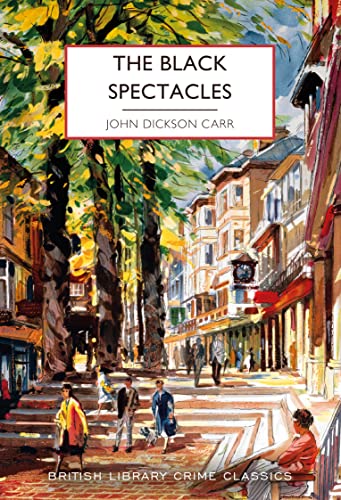
The Black Spectacles by John Dickson Carr

This is only the second book I’ve read by the very prolific John Dickson Carr, who also wrote under several pseudonyms including Carter Dickson. The first one I read was It Walks By Night, one of his Henri Bencolin mysteries, and although I enjoyed it overall, I found the plot too far-fetched and I didn’t much like Bencolin himself. The Black Spectacles, first published in 1939 and recently reissued as a British Library Crime Classic, is from a different series, featuring a different detective – Dr Gideon Fell – so I hoped it would be more to my taste. And it was – I loved it!

The novel is set in the small English village of Sodbury Cross, where a child has died after eating poisoned chocolates. The culprit has not been found, but suspicion has fallen on Marjorie Wells, because she was the one who sent the little boy to the shop to buy chocolates that day. Marjorie’s uncle, Marcus Chesney, believes that most people see the world through ‘black spectacles’, unable to correctly observe what is right in front of their eyes. To prove his point, he decides to stage a performance showing exactly how the real chocolates were substituted with the poisoned ones – and invites Marjorie, her fiancé George Harding and a family friend, Professor Ingram, along to watch. The performance is being filmed with a cine-camera and Marcus has compiled a list of questions to test the observational skills of the three people watching. But when he is found dead, murdered in full view of both the camera and his audience, each of the three witnesses seems to have seen something completely different!

I’ve said that this is a Dr Gideon Fell mystery, but Fell himself doesn’t appear until halfway through the novel. Until that point, the investigations are handled by Inspector Elliot of Scotland Yard, who seems quite competent and thorough…until we discover that he is not being entirely honest with the reader. By the time Fell is brought into the story, most of the clues are in place, but Elliot and the local Sodbury Cross police have failed to interpret them correctly. I’m not surprised they were struggling, because this is a very clever mystery with lots of twists and turns and an ingenious solution. I certainly couldn’t solve it and had to wait for Fell to explain it all, which he does bit by bit as each piece of the puzzle falls into place. I was particularly impressed by a clue involving a clock, which I would never have worked out for myself.

There are so many other things I loved about this book. Carr does an excellent job of capturing the mood and atmosphere of a little English village where the people are trying to come to terms with the discovery that there’s a poisoner in their midst. Some references to real life crimes and poisoning cases are worked into the plot – in particular the case of Christiana Edmunds, who was known as the ‘Chocolate Cream Killer’. I was also fascinated by the descriptions of 1930s film and camera technology, with the recording made of Marcus Chesney’s dramatic scene playing a very important part in the solving of the mystery.

Having enjoyed The Black Spectacles so much, I’m sure I’ll be reading more of the Gideon Fell mysteries soon. You may want to note that this book has also been published in the US as The Problem of the Green Capsule, just in case anyone buys the same book twice!

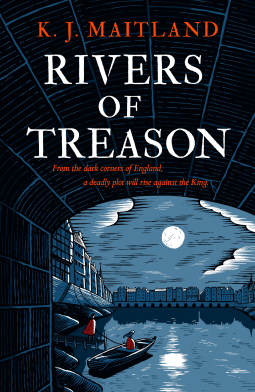
Rivers of Treason by KJ Maitland

This is the third book in KJ Maitland’s 17th century mystery series and continues Daniel Pursglove’s search for the mysterious Spero Pettingar. If you haven’t read the first two (The Drowned City and Traitor in the Ice) I strongly recommend that you do so before starting this book. Even though I’ve read both of them, the plot is so complex I found it difficult to keep track of what was happening at times, so I think coming straight to this book could be quite confusing.

The series is set in the aftermath of the Gunpowder Plot of 1605, a failed attempt by Catholic conspirators to blow up the Houses of Parliament and assassinate the King (James I of England and VI of Scotland). In the first book, Daniel Pursglove was released from Newgate Prison by the King’s advisor, FitzAlan, on the condition that he would hunt down and identify one of the escaped conspirators, a man known only as Spero Pettingar. As Rivers of Treason opens, Daniel has still not caught Spero but the mystery surrounding his whereabouts continues to deepen.

It’s now 1607 and the Great Frost that has held England in its grip during the winter is beginning to thaw. Without FitzAlan’s permission, Daniel has headed north to his childhood home in Yorkshire, not on the King’s business this time, but hoping to find answers about his own past. When an old woman is found murdered, however, Daniel finds himself under suspicion and is forced to flee across the country, pursued by a sinister man with a distinctive black and white beard. Has Daniel stumbled upon the trail of Spero Pettingar at last or has he become caught up in another, even bigger conspiracy?

I enjoyed this book, despite feeling that there was too much going on, a criticism I’ve had of the first two books in the series as well. I would have preferred a tighter focus on the central mystery, which often seems to get lost under the numerous subplots Maitland throws into the story. Having said that, some of the subplots were quite fascinating, such as one involving a London apothecary commissioned by the King to make an antidote to poison. After narrowly avoiding death in the Gunpowder Plot, it’s understandable that James has developed a paranoia about further attempts on his life! During Daniel’s time in Yorkshire, meanwhile, we learn a little bit more about our protagonist’s past and although I still don’t feel that we know him very well, it was good to have some questions answered.

I also love the atmosphere Maitland creates in this series, making it easy to feel immersed in the early 17th century, particularly where she describes the lives of the ordinary people Daniel meets on his travels but also in her descriptions of the Jacobean court. In this book, we follow the preparations for an elaborate masque (play or entertainment) written by the playwright Ben Jonson, with the set and costumes designed by the architect Inigo Jones. Jonson and Jones really did collaborate on many court masques, but this is the first time I’ve read about their work together, so I found that aspect of the story interesting.

Rivers of Treason finishes on something of a cliffhanger, leaving us wondering what Daniel is going to do next. I hope we won’t have to wait too long for the next book so that we can find out!

Thanks to Headline Review for providing a copy of this book for review via NetGalley.

This is book 13/50 read for the 2023 Historical Fiction Reading Challenge.
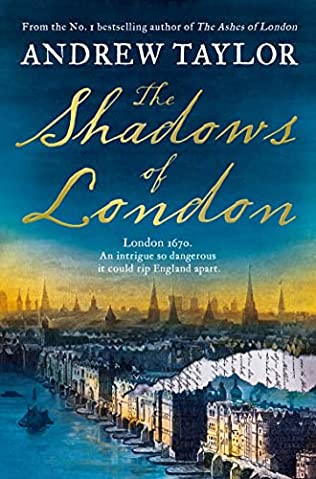
The Shadows of London by Andrew Taylor

A new book in Andrew Taylor’s Marwood and Lovett series is always something to look forward to. This is the sixth in the series and another one I thoroughly enjoyed. If you’re new to these books they do all work as standalones, but I would recommend reading all of them in order if possible so you can watch the relationship develop between James Marwood and Cat Lovett.

The Shadows of London is set around six years after the devastation of the Great Fire of London in 1666. The city is continuing to rebuild and Cat Lovett – now the widowed Mistress Hakesby – is working on the restoration of an ancient almshouse. Having taken over the running of her late husband’s architecture business, Cat is establishing a reputation for herself as a talented architect in her own right, and she and her partner, Brennan, have received a commission to rebuild the almshouse and construct new brick houses on the adjoining land. When a dead body is found on the site, bringing the project to a halt, Cat approaches her friend James Marwood to ask for his help in speeding up the investigations so that work can continue.

Marwood is now working as private secretary to the powerful statesman Lord Arlington. When it emerges that the dead man could be a clerk employed at the Council of Foreign Plantations, Arlington instructs Marwood to find out all he can about the murder. As he and Cat begin to investigate, however, they begin to uncover a trail that seems to be leading to the royal court and to Marwood’s old enemy, the Duke of Buckingham.

The investigation also has implications for another young lady, Louise de Kéroualle, formerly a maid of honour to Charles II’s sister, Minette. The King has his eye on Louise and she has been brought to England to serve as lady-in-waiting to his queen, Catherine of Braganza. It will suit certain people in both England and France to have a Frenchwoman in the King’s bed, but Louise has other things on her mind. Her lover, a French tutor, has gone missing – could he be involved in the almshouse murder?

As with the other five books in this series, Andrew Taylor blends fact and fiction together perfectly. Although the story of the dead man on the building site is fictional, it weaves in and out of the government intrigues and court conspiracies in a way that almost convinces you it could really have happened. While it was good to meet Cat and Marwood again, as well as some of the recurring characters I’ve become quite fond of, such as Marwood’s servants Sam and Margaret Witherdine, I also enjoyed getting to know Louise de Kéroualle. It was interesting to read Taylor’s author’s note where he discusses the politics behind Louise’s seduction by Charles II – with letters from the period as evidence – and why his interpretation of her story is more sympathetic than some.

Long-term readers of the series will be wondering whether this is the book where Cat and Marwood finally get together after what has been a bit of a love-hate relationship. Well, I’m not going to tell you that, but I do think you’ll be pleased to know that, unlike in some of the previous novels, there are plenty of interactions between the two of them and they work closely with each other to solve the mystery. I found the ending of the book quite satisfying, but I’m hoping there will be a book seven as I would love to see what’s in store next for Marwood and Lovett!

Thanks to HarperCollins for providing a copy of this book for review via NetGalley.

This is book 8/50 read for the 2023 Historical Fiction Reading Challenge.