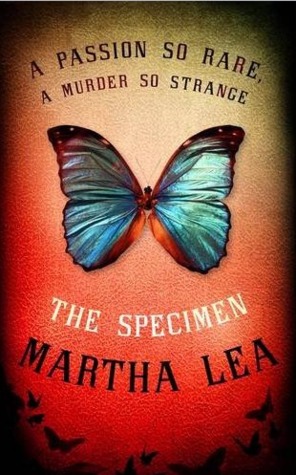
 The Specimen sounded like the type of book I usually love. A Victorian setting, a murder mystery, exotic locations, interesting and unusual female protagonists – these are all things I love in a novel, so I had high hopes for this one.
The story begins in 1866 with Gwen Carrick on trial for the murder of the naturalist Edward Scales who has been found dead at his home in London. The narrative then takes us back in time to show us how Gwen first meets Scales and the events that lead up to his death and the murder trial.
Seven years earlier, in 1859, Gwen is living with her sister Euphemia in their remote home in Cornwall. Both women are unmarried and are leading unconventional lives for the time period – Gwen is an artist who is fascinated by natural sciences and loves to draw butterflies, beetles and other insects, while Euphemia is a spiritualist with a talent for mimicking voices. The sisters have little in common and their relationship is a difficult one. When Gwen meets and falls in love with Edward Scales she leaves her sister behind and accompanies him to Brazil to study and illustrate specimens of the flora and fauna there, but on their arrival in South America she starts to discover that Scales is not quite the person she thought he was. Why did Scales really invite Gwen on the trip to Brazil? What is he hiding from her? And is Gwen guilty of his murder?
Sadly, despite sounding so promising, this book didn’t live up to my expectations. I struggled to engage with the characters (Edward Scales is particularly unlikeable) and the Brazilian setting never really came to life. But my biggest problem was that I found the plot so difficult to follow and even after reaching the final page I wasn’t sure I’d understood what had happened. I do like books that encourage the reader to think, but this one was just too confusing for me. This is probably a book that would benefit from a re-read as it’s the type of story that has lots of clues buried in each chapter, which don’t necessarily have a lot of meaning until you get to the end and can see the whole picture. I didn’t like the book enough to want to read it more than once but I do think that might be the only way I would be able to fully appreciate it!
I do like to read about women who were involved in the sciences during the Victorian period and it was interesting to read about Gwen’s interest in studying and drawing insects. Gwen does not always behave the way a Victorian woman is expected to behave; she values her independence and is struggling to find a place for herself and her work in a nineteenth century society dominated by men. Euphemia was an interesting character too, though again, I found her storyline confusing (and often bizarre) and I don’t think I completely understood what was going on with her.
The Specimen is full of fascinating ideas and themes, so I’m sorry I can’t be more positive about it. I think as long as you’re aware that you need some patience and concentration and don’t go into this book expecting the gripping melodrama promised by the blurb, you might enjoy it more than I did.
I received a review copy of this book from the publisher via Netgalley

 She Reads Novels