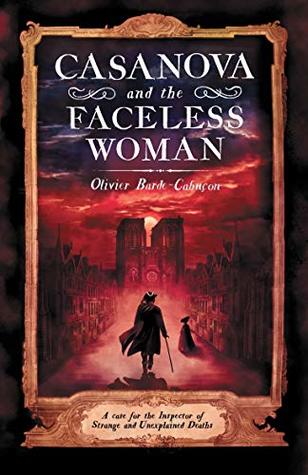
Casanova and the Faceless Woman by Olivier Barde-Cabuçon

Casanova and the Faceless Woman is the first in a series of historical mysteries by French author Olivier Barde-Cabuçon, set in pre-Revolutionary France. There are currently seven books in the series but this one, translated from the French by Louise Rogers Lalaurie, is the first to appear in English. When I was offered a copy for review by Pushkin Vertigo I was immediately intrigued because although I read a lot of historical mysteries I don’t think I’ve read any set in this particular period.

It’s 1759 and Louis XV is on the throne of France. He is not a popular king – unrest is growing amongst those who feel they have been oppressed under his reign and his rumoured liaisons with innocent young girls have not helped his reputation either – and there are several different factions plotting to overthrow or discredit him. Not long before our story begins, Louis had been the target of an assassination attempt and narrowly avoided being stabbed to death thanks to the quick actions of the Chevalier de Volnay. As a reward for his bravery, Volnay has been given the title of Inspector of Strange and Unexplained Deaths, responsible for investigating particularly unusual crimes on the king’s behalf.

One such crime occurs when a young woman is found dead in a dark Paris courtyard with the skin torn away from her face. On arriving at the scene, Volnay removes a sealed letter from the corpse intending to examine it later, but it seems that someone – perhaps several people – have seen him do it. Over the days that follow, as Volnay sets about trying to identify the woman and hunt down her killer, he himself is hunted by those who want to retrieve the letter and will stop at nothing to get it back.

Volnay interested me from the beginning because he is such a mysterious character. We are told very little about him at first, with the secrets of his tragic and eventful past being revealed very gradually as the story progresses. He seems very alone in the world, his only companions being a monk (with whom he forms a fascinating crime-solving partnership) and a tame magpie. There is a sense that he is not somebody who finds it easy to love or to trust others, and so, when he enters into a relationship with the beautiful Chiara D’Ancilla, we worry that he is going to get hurt – especially as his rival in love is the legendary Casanova.

Giacomo Casanova is one of several real historical figures who have important roles to play in the novel; others include Madame de Pompadour, the king’s mistress, and the Comte de Saint-Germain, the alchemist, sorcerer and musician who has fascinated me since I first met him in Diana Gabaldon’s Outlander series. I don’t think Casanova has appeared in any other novels I’ve read, although his career as writer, adventurer, gambler and, most famously, seducer of women, makes him an ideal subject for historical fiction. His character is well developed and convincing here and Barde-Cabuçon explores events from his past in order to explain his present behaviour, but I could never quite warm to him because my sympathies were with Volnay from the start. While Casanova seems to treat his romance with Chiara – and his involvement with the stolen letter and all the intrigue surrounding it – as a game, for Volnay these things are literally a matter of life and death.

I’m not sure whether Louis was really as disgusting and depraved as he is depicted in the novel but his reign certainly wasn’t seen as very successful and I think the author does a good job of conveying the mood in France in the years leading up to the Revolution and the discontent of the people with the king and the aristocracy. However, as a mystery novel, I thought the plot felt a bit more complicated than it really needed to be and the action moved between one set of characters and another too quickly, so that there were times when I struggled to hold on to all the different threads of the story. I also found the ending unnecessarily dramatic with one twist too many – although I had been intrigued by some of the revelations near the end, which left me wanting to read the next book in the series. I hope it’s going to be available in English soon too as I would love to see more of the Inspector of Strange and Unexplained Deaths.

Thanks to Pushkin Press for the review copy.

The Return of Mr Campion by Margery Allingham

This collection of thirteen short stories by Margery Allingham was originally published in 1989 and has been reissued by Agora Books this month. The title is maybe slightly misleading as Allingham’s famous detective Albert Campion only appears in half of the stories, but I actually found that some of the non-Campion stories were amongst my favourites from the collection.

Of the stories featuring Campion, I thought the best were The Black Tent, in which Albert catches a girl stealing a package from a desk during a party and The Case is Altered, where he stumbles upon a case of espionage while spending Christmas with friends. I was less impressed with the other Campion stories in the book, but I thought these two were just the right length, were well plotted and had satisfying conclusions. There’s also an essay, My Friend Mr Campion, where Allingham describes how she created the character of Albert Campion (or rather, how he created himself) and later in the book, in What to Do with an Ageing Detective, she imagines herself coming face to face with an elderly Campion and his servant Magersfontein Lugg. I found the first of these pieces interesting, but I think the second is really just for true Campion fans – which I can’t say that I am yet, having so far only read one full-length novel (Mystery Mile) and a few short stories.

The rest of the stories – the ones which don’t involve Campion and are not necessarily mysteries either – cover a mixture of subjects and genres. I loved Sweet and Low, in which two women who have nothing in common apart from a love of horse riding compete for the attentions of the same man. The horse called ‘Sweet and Low’ has a personality of his own and is the real star of the show in this one! The Wind Glass, about a young girl who rejects a marriage proposal from a Japanese man and receives a rather sinister gift in return, is another one that stood out due to the genuinely eerie atmosphere Allingham creates, although it was difficult to ignore the overt racism which did unfortunately spoil that particular story for me. On a more light-hearted note, I think The Kernel of Truth also deserves a mention. A man prepares a recipe for punch and adds one very special ingredient – but his wife won’t be very pleased if she finds out what it is. This is an entertaining little story that you won’t fully appreciate until you read the final paragraph!

Considering that I’m not usually a lover of the short story format, I enjoyed almost all of the tales in this collection, with only one or two exceptions. I’ll have to try more of the full-length Albert Campion mysteries soon!

Thanks to Agora Books for providing a copy of this book for review via NetGalley.

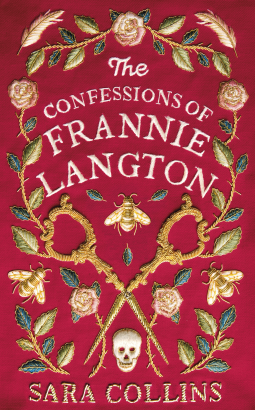
The Confessions of Frannie Langton by Sara Collins

In the author’s note that opens The Confessions of Frannie Langton, Sara Collins remembers reading books like Wuthering Heights and Jane Eyre on the small Caribbean island where she grew up and asking the questions: “Why couldn’t a Jamaican former slave be the star of her own gothic romance? Why couldn’t she be complicated, ambiguous, complex? Why had no one like that ever had a love story like those?’ Frannie Langton is Collins’ attempt to redress the balance and give that Jamaican former slave her very own story in which to star.

The novel opens in 1826 with Frannie – or the ‘Mulatta Murderess’, as she has become known – awaiting trial at London’s Old Bailey for the murders of her employers, George and Marguerite Benham. Frannie, who had been a maid in the Benham household, had been found lying in bed, covered in blood, beside Marguerite’s dead body. She has no idea how she came to be there and is sure she couldn’t possibly have killed her beloved mistress, yet all the evidence suggests that she is guilty. While she waits for her fate to be decided, Frannie looks back on her life and recalls the sequence of events that have led her to this point.

Frannie remembers her childhood, growing up on the Langtons’ sugar plantation in Jamaica (ironically called ‘Paradise’) and describes the circumstances that meant she received an education that would usually be denied to a slave. Later, when Mr Langton returns to England, he takes Frannie with him and she looks forward to new experiences and new opportunities. On their arrival in London, however, she is handed over to the Benhams to become a servant in their home and finds that life is not much better here than it was on the plantation. The one bright spot in her life is her relationship with ‘Madame’ (Mrs Benham), but as we already know from the opening chapter of the book, that relationship will end in tragedy.

The Confessions of Frannie Langton is Sara Collins’ first novel and I’m sure it’s going to be a big success for her. It has been given a beautiful front cover, which stands out even amongst the many other beautiful covers that are around at the moment and the book has already been getting lots of very positive reviews since its publication last week. I didn’t love it as much as most other people seem to have done, but that’s probably because it wasn’t really what I’d expected. I thought the crime element would have been a more important part of the story, but the murder and the trial are confined mainly to the final few chapters, and I’m not sure I would agree with the description of the book as a gothic novel either, although I suppose it would depend on what you consider gothic to mean.

I did find Frannie an interesting and engaging heroine with a strong narrative voice and although there were some parts of her story that I felt I’d read many times before (bearing in mind that I do read a lot of historical novels set in the 19th century), Frannie’s background and unusual circumstances mean that we are seeing things from a slightly different angle. Having one white parent and one black, Frannie never really fits in with the other slaves on the plantation – especially when she is given an education and an enviable position as house slave – but she knows she will never be accepted by most white people either. As you can imagine, she experiences a lot of cruelty and prejudice in her life and this is quite a sad story at times – and also quite disturbing, particularly the descriptions of the ‘scientific experiments’ and research carried out by Frannie’s two masters, Langton and Benham.

Sara Collins writes beautifully and I was struck by sentences like “A man writes to separate himself from the common history. A woman writes to try to join it…” and “A good scientist merely searches for the answer to the question posed, but the one whose name history will record reaches for the questions no one has even thought to ask”. And of course, as a fellow book lover, I appreciated Frannie’s love of literature and her determination to read all the books she could get her hands on. But was Frannie really responsible for the deaths of George and Marguerite Benham? You will need to read her confessions to find out…

Thanks to Penguin/Viking Books for providing a review copy of The Confessions of Frannie Langton and for inviting me to take part in their blog tour.

The Great Impersonation by E. Phillips Oppenheim

I don’t usually pay much attention to the recommendations that pop up on sites like Goodreads and Amazon (“as you liked that book, you might like this one”) but there have been one or two occasions where a particular recommendation has caught my attention, I’ve tried the book and enjoyed it – and that was what happened with The Great Impersonation! This novel by E. Phillips Oppenheim was apparently hugely successful on its publication in 1920, has been adapted for film three times and was included on The Guardian’s list of 1000 Novels Everyone Must Read, yet until now I had never come across the book and didn’t know anything about the author. It seems Oppenheim wrote a very impressive number of books – over 100, mostly thrillers, between 1887 and 1943. I’m not sure whether I’ll look for more of them, but I’m glad I read this one.

The Great Impersonation opens in East Africa in 1913, just before the start of the First World War, and begins with an unexpected encounter between two men who once attended school and university together. One of them is thirty-six-year-old Everard Dominey, who fled England several years earlier following a scandal which arose when he was believed to have killed a man in a fight over his (Everard’s) wife, Rosamund. Since then, Everard has become a dissolute, disreputable drunk, wandering aimlessly from country to country with no direction or purpose in life. The other is Leopold von Ragastein, a German nobleman who has also been banished for duelling with and killing the husband of his lover, the Princess Eiderstrom.

Everard and Leopold have always looked remarkably alike and still do, although the resemblance is not as strong as it used to be because of the very different lifestyles they have been leading. After a night spent drinking and confiding in each other the secrets of their pasts, we see Leopold hatching a plot to dispose of Everard in the desert so that he can steal his identity and undertake a spying mission for the German government.

A few months later, Everard Dominey returns to England, much to the surprise of his friends and family. Rosamund, who has still not recovered from the tragic circumstances of his departure, is shocked by the change in her husband, insisting that he is not the Everard she remembers. Obviously, thinks the reader, that’s because he’s really Leopold von Ragastein! But is he? We didn’t actually witness Everard’s death, after all…

The Great Impersonation is very cleverly written so that, however much we may think we know the truth, we can never be quite certain. Everard/Leopold is always referred to as Everard, even in scenes where he is discussing his spying activities with his German contacts, who have no doubt that he is Leopold. The two men’s lovers, Rosamund and Princess Eiderstrom, cause even more confusion with Rosamund accusing Everard of not being Everard and the Princess claiming that he is Leopold, before changing her mind again! If they cannot identify the man they love, what chance does the reader have? Of course, I am not going to tell you what is revealed in the end, except that I guessed correctly (I had a 50% chance of that, I suppose).

Bearing in mind that the book was published in 1920, I should mention that there is some racist language in the opening chapters set in Africa, but there is much less of this once the action moves back to Europe. I can also tell you that although this is described as a spy novel, there’s not a huge amount of spying in it, so if you’re not very interested in that sort of thing, there’s still some romance, the mistaken/stolen identity storyline, and also some gothic elements (mainly involving a possible ghost or demon that haunts the Black Wood near the Dominey estate).

If anyone else has read this book, please let me know what you thought of it – and whether you can recommend any more of Oppenheim’s many novels.

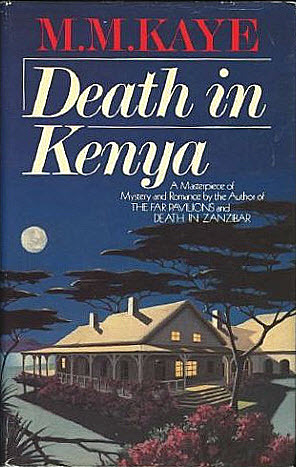
Death in Kenya by M.M. Kaye

This is the fourth in M.M. Kaye’s Death In… mystery series, although the books can be read in any order as they each stand entirely on their own. Like the other novels in the series, this one, Death in Kenya (originally published in 1958 as Later Than You Think), is set in one of the many locations in which Kaye herself lived for a while with her husband, an officer in the British army. In the 1950s, Kenya was still a British colony but the Mau Mau Uprising had been causing unrest across the country throughout the decade and this forms the backdrop for Kaye’s story.

The mystery takes place in and around Flamingo, an estate in Kenya’s Rift Valley which belongs to Lady Emily DeBrett, an eccentric elderly woman who has lived there for many years. When some mysterious, inexplicable events begin to occur at Flamingo – and rumours of a ghost begin to circulate – Lady Em acknowledges that she needs help and sends for her niece in England, Victoria Caryll, to come and join her as companion and secretary. Victoria is tempted by the invitation: Kenya is where she grew up and she longs to return to the country she loves so much, but she knows that Em’s grandson, Eden DeBrett also lives at Flamingo with his wife, Alice – and Eden is the man Victoria was once engaged to, before he ended their relationship with no explanation and broke her heart.

Torn between going and staying, the pull of the Rift Valley eventually wins and Victoria finds herself boarding a plane for Kenya. But when she arrives, she discovers that she has much more than an old lover and a jealous wife to worry about. A murder has been committed and the estate is in turmoil. Will the murderer be found before he or she kills again? Do the people of Flamingo face danger from the Mau Mau leader known as General Africa? And what is the significance of the haunting piece of music called the Rift Valley Concerto?

The mystery aspect of the book is quite enjoyable. I didn’t guess who the murderer was so I was surprised when the truth was revealed, although looking back I feel as though I should have guessed – we were given enough clues to be able to work it out, I think. The descriptions of Kenya are wonderful too, of course; it helps that Kaye lived there herself so could draw on her own experiences and memories when writing the book. I’ve read about the Mau Mau Uprising before, in Leopard at the Door by Jennifer McVeigh, so I already had some basic background knowledge, but that is a recent historical novel whereas Death in Kenya was a contemporary one, so the authors are looking at the same events from different perspectives and from different points in time. Kaye’s sympathies here seem to be more with the white European settlers, which is interesting because that’s not always the case in her novels – as anyone who has read The Far Pavilions or Shadow of the Moon will know, she usually takes a much more balanced view when writing about colonialism. However, she does state in her author’s note that “the opinions voiced by my characters were taken from life and at first hand.”

Although Death in Kenya has the same elements as the previous three books – an interesting, atmospheric setting, a courageous young heroine, a murder mystery to solve and a touch of romance – I found this one slightly different. While the others followed a similar formula (with the heroine actually being on the scene at the time of the murder and falling under suspicion herself), in this book Victoria Caryll doesn’t enter the story until some of the key events have already been played out. This makes Victoria feel somewhat like an outsider and no more or less important to the story than any of the other characters. That lack of one strong, central character to really focus on and connect with probably explains why I felt less engaged with this novel than I did with some of the others, particularly Death in Kashmir and Death in Cyprus.

I still have the last two books in the series – Death in Zanzibar and Death in the Andamans to read – and as they are set in two places I know nothing at all about, I’m looking forward to reading them and learning more!

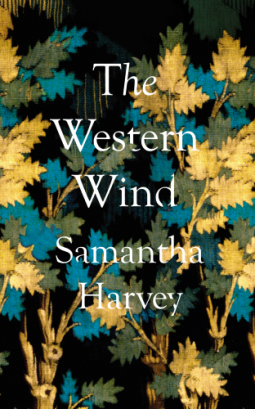
The Western Wind by Samantha Harvey

When The Western Wind was longlisted for the Walter Scott Prize for Historical Fiction in March, I decided to read my copy of the book before the shortlist was announced so that I could see whether I agreed with its inclusion or omission. Now that I’ve read it, although I can’t really say that I particularly enjoyed it, I wasn’t surprised to see this morning that it has been shortlisted as I found it a complex, multi-layered novel with an unusual structure and some interesting ideas to explore. The sort of book judges usually like, I think!

The Western Wind is, on the surface, a murder mystery set in a small English village in 1491. Oakham in Somerset is an isolated place, cut off from the rest of the world by a river without a bridge. The wealthy Thomas Newman, who understands the importance of trade, has plans to rebuild the bridge, but before work can begin he disappears, presumed to have been swept away by the river and drowned. But was it an accident or was it murder? Lord Townshend, who has been losing some of his lands to Newman, would seem to have the most obvious motive, but he is not the only suspect…

Under pressure from his dean to discover what really happened, village priest John Reve listens to the confessions of his parishioners and is surprised by how many of them are willing to confess to having some involvement in Newman’s death. It is up to Reve to use his judgement and his knowledge of his friends and neighbours to decide who is telling the truth. The story, however, is told in reverse, beginning on day four and then moving back in time to a point just before Newman’s disappearance – and by the time we reach the end of the novel, it has become clear that Reve himself knows much more than he seemed to at first.

Despite the mystery at the heart of this novel, I didn’t feel that it was the main focus of the book. The fate of Tom Newman acts as a starting point from which we – through the eyes of John Reve – explore the daily lives of the people of Oakham, their personalities and relationships, the way their community is structured, and the superstitions and traditions that rule their lives. Social and economic change is another theme; even Newman’s name is symbolic, as he is a relevant newcomer to the village, bringing with him new ideas and new ways of looking at the world.

Although we are told that the book is set in February 1491 (at the beginning of Lent) I would otherwise have found it hard to say exactly when the story is taking place. There are very few references to anything happening in the wider world that give us any clues to the precise time period, but maybe that is the point – news from outside would be slow to reach the isolated, insular Oakham after all. I’m not sure how much importance the author places on historical accuracy in any case; she has acknowledged that the confession box which plays such a big part in the story wouldn’t have arrived in English churches until the following century, but she decided to keep John Reve’s box in her novel anyway. I have to admit, I’ve never given any thought to when confession boxes first came into use – but I am fairly sure that fifteenth century men didn’t wear trousers with waistbands as Herry Carter does in the opening chapter of the book. This is the sort of thing that will either bother you or it won’t, I suppose.

I did like Samantha Harvey’s writing but, as well as the points I’ve made above, there was something about the story that left me feeling slightly dissatisfied. I think part of that was due to the fact that, with the exception of John Reve as our narrator, I struggled to connect with any of the characters. This was probably because the way the novel is structured makes it difficult to tell whether we can trust or rely on anything they say or do, especially as we only witness their words and actions from Reve’s perspective. I’m sure that if I’d taken the time to go back and read the whole book again from the beginning, it would have been a very different experience the second time. I didn’t enjoy the book enough to want to do that, but I think it would have helped me to fully understand and appreciate it.

Thanks to Jonathan Cape for providing a copy of this book for review via NetGalley.

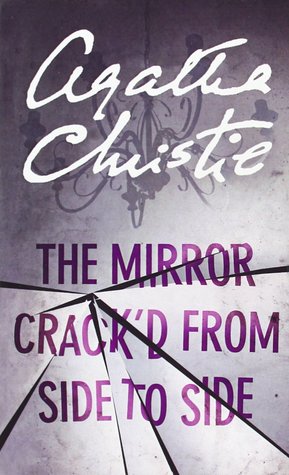
The Mirror Crack’d from Side to Side by Agatha Christie

This month’s book for the Agatha Christie Reading Challenge is one of her later Miss Marple mysteries, The Mirror Crack’d From Side to Side, published in 1962. I tend to prefer the Poirots to the Marples, so I was curious to see what I would think of this one.

The novel opens with the elderly Jane Marple recovering from a recent illness and deciding to take a walk around ‘the Development’, a new housing estate near her home in St Mary Mead. She falls and is helped to her feet by Heather Badcock, one of the new residents, who rushes out of her house to assist. Later, Mrs Badcock is poisoned during a party at nearby Gossington Hall hosted by its new owner, the famous American actress Marina Gregg. It seems unlikely, however, that Mrs Badcock had been the intended victim…it was only through an unfortunate set of circumstances that she came to drink the poison instead of Marina.

Detective-Inspector Dermot Craddock begins to investigate, interviewing all those who were present at Gossington Hall at the time of Heather Badcock’s death and delving into Marina Gregg’s past, uncovering stories of adopted children, jealous rivals and a series of failed marriages. Miss Marple, however, is conducting some very different investigations of her own, based around what she knows of human nature. She is sure that the key to the mystery lies in discovering what caused the strange expression on Marina Gregg’s face just before Mrs Badcock dropped dead – an expression which other guests at the party described as reminding them of Tennyson’s poem The Lady of Shalott (“Out flew the web and floated wide – The mirror crack’d from side to side; ‘The curse is come upon me,’ cried The Lady of Shalott).

This hasn’t become a favourite Christie novel and I didn’t find it quite as clever as some of her others, but I did still enjoy reading it. It seems that she got the idea for the plot from the tragic true story of a real American actress, although I won’t tell you her name because if you look it up it will completely spoil the surprises contained in the solution to the mystery. I correctly guessed who the murderer was very early in the story, but I had no idea what the motive could have been and had to wait for Miss Marple to explain it all for me at the end of the book!

As well as being a murder mystery, this book is also an interesting study of some of the social changes taking place in 1960s Britain with a lot of time devoted to describing the houses on the ‘Development’ and the type of people who live there – with Miss Marple coming to the conclusion that, whatever the time and place, people are still people with the same hopes and ambitions, fears and uncertainties. It is through observations like this that she is able to move towards solving the mystery, drawing parallels between the suspects and other people she has known in the past. Miss Marple is also having personal problems of her own in this book, with her companion/housekeeper Mrs Knight, who treats her like a child and is generally overbearing and domineering. It’s clear that, however much Miss Marple’s age might be catching up with her physically, there is nothing wrong with her mind and she resents Mrs Knight’s condescending attitude. Again, I don’t want to spoil things, but there is a happy ending to this part of the story too!

I can’t say that I loved this one, but I am looking forward to working through the rest of the Marple novels that I haven’t read yet.