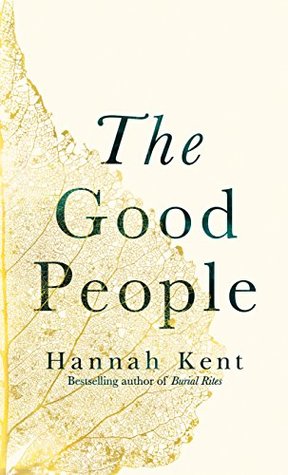
 The Good People is the second novel from Australian author Hannah Kent, following her 2013 debut Burial Rites. I liked Burial Rites – the story of a woman found guilty of murder in 19th century Iceland – but I didn’t love it the way so many other readers did and I was curious to see what I would think of this new one. Now that I’ve read it, I can say that this is definitely my favourite of the two.
The Good People is set in rural Ireland in the 1820s. Nóra Leahy is going through a difficult time, having lost both her daughter and her husband in the space of a year. She has been left to take care of her four-year-old grandson, Micheál, who should be a blessing to her – but to Nóra he is nothing but a worry. She remembers seeing him as a healthy, happy baby, yet the little boy her son-in-law has brought to live with her is entirely different: he is thin and sickly, has lost the use of his legs, can’t understand what is being said to him and communicates through uncontrollable screaming. Nóra knows something is badly wrong with him and, unable to cope on her own, she hires a girl, Mary Clifford, to help her look after him.
Mary is shocked by Micheál’s condition, but does her best for him with the limited knowledge she has, aware that Nóra is starting to view the child with fear and revulsion. In this isolated community, neither the village priest nor the doctor are able to offer any useful advice or explanations, so Nóra seeks the help of the healer and wise woman Nance Roche. Nance knows all about the world of the fairies, or the Good People, as she calls them, and tells Nóra that Micheál is not her grandson at all, but a changeling. Together, Nóra, Nance and Mary set about trying to drive the fairy out of the child’s body in the hope that the real Micheál will be restored.
As you can imagine, The Good People is not exactly the happiest or most uplifting of books – but then, not everything that happens in life is happy or uplifting either, and, like Burial Rites, this novel is based on a true event from history. Poor Micheál’s story is a tragic one, all the more so because of the treatment he receives from the very people he should be able to rely on for love and affection. The worst of it is, these people really seem to believe in fairies and convince themselves that Micheál really is a changeling, because then there is a chance that he can be cured. Through a mixture of ignorance and superstition, they think they are doing the right thing.
Hannah Kent writes beautifully and from the very first page the reader is pulled into a bygone world, a remote community in which the people, despite living in a Christian society, are still holding on to their ancient beliefs and traditions. This is not a fantasy novel or a fairy tale, yet the unseen fairies are a very strong presence throughout the story: we are told that the Good People live in their ringfort, Piper’s Grave, in a lonely part of the valley where lights dance around the ghostly whitethorn tree, and that their powers are strongest at the place where three rivers meet. Everyone seems to know of at least one person who has been ‘swept’ away by the fairies and they just accept these things as part of their everyday lives.
Because of the overwhelming sadness of the story and the suffering of little Micheál, I know this isn’t a book that will appeal to everyone, but I was very impressed by it. I loved it for the quality of the writing, the intensity of the atmosphere and the insights into life in a less enlightened time and place.
Thanks to Pan Macmillan for providing a copy of this book for review via NetGalley.
 In 1922, Count Alexander Ilyich Rostov is brought before a Bolshevik tribunal and found guilty of the crime of being an ‘unrepentant aristocrat’. Once a recipient of the Order of Saint Andrew, member of the Jockey Club and Master of the Hunt, the Count is now considered a Former Person and is sentenced to live out the rest of his days under house arrest in his current place of residence, Moscow’s Metropol Hotel. Forced to leave his luxury suite and move his possessions to a tiny room in the attic, the Count refuses to let his spirit be broken and decides to make the best of his situation, continuing with his daily routines as far as he is able without leaving the building.
 A Country Road, A Tree by Jo Baker
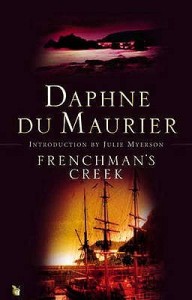 Daphne du Maurier’s Rebecca has been one of my favourite books since I first read it as a teenager, but it’s only relatively recently that I started to explore the rest of her work. Since 2010, I have now read several of her short story collections and one of her non-fiction books, as well as working through almost all of her novels, saving Frenchman’s Creek until near the end (as it sounded like one that I would particularly enjoy and I wanted to have something to look forward to).
 Elizabeth Shore, known as Jane, was a mistress of King Edward IV of England and said to be “merry in company, ready and quick of answer”. She often appears in fiction set during the Wars of the Roses as a minor character – depending on the book, either as a bad influence or a comfort to Edward in his declining health, and a possible conspirator against his brother, Richard III – but several novels have also been written specifically about Jane. I have read two recently and am combining my reviews into one post.
 After reading the Mary Bennett book, I remembered that I had also received The Merry Mistress by Philip Lindsay from
  It’s Christmas 1836 and Hannah Brown is looking forward to her wedding to James Greenacre. However, the marriage will never take place; instead, Hannah is brutally murdered and in the weeks that follow, the parts of her dismembered body are discovered in various locations around London. Her fiancé, Greenacre, is arrested and found guilty – but although he admits to disposing of the body, he claims that Hannah was already dead when he found her. This makes no difference to the judge and jury and Greenacre is sentenced to hang, along with his mistress, Sarah Gale, who is accused of concealing the murder.
 She Reads Novels