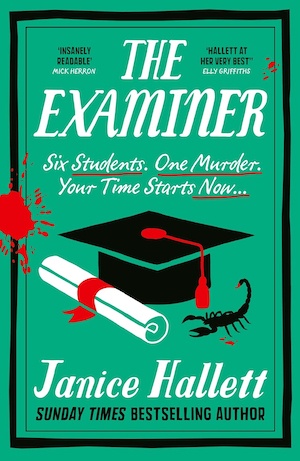
The Examiner by Janice Hallett

It’s September 2023 and six students are preparing to start Royal Hastings University’s new Multimedia Art course. The course is led by Gela Nathaniel who has personally selected her students from different backgrounds to ensure a range of skills and artistic knowledge. There’s Jem Badhuri, an ambitious and enthusiastic young woman who works mainly in sculpture and sound; Alyson Lang, already an experienced and talented artist; Jonathan Danners, whose family own an art gallery; Cameron Wesley, a marketing executive trying to juggle the course with his job; Ludya Parak, a graphic designer and single mother; and finally, Patrick Bright, a man in his fifties who runs an art supplies shop.

Almost as soon as the course gets under way there are hints that something is wrong. Some of the students seem to be hiding secrets and tensions quickly develop between them. Then, five of the group go on an overnight trip to Somerset to visit a museum and it’s not clear whether all five have returned again. Is the missing student still alive or have they been murdered and the others are covering it up? As the course comes to an end, Ben Sketcher, an external examiner responsible for giving an independent assessment of the course and the students’ grades, is given access to all the communications between Gela and her class and must decide whether a crime has been committed.

The Examiner is written entirely in the form of emails, WhatsApp messages and transcripts of chats from the Royal Hastings University messaging app, Doodle. This makes it easy for Hallett to conceal the truth from the reader because each character only reveals what they want the others to know and they aren’t necessarily always being honest. Clues do eventually begin to emerge but the full picture doesn’t become clear until Ben has read every message and every email. Readers of Hallett’s The Appeal or The Mysterious Case of the Alperton Angels will already be familiar with the epistolary format she uses and to be honest I think it’s something you either love and connect with immediately or you don’t. If you didn’t enjoy her other books this one probably won’t change your mind. Personally, I find them unusual and imaginative – and very gripping, as the short length of the emails and chats makes it difficult to stop reading!

The Multimedia Art course is a year long and during that time the students are given various assignments and projects to complete. Their responses to these are provided in the book and although I know very little about multimedia art I enjoyed reading them as they give a deeper insight into each character. I was particularly intrigued by Jem’s work with soundscapes and binaural audio and Patrick’s experiments with resin. Gela’s notes as she examines and grades each project are also interesting as they give us clues about how she views each student and her relationship with them. Why does she show such favouritism to the overqualified Alyson, for example? Why does she make so many allowances for Cameron, who barely attends the course and makes very little effort when he does?

When I eventually discovered what was going on behind the scenes of Gela’s Multimedia Art course I felt slightly let down because it seemed so far-fetched and not what I had expected. Still, the fun was in getting there and watching the dynamics play out between the six students along the way. Although The Twyford Code and The Alperton Angels are still my favourite Hallett novels, I did love this one as well; it’s maybe not the best place to start with her books, but I think existing Hallett fans will enjoy it as much as I did.

I’m counting this as my third book for this year’s RIP challenge.
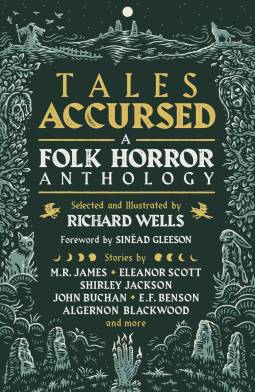
Tales Accursed: A Folk Horror Anthology selected and illustrated by Richard Wells

Folk horror is not a subgenre I’ve ever really taken the time to explore, so I wasn’t sure what to expect from this new anthology selected and illustrated by the artist Richard Wells. What I found was a collection of sixteen stories, most of them from the 19th and early 20th centuries, all blending folklore with elements of the supernatural and lonely rural settings. Each story is accompanied by a beautiful lino print illustration by Wells which I’m sure will look even more impressive in the physical edition of the book than in the ebook version I read.

The stories are arranged chronologically, beginning with Sheridan Le Fanu’s The White Cat of Drumgunniol from 1870 and ending with Shirley Jackson’s The Man in the Woods, published posthumously in 2014. I had read both of these authors before (although not these particular stories) and there were two other authors I’d also read previously – John Buchan and E.F. Benson – but the others were all new to me. In fact, there were several I’d never even heard of until now, so it was good to be made aware of them and to be able to try their work for the first time.

As with most anthologies, the stories vary in quality. However, I found that there wasn’t much variety in terms of plot or setting. Many of them, particularly the older ones, are based on Celtic folklore and have similar structures, with our narrator travelling in an unfamiliar part of the countryside and meeting someone who tells them a story about strange sightings or occurrences, which the narrator then experiences for themselves. Although this did make the collection as a whole feel slightly formulaic and repetitive, there were still some stories that were different and stood out. One of these is Woe Water by H.R. Wakefield, which unfolds in the form of diary entries written by a man with a troubled past who moves into a remote lakeside cabin and begins to struggle with his conscience. I also enjoyed Elinor Mordaunt’s The Country-Side, told from the perspective of a parson’s wife whose relationship with her unfaithful husband takes a sinister turn when she meets an old woman in the village who is said to be a witch.

Ancient Lights by Algernon Blackwood is another highlight – it has a wonderfully eerie atmosphere as the narrator describes his journey through enchanted ancient woodland. The Shirley Jackson story, The Man in the Woods, in which a man accompanied by a stray cat stumbles upon an old house inhabited by three strange people, is also very good. It’s packed with references to mythology and witchcraft and there are lots of layers to unravel, but the open ending left me frustrated and wanting to know more!

Despite the ‘folk horror’ label in the title, I found the stories in this collection creepy or unsettling rather than frightening. I deliberately haven’t said much about any of the individual stories because some of them are very short and it would be easy to spoil them, but overall I did enjoy the book and am interested in reading more by some of these authors.

Thanks to Unbound for providing a copy of this book for review via NetGalley.

I’m counting this as my second book towards this year’s RIP challenge.

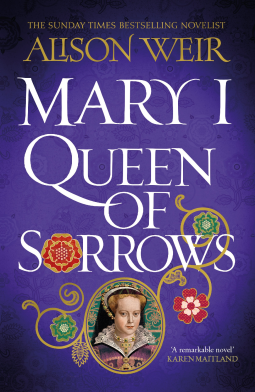
Mary I: Queen of Sorrows by Alison Weir

This is the third novel in Alison Weir’s Tudor Rose trilogy, following Elizabeth of York: The Last White Rose and Henry VIII: The Heart and the Crown. You definitely don’t need to have read the previous two books before starting this one, although if you’re not very familiar with Tudor history it would probably be helpful to read them in order.

The novel begins in 1525, introducing us to nine-year-old Mary who has recently become betrothed to Charles V, Holy Roman Emperor and King of Spain. As the daughter of Henry VIII and his Spanish wife, Katherine of Aragon, a marriage between Mary and Charles would cement England’s alliance with Spain. Mary’s future looks bright, but things don’t go as planned and it’s not long before her whole life is thrown into turmoil. First, Charles decides he doesn’t want to wait for Mary to grow up and takes another bride, one who is richer and old enough to give him children. Then, Mary’s father becomes obsessed with the idea of marrying Anne Boleyn and casts Mary’s mother aside.

It would be difficult not to sympathise with the young Mary as she is put under pressure to betray her mother and denounce her Catholic faith, gains and loses one stepmother after another and, with the arrival of a younger half-sister and half-brother, becomes uncertain of her place in the succession. However, I did find these early sections of the book quite repetitive as having read all of Weir’s Six Tudor Queens series, as well as her novel on Henry VIII, I felt that there wasn’t much here that was new to me. The second half of the book interested me more as it moved on to Mary’s own reign as Queen, her marriage to Philip of Spain and her ‘phantom pregnancies’, and, of course, the persecution of Protestants that famously gained her the nickname ‘Bloody Mary’.

On finishing the book and reading the author’s note at the end, I was interested to find that Alison Weir herself felt that she and Mary shared some childhood experiences, such as the separation of their parents and dislike of the new woman in their father’s life; this probably explains why the chapters dealing with Mary’s early years are written with such sympathy and understanding. Later in the novel, however, Mary becomes a much more difficult character to like as she ignores advice and public opinion, makes some poor decisions, and those who don’t share her Catholic faith burn at the stake. Weir states that she found it hard to make the adult Mary sympathetic when the historical evidence tells us otherwise.

As I wouldn’t want anyone to accidentally buy the same book twice, be aware that the US title of this book is The Passionate Tudor: A Novel of Queen Mary I. Alison Weir’s next novel, coming in 2025, stays in the Tudor period and is about the rise and fall of Cardinal Wolsey. I’ve never read a book written from Wolsey’s perspective before, so that should be interesting.

Thanks to Headline for providing a copy of this book for review via NetGalley.

Book 43/50 for the Historical Fiction Reading Challenge 2024

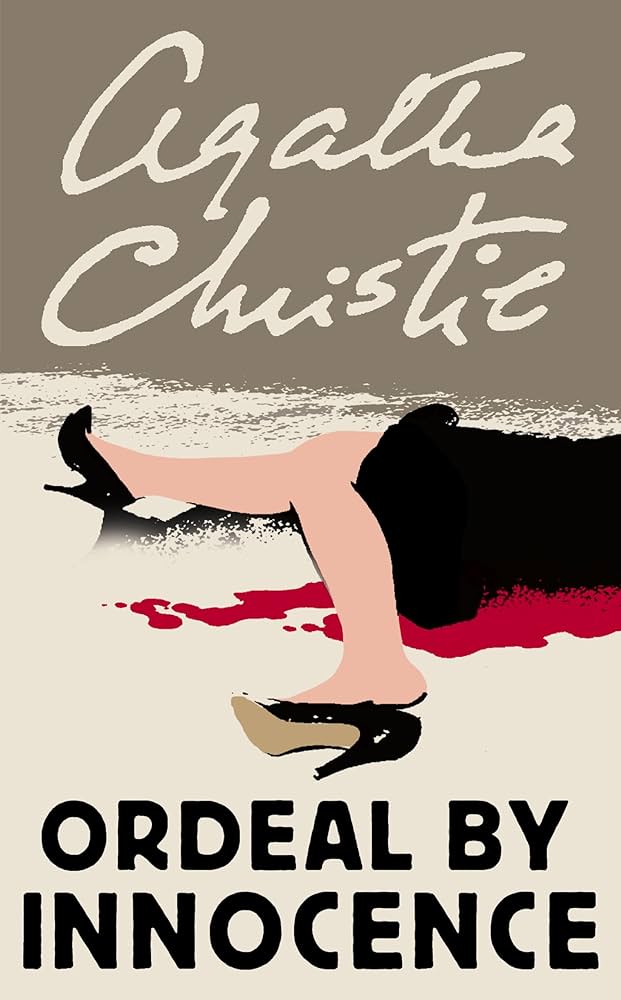
Ordeal by Innocence by Agatha Christie

The September choice for the Read Christie 2024 challenge is Ordeal by Innocence, a book which, along with Crooked House, Christie herself named as one she felt most satisfied with. It was first published in 1958 and is a standalone novel, with no Poirot, Miss Marple or any of Christie’s other recurring characters.

The novel begins with Dr Arthur Calgary visiting the Argyle family at their home, Sunny Point, to give them what he hopes will be some very welcome news. Two years earlier, Jacko Argyle was found guilty of the murder of his adoptive mother. Although he claimed to have an alibi, he was unable to prove it and was sentenced to life imprisonment. Now, Dr Calgary has come forward to confirm that he was with Jacko at the time of the murder, therefore he couldn’t have committed the crime. Calgary seems to have a valid reason for not speaking out sooner – a head injury affecting his memory, followed by a long trip to the Antarctic – but it’s now too late to help Jacko, who has died of pneumonia in prison. Still, Calgary hopes his belated evidence will bring some comfort to the family. However, it has the complete opposite effect…because if Jacko didn’t kill Mrs Argyle, who did?

This is a novel driven by characters, personalities and motives rather than one with a lot of plot. Most of the book is made up of conversations between various members of the Argyle household as they discuss amongst themselves and with Superintendent Huish the events that took place the night of Mrs Argyle’s murder and who they think could be responsible. There’s the dead woman’s husband, Leo Argyle, who is now planning to marry his secretary, Gwenda; there are the other four adopted Argyle children, Mary, Micky, Tina and Hester, all now adults who have had one reason or another to resent their adoptive mother; and Kirsten Lindstrom, their Swedish nurse who has been with the family for many years. It (unbelievably) doesn’t seem to occur to Dr Calgary, until it is pointed out to him, that by clearing Jacko’s name he has simply cast suspicion on the rest of the family again, but this becomes a major theme of the book – the idea that only the guilty person knows the truth, therefore it’s the innocent who suffer the most:

“The family would come under suspicion,” he said, “and it might remain under suspicion for a long time – perhaps for ever. If one of the family was guilty it is possible that they themselves would not know which one. They would look at each other and – wonder… Yes, that’s what would be the worst of all. They themselves would not know which…”

Another theme Christie tackles in this book is adoption and the question of nature vs nurture. Sadly, her opinion of adoption seems to be quite a negative one, with several characters stating that the relationship between a child and their adoptive mother can never be as strong as with their biological mother. It’s also strongly implied that some of the Argyle children have criminal tendencies because they’ve inherited those traits from their birth parents and are destined to be bad people regardless of how much love and attention they receive from their adoptive parents. These are not views I agree with, but clearly they are subjects Christie was interested in and wanted to explore in this novel.

As a standalone, I think this book suffers from not really having a character who does any ‘detecting’. Dr Calgary does take on this role eventually, wrapping things up for us in the final chapter, but otherwise we don’t see much of Superintendent Huish and the only member of the Argyle household who shows any interest in trying to solve the crime is Mary Argyle’s husband, Philip. There’s not much action until very late in the book, so most of the focus is on the characters discussing their memories of Mrs Argyle and what they were doing at the time of her death. In this respect, the book reminded me of Five Little Pigs, another Christie novel which deals with a mystery from the past.

Next month, and for the rest of the year, the Read Christie challenge will be moving on to books published in the 1960s and 1970s. I have plenty of those still to read!

I’m counting this as my first book towards this year’s RIP challenge.

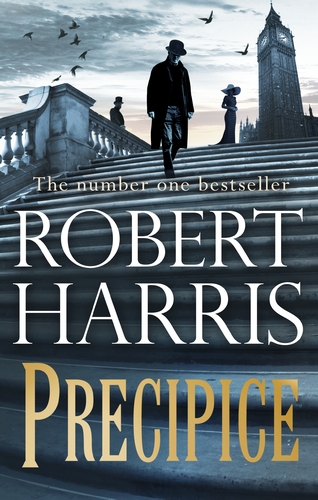
Precipice by Robert Harris

Robert Harris became a must-read author for me after reading and loving An Officer and a Spy, the Cicero trilogy and Conclave, but some of his more recent books have left me feeling slightly disappointed. His new one, Precipice, sounded promising, but would it be a return to form?

The novel opens in London in the summer of 1914 and introduces us to Venetia Stanley, a twenty-six-year-old woman from a wealthy, aristocratic family. Venetia is growing bored with the aimlessness of her days and the spoiled, shallow group of friends, known as the Coterie, that she has fallen in with, so when Herbert Henry Asquith begins an affair with her she sees it as a welcome escape. Not only is Asquith more than twice her age, he is also the Prime Minister and Venetia finds it flattering that he seems to value her opinion on politics and includes her in discussions on important matters of state.

Asquith is currently preoccupied with the situation in Ireland where the Nationalists are campaigning for Home Rule, but soon he has an even bigger problem to deal with as tensions begin to escalate in Europe and it looks increasingly possible that Britain could be pulled into a war. At this crucial moment in British history, it seems that the security of the nation is being put at risk – several confidential documents giving details of the government’s military and diplomatic plans have been found by members of the public and handed to the police. Only a small number of high-ranking government ministers have access to this information so, unlikely as it seems, one of them must be responsible for the leaks. Detective Sergeant Paul Deemer is given the task of investigating and it’s not long before he makes a shocking discovery.

Although I’ve read many novels set during WWI, they’ve usually dealt with ordinary people rather than politicians and certainly haven’t been written from the perspective of the Prime Minister. I knew nothing about H.H. Asquith’s private life, what he was like as a person or how he was viewed by his friends, colleagues and the public, so I learned a lot from this book. Harris draws on Asquith’s published letters to Venetia Stanley as one of his main sources and quotes from them extensively throughout the novel (Venetia’s letters to Asquith were apparently destroyed, so Harris uses his imagination to recreate them).

The impression I got of Asquith from this book, as a politician, was of a generally well-meaning man who was competent enough as a peacetime Prime Minister (apart from where the challenge of Ireland was concerned) but definitely not the right person to lead the country through a war. His overly cautious approach in the early stages was very frustrating to watch; it’s likely that the outbreak of war was inevitable and nothing he could have done would have averted it, but he didn’t seem to grasp the seriousness of the situation at all and refused to commit Britain one way or the other when he was being pressed from all sides to take decisive action. Even when war did break out, it seemed to be of less importance to him than his relationship with Venetia and again it was frustrating to see him sitting composing letters to her during cabinet meetings and plotting ways to escape from political duties to go and visit her. Although the general public weren’t supposed to know about the affair, it was an open secret amongst their family members and I couldn’t help feeling sorry for Margot, Asquith’s wife.

The thriller element of the novel is weaker and although I was never bored, the book never quite became unputdownable either. There’s no real mystery surrounding the security breaches because both we and Paul Deemer know from very early on who is responsible, but it’s still interesting to see how Deemer approaches the situation and there’s an entertaining section where he goes undercover in Wales in search of more information. There’s also a small twist towards the end of the book, which I hadn’t really seen coming, although it had started to occur to me that something wasn’t quite right!

Precipice is definitely more historical fiction than thriller, which may or may not appeal depending on your personal taste. Although it hasn’t become one of my absolute favourites by Robert Harris, I really enjoyed it for the fascinating insights into Asquith and his government.

Thanks to Hutchinson Heinemann for providing a copy of this book for review via NetGalley.

Book 42/50 for the Historical Fiction Reading Challenge 2024

Hera by Jennifer Saint

In her previous novels, Jennifer Saint has retold the stories of several women from Greek mythology including Ariadne, Elektra and Atalanta. Her new book, Hera, as the title suggests, is a retelling of the life of Hera, Greek goddess of marriage.

The novel opens with Hera helping her brother Zeus to overthrow their father, the Titan Cronus, in a great war. With Cronus and the other Titans defeated and banished, Zeus divides control of the world between himself and his two brothers, Poseidon and Hades. Hera wants nothing more than to rule beside Zeus, so while her sisters Demeter and Hestia find new roles for themselves as goddesses of the harvest and the hearth respectively, Hera ends up marrying her brother. She isn’t able to gain the power she desires, however, and begins to grow increasingly resentful of Zeus.

Zeus makes Hera the goddess of marriage, presiding over weddings and childbirth, but their own marriage is far from perfect. Zeus is an unfaithful husband, cheating on Hera with nymphs, mortals and other goddesses, producing a multitude of children who either join the gods on Mount Olympus (such as Artemis and Apollo) or become heroes in the mortal world (Heracles and Perseus). Hera is determined to take revenge, but is this really her best route to happiness?

Hera is usually depicted in Greek myths as vengeful, jealous and vindictive and although Jennifer Saint has clearly set out to paint a more nuanced picture of her here, she doesn’t really do much to change that overall impression. I could certainly have sympathy for her as she’s repeatedly betrayed and treated badly by Zeus and struggles to achieve what she sees as her rightful position as his equal, but Saint’s Hera is still not an easy character to like. Her actions often seem petty and spiteful, taking out her frustrations not just on Zeus but on his children and their mothers, despite the fact that most of those women were actually raped or tricked by Zeus.

Hera is involved in many of the key moments and incidents from Greek myths and I felt that Saint tried to include absolutely everything in this book. Some episodes are fascinating and gripping, but I think others could probably have been left out. My favourite parts of the book were Hera’s visits to the caves inhabited by Ekhidna (usually spelled Echidna), the half woman-half snake who is mother to many of the most famous Greek monsters including Cerberus, the Hydra and the Chimera. In this version, Hera is the mother of Typhon, a monstrous snake-like giant, whom she gives birth to secretly and gives to Ekhidna to raise without Zeus’s knowledge.

This isn’t my favourite Jennifer Saint book – that would probably be Ariadne – but I did find it quite enjoyable and it was interesting to see Saint writing from the perspective of a goddess rather than a mortal woman for a change. Ultimately, though, I was left with a feeling of sadness because Hera seemed so bitter and unhappy; I wished she could have carved out her own path in life like Demeter and Hestia instead of allowing Zeus to do it for her. I’ll be interested to see who Saint writes about next; I would love a whole novel about Ekhidna and her monsters!

Thanks to Headline, Wildfire for providing a copy of this book for review via NetGalley.

The King’s Messenger by Susanna Kearsley

The role of Royal Messenger is one that still exists, but has changed and diminished over time due to modern technology and the declining power of the monarchy. In the 17th century, when Susanna Kearsley’s new novel is set, the job involved acting as a courier to convey messages or important documents around the country, as well as carrying out other diplomatic missions on behalf of the monarch, in this case King James VI and I.

The King’s Messenger opens in London in 1613, ten years after James united Scotland and England under one crown. His eldest son and heir, Henry, Prince of Wales, has died unexpectedly and rumours of poisoning have started to spread. Determined to find out who is responsible, the King summons one of his Messengers, Andrew Logan, and sends him north to Scotland with orders to arrest Sir David Moray, who had been a companion to the young prince. James believes that capturing Sir David is the key to finding out what really happened to his son and he hopes to make him confess to his involvement.

A neighbour of Logan’s, Laurence Westaway, is commissioned to travel with Logan as a scrivener, or scribe, tasked with writing down any information Moray gives them that can be used as evidence. Because Westaway is in poor health, his daughter Phoebe insists on accompanying them to Scotland and back. Unfortunately, Phoebe has always hated Andrew Logan and her loathing for him has intensified since he became embroiled in a confrontation with her lover, the courtier Valentine Fox. It’s going to be an interesting journey!

The novel is written from four different perspectives. Andrew Logan and Phoebe Westaway are two of them and it’s interesting to see how they view each other and how their feelings change as the journey progresses. Sir David provides a third perspective, offering an outsider’s view of the other members of the party, as well as giving us some flashbacks to his time in Prince Henry’s service. Finally, there are a few chapters focusing on Queen Anna, the Danish wife of King James, who also wants to know more about her son’s death. I felt that the Anna sections weren’t really needed and added very little to the novel, but the other shifting perspectives worked very well, changing from one to another at appropriate times to move the story forward.

A large portion of the book is set on the road, as Andrew, Sir David and the Westaways make their way back to London from Scotland. I found the route they take interesting because it’s not very direct, but of course there are no modern roads or infrastructure in the 17th century and they also need to find towns and castles where they can shelter for the night along the way. Andrew’s scarlet livery, which identifies him as a King’s Messenger, can be either a blessing or a danger, depending on the political allegiances of the people they meet. Something else which could put him in danger, considering the witch hunts sweeping across the country during that period, is his ability to glimpse the future. Susanna Kearsley’s novels often contain elements of the supernatural and I liked the way they were handled in this book; Andrew’s second sight doesn’t form a big part of the story but does lead to a wonderfully eerie scene as the party are crossing the Tarras Moss in the land of the Border Reivers.

Susanna Kearsley’s author’s note is almost as interesting as the book itself! I was impressed by the level of research she carried out, including touring the Scottish Borders and north of England to trace the route her fictional characters would take. She also describes the history of the Royal Messengers which led to the creation of her fictional hero Andrew Logan and explains which of the other people in the book were historical figures who really existed. Sir David Moray is one of these, although usually referred to as Murray (she has a reason for using the Moray spelling). Whether real or fictional, all of the characters in the novel come to life; I loved both Andrew and Sir David and although it took me longer to warm to Phoebe, she did win me over in the end!

I loved this book; it’s probably my favourite by Susanna Kearsley so far. It’s also coincidentally the second book I’ve read in the space of two months about Anne/Anna of Denmark (the other was The King’s Witches by Kate Foster).

Thanks to Simon & Schuster UK for providing a copy of this book for review via NetGalley.

Book 41/50 for the Historical Fiction Reading Challenge 2024