Lord Edgware Dies by Agatha Christie

This year’s Read Christie challenge has a ‘Through the Decades’ theme and this quarter we’re reading books from the 1930s. My choice for May is Christie’s 1933 Poirot mystery Lord Edgware Dies (published in the US as Thirteen at Dinner).

The novel is narrated by Poirot’s friend, Captain Hastings – a nice surprise as I tend to love the Hastings books and hadn’t realised he was in this one. At the beginning of the book, Poirot and Hastings are visiting the theatre to watch a performance by the American impressionist Carlotta Adams, known for her impersonations of famous people such as the actress Jane Wilkinson. After the show, they are approached by Jane Wilkinson herself, who asks for Poirot’s help in obtaining a divorce from her husband, Lord Edgware. The actress desperately wants to marry the wealthy Duke of Merton and tells Poirot that if Edgware won’t agree to a divorce, she’s just going to have to kill him!

When Lord Edgware is indeed found dead in his own home, having been stabbed in the neck, Jane Wilkinson appears to be the obvious suspect – after all, she was seen entering the house that evening and everyone knew that she wanted her husband dead. However, Edgware had already agreed to a divorce earlier that day, taking away Jane’s motive. And Jane had spent the whole of that evening at a dinner party with twelve other guests, all of whom can provide her with an alibi. Was Jane really in two places at once – or was it Carlotta Adams who entered Lord Edgware’s house in disguise?

This is a very enjoyable Poirot novel with a clever solution, although I don’t think it’s an absolute favourite as I found it a little bit lacking in atmosphere. The whole story takes place in London and we don’t see much of Poirot actually going out in search of clues – instead he sits and waits for the clues to come to him, much to the frustration of Hastings who wishes Poirot would take a more active role in solving the mystery, like their old friend Inspector Japp:

Poirot replied that he preferred to solve it sitting at home.

“But you can’t do that, Poirot.”

“Not entirely, it is true.”

“What I mean is, we are doing nothing! Japp is doing everything.”

“Which suits me admirably.”

“It doesn’t suit me at all. I want you to be doing things.”

“So I am.”

“What are you doing?”

“Waiting.”

Of course, Poirot is the one who correctly identifies the murderer while Japp, as usual, jumps to the wrong conclusions. I also failed to solve the mystery; although I did guess part of the solution very early on, I allowed myself to get distracted by the red herrings, of which there are many!

What I particularly loved about this book was the relationship between Poirot and Hastings and the way they work so well together, with some chance remarks of Hastings’ inadvertently pointing Poirot in the direction of important clues. Having the novel narrated by Hastings means the reader gets to hear Poirot discussing possible theories with him and sharing his thought processes, which I find more enjoyable than the books where we have no idea what Poirot has been thinking until the end. It also means that we only see the various suspects and witnesses from Hastings’ perspective; Jane Wilkinson, for example, presents herself in public as so silly and vacant that we know there must be more to her than meets the eye. Jane is a great character and Jenny Driver, Carlotta Adams’ friend who owns a fashionable London hat shop, was another favourite.

I’m hoping to read another 1930s Christie novel in June, then for July-September we move on to the 40s and 50s!
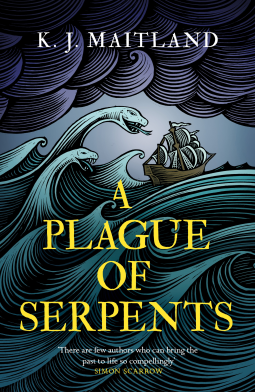
A Plague of Serpents by KJ Maitland

This is the fourth and final book in the Daniel Pursglove series by KJ Maitland (who has also published under the name Karen Maitland). Although I’ve done my best to avoid spoilers in this review, I wouldn’t recommend starting with this book anyway; the plots are complex and there are lots of characters to keep track of, so this is a series that should really be read in order, beginning with The Drowned City and moving on to Traitor in the Ice and Rivers of Treason.

This fourth novel, A Plague of Serpents, is set in the spring of 1608. It’s been three years since the Gunpowder Plot of 1605, a failed attempt on the life of King James I of England and VI of Scotland by Catholic conspirators. One of the escaped conspirators, a man known only as Spero Pettingar, remains unidentified and uncaptured, but Daniel Pursglove is still on his trail. The King’s man, Charles FitzAlan, who released Pursglove from Newgate Prison on the condition that he would hunt down Spero Pettingar in return, is growing impatient; the longer Pettingar remains on the loose, the longer the King’s life remains at risk.

In search of answers, Daniel infiltrates a secret group of Catholics known as the Serpents who are plotting another assassination attempt. However, he has also become aware of a second group, the Wyverns, who are planning to use the Serpents as pawns and then seize control of the throne for themselves. To make things even more dangerous for Daniel, there are people within both factions who know too much about him and are prepared to threaten and blackmail him to get what they want.

Unlike the previous three novels, which took us to Bristol, Sussex and Yorkshire respectively, this one is set in London and while floods, frosts and thaws played a big part in those three books, the natural environment is less significant in this one. Instead of extreme weather conditions, this time the public have an outbreak of plague to deal with. I’ve always found the plague an interesting topic to read about, even more so since our own recent pandemic, but it doesn’t actually form a very big part of the book despite the title and prologue which made me think otherwise! Other than that, Maitland does her usual excellent job of creating an immersive and believable 17th century world. Rather than breaking the flow of the story to explain the meanings of terms and phrases, she saves these for a glossary at the end of the book, so if you want to know what a bene-feaker is, what a palterer does or what a cracknel tastes like, you’ll have your chance to find out.

The characters in the novel are a mixture of real and fictional; some, like Robert Cecil, are well known historical figures, but others are more obscure – I was surprised to find that the brothel-keeper Donna Britannica Hollandia really existed! With this being the last in the series, the storylines for the characters who have been with us for several books are wrapped up in one way or another and I was pleased to see that my theory about one particular character was proved correct.

Although I did enjoy A Plague of Serpents, I felt that it, like the earlier books, was far more complicated than it really needed to be. With several different groups of conspirators and others at court working with or against each other for their own purposes, it was difficult at times to remember who was on which side and who knew what. Otherwise, this was a perfect ending to the series and I will be interested to see whether Maitland continues to write historical mysteries/thrillers like these or goes back to the kind of standalone historical novels she wrote earlier in her career.

Thanks to Headline Review for providing a copy of this book for review via NetGalley.

Book 17/50 for the Historical Fiction Reading Challenge 2024

The Household by Stacey Halls

Urania Cottage in Shepherd’s Bush, London, was a home for ‘fallen women’ founded in 1846 by Charles Dickens and Angela Burdett-Coutts. Their vision was to provide a safe place for young women to rehabilitate after serving prison sentences or working on the streets as prostitutes. At Urania Cottage they would receive an education and the opportunity to train as domestic servants, enabling them to start new, more respectable lives overseas. In her latest novel, The Household, Stacey Halls imagines the stories of some of these women.

During the period covered in the novel, there are many young women staying at Urania Cottage, but Halls chooses to focus on two of them. One is Martha who, while trying to rebuild her own life at the cottage, is also worrying about her sister, Emily, who has disappeared. As Martha grows more desperate about Emily, she is driven to make a decision she may later regret. The other is Josephine, who had expected a close friend to accompany her to Urania Cottage. When the friend never arrives, Josephine must decide whether to continue participating in the scheme or leave in search of happiness elsewhere.

Dickens himself is mentioned now and then but always stays in the background, never becoming an actual character in the novel. Angela Burdett-Coutts, on the other hand, has a much larger role. We meet Angela as a woman in her early thirties who several years earlier inherited a fortune from her banker grandfather, making her one of England’s wealthiest people. She is becoming known as a philanthropist and Urania Cottage is one of her first big projects.

Angela’s privileged lifestyle means she struggles to truly understand the needs of the women at the cottage, but she and Dickens both enter into the project with the best intentions. However, despite Angela’s wealth and position she still has problems of her own to deal with – such as being stalked by Richard Dunn. She had thought she was safe from Dunn when he was sent to prison for four years, but now he’s been released early and is on her trail again. As I read, I wondered whether this was a fictitious storyline, but I looked it up and found that, yes, Richard Dunn was a real person and did obsessively pursue Angela Burdett-Coutts as described in the book. It seems that other parts of the novel I had assumed were invented were also based on historical fact; after finishing the book I was interested to learn that many of the incidents described as happening at Urania Cottage were taken from Dickens’ letters to Angela and even inspired his own David Copperfield.

The Household is fascinating in many ways, yet it’s probably my least favourite of Stacey Halls’ books. The separate stories of Angela, Josephine and Martha never quite blend together properly and give the novel a disjointed feel. I found the first half very slow and although there’s a twist towards the end that I hadn’t seen coming, it happens too late to really change the way I felt about the book overall. Still, I’m pleased to have had the opportunity to learn about life at Urania Cottage and will look forward to whatever Stacey Halls writes next.

Thanks to Manilla Press for providing a copy of this book for review via NetGalley.

Book 16/50 for the Historical Fiction Reading Challenge 2024

Close to Death by Anthony Horowitz

At some point in our lives, many of us will have to deal with the problem of difficult neighbours. Loud music and late-night parties, badly-behaved children, disputes over parking and damage caused by cats and dogs are all things that can make life stressful – but most of us wouldn’t resort to murder as a solution. However, that is exactly what seems to have happened at Riverview Close, a street of six large, luxurious houses in an affluent area of London.

The residents of Riverview Close include a doctor, a dentist, a retired lawyer, a chess grandmaster and two former nuns, all of whom have been getting on well together and leading peaceful lives. Everything changes with the arrival of Giles Kenworthy and his family, who are noisy and inconsiderate and succeed in annoying everyone else in the Close. When the residents learn that the Kenworthys are planning to cut down a beautiful tree and build a new swimming pool in its place, they decide to hold a meeting to discuss the situation – but a few weeks later the problem is solved anyway, as Giles is found dead, having been shot with a crossbow.

Five years later, author Anthony Horowitz (who uses himself as a character in his own novels) is looking for a subject for his new book. His previous four have been accounts of mysteries he has investigated alongside the private detective Daniel Hawthorne, but it seems there are no new mysteries to solve – and his publisher is putting pressure on him to start writing. Anthony decides to write about one of Hawthorne’s older cases instead, which happens to be the murder of Giles Kenworthy. Hawthorne agrees to share the details of the investigation with him, but warns him that the ending isn’t very satisfactory.

With large sections of the book set in the past and written in the third person from the perspectives of the residents of Riverview Close, this means Horowitz himself plays a much smaller part in this novel than he did in the earlier books in the series (the first one is The Word is Murder, if you’re wondering). Although I love these books, I know there are a lot of readers who find it irritating and egotistical of Horowitz to use himself as a character, but I think that would be less of a problem with this particular novel.

Because we see less of Anthony, there’s also less time spent on his interactions with Hawthorne, which is a shame as that’s one of my favourite things about this series. I had hoped to learn more about Hawthorne as each book has been slowly adding to our understanding of his character and background, but there aren’t really any major revelations about him in this instalment. There are lots of other interesting characters to get to know, though, including the members of the various households that make up Riverview Close; I particularly enjoyed meeting the two old ladies, May and Phyllis, who used to be nuns but now own a tea shop/book shop that sounds like a great place to visit!

They did not stock any modern, violent crime novels, especially ones that contained bad language. A casual reader looking for Harlan Coben, Shari Lapena, Ian Rankin or even James M. Cain (The Postman Always Rings Twice) would have to continue down the hill to Waterstones at the corner. What they specialised in – exclusively – was cosy crime.

They also stocked a range of gifts that were all crime-related, including the Agatha Christie tea towel May had used to wipe her hands. Other novelties included a Sherlock Holmes magnifying glass, Midsomer Murders mugs and T-shirts, Cluedo jigsaw puzzles and a box of assorted chocolates marked ‘POISONED’, a tribute to the great novel by Anthony Berkeley.

The mystery itself is an interesting one as all of the suspects have the same motive – Giles Kenworthy’s selfish, inconsiderate behaviour – and although I was convinced I had guessed the culprit correctly, it turned out I was wrong. I did wonder why Horowitz (the character) didn’t just look up the solution to the murder on the internet rather than waiting for Hawthorne to tell him the story bit by bit and getting frustrated about not knowing the ending, but that’s just a minor quibble. I’ll look forward to the next book in this series, assuming that there’s going to be one, but I’ll also continue to hope for a new book in the Magpie Murders series!

Thanks to Century for providing a copy of this book for review via NetGalley.

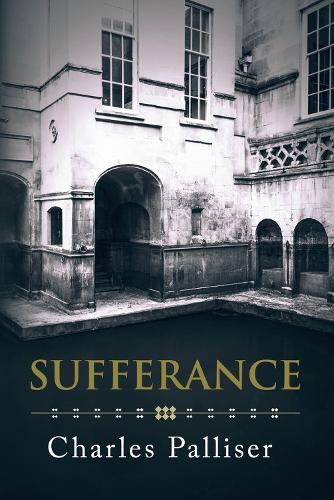
Sufferance by Charles Palliser

Charles Palliser is probably best known as the author of The Quincunx, a long and twisty Dickensian novel which I read and loved years ago, but he has also written five more books including The Unburied and this new one, Sufferance.

Sufferance is a strange novel as none of the characters are named – not even the narrator – and we are not told where or when the story is set. However, it’s obvious enough that we are reading about an occupied European city during the Second World War and at the start of the novel, the Enemy has divided the city into Western and Eastern Zones. We also know that our narrator is a respectable, law-abiding man who works for the government and has a wife and two teenage daughters.

When the narrator’s youngest daughter brings a friend home from school and explains that the girl’s parents have become trapped in the other zone, unable to return to their house, he thinks he is doing the right thing by inviting her to stay with them until her parents come back. He doesn’t expect it to be for long – and it seems that the girl’s parents are wealthy people, who might repay the family for their kindness when they return. Unfortunately, a series of government announcements makes it clear that the girl belongs to a ‘protected community’, who are gradually having their rights taken away and are being closely monitored by the Enemy occupiers.

As the weeks and months go by with no news of the girl’s parents, our narrator and his wife become increasingly anxious and afraid. What will happen if the authorities discover that they are sheltering one of the protected community? To make things worse, the girl has proved to be a selfish, manipulative person who seems ungrateful for the help she has been given and completely unaware of the danger all of them are facing. Tensions within the family start to build as they struggle to agree on how to deal with the situation, but things are only going to get worse the longer they wait.

This is an excellent novel; the vagueness surrounding names, dates and places, which I could have found irritating in another book, is used very effectively here to create a sinister, unsettling atmosphere. Although the historical parallels are very obvious, we are left with the impression that the things described could happen anywhere, at any time and to anybody. The sense of fear and desperation felt by the narrator comes across very strongly, as with the introduction of identity cards, rationing and new laws regarding the girl’s community, he becomes aware that he is committing a crime.

Sufferance is a fascinating exploration of how each decision we make can have serious consequences and how quickly things can spiral out of control. I loved it and really must find time to re-read The Quincunx!

Thanks to Guernica Editions for providing a copy of this book for review via NetGalley.

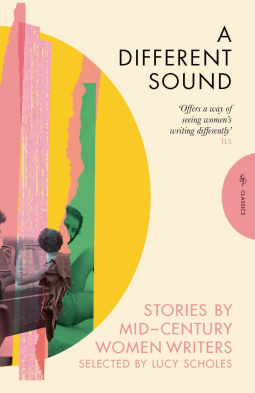
A Different Sound: Stories by Mid-Century Women Writers edited by Lucy Scholes

This is a fascinating collection of short stories, all written by women and originally published in the 1940s and 50s. When I saw the list of authors included in the book, there were several I’d already read, others I’d heard of but never read, and a few that were completely new to me. There are eleven stories in total and as always when writing about collections like this, I’ll have more to say about some of them than others!

There’s only one story in this collection that I’ve read before – and that’s The Birds by Daphne du Maurier. As she’s one of my favourite authors, I decided to read it again and found it just as wonderful and atmospheric as I did the first time. Rather than discuss it again here, I’ll direct you to my previous review and will just add that even if you’ve seen the Hitchcock film, I would still recommend reading the story which is quite different in several ways.

Elizabeth Jane Howard is an author I’m familiar with through her Cazalet Chronicles (I’ve read the first two books in the series and am planning to read the others) and she is represented here with Three Miles Up, an eerie story in which two men are taking a trip through the countryside on a canal boat when they encounter a young woman called Sharon. Once Sharon joins them on the boat, things begin to go wrong and they find themselves sailing up a canal that doesn’t appear on any maps. I loved this one, although I wasn’t aware that Howard wrote ghost stories so it wasn’t what I’d expected at all.

The other two authors I’ve read previously are Stella Gibbons and Elizabeth Taylor. The Gibbons story, Listen to the Magnolias, is set during the war and involves an elderly widow nervously awaiting the arrival of five American soldiers who will be billeted in her home, while Taylor’s The Thames Spread Out follows a woman who is trapped upstairs in her house during a flood while swans swim at the bottom of her staircase. I liked both of these, particularly the second.

Apart from The Birds, my favourite story in the book turned out to be The Skylight by Penelope Mortimer, in which a woman and her young son rent a house in a remote area of France but arrive to find the doors all locked and no sign of the owners. The only point of access is an open skylight in the roof and the mother makes a decision she quickly comes to regret. Mortimer creates a real sense of fear and tension in this story and I couldn’t wait to reach the end to find out if everything was going to be okay!

Considering the publication dates, the Second World War naturally plays a part in many of these stories – I’ve already mentioned the Stella Gibbons, but another is Diana Gardner’s wonderful story, The Land Girl, about a young woman placed on a farm as a Land Girl who takes an instant dislike to the woman whose home she is staying in and decides, out of spite and jealousy, to cause trouble for her.

The stories above are the ones that really stood out for me in this collection, but I enjoyed all of them to some extent, apart from maybe Elizabeth Bowen’s Summer Night which I found well written but confusing due to the structure and changing perpectives. I was also slightly disappointed by Sylvia Townsend Warner’s Scorched Earth Policy about an elderly couple preparing for a wartime invasion, simply because it was too short for any real plot or character development. It was nice to discover some authors I’d never come across before, though: Frances Bellerby, who in The Cut Finger tells the story of a little girl learning some important lessons about the world; Inez Holden whose Shocking Weather, Isn’t It? follows a woman who visits her cousin in various different places over the years; and Attia Hosain who explores the feelings of a newly married woman struggling to fit in with her husband’s friends in The First Party.

I can definitely recommend this collection; I found something to interest me in every story, even the ones I didn’t enjoy as much. I also now have a list of authors I need to explore further!

Thanks to Pushkin Press Classics for providing a copy of this book for review via NetGalley.

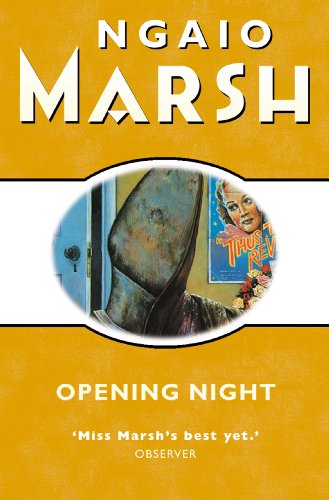
Opening Night by Ngaio Marsh

Opening Night (also published as Night at the Vulcan) is the sixteenth book in Ngaio Marsh’s Inspector Roderick Alleyn series and like many of her novels has a theatrical setting, which makes it perfect for Reading the Theatre, hosted this month by Lory of Entering the Enchanted Castle.

Published in 1951, the novel opens with Martyn Tarne, a young woman from New Zealand, arriving in London to look for acting work. After an exhausting day of unsuccessful auditions and meetings with agents, she eventually finds herself at the door of the Vulcan Theatre where rehearsals are about to begin for a new play, Thus to Revisit. Disappointingly, the play has already been cast, but there’s a vacancy for a dresser to the leading actress, Helena Hamilton, and Martyn finds herself accepting the job.

The next 100+ pages (of a 240 page book) are devoted to describing the backstage preparations for the play, Martyn’s work as first a dresser and then an understudy, and the relationships and interactions between the various members of the cast. There is no hint of any crime until we reach the middle of the book and no sign of Inspector Alleyn either until after the halfway point. I think how much you enjoy this novel will depend on whether you picked it up just because you wanted to read a murder mystery or because you were drawn to the setting.

The crime, when it eventually occurs, involves the death on opening night of one of the actors, Clark Bennington, who is found unconscious backstage after inhaling gas. Suicide is assumed – everyone knows that Bennington has been unhappy and has a drinking problem – but when Alleyn arrives to investigate, he quickly decides that the man was murdered. There are plenty of suspects and motives; for a start, Bennington was married to Helena Hamilton, who has openly been having an affair with one of the other actors, Adam Poole. Also, Bennington is known to have had several heated arguments and altercations before and during the opening night. And to complicate things further, Martyn Tarne’s arrival at the Vulcan has not been welcomed by everyone, least of all Gay Gainsford, a young actress who feels that her role in the company is threatened by Martyn.

Although I would have preferred the murder to have come earlier in the book, once it does happen and Alleyn’s investigation gets under way, the mystery becomes quite an interesting and compelling one. I guessed who the murderer was, but not the motive – and I think it would be very difficult to work that out before it’s revealed right at the end of the book. The mystery is definitely secondary to the setting in this novel, though; Ngaio Marsh herself was a theatre director and her love and knowledge of the theatre comes through very strongly.

Have you read any of Marsh’s Inspector Alleyn novels, theatrical or otherwise? I’ve read very little of her work compared to other Golden Age crime writers so would love to hear your recommendations.