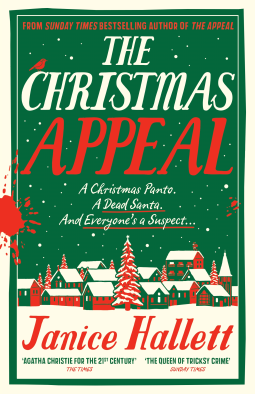
The Christmas Appeal by Janice Hallett – #NovNov23

In this new novella, published just in time for Christmas, Janice Hallett returns to the world of her earlier novel, The Appeal. Once again, newly qualified lawyers Femi and Charlotte are sent a folder of documents and are challenged by their former mentor, the now retired Roderick Tanner, to read through them all and solve the mystery they contain. And once again, the mystery unfolds in the town of Lower Lockwood where the amateur theatrical group known as The Fairway Players are preparing to stage another play, with the aim of raising money for the church roof appeal. This time, it’s that great British tradition, the Christmas pantomime! This year’s choice is Jack and the Beanstalk and rehearsals are about to begin.

Sarah-Jane MacDonald, the fundraising expert from The Appeal, and her husband Kevin have now been elected as co-chairs of The Fairway Players, a move that not everybody is happy with – particularly not Celia Halliday, who believes that she should be the one running the group. Celia is determined to do whatever it takes to prevent Jack and the Beanstalk from being a success, but it seems that the pantomime is already destined to be a disaster and anything that can go wrong will go wrong. What has happened to the young couple who auditioned for parts and have never been seen or heard from since? Is it true that the giant beanstalk Sarah-Jane wants to use as a prop is made of deadly asbestos? Is it really a good idea to use a script written in the 1970s? And whose is the dead body that appears on the night of the performance?

Like The Appeal, this book is written entirely in the form of emails, texts, WhatsApp messages and other types of media. If you’ve read the first book you’ll already be familiar with many of the characters which will make things easier to follow, but if not I don’t think it will be too much of a problem as this one should also work as a standalone. The format of the book allows the different personalities of the characters to shine through very strongly, from bossy Sarah-Jane to snobbish Celia, so you should be able to get to know them quickly.

I found this a more light-hearted book than The Appeal, with lots of humorous misunderstandings and funny moments (I particularly loved Kevin attempting to buy ‘sweets’ to hand out to the children on performance night and accidentally purchasing something completely different instead). I felt that Hallett was trying to make this an entertaining festive read rather than a more serious crime novel, which does mean that the actual mystery is quite weak. The solution relies heavily on information that is only revealed by Tanner at the end of the book and I think it would be almost impossible to solve otherwise. As Tanner already knows all the answers, he doesn’t really need Charlotte and Femi’s assistance and there’s a sense that he has set them this task simply as a problem-solving exercise and to see what they will do with what they’ve learned.

Despite the mystery not being very strong, I enjoyed this book for the characters, the humour and the insights into staging a Christmas pantomime. Hallett’s next novel, The Examiner, out next year, seems to be unrelated to this one, but I wonder whether she’ll return to the Fairway Players in the future for another book.

Thanks to Viper for providing a copy of this book for review via NetGalley.

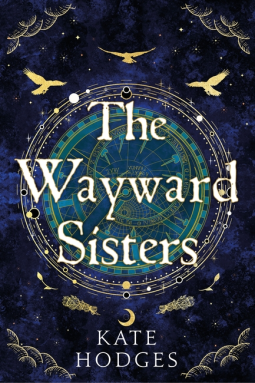
The Wayward Sisters by Kate Hodges

It’s 1769 and Nancy Lockaby is on her way to Inverness where she has been invited to stay with the renowned Shakespearean scholar, Caleb Malles, to help him with his research. Nancy is a keen astronomer who has been developing a theory of her late mother’s involving an astronomical phenomenon known as ‘the Fold’ – a theory that has provoked the scorn and derision of her male colleagues at the Greenwich Observatory. Nancy isn’t sure what her role will be in Caleb’s work as she has little interest in literature, but she welcomes the opportunity to get away from the hostile atmosphere of the Observatory for a while and start a new life in Scotland.

Arriving at the large, crumbling Blackthistle House with her maid, Cora, on a cold, snowy night, Nancy is immediately unsettled by the atmosphere. Why are there lights flashing in the window of a turret? Who are the three strange women she sees in the darkness as her carriage approaches the house? Once she settles in, however, she becomes fascinated by Caleb Malles and his passion for Shakespeare’s Macbeth. She also gets to know the three women she glimpsed in the dark and finds them less threatening as she learns more of their backgrounds. But is it true that they have lived for many centuries and possess special powers? And what is Caleb’s real reason for bringing Nancy to Blackthistle House?

The Wayward Sisters is Kate Hodges’ first novel, having previously written several non-fiction books. You never really know what to expect when trying a new author and I had mixed feelings about this book, but generally more positive than negative. The first half is slow, but has a wonderfully eerie, Gothic atmosphere as Hodges sets the scene and introduces the characters. There’s a particularly memorable scene where Nancy encounters some sinister crows during a snowstorm! I had expected elements of Macbeth to be more deeply woven into the plot, but they really aren’t, apart from the presence of the three women, who clearly represent Shakespeare’s three witches, the Weird (or Wayward) Sisters. The witches have more nuance here than in the play, with each being given a detailed backstory of her own.

Kate Hodges writes very well and there are some nice descriptions to bring the Scottish setting to life, although I was surprised that the recent Jacobite Rebellions were barely mentioned as they must surely have still been having an impact on the lives of the Highlanders in the 1760s. Nancy is an interesting heroine; astronomy is an area of science where women could and did make an impact in the 18th century (the most famous female astronomer of that period was probably Caroline Herschel, the first woman to discover a comet) although it was obviously still a male-dominated field and difficult for women to be taken seriously. However, Nancy’s theories regarding the Fold begin to take the story into the realms of science fiction, particularly when the witches get involved and we discover Caleb’s motives for enlisting the services of an astronomer.

I think I would have enjoyed this book more if it had continued as the atmospheric historical fiction novel it seemed to be at first, rather than the more fantastical story it became. There’s a lot to like about The Wayward Sisters, but it wasn’t really the right book for me.

Thanks to Hodder & Stoughton for providing a copy of this book for review via NetGalley.
This is book 45/50 for the 2023 Historical Fiction Reading Challenge.

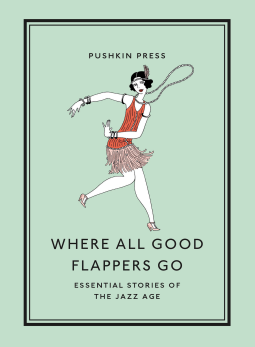
Where All Good Flappers Go: Essential Stories of the Jazz Age – edited by David M. Earle

I’ve never considered myself to be a fan of Jazz Age fiction – but, to be fair, I’ve read very little of it, other than a few F. Scott Fitzgerald novels. When I saw that Pushkin Press had put together this collection of Jazz Age short stories, I thought it would be a good opportunity to branch out and try some new authors from that era.

This edition begins with an introduction discussing the changes following WWI that led to the birth of the ‘flapper’ as women pursued social and sexual equality, then a short 1925 essay by Zelda Fitzgerald, What Became of the Flappers?. In this essay, Fitzgerald attempts to give her own definition of what a flapper is, before revealing what she believes will happen to them in the end:

The best flapper is reticent emotionally and courageous morally. You always know what she thinks, but she does all her feeling alone. These are two characteristics which will bring social intercourse to a more charming and sophisticated level. I believe in the flapper as an artist in her particular field, the art of being – being young, being lovely, being an object.

The essay is followed by twelve short stories, most of which were originally published in various periodicals between 1920 and 1932. Apart from F. Scott Fitzgerald, all of the other authors were new to me; I had at least heard of a few of them, such as Zora Neale Hurston, Anita Loos and Dorothy Parker, but was unfamiliar with the rest. The Fitzgerald story is Bernice Bobs Her Hair, which stands out as one of the best in the book, but I expect a lot of people will have read that one so I’m going to focus on some of the less well known stories instead.

My favourite story is probably Night Club by Katharine Brush, which describes a typical night at a New York club through the eyes of Mrs Brady, who works there as a maid. Mrs Brady’s job involves looking after a dressing room, where young women come to reapply their make-up throughout the evening, therefore she gets to hear a lot of scandalous gossip involving affairs and proposals. In the world of the flapper, however, these dramas have become so commonplace that Mrs Brady is more interested in the ‘real life’ stories in her magazine!

Another I particularly enjoyed is Dawn Powell’s Not the Marrying Kind, about Aileen, who is not the kind of girl men want to marry – unlike Joan who has always known she will marry and has a ‘hope chest’ of linen ready and waiting for her special day. Then there’s Gertrude Schalk’s The Chicago Kid, in which a chorus girl at the Yellow Parrot cabaret elopes with a millionaire, which inspires Flora, a black girl from Chicago to set out to do the same. I liked the twist at the end of this one!

Despite all dealing with the common theme of the flapper lifestyle, the stories in this collection are quite diverse and include contributions by male authors and black authors, so we see things from a range of different perspectives. Rudolph Fisher’s Common Meter describes a battle-of-the-bands contest between two jazz band leaders trying to win the affections of a beautiful woman, while Viña Delmar’s Thou Shalt Not Killjoy is written in the style of a Biblical parody. I can’t claim to have enjoyed all of the stories – Dorothy Parker’s The Mantle of Whistler, a story written mostly in dialogue as a satire on the flirtatious language used by the flappers, was particularly disappointing, considering she is one of the more famous authors in the collection.

Stories by Dana Ames, John Watts and Guy Gilpatric make up the rest of the book and although, as I’ve said, I found this collection a real mixed bag, it’s always good to try something different and it was an entertaining read overall.

Thanks to Pushkin Press for providing a copy of this book for review via NetGalley.
Water by John Boyne – #NovNov23

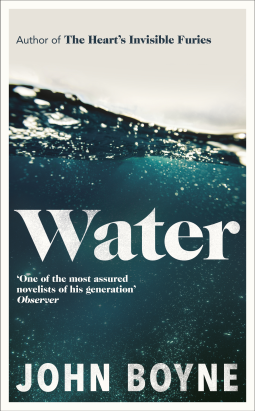
Water is the first in a planned quartet of novellas named after the four elements and linked by some shared characters and themes. I’ve enjoyed many of John Boyne’s longer novels so I was intrigued to see what he could do with a shorter format.

We begin with Vanessa Carvin arriving on an island off the coast of Ireland where she has rented a cottage in the hope of escaping from her past and starting a new life for herself. The first thing she does when she gets there is cut her hair and change her name to Willow, before settling into a quiet existence, going for walks, attending church and trying not to attract too much attention to herself.

The whole book is narrated by Willow and she reveals her secrets to the reader slowly, when she is ready to do so, but we know from the start that something has gone badly wrong with her marriage to Brendan Carvin, Director of the National Swimming Federation. Where is he now? What happened to their eldest daughter, Emma? Why is Willow estranged from her younger daughter, Rebecca, who refuses to answer her texts and keeps blocking Willow’s number? It takes a while for the truth to emerge but, once it does, it gives Boyne the opportunity to return to the themes he has explored in other books such as A History of Loneliness and All the Broken Places (Father Odran Yates, protagonist of the former, is even referred to once or twice as a friend of Brendan’s, strengthening the tie between the two books). These themes include the questions of whether we can be considered complicit in another person’s crimes just by choosing to look the other way when our instincts tells us something is wrong and whether there is always more we could and should have done.

Water is the title of the book, but that element is also worked into the novel in a variety of different ways. Not only is Willow’s husband a swimming coach, but the sea has a role to play in the fate of one of the other characters and Willow’s own name refers to a tree that grows by water. And of course, the island itself is surrounded by water, both physically and metaphorically separating Willow from her old life in Dublin. For such a short book (176 pages in the hardback edition) it’s a very powerful one. It deals with some difficult and uncomfortable topics but, as I’ve come to expect from Boyne, there are also some humorous moments to lighten the mood. I can’t wait to see how he tackles the other three elements; I’m already looking forward to the second book in the series, Earth, which is due in May 2024.

Thanks to Doubleday for providing a copy of this book for review via NetGalley.
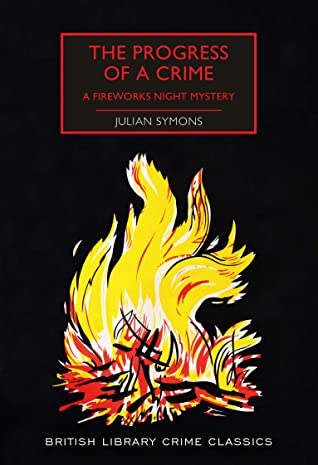
The Progress of a Crime by Julian Symons

Remember, remember, the Fifth of November,
Gunpowder, treason and plot,
I see no reason why gunpowder treason,
Should ever be forgot

It’s the fifth of November today, so no better time to review one of my recent reads, Julian Symons’ The Progress of a Crime, first published in 1960 and subtitled A Fireworks Night Mystery. For those not in the UK or familiar with British culture, this is the night when people traditionally light bonfires and set off fireworks to mark the anniversary of when Guy Fawkes was caught preparing to blow up Parliament with gunpowder in 1605. The Progress of a Crime, the first book I’ve read by Julian Symons, deals with a murder committed at a Bonfire Night celebration.

Hugh Bennett, reporter with the Gazette, has been covering a news story in the village of Far Wether on November the fifth and decides to stay on to watch the lighting of the bonfire on the village green. However, he witnesses more than just a fire that evening when a gang of youths arrive and begin throwing fireworks and causing a disturbance. Things escalate and a man is stabbed to death, but although there are many witnesses, in the darkness nobody is able to say with any certainty which of the boys was the culprit.

All of the group are arrested and questioned, but two quickly emerge as the most likely suspects: the leader, Jack ‘King’ Garney, and his most faithful friend, Leslie Gardner. There’s enough evidence to bring the two to trial and Hugh Bennett is drawn into the investigations due to both his role as a local journalist and as a witness to the crime. Hugh has his own opinions on what happened in Far Wether that night, but when he begins to fall in love with Jill Gardner, Leslie’s sister, things become more complicated.

The Progress of a Crime is an interesting portrayal of society in the early 1960s, but will probably disappoint anyone looking for a more conventional mystery novel. There’s very little suspense and not much actual ‘detecting’ as there are only really two suspects and we know who they are from the beginning. The most exciting part of the book comes in the second half when Garney and Gardner stand trial and we are given some insights into the preparations for the court case, the cross examining of the witnesses and the tensions between family members as they worry over what will happen in court.

According to Martin Edwards’ introduction, Symons took his inspiration for this novel from a real crime, and the book as a whole does feel realistic and gritty. It explores a range of topics including the causes and consequences of juvenile crime, the methods of extracting information used by the police, and the role of the press in reporting on the investigations and maybe even influencing the outcome. This British Library Crime Classics edition also features a short story by Symons, The Tigers of Subtopia, which has obviously been selected for inclusion because it covers similar themes. I can’t really say that I enjoyed either the novel or the short story as I found them quite bleak and depressing, with some very unlikeable characters, but they are interesting from a social history perspective and I would be happy to read some of Symons’ other books.

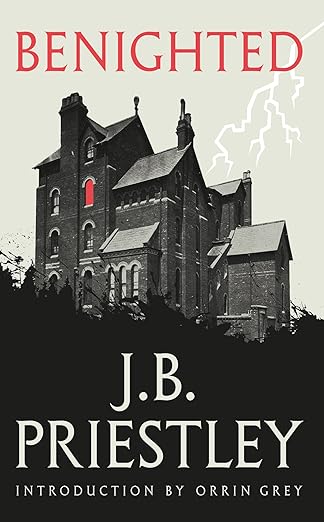
Benighted by J.B. Priestley

This is the first book I’ve read by J.B. Priestley and a great choice for this time of year. Published in 1927, it was filmed as The Old Dark House in 1935, although I don’t think I’ve seen it so can’t comment on how similar or different it is from the book.

The novel begins as married couple Philip and Margaret Waverton, accompanied by their friend Roger Penderel, get caught in a storm as they try to drive home through the Welsh countryside one night. The rain is torrential and with the roads starting to become impassable, they decide to seek shelter in an old, crumbling mansion, the only house they can see for miles around. It doesn’t look very inviting…

It was the house itself that was so quiet. Driving up like this, you expected a bustle, shadows hurrying across the blinds, curtains lifted, doors flung open. But so far this house hadn’t given the slightest sign in spite of its lighted windows. It seemed strangely turned in upon itself, showing nothing but a blank face in the night. You could hardly imagine that great front door ever being opened at all.

The door is eventually opened by a huge, silent butler and as the trio step inside their sense of unease continues to grow. The house is home to the Femms – the strange and nervous Horace and his fanatically religious sister, Rebecca. The Femms reluctantly allow them to stay for the night, but it quickly becomes obvious to the visitors that they’re unlikely to get much sleep in such an eerie, unwelcoming house. After a while, they are joined by two more people looking for shelter – Sir William Porterhouse, a wealthy businessman, and Gladys du Cane, a chorus girl. The rest of the novel describes the unpleasant, frightening experiences the five guests undergo during their night in the Femm household. It seems that there are other members of the Femm family who haven’t made an appearance yet – and when they do, the guests begin to wish they had stayed outside in the storm after all!

Benighted is a short, quick read and one that I enjoyed, with a few reservations. By the standards of modern horror novels it’s quite tame – I would describe it as creepy and unsettling rather than terrifying – but as a book from the 1920s, it has clearly had a huge influence on what Orrin Grey in the introduction describes as the ‘old dark house’ subgenre. There’s nothing supernatural going on in the novel; the creepiness comes entirely from the portrayal of the odd, sinister characters, the descriptions of the dark, desolate house and the mystery surrounding a locked door upstairs and what lies behind it. I was intrigued to learn that the Addams Family creator, Charles Addams, drew the illustrations for the opening sequence of a 1963 remake of The Old Dark House, because there are some unmistakable similarities between the Addams and Femm families!

Perhaps the real horrors being described in Benighted are the effects of the First World War, which ended less than ten years before the book was published. Priestley himself is quoted as saying that the novel’s characters are “forms of postwar pessimism pretending to be people”. This leads to some long passages in which Priestley explores the mental states of the characters and how they are affected by their night in the Femm house, most notably Roger Penderel who has experienced various traumas during the war, including the loss of his brother at the Battle of Passchendaele, and has been left disillusioned and cynical. These passages added depth to the novel, but at the same time I felt that they slowed down the pace of the plot and pulled me out of the story. In the end, this book didn’t quite work for me either as a horror novel or a psychological study, but it was still an interesting read and has definitely piqued my interest in reading more books by Priestley.

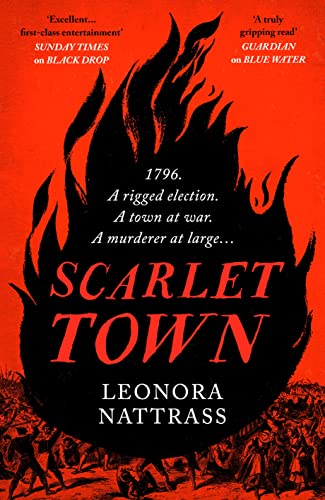
Scarlet Town by Leonora Nattrass

Scarlet Town is the third book in Leonora Nattrass’s Laurence Jago series set in the final decade of the 18th century. I enjoyed the first two books – Black Drop and Blue Water – and this one is another strong entry in the series.

It’s 1796 and Laurence Jago, accompanied by his friend, the journalist William Philpott, has just returned from his voyage to America (described in Blue Water). Jago, once a clerk in the Foreign Office, is now apprenticed to Philpott and is grateful to his friend for the opportunity, while at the same time angry with him for causing his beloved dog, Mr Gibbs, to be left behind in Philadelphia! Back in England again, they head for Jago’s home town of Helston in Cornwall, intending to visit his cousin Pythagoras (affectionately known as Piggy). On arrival in Helston, however, they are shocked by what they find. Not only does wig-wearing appear to have fallen out of fashion during their absence, but the entire town seems to be caught up in the fever of the upcoming election.

Helston is known as a ‘rotten borough’, where only two men in the town are allowed to vote – and one of these two electors has died under suspicious circumstances. It seems that someone is also attempting to kill the remaining elector, so the town’s patron, the Duke of Leeds, asks Laurence to investigate – but to Laurence’s dismay, his own beloved cousin Piggy begins to emerge as the number one suspect. Will he be able to prove Piggy’s innocence and find the real culprit? And who will win the election if both of the Duke’s electors are unable to vote?

According to the author’s note, the situation described in the book (without the deaths/murder attempts) is based on an election that actually did take place in Helston in the 1790s. Several of the characters are people who really existed, including Sir James Burges, the Duke’s candidate for Parliament, and Stephen Lushington (chairman of the East India Company), the alternative candidate put forward by the town’s mayor – and the novel’s title refers to the red ribbons and silks worn by supporters of the mayor’s candidate as opposed to the blue worn by supporters of the Duke’s. I remember learning about the rotten boroughs at school and the events portrayed in this book perfectly illustrate why electoral reform was so desperately needed. Many people complain about today’s electoral system, but the people of Helston were dealing with a system so corrupt that only a tiny minority were making decisions that affected everyone else, where there was no secret ballot and votes could be bought and sold, leaving the electors open to bribery and blackmail.

As well as the fascinating historical setting, I also found the murder mystery quite compelling; it was maybe not as enjoyable as the mystery in Blue Water, and there were times when I felt it became a bit too complicated, but it was intriguing and kept me guessing until the end. Nattrass also lightens the mood with some humour in the form of Toby the Sapient Hog (based on a real performing pig). I love the 18th century world she has created in this series – everything feels so authentic and thoroughly researched. I’m not sure if there’s going to be a fourth book, but if there is then I can’t wait to read it.

Thanks to Viper for providing a copy of this book for review via NetGalley.
This is book 44/50 for the 2023 Historical Fiction Reading Challenge.