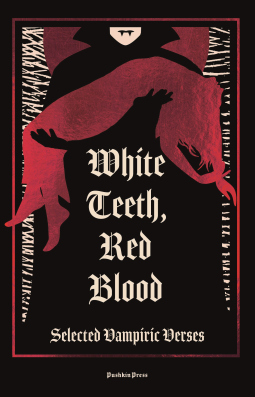
White Teeth, Red Blood: Selected Vampiric Verses

I don’t usually choose to read poetry anthologies but this vampire-themed collection sounded appealing, particularly with Halloween just a few weeks away.

White Teeth, Red Blood contains the work of famous poets such as Samuel Taylor Coleridge, Christina Rossetti, Rudyard Kipling, Emily Dickinson and Alfred, Lord Tennyson, as well as some lesser known names and some contemporary writers. Some of the poems feature traditional undead, blood-sucking vampires, while in others there is no actual vampire character; as we are told in the introduction, the vampire ‘acts as a metaphor for many things, from pregnancy and art to racism and colonialism’.

I can’t possibly talk about all the poems in the book, so I will just highlight my favourite, which was actually the first poem in the book, Lenore by the German author Gottfried August Bürger. Originally published in 1774, it’s not technically a vampire story, but does feature a character who has returned from the dead. Lenore is a young woman who loses her faith in God when her lover, William, fails to return from the Seven Years’ War. Late that night, a man who looks like William appears and asks her to join him on a midnight horseback ride to their wedding bed. The translation by Dante Gabriel Rossetti is wonderful – I always find it impressive that poetry translated from another language manages to retain its rhythm and rhyming words.

Although I enjoyed this collection overall, it does feel very uneven. The first section, Chilling Tales, which takes up around three-quarters of the book, is made up of long narrative poems (or extracts from them); a lot more pages are devoted to Byron’s The Giaour than to anything else. The poems in the second and third sections, Dire Warnings and The Vampire Within, are much shorter, sometimes less than a page long. I can appreciate that there’s some logic in the way the poems are divided into these three groups (explained in the introduction by the author Claire Kohda), but I think I would have preferred them mixed together for more variety. Also, the poems are ordered chronologically within each section and as the majority are from the 18th and 19th centuries, the small number of very modern ones feel a bit out of place.

With some of the poems, I struggled to see why they were included and what the connection with vampirism was, so it would have been nice to have been given some context, but this really is just a straightforward anthology with no additional material or notes apart from Kohda’s introduction. I didn’t find it completely satisfying, then, but I think it would make a nice gift for a poetry lover or someone with an interest in vampire mythology.

Thanks to Pushkin Press for providing a copy of this book for review via NetGalley.

Book 3 for RIP XX

A History of England in 25 Poems by Catherine Clarke

If you had to choose a selection of poems to represent your country’s past, which ones would you pick? What can poetry teach us about a nation’s history, culture and identity? These are some of the questions Catherine Clarke sets out to answer in this wonderful new book which tells the story of England through twenty-five famous and not-so-famous poems.

Beginning with the 8th century poem Cædmon’s Hymn, written in Old English, the book then moves chronologically through time, ending with Zaffar Kunial’s The Groundsman from 2022. Familiar names including Geoffrey Chaucer, Shakespeare, Tennyson and Lewis Carroll are all represented, but so are some lesser known poets from more diverse backgrounds such as Phillis Wheatley, the first African-American woman to have her poems published, and Grace Nichols, an immigrant to Britain from Guyana. The poems have all been selected for what they can tell us about specific moments in English history: Viking raids, the Battle of Agincourt, the plague, the miners’ strikes, the Great Storm of 1987 and many more.

Before picking up this book, it’s important to know that it shouldn’t really be approached as simply a poetry anthology. Not all of the poems appear in full – many are just extracts – and they haven’t necessarily been chosen for the beauty of the language. The literary merit of each poem is discussed only briefly or not at all, as Clarke is more interested in the life of the writer, why they chose to write that particular poem at that particular time and how the poem fits into the wider context of what was happening in England during that period. Each poem is given its own chapter and with twenty-five of them to get through, the chapters are relatively short, although still long enough to say everything that needs to be said.

I enjoyed every chapter – although I was already familiar with most of the historical figures and topics discussed in the book, it was interesting to see them from different, unusual perspectives and to discover some new poems I’d never read before. Some of my favourites were Mary Leapor’s Crumble Hall, written through the eyes of a servant in an 18th century country house; Adlestrop by Edward Thomas, describing a train briefly stopping at a station in 1914; and Elizabeth Barrett Browning’s The Cry of the Children, a protest against child labour during the Industrial Revolution.

I can highly recommend this book to anyone with an interest in English history. If you also like poetry it would be helpful, but not essential! I thought it was a fascinating approach and it would be good to read about another country’s history seen through the lens of its poetry like this.

Thanks to Penguin Classics/Allen Lane for providing a copy of this book via NetGalley.

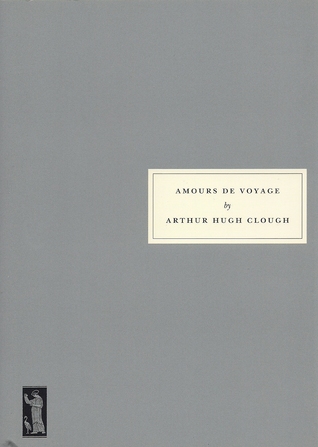
Amours de Voyage by Arthur Hugh Clough – A book for the Persephone Readathon

This week Jessie of Dwell in Possibility is hosting another of her Persephone Readathons. My choice of book this time proved to be very different from any of the other Persephones I’ve read, for several reasons. For one thing, it is one of only a few Persephones written by a man. With an original publication date of 1858, it must also be one of the oldest books they publish – the majority are from the first half of the twentieth century. Finally, it is written in verse, something which filled me with trepidation as I’m not really a fan of narrative poems (although, to be fair, I haven’t read all that many of them).

Anyway, Amours de Voyage follows a group of people who are visiting Italy during the political turmoil surrounding the fall of the short-lived Roman Republic in 1849. Their story is told in the form of letters written in hexameter verse and divided into five cantos. One of the letter-writers is Claude, a young man who is spending some time in Rome as part of his ‘grand tour’ and keeping a friend, Eustace, updated on everything he has seen and experienced. It seems that so far Rome has entirely failed to impress him:

Rome disappoints me much; I hardly as yet understand it, but

RUBBISHY seems the word that most exactly would suit it.

And then:

What do I find in the Forum? An archway and two or three pillars.

Well, but St. Peter’s? Alas, Bernini has filled it with sculpture!

I love Rome and ‘rubbishy’ is certainly not how I would describe it, but Claude is the sort of person who appears not to like or admire anything or anybody. This includes his fellow tourists, particularly the Trevellyns, who find Rome ‘a wonderful place’ and are ‘delighted of course with St. Peter’s’. This is Claude’s initial impression of the Trevellyns:

Middle-class people these, bankers very likely, not wholly

Pure of the taint of the shop; will at table d’hote and restaurant

Have their shilling’s worth, their penny’s pennyworth even:

Neither man’s aristocracy this, nor God’s, God knoweth!

As he gets to know the family better, however, he changes his opinion slightly and the tone of his letters to Eustace starts to suggest that he has fallen in love with Mary Trevellyn. Through Mary’s own letters to her friends Louisa and Miss Roper, we learn that although her own first impression of Claude was that she thought him ‘agreeable, but a little repulsive’, she is also beginning to change her mind:

Yes, repulsive; observe, it is but when he talks of ideas

That he is quite unaffected, and free, and expansive, and easy.

Unfortunately, before a romance has time to develop, violence breaks out on the streets of Rome and the Trevellyns leave the city just before it becomes besieged by the French. Claude has no intention of fighting for or against the Roman Republic (he doesn’t have a musket, he tells Eustace, and even if he did, he wouldn’t know how to use it) so he sets off in search of the Trevellyns instead. Due to bad luck and a series of misunderstandings, they keep missing each other as they move around Italy. Will Claude and Mary ever be reunited – or has the opportunity been lost forever?

I found Amours de Voyage much easier to get through than I had expected; it hasn’t become a favourite Persephone but it was still an enjoyable one and the rhythm, structure and colloquial language make it very readable. Despite Claude being such an annoying character, the way his story plays out is quite sad and moving as he begins to regret not speaking to Mary and telling her how he felt while he had the chance. Mary could have made the first move, but she knows that Claude ‘thinks that women should woo him; Yet, if a girl should do so, would be but alarmed and disgusted.’

The poem’s historical background is interesting too. Arthur Hugh Clough himself was in Rome in 1849 during the siege so was writing from personal experience, which explains why the parts of the poem that deal with the conflict – such as Claude’s account of witnessing a priest being killed and Mary’s description of Garibaldi riding into the city – feel vivid and authentic. I know nothing about Clough as a person other than the little I’ve been able to find online so I don’t know to what extent the rest of the story is autobiographical or how much of himself he put into Claude’s character.

Amours de Voyage endpapers

Because Amours de Voyage is in the public domain, it is available as a free ebook from sites like Project Gutenberg, but the Persephone edition has an introduction by Julian Barnes, illustrations, and gorgeous endpapers, taken from a woven dress silk from 1850. It isn’t a Persephone that gets much attention, so if you’ve read it (in any format) I’d love to hear your thoughts!

She reads poetry…Lyrical Ballads 1798 and 1802

Lyrical Ballads 1798 - 1802

It is an ancyent Marinere,
And he stoppeth one of three:
“By thy long grey beard and thy glittering eye
Now wherefore stoppest me?”

I’m not someone who reads a lot of poetry but that’s something I would like to change, so I was pleased to have the opportunity to try this new Oxford World’s Classics edition of Lyrical Ballads, a collaboration by William Wordsworth and Samuel Taylor Coleridge, first published in 1798. This book contains both the original 1798 version and the revised, expanded one from 1802, together with their prefaces and appendices. There’s also an extensive introduction, chronology and notes, though I didn’t personally find the notes particularly helpful – and they were sometimes a distraction when I would have preferred to just concentrate on reading the poem.

From the point of view of a casual reader of poetry I don’t think it was really necessary to have both the 1798 and 1802 versions together in one book. I would have been happy with just the second one, as it seems to include all the poems from the first edition (though in a slightly different order) as well as a large number of new poems. For students of Romantic poetry, though, it will probably be useful to be able to compare the earlier edition with the later one and see how each was originally presented (any significant changes to wording etc are mentioned in the notes).

The only poem in this collection that I was already familiar with was The Rime of the Ancient Mariner by Coleridge. It’s here in two different versions; in the 1802 one the language has been ‘modernised’, replacing some of the archaic spellings used in the original. I’ve liked this poem since the first time I read it at school and it really stands out among the other poems in the book as something special and unique. There are only a few other poems by Coleridge in Lyrical Ballads and the overwhelming majority are by Wordsworth; the most famous of Wordsworth’s is probably Lines written a few miles above Tintern Abbey. I’ve never thought Wordsworth would be a poet that I would like, but there are quite a few of his poems here that I enjoyed, including Goody Blake and Harry Gill, We Are Seven and The Thorn, all of which appear in both volumes, and in the 1802 collection I also liked his anti-hunting poem, Hart-Leap Well.

Whether or not you like William Wordsworth and Samuel Taylor Coleridge, it can’t be denied that their Lyrical Ballads was an important work with an influence on both the Romantic Movement and the development of poetry in general. While there were only a few poems in this book that I thought had any real brilliance, I did enjoy reading most of them and found them all easy enough to read even for someone like myself who isn’t really a fan of poetry. The idea behind Lyrical Ballads was to make poetry accessible to the average person by using simple language that could be understood by everyone, so in this respect I think it was a success.

As this Oxford World’s Classics edition is quite academic it would probably be a good choice for students of Romanticism but I think for the general reader like myself it might be better to look for a collection of the most popular works of Wordsworth or Coleridge.

A Poem For Halloween: Ulalume by Edgar Allan Poe

As today is Halloween, I decided to post one of my favourite poems by Edgar Allan Poe. Like a lot of Poe’s work this poem looks at the themes of loss and death. The narrator is walking through the woods on a dark night in October and finds himself at the tomb of Ulalume, whom he had buried there on the same night the year before.

There are several references to mythology throughout the poem and you may need to look up the meanings of any unfamiliar words and phrases. The name Ulalume, for example, is thought to be taken from the Latin verb ululare which means to shriek or wail.

(Note: The following poem is in the public domain)

The skies they were ashen and sober;
The leaves they were crisped and sere–
The leaves they were withering and sere;
It was night in the lonesome October
Of my most immemorial year:
It was hard by the dim lake of Auber,
In the misty mid region of Weir–
It was down by the dank tarn of Auber,
In the ghoul-haunted woodland of Weir.

Here once, through an alley Titanic,
Of cypress, I roamed with my Soul–
Of cypress, with Psyche, my Soul.
These were days when my heart was volcanic
As the scoriac rivers that roll–
As the lavas that restlessly roll
Their sulphurous currents down Yaanek
In the ultimate climes of the pole–
That groan as they roll down Mount Yaanek
In the realms of the boreal pole.

Our talk had been serious and sober,
But our thoughts they were palsied and sere–
Our memories were treacherous and sere,–
For we knew not the month was October,
And we marked not the night of the year
(Ah, night of all nights in the year!)–
We noted not the dim lake of Auber
(Though once we had journeyed down here)–
Remembered not the dank tarn of Auber,
Nor the ghoul-haunted woodland of Weir.

And now, as the night was senescent
And star-dials pointed to morn–
As the star-dials hinted of morn–
At the end of our path a liquescent
And nebulous lustre was born,
Out of which a miraculous crescent
Arose with a duplicate horn–
Astarte’s bediamonded crescent
Distinct with its duplicate horn.

And I said: “She is warmer than Dian;
She rolls through an ether of sighs–
She revels in a region of sighs:
She has seen that the tears are not dry on
These cheeks, where the worm never dies,
And has come past the stars of the Lion
To point us the path to the skies–
To the Lethean peace of the skies–
Come up, in despite of the Lion,
To shine on us with her bright eyes–
Come up through the lair of the Lion,
With love in her luminous eyes.”

But Psyche, uplifting her finger,
Said: “Sadly this star I mistrust–
Her pallor I strangely mistrust:
Ah, hasten! -ah, let us not linger!
Ah, fly! -let us fly! -for we must.”
In terror she spoke, letting sink her
Wings until they trailed in the dust–
In agony sobbed, letting sink her
Plumes till they trailed in the dust–
Till they sorrowfully trailed in the dust.

I replied: “This is nothing but dreaming:
Let us on by this tremulous light!
Let us bathe in this crystalline light!
Its Sybilic splendour is beaming
With Hope and in Beauty tonight!–
See! -it flickers up the sky through the night!
Ah, we safely may trust to its gleaming,
And be sure it will lead us aright–
We safely may trust to a gleaming,
That cannot but guide us aright,
Since it flickers up to Heaven through the night.”

Thus I pacified Psyche and kissed her,
And tempted her out of her gloom–
And conquered her scruples and gloom;
And we passed to the end of the vista,
But were stopped by the door of a tomb–
By the door of a legended tomb;
And I said: “What is written, sweet sister,
On the door of this legended tomb?”
She replied: “Ulalume -Ulalume–
‘Tis the vault of thy lost Ulalume!”

Then my heart it grew ashen and sober
As the leaves that were crisped and sere–
As the leaves that were withering and sere;
And I cried: “It was surely October
On this very night of last year
That I journeyed -I journeyed down here!–
That I brought a dread burden down here–
On this night of all nights in the year,
Ah, what demon hath tempted me here?
Well I know, now, this dim lake of Auber–
This misty mid region of Weir–
Well I know, now, this dank tarn of Auber,
This ghoul-haunted woodland of Weir.”

[Ulalume – Edgar Allan Poe]