The Elopement by Gill Hornby

This is the third novel Gill Hornby has written based on the lives of members of Jane Austen’s extended family. I loved Miss Austen and Godmersham Park, so I was looking forward to reading The Elopement, which focuses on Jane’s niece, Fanny Knight, and Fanny’s stepdaughter, Mary Dorothea Knatchbull.

Fanny’s father is Jane’s brother Edward, who was made the legal heir of their wealthy Knight relatives and inherited three estates at Steventon, Chawton and Godmersham (Fanny appears as a secondary character in Godmersham Park). For a long time it seems likely that Fanny is going to remain a spinster until, in 1820, she marries Sir Edward Knatchbull of Mersham-le-Hatch at the age of twenty-eight. She doesn’t love him and he doesn’t love her, but Fanny has always been a practical person and decides that it could still be a marriage that works well for both of them.

Sir Edward has five children from his previous marriage and Fanny is sure she can be a good stepmother to them. However, there’s tension between Fanny and the only daughter, Mary Dorothea, from the beginning. Fanny is not a naturally loving or compassionate person and Mary finds it impossible to warm to her, viewing her as aloof and distant. Things come to a head when Mary falls in love with a man her father considers unsuitable. She knows she can expect no empathy or understanding from Fanny, so is forced to do something drastic.

It took me a while to get into this book. The pacing is uneven, with the first half being very slow and the second much more gripping. The title is maybe slightly misleading, as the elopement doesn’t happen until late in the book and doesn’t really play a big part in the story, although the buildup and consequences do. I think I would have preferred not to have known there was going to be an elopement so I wouldn’t have spent most of the book wondering when it was going to happen.

Hornby focuses less on Mary Dorothea’s romance and more on the relationship between stepmother and stepdaughter, which gets off to a bad start and worsens throughout the book. I went from feeling sympathetic towards Fanny to disliking her more and more as she tries to align herself with her husband’s views and closes her mind to Mary’s feelings. Still, the portrayal of Fanny and Sir Edward’s marriage illustrates the limited options available to 19th century women who would often marry out of duty, necessity or to meet society’s expectations. Mary is trying to do something different and marry for love.

In her author’s note at the end of the book, Hornby explains that she has based the novel on Fanny Knight’s own diaries which she kept from 1804 to 1872. I haven’t read the diaries so I don’t know how the personality of the real Fanny compares to the fictional one, but I was sorry not to have liked her more considering that Jane Austen apparently described her as her “favourite niece”.

I’ve learned that following the recent TV adaptation of Miss Austen which was shown earlier this year, The Elopement is also going to be adapted under the title Miss Austen Returns (I’m not sure why they’ve missed out Godmersham Park). Cassandra Austen, the star of Miss Austen, only appears once or twice in this book so I imagine she’s going to be given a much bigger role in the new adaptation. I’ll be interested to see what Gill Hornby’s next book will be about; I’m sure there’s still more she could write about the Austen family and there seems to be a never-ending appetite for it by readers and TV viewers!

Thanks to Random House UK, Cornerstone for providing a copy of this book for review via NetGalley.

Top Ten Tuesday: Literary Candles

This week’s topic for Top Ten Tuesday (hosted by That Artsy Reader Girl) is “Literary/Bookish Candles I’d Make (Pick a book and assign it a fragrance or fragrance combo that would make a nice candle.)” (Submitted by Heather @ The Frozen Library)

I thought this would be difficult, especially as I’m not someone who buys a lot of candles, but I actually found it surprisingly easy and fun to do. I’ve picked a combination of two or three scents for each of the books below, based on either the title or the setting. Let me know what you think!

1. The Language of Flowers by Vanessa Diffenbaugh is about a young woman who works as a florist and learns how to communicate using different flowers to represent emotions. As a companion candle, I’ve chosen a floral fragrance of rose, lily and violet.

2. In Tracy Chevalier’s At the Edge of the Orchard, a couple try to establish an orchard in the Black Swamp of Ohio. An apple and cinnamon candle quickly came to mind!

3. The next one is obvious. I’ve matched Wild Strawberries, the second book in Angela Thirkell’s Barsetshire series, with a strawberry candle. I wasn’t sure which other scents would go well with strawberry, but a quick google search suggested rhubarb.

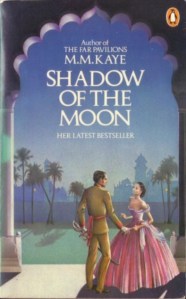
4. Shadow of the Moon by MM Kaye, a book I loved, is set in India during the Sepoy Mutiny. This made me think of two scents associated with India: jasmine and sandalwood.

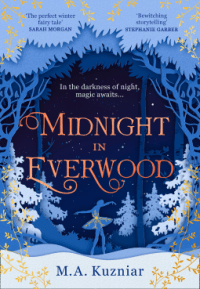
5. Moving away from floral and fruity scents for a while, my next candle combines chocolate, vanilla and almond. It represents Midnight in Everwood by MA Kuzniar, a retelling of The Nutcracker set in a sugar-filled fantasy land.

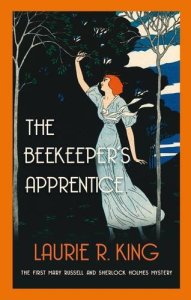
6. In The Beekeeper’s Apprentice, the first in Laurie R. King’s Mary Russell series, Sherlock Holmes has retired to the Sussex countryside to become a beekeeper. I’ve paired a honey and lemon candle with this one.

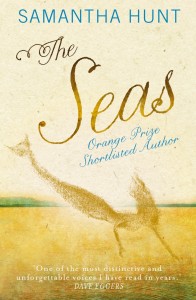
7. The Seas by Samantha Hunt is set in a lonely coastal town and features a girl who believes she is a mermaid. I think a seaweed and samphire candle is appropriate!

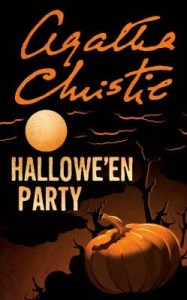
8. Hallowe’en Party by Agatha Christie is a Poirot novel in which a murder takes place at a children’s Halloween party. I’ve put together a warm, autumnal candle of pumpkin, ginger and caramel.

9. In A Dictionary of Mutual Understanding by Jackie Copleton, an elderly woman reflects on her life in Nagasaki and her memories of the atomic bombing. It’s a beautiful novel with some very moving moments. My candle combines Japanese fragrances of cherry blossom, mimosa and pear.

10. I hope it’s not too early to mention Christmas! Inspired by a true classic, A Christmas Carol by Charles Dickens, a suitable candle could include pine, balsam and nutmeg.

~

What do you think? Would you buy any of these candles? And have you read any of the books associated with them?

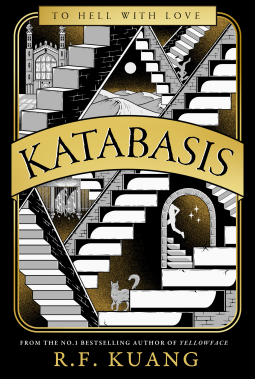
Katabasis by RF Kuang

Alice Law is an American PhD student who is studying Analytic Magick under the guidance of Professor Jacob Grimes at Cambridge University. Along with her equally brilliant rival, Peter Murdoch, Alice is considered the most gifted student in the department, but sometimes spells can still go wrong and she is horrified when Professor Grimes steps inside one of her pentagrams and is whisked away to hell. How will she finish her degree without Grimes to advise her? The only thing to do is to enter hell herself and bring him back.

A decision to go to hell is not something that should be taken lightly, particularly as the price of going and coming back again is half of a person’s remaining lifespan, but Alice feels she has no choice, especially as she was responsible for the disaster. However, she’s not at all pleased when Peter Murdoch insists on coming with her. She and Peter were once friends but their academic rivalry has driven them apart. Will they be able to work together to navigate their way through hell and rescue Professor Grimes?

RF Kuang is an author I keep seeing on other blogs I follow, but I’ve never tried one of her books myself until now. Whether this was the best one I could have started with I don’t know – the premise certainly sounded fascinating and there were plenty of things I enjoyed about the book, but overall it didn’t quite deliver for me. I think a big part of the problem is that I found Alice difficult to like; Peter was a more engaging character, but apart from some flashbacks to his early life, we don’t see much of the story through his eyes. Professor Grimes was even less sympathetic – the more I learned about him, the less I cared whether he was rescued or not and the weaker Alice’s motive for following him into hell became.

Hell is an unusual setting, although there have obviously been several classics set there, including Dante’s Inferno, which are referred to repeatedly throughout the book as Alice and Peter discuss the experiences of those who have visited the underworld before them. Kuang’s portrayal of hell draws on many different sources, including Dante with his circles based on various sins, and elements of Greek, Chinese and other mythologies. I particularly enjoyed reading about the Weaver Girl who presents Peter and Alice with a challenge to determine whether one, both or neither will cross the River Lethe, as well as their first encounters with Shades and creepy ‘bone-things’. I was a bit confused, though, because the entire underworld seems to be populated by students and magicians and as our protagonists wander through the ‘Eight Courts of Hell’, they find that one resembles a library and another a campus. Where did all the people from other walks of life go? Was there a separate hell for everyone else?

Katabasis (the title is from the Ancient Greek term for a descent into the underworld) falls firmly into the ‘dark academia’ subgenre as well as fantasy. As well as all the characters being academics and hell resembling a university, Alice and Peter also have lots of long, detailed discussions about algorithms, paradoxes and the science of magic. None of this interested me very much and I felt it slowed the story down, but I’m sure other readers will get more out of these sections than I did. One thing that did intrigue me was the time period in which the book is set. I assumed at first that it was a contemporary setting, but then came across lots of references to music, culture and scientific developments that seem to place the book in the late 1980s. It didn’t seem to have any actual relevance to the plot, so I’m curious to know why Kuang chose this particular period.

I’m pleased to have had the opportunity to try a book by Kuang at last, but based on this one I don’t think she’s an author for me.

Thanks to HarperVoyager for providing a copy of this book for review via NetGalley.

The House of Seymour by Joanna Hickson

I’ve enjoyed some of Joanna Hickson’s previous historical fiction novels, so I was looking forward to reading her latest one, The House of Seymour, which is the first in a new trilogy. Sadly, I found it disappointing and I probably won’t be continuing with the next two books, but there were still enough things to like that I don’t feel I’ve wasted my time.

This book is not about Henry VIII’s wife Jane Seymour as you might expect, but her ancestors – specifically her great-great-grandmother, Isabel Williams, and her husband, John Seymour. We first meet Isabel, the daughter of a wealthy merchant, in 1424 when she becomes betrothed to John, the ambitious Lord of Wolf Hall in Savernake Forest, Wiltshire. From very early in their marriage, it becomes clear that their relationship is not going to be a happy one. John is a cruel and ruthless man preoccupied with political advancement and winning the support of the Duke of Gloucester, protector of the young king, Henry VI.

Isabel finds some solace in her relationship with John’s young cousin Edmund, a much kinder man than her husband, and also a new friendship with Jess, a shepherdess who has been forced to leave her home near the village of Avebury. Jess and a farm hand, Addy (Adhelm), had taken shelter from a storm in the Long Barrow – an ancient burial chamber – only for Addy to disappear without trace. Accused of witchcraft, Jess takes refuge at Easton Priory where she meets Isabel and is given a position in her household.

The narrative is divided mainly between Isabel and Jess, although we also occasionally see things from the perspective of John and other characters. The voices and attitudes of both women felt too modern for my taste – I prefer to feel fully immersed in the period when I read historical fiction – so I couldn’t quite manage to believe in them as convincing 15th century people. As my blogging friend Jessica of The Bookworm Chronicles explains in her review, even using the name Jess is an anachronism.

I did love the setting – or rather settings, as there are two main ones. The first is Wolf Hall, or Wulfhall to use the spelling of the time, which becomes home to Isabel’s family after John inherits the wardenship of Savernake Forest. The other is Avebury, an atmospheric place with its Neolithic stone circles, ancient barrows and monuments. Although the characters do sometimes cross paths with members of the royal court, most of the book takes place in these two settings and the surrounding areas so the focus is mostly on Isabel’s household and Jess and her family. The problem here is that none of the characters really came to life for me and most of them lacked depth. The book as a whole felt a lot lighter and less substantial than Hickson’s other recent ones.

Although I didn’t enjoy this book as much as I would have liked, it was still good to learn a little bit about the Seymour family and their history. I’m probably not going to read the second book when it comes out, but I’ll be interested to hear whether it’s stronger than this one.

Thanks to HarperCollins for providing a copy of this book for review via NetGalley.

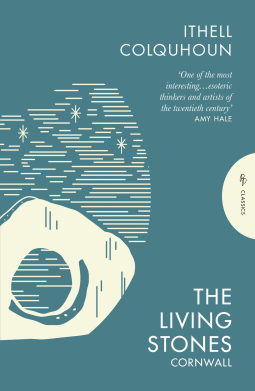
The Living Stones: Cornwall by Ithell Colquhoun

Earlier this year I enjoyed reading Ithell Colquhoun’s The Crying of the Wind, an account of the author’s travels around Ireland, so I decided to read her other travel book, The Living Stones, published two years later in 1957. This one is inspired by her visits to Cornwall in the late 1940s, where she came in search of escape from post-war London. As an artist, she wanted a suitable property to use as an occasional refuge where she could paint in peace and in 1949 she purchased Vow Cave, a small wooden studio with very basic living facilities.

Vow Cave (Colquhoun tells us that Vow is derived from vugha, the Cornish word for cave) is in the village of Lamorna on the Penwith peninsula a few miles from Penzance. Although she writes about the landscape, the surrounding countryside and some local places of interest, this book isn’t really a travelogue in the same sense as The Crying of the Wind, where the author described trips and excursions to different areas of Ireland. Instead, she explores the culture and history of Cornwall in general, with chapters devoted to separate topics, giving it almost the feel of a collection of short essays.

Lots of Cornish customs and rituals are discussed, ranging from the Gorsedh of Cornwall, or gathering of the bards, and the ‘Obby ‘Oss (hobby horse) festival in Padstow to the Furry Day celebrations which mark the arrival of spring (the name likely has nothing to do with fur and comes from the Cornish word for ‘fair’ or ‘feast’). There’s a chapter on traditional Cornish foods such as potato cakes, Cornish cream and the Cornish pasty, and another on folk medicine and witchcraft – Colquhoun has a particular interest in the occult. Some sections are fascinating, although there were others where I found my attention wandering.

Both books I’ve read by this author feel random and meandering, lacking in focus. I found that the best way to read them was in small doses, a few short chapters at a time alternating with other books, rather than straight through from beginning to end. As a pair, they’re definitely worth reading if you have any interest in Ireland or Cornwall, and I did learn a lot from them. Colquhoun has also written a novel, Goose of Hermogenes, which sounds intriguing!

Thanks to Pushkin Press Classics for providing a copy of this book for review via NetGalley.
Six Degrees of Separation: From Ghost Cities to Major Pettigrew’s Last Stand

It’s the first Saturday of the month which means it’s time for another Six Degrees of Separation, hosted by Kate of Books are my Favourite and Best. The idea is that Kate chooses a book to use as a starting point and then we have to link it to six other books of our choice to form a chain. A book doesn’t have to be connected to all of the others on the list – only to the one next to it in the chain.

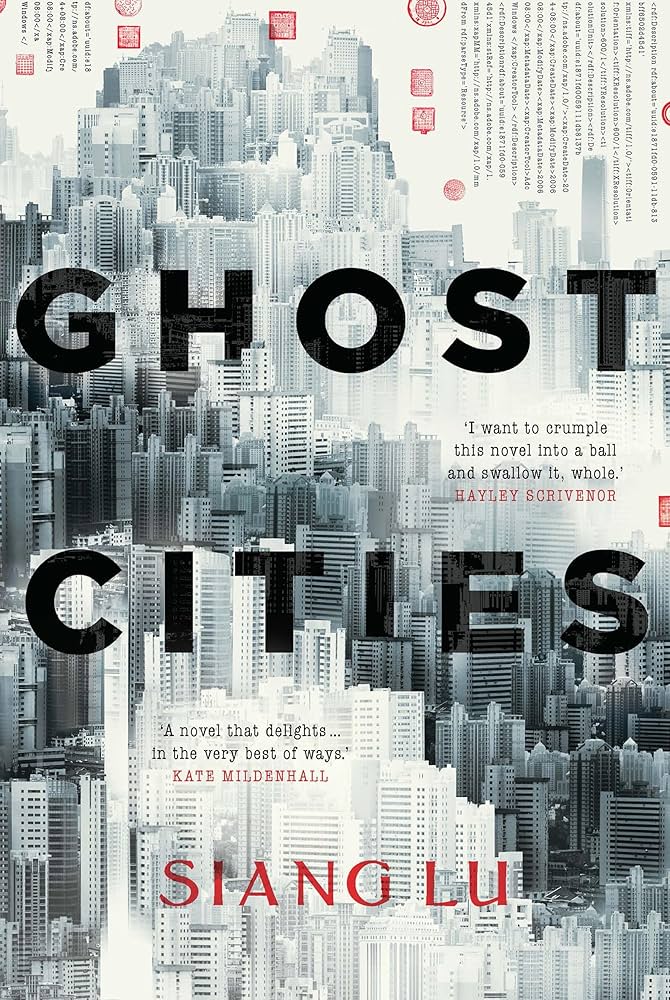
This month we’re starting with Ghost Cities by Siang Lu. It’s not a book that I’ve read, but here’s what it’s about:

Ghost Cities – inspired by the vacant, uninhabited megacities of China – follows multiple narratives, including one in which a young man named Xiang is fired from his job as a translator at Sydney’s Chinese Consulate after it is discovered he doesn’t speak a word of Chinese and has been relying entirely on Google Translate for his work.

How is his relocation to one such ghost city connected to a parallel odyssey in which an ancient Emperor creates a thousand doubles of Himself? Or where a horny mountain gains sentience? Where a chess-playing automaton hides a deadly secret? Or a tale in which every book in the known Empire is destroyed – then re-created, page by page and book by book, all in the name of love and art?

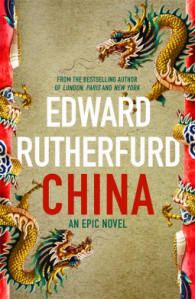
I had trouble thinking of a first link this month, so I’ve just gone for something very obvious – another novel about China! Edward Rutherfurd’s China (1) tells the story of 19th century China, covering key events such as the Opium Wars and the Boxer Rebellion through the lives of several fictional families.

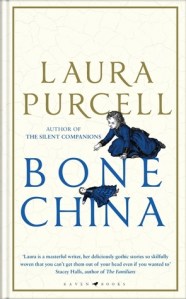
The word ‘China’ also appears in the title of Bone China by Laura Purcell (2), but this time it refers not to the country but the type of porcelain. This is a Gothic novel set in the 19th century on the coast of Cornwall where our narrator has taken a new position as nurse to Louise Pinecroft, a woman who spends her days sitting silently in a room surrounded by china cups and plates. This book was published in the US as The House of Whispers, just in case there’s any confusion!

One of the characters in Bone China is a doctor who is carrying out research into consumption (tuberculosis). The Victorian Chaise-longue (3), an unsettling novella by Marghanita Laski, features a young woman recovering from tuberculosis in 1950s London. Falling asleep on a chaise-longue in the drawing room, she wakes up to find herself in the year 1864.

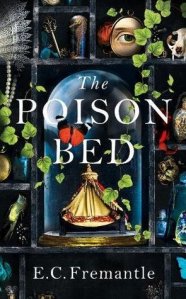
Staying with a furniture theme, my next book is The Poison Bed by Elizabeth Fremantle (4). This is a fictional account of the real-life Thomas Overbury murder case, a poisoning which took place in the early 17th century and implicated Robert Carr, a favourite of King James VI and I, and his wife, Frances Howard.

Cyanide is a type of poison, so my next link leads me to Sparkling Cyanide by Agatha Christie (5), in which a beautiful heiress is poisoned while celebrating her birthday in a restaurant. No Poirot or Miss Marple in this one, but it does feature one of Christie’s other recurring characters, Colonel Race.

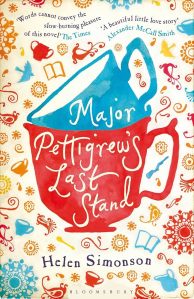
I looked for another book I’d read with a glass on the cover but struggled to find one, so I’m linking to one with teacups on the cover instead. Major Pettigrew’s Last Stand by Helen Simonson (6) is a lovely book about the relationship between a retired British Army officer and a widowed Pakistani woman.

~

And that’s my chain for September! My links included: Books about China, the word ‘China’, tuberculosis, furniture, poison and pictures of drinks.

In October we’ll be starting with I Want Everything by Dominic Amerena.

20 Books of Summer: Final Recap Questionnaire

With this year’s 20 Books of Summer challenge now over, one of our hosts – Emma of Words and Peace – has compiled a final questionnaire to help us look back at what we read during the summer months.

I’m pleased to say that I completed all 20 books for only the second time since I started participating in 2017. I think the reason for my success this year is that I only listed 14 books in advance and left the other six slots empty so I had the freedom to choose books as I went along (my only rule was that they needed to be books I’d acquired prior to January 2025).

Here’s what I managed to read:

1. Come, Tell Me How You Live by Agatha Christie
2. One, Two, Buckle My Shoe by Agatha Christie
3. Jennie by Paul Gallico
4. A Schooling in Murder by Andrew Taylor
5. The Stepdaughter by Caroline Blackwood
6. The Rush by Beth Lewis
7. These Wicked Devices by Matthew Plampin
8. Sinners by Elizabeth Fremantle
9. Strange Houses by Uketsu
10. The Spiral Staircase by Ethel Lina White
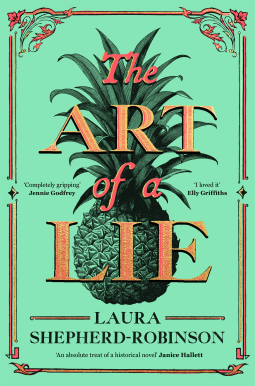
11. The Art of a Lie by Laura Shepherd-Robinson
12. Love and Other Poisons by Lesley McDowell
13. How to Lose a Lord in Ten Days by Sophie Irwin
14. The House at Devil’s Neck by Tom Mead
15. A Caribbean Mystery by Agatha Christie
16. The Lily and the Lion by Maurice Druon
17. The End of the Affair by Graham Greene
18. Fire from Heaven by Mary Renault
19. No Life for a Lady by Hannah Dolby
20. The Silent Companions by Laura Purcell

~

And here are my answers to Emma’s questionnaire.

1. Did you manage to finish all 10/15/20 books? If not, what kept you from completing the challenge?

Yes, I did (see above)!

2. Of all the books you read this summer, which one(s) was/were your favorite and why? Did you DNF any? Why?

My favourites were The Rush by Beth Lewis, Sinners by Elizabeth Fremantle, No Life for a Lady by Hannah Dolby and The Silent Companions by Laura Purcell. I didn’t DNF anything, but I usually don’t anyway.

3. Which book surprised you the most, either by being better or worse than you expected?

I wasn’t expecting Come, Tell Me How You Live to be so funny. Christie’s own personality really shines through in that book.

4. Did you notice any patterns in the genres you chose or enjoyed this summer?

Not surprisingly, most of the books I read were either historical fiction or mystery/crime. I did also manage to include a children’s book, a non-fiction book and some classics.

5. Which one had the best cover?

I like the cover of The Art of a Lie by Laura Shepherd-Robinson.

6. Which one was the longest? And the shortest?

The shortest was The Stepdaughter by Caroline Blackwood at 128 pages. The Lily and the Lion by Maurice Druon, at 432 pages, was the longest.

7. Did you read them mostly in print? ebook? audio?

Most of them were ebooks as they were review copies from NetGalley. The rest were print copies – I don’t tend to listen to audio.

8. Imagine you’re hosting a “20 Books of Summer” book club wrap party.
Which book would you nominate as the guest of honor, and what kind of toast or speech would you give celebrating it?

I would nominate The Rush by Beth Lewis, one of my favourite books of the summer, because it has such an interesting setting – Canada during the Gold Rush. I would invite all three main characters (Kate, Ellen and Martha) to speak to the audience about their experiences of life in such a harsh but fascinating environment.

9. Looking back at all the characters you met over the summer, which one would you want as a summer buddy for a weekend getaway, and what activity would you do together?

There weren’t actually many characters from my summer reading that I would like to spend time with! I did love Violet Hamilton from No Life for a Lady so I would join her in Hastings and we could be Lady Detectives together for the weekend.

~

Did you take part in 20 Books of Summer? How did you do?

Thanks to Emma and Annabel for hosting this year’s challenge! I’m looking forward to 2026.