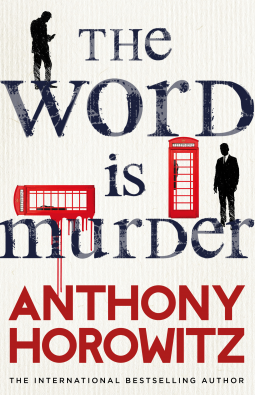
 One bright spring morning Diana Cowper walks into a funeral parlour to arrange her own funeral. Six hours later she is dead, strangled in her own home. It can’t be a coincidence…can it? Detective Inspector Daniel Hawthorne – who is technically no longer with the police but still assists with particularly challenging cases – is called in to investigate. This is to be an investigation with a difference, however, because Hawthorne has enlisted the services of author Anthony Horowitz to write a book about the case.
Horowitz has never written a true-crime book before and admits to being much more comfortable when writing fiction such as his Sherlock Holmes sequel The House of Silk or the Alex Rider young adult series. It is with some reservations, then, that he agrees to write Hawthorne’s story, but as he accompanies the detective while he interviews suspects and searches for clues, Horowitz is drawn into the investigation despite himself.
The two have very different visions for their book; Horowitz believes in using artistic licence to tell a story that people will want to read, but Hawthorne is adamant that he should report only the facts, leaving nothing out that could be of significance. The author also tries in vain to get to know the detective, to shape him into a character who will stand alongside Holmes and Poirot, but the other man remains frustratingly enigmatic:
“Well, if I was going to write about you, you’d have to tell me. I’d have to know where you live, whether you’re married or not, what you have for breakfast, what you do on your day off. That’s why people read murder stories.”
“Is that what you think?”
“Yes!”
He shook his head. “I don’t agree. The word is murder. That’s what matters.”
I started to read The Word is Murder with very high hopes, having loved Horowitz’s previous novel, Magpie Murders (one of my favourite books of last year). I wasn’t disappointed; this is another great book! In fact, like Magpie Murders – but in a different way – it is almost two books in one. We have the story of Horowitz and his relationship with Hawthorne and then we have the murder investigation itself. I’m aware that I’ve said very little so far about the latter – and I’m not going to say much more, other than that it is a very clever, tightly plotted mystery with plenty of clues, suspects and red herrings. Thanks to Hawthorne’s insistence on everything being written down, most of the clues are there from the beginning and the rest are at least revealed early enough for us to guess the solution before Horowitz does. I have to admit, though, that I was slow to put them together and didn’t come close to solving the mystery!
I should probably make it clear that Diana Cowper is a fictional character – she wasn’t really murdered six hours after arranging her own funeral and Hawthorne, who is also fictional, wasn’t really brought in to investigate. Anthony Horowitz, however, is obviously a real person and so The Word is Murder is a curious blend of fiction and non-fiction. He is not the first author to use themselves as a character in their own novel, but I’m not sure if anyone else has done it in quite the same way!
Although the passages in which Horowitz describes his various writing projects, his appearances at book festivals and his views on literary agents are a bit of a distraction from the central plot at times, his main role in the story is as a sort of Watson-style sidekick, and this aspect of the novel works very well. As for Hawthorne, he has quite an unpleasant personality, being humourless, secretive, pedantic, and – to Horowitz’s disgust – homophobic, but I found him a fascinating character, precisely because he is so unattractive. They are an unlikely pairing but there is plenty of potential here for more Hawthorne/Horowitz mysteries, I think – I would certainly be happy to read them, anyway!
Thanks to the publisher, Random House, for providing a copy of this book for review via NetGalley.




 She Reads Novels