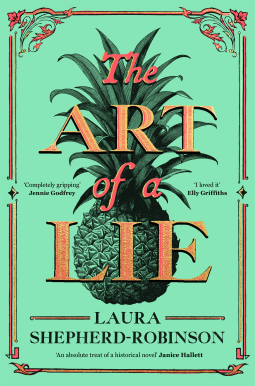
The Art of a Lie by Laura Shepherd-Robinson

I’ve enjoyed all of Laura Shepherd-Robinson’s previous books, particularly The Square of Sevens, so this is one of the new releases I’ve been most looking forward to reading this year. It has many of the same elements as her others – an 18th century setting, a mystery to be solved, lots of surprising plot twists and characters who are not quite as they seem! This one also features ice cream, which makes it a perfect summer read.

The Art of a Lie opens in London in 1749 and the first section is narrated by Hannah Cole, whose husband Jonas was found dead in the street several months earlier, seemingly the victim of a robbery. Since his death, Hannah has continued running their business, a confectionery shop known as the Punchbowl and Pineapple, but is struggling financially. A visit from the magistrate, Henry Fielding – who is also the author of the recently published Tom Jones – brings her some welcome news: Jonas had a large sum of money in his bank account that she knew nothing about. Unfortunately, her excitement is short-lived because Fielding also tells her that he suspects the money was acquired illicitly and that Jonas was probably not just the victim of a random attack as first thought, but was murdered by someone he knew.

A second way of improving her financial position soon presents itself to Hannah when a gentleman enters the Punchbowl and Pineapple and introduces himself as William Devereux, a friend of her late husband’s. William gives Hannah a recipe for ‘iced cream’, a frozen dessert made by his mother, who was raised in Italy. Despite some initial problems – freezing cream without the aid of an electric freezer is not an easy task – the new treat proves a big success. And soon William is helping her to solve a bigger problem – the question of who killed Jonas Cole and where the money in his bank came from.

The perspective switches between Hannah and William several times throughout the novel, with each narrator being given a distinctive narrative voice of their own. I felt a stronger connection with Hannah, but seeing things from William’s point of view provides a whole different side to the story. It quickly becomes clear to the reader that neither one of them is being completely honest with the other (or with anyone else) and that, as the title suggests, this really is a novel about the art of telling lies! It was fascinating to follow both of their narratives, wondering who was going to come out on top. The ending of the book wasn’t really what I’d expected and although I would have preferred the ending I had expected, it was good to be taken by surprise!

I loved the setting of the book, particularly the descriptions of Hannah’s shop and all the cakes, chocolates and sweets she sells. I enjoyed reading about her experiments with different varieties of ice cream (don’t miss the author’s note at the end of the book, which has some factual information about the history of ice cream in the UK). The inclusion of Henry Fielding as a character in the book was also interesting – he really was Chief Magistrate of Westminster at the time the story is set and was the founder of the Bow Street Runners, London’s first police force.

The Square of Sevens is still my favourite Laura Shepherd-Robinson book, but I think it’s just a matter of personal taste and I’m sure some readers will like this one better. It reminded me very much of The Queen of Fives by Alex Hay and I think if you enjoyed that one you’ll probably enjoy this one as well.

Thanks to Pan Macmillan/Mantle for providing a copy of this book for review via NetGalley.
Book 9/20 for 20 Books of Summer 2025.
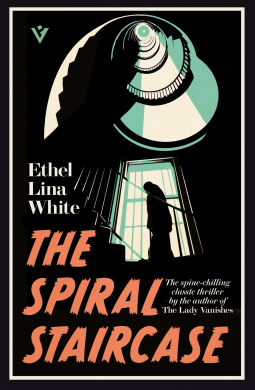
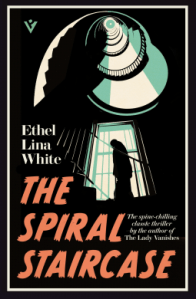
The Spiral Staircase by Ethel Lina White

Originally published as Some Must Watch in 1933, this is a reissue by Pushkin Vertigo under the title The Spiral Staircase – the name of the 1946 film adaptation. I’ve previously read two other novels by Ethel Lina White – The Wheel Spins and Fear Stalks the Village – and enjoyed both, although I found the former slightly disappointing in comparison with Alfred Hitchock’s wonderful The Lady Vanishes, which is based on it. This book has turned out to be my favourite of the three!

Almost the entire novel is set within the walls of the Summit, a lonely country house near the Welsh/English border. Adding to the sense of tension and claustrophobia, the main events of the story also take place over the course of a single evening. As the novel opens, we learn that four murders have recently been committed – the first two in the nearest town, which is over twenty miles away, the next slightly closer, and the fourth in another country house just five miles from the Summit. All four victims were young women and their deaths are on Helen Capel’s mind as she returns to the Summit after her afternoon off and is convinced that she sees a man hiding behind a tree in the dark.

Helen has just started a new job as ‘help’ to the Warren family – Miss Warren and her brother, known as the Professor, and their elderly, bedridden stepmother, Lady Warren. At the start of the novel, the Professor’s son and his wife are staying at the house, as is a student of the Professor’s, Stephen Rice. The rest of the household is made up of two more domestic servants, Mr and Mrs Oates, and the newly arrived Nurse Barker, who has been employed to look after Lady Warren.

When news of another murder, closer than ever this time, reaches the family, the Professor orders that all the doors are locked and everyone stays inside until morning. These should be easy enough instructions to follow, yet for a variety of reasons, one person after another leaves the house or becomes otherwise incapacitated. As a storm rages outside and the tension builds inside, Helen is forced to confront the idea that one of the remaining people in the house could be the murderer.

This book is good fun, but you do need to be able to suspend disbelief now and then (Helen is one of those heroines typical of this genre of book, who, despite knowing there’s a murderer on the loose, tries to open the front door every time someone knocks and spends most of the night wandering around the house on her own, along dark passageways and up and down dimly-lit staircases). Still, Ethel Lina White does a great job of creating an atmosphere of foreboding and fear, not just through stormy weather and shadows, but also through hints that various characters may not be as they seem. Is Lady Warren really unable to walk – and why does she have a gun in her room? And what if Nurse Barker isn’t really a nurse?

I found this a quick, entertaining read, let down slightly by the ending because the killer’s identity wasn’t particularly surprising and their motive was unconvincing. If you’re looking for a cleverly plotted mystery, I think you’ll be disappointed as I would describe this as much more of a psychological horror/suspense novel than a crime novel. It reminded me a lot of Benighted by J.B. Priestley and I think if you enjoyed one there’s a good chance you would enjoy the other. After finishing this book, I watched the film for the first time (it’s currently available on YouTube) and while it’s worth watching in its own right, I didn’t feel that it had much in common with the book!

Thanks to Pushkin Vertigo for providing a copy of this book for review via NetGalley.

Book 8/20 for 20 Books of Summer 2025.
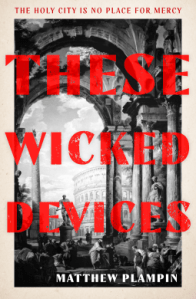
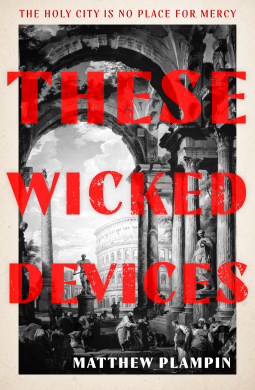
These Wicked Devices by Matthew Plampin

I’ve only read one Matthew Plampin book – Mrs Whistler, about the life of Maud Franklin, the model and muse of the artist James McNeill Whistler – so I was intrigued by the description of his new one, which is set in an entirely different time and place. These Wicked Devices takes us to Rome in the summer of 1650 and introduces us to three separate characters whose stories become entwined in various ways.

First, we meet Sister Orsola, a Benedictine nun who has fled to Rome after the city of Castro, including the convent that was her home, was razed to the ground on the Pope’s orders. Orsola is accompanied by Sister Serafina, a choir nun who goes into trance-like states where she endlessly recites the lives of the saints. In the final hours before Castro’s destruction, the Mother Abbess had asked Orsola to protect Serafina and help her find another convent where she could live in safety. Orsola agreed, hoping that performing this task would help her to atone for the sin of giving birth to a child who died unbaptised.

Another thread of the novel follows Donna Olimpia Maidalchini, the most important woman in Rome. As the sister-in-law of Pope Innocent X, she is regarded as the real power behind the papal throne, involving herself in politics and the appointment of positions within the church. At the beginning of the novel, Donna Olimpia is negotiating with France to help a French invasion force seize the Kingdom of Naples from Spain.

Finally, we meet Juan de Pareja , newly arrived in Rome from Spain. Juan is an assistant and slave of the Spanish artist, Diego Velázquez, who hopes to paint a portrait of the Pope. When Juan discovers some secret papers hidden inside a metal statue, however, he suspects that there’s also another reason for their presence in Rome.

These three storylines alternate throughout the book, clearly marked with the Latin headings Sorores (sisters), Domina (mistress) and Servus (servant), to indicate whose perspective we’ll be reading from next. The three do merge together a lot, but I did find myself preferring one over the others – the one about Sisters Orsola and Serafina. There’s a real sense of danger as they are suspected of being heretics due to their connection with Castro and Orsola isn’t sure who can and can’t be trusted as she tries to carry out her promise to the Abbess. There was a lot to interest me in Juan de Pareja’s story as well – his relationship with his master, Diego Velázquez, his own ambitions of becoming an artist and his desire to live his life as a free man – but I found Donna Olimpia’s sections less engaging, maybe because she herself is much less likeable as a person.

Plampin creates a strong sense of time and place, with vivid descriptions of the piazzas, fountains, palazzi and churches of Rome as the city bakes in a late spring heatwave. I found the writing style quite dry, though, so for me this was an interesting read rather than an entertaining one. Still, it was good to add to my knowledge of a period in Rome’s history that I knew very little about.

Thanks to The Borough Press for providing a copy of this book for review via NetGalley.

Book 7/20 for 20 Books of Summer 2025.
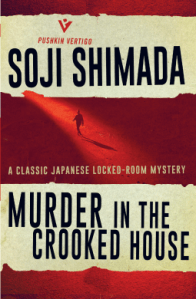
Six Degrees of Separation: From Theory & Practice to Murder in the Crooked House

It’s the first Saturday of the month which means it’s time for another Six Degrees of Separation, hosted by Kate of Books are my Favourite and Best. The idea is that Kate chooses a book to use as a starting point and then we have to link it to six other books of our choice to form a chain. A book doesn’t have to be connected to all of the others on the list – only to the one next to it in the chain.

This month we’re starting with Theory & Practice by Michelle de Kretser. As usual, this is a book I haven’t read! Here’s what it’s about:

In the late 1980s, the narrator of Theory & Practice — a first generation immigrant from Sri Lanka who moved to Sydney in her childhood — sets up a life in Melbourne for graduate school. Jilted by a lover who cheats on her with another self-described “feminist,” she is thrown into deeper confusion about her identity and the people around her.

The narrator begins to fall for a man named Kit, who is in a “deconstructed relationship” with a woman named Olivia. She struggles to square her feminism against her jealousy toward Olivia—and her anti-colonialism against her feelings about Virginia Woolf, whose work she is called to despite her racism.

What happens when our desires run contrary to our beliefs? What should we do when the failings of revered figures come to light? Who is shamed when the truth is told? In Theory & Practice, Michelle de Kretser offers a spellbinding meditation on the moral complexities that arise in this gap. Peopled with brilliantly drawn characters, the novel also stitches together fiction and essay, taking up Woolf’s quest for adventurous literary form.

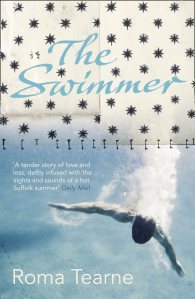
I’m going to use an immigrant from Sri Lanka as my first link. The Swimmer by Roma Tearne (1) begins with Ria, a woman in her forties, discovering a young man swimming in the river behind her house in Suffolk. His name is Ben and he’s a Tamil refugee who has fled violence in Sri Lanka and made his way to England. I enjoyed watching Ria and Ben’s relationship develop until a sudden change of narrator sent the story in a different direction.

Staying with the theme of swimming, Wonder Girls by Catherine Johnson (2) is set in 1928 and tells the story of Ida Gaze, who at the age of sixteen sets out to become the first person ever to swim the Bristol Channel between Wales and England. Although it’s a fictional story, it’s still a very inspirational one!

Another book with ‘wonder’ in the title is The Wonder by Emma Donoghue (3), a dark but fascinating novel about an eleven-year-old girl in 19th century Ireland whose parents claim she has eaten nothing at all for four months. To prove whether the girl really is a miracle or whether it’s a hoax, a nurse, Lib Wright, is hired to watch over her and see if the claims are true. Lib has been serving in the Crimean War and was trained by Florence Nightingale, which leads me to the next book in my chain…

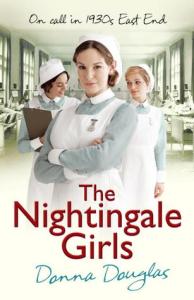
The Nightingale Girls by Donna Douglas (4) is the first in a series about a group of student nurses at London’s Nightingale Hospital in the 1930s. I enjoyed meeting the three main characters and stated in my review that I was looking forward to the rest of the series – well, that was twelve years ago and I still haven’t picked up any of the others!

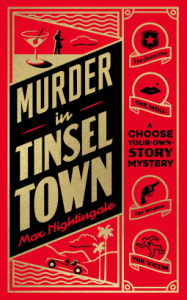
Nightingale is the name of the author of the next book in my chain. Murder in Tinseltown by Max Nightingale (5) sounded fun, but was a disappointment. It’s an interactive ‘choose your own adventure’ style book, where you play the role of a detective investigating a murder and at various points in the story you choose what happens next by turning to different pages. A good idea, but it needed a lot more editing, unfortunately.

A book starting with the same two words in the title is Murder in the Crooked House by Soji Shimada (6). This is one of several Japanese crime novels I’ve read over the last few years, but not one of my favourites as I found the mystery far too convoluted and too concerned with alibis, timings, room layouts and other little details rather than the characters and their motives. It was originally published in 1982 but I read a reissue in an English translation by Louise Heal Kawai.

~

And that’s my chain for July. My links have included: Sri Lanka, swimming, the word ‘wonder’, Florence Nightingale, the name Nightingale and titles beginning with ‘Murder in’.

In August we’ll be starting with The Safekeep by Yael van der Wouden. I have that book on my TBR – I wonder if I’ll be able to read it before August!

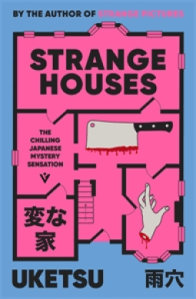
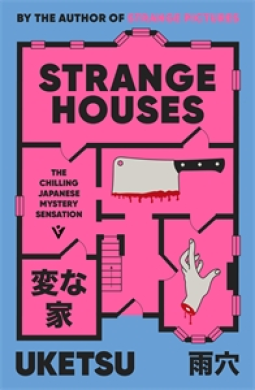
Strange Houses by Uketsu

“I can’t tell you how many people have told me their scary house stories.

But none of them can compare to the houses in this story. These strange, strange houses.”

I loved Uketsu’s Strange Pictures when I read it earlier this year, so I was excited to see another of his books, Strange Houses, available on NetGalley. Like the first book, this one has been translated into English from the original Japanese by translator Jim Rion. Also like the first book, it contains a number of illustrations and diagrams that form an important part of the story.

The novel begins with our narrator, a freelance writer, being approached by his friend Yanaoka, who is searching for a suitable house in which he and his wife can raise their first child. Having viewed a house in a quiet residential area of Tokyo, Yanaoka and his wife have both fallen in love with it but are confused by the floor plan which shows a ‘dead space’ – in other words, a tiny hidden room with no doors. The narrator has another friend, Kurihara, who is an architect, so he decides to ask his opinion.

When Kurihara studies the floor plans, he picks up on several other unusual features of the house. These, together with the hidden room, lead him to form a bizarre but terrifyingly logical explanation for the design of the building. Yanaoka chooses not to buy it, but the narrator is intrigued and continues digging into the house’s history, uncovering connections with some other equally strange houses!

I really enjoyed the first half of this book, almost as much as Strange Pictures. It has a similarly interactive feel, where we are encouraged to look at the illustrations and identify the clues in them along with the narrator. Although Kurihara’s theory about the design of the Tokyo house seems ridiculously far-fetched, it does also make sense when you consider the layout of the rooms, the positions of doors and windows and the location of the house itself. I would never have imagined that floor plans could be creepy, but the ones in this book certainly are!

A difference between this book and Strange Pictures is that the other book is made up of several separate but interconnected stories, while this one consists of just one plot and one set of characters. The change in format means this book feels less varied and innovative, but it also allows us to follow the story of one family – the family who built the houses – through to the end. In the second half of the book, the focus moves away slightly from the plans and layouts and concentrates more on the history of the family. Things become quite convoluted, with complex relationships between the family members, rivalries between different branches and tales of curses and traditions going back several generations. I was reminded of Seishi Yokomizo’s mystery novels and I wonder if these, as well as Yukito Ayatsuji’s Bizarre House series, have influenced Uketsu.

In an interview, translator Jim Rion has talked about how Uketsu wants his writing to be easy to read and accessible to all readers and I think Rion has done a great job of keeping that same clarity in his translations. I’ve also discovered that a third book, Strange Buildings, is coming soon. Something to look forward to!

Thanks to Pushkin Vertigo for providing a copy of this book for review via NetGalley.

Book 6/20 for 20 Books of Summer 2025.
20 Books of Summer 2025: June Recap

Now that the first month of this year’s 20 Books of Summer challenge is over, one of our hosts – Emma of Words and Peace – has compiled a list of five questions to help us recap our June reading. I had fun answering these, although I’m afraid some of my answers aren’t quite as creative as the questions!

I read nine books for the challenge in June and have only reviewed five of them so far. The other four reviews will be coming soon, I promise!

1. If your #20BooksofSummer25 TBR were a beach, what’s the most surprising thing you’ve unearthed so far – a hidden gem, a total shipwreck, or something unexpectedly delightful?
This question gets at whether you’ve discovered a new favorite, encountered a book you didn’t enjoy, or found something pleasantly surprising.

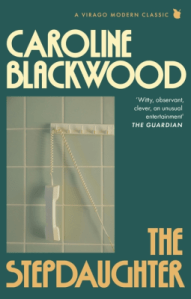
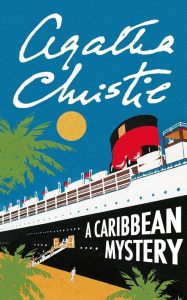
Of the books I’ve read for 20 Books of Summer so far, two were by authors who were new to me – The Rush by Beth Lewis and The Stepdaughter by Caroline Blackwood – and both were surprisingly good! I’m sure I’ll be reading more by both of those authors. Agatha Christie’s 1964 Miss Marple novel, A Caribbean Mystery, is another book I enjoyed more than I was anticipating – it hadn’t appealed to me much as it’s not a setting I associate with Miss Marple.

There were no total shipwrecks on my beach as the other books I read in June were by authors already familiar to me, so I knew what to expect!

2. Imagine your reading progress as a summer road trip. Which book has been the scenic route, which has been the highway, and is there a rest stop book you’re looking forward to?
This question explores reading pace and anticipation. A scenic route book might be slower-paced and atmospheric, while a highway book is a fast-paced read. The rest stop book is one you’re looking forward to for a break or change of pace.

The scenic route would be A Schooling in Murder by Andrew Taylor, a slow-paced historical mystery novel set in and around a girls’ school in the 1940s. Caroline Blackwood’s The Stepdaughter would be the highway book – it’s a novella that I finished in one day.

The rest stop book I’m looking forward to is this month’s Read Christie 2025 selection, Come, Tell Me How You Live? It will be the first non-fiction book I’ve read for 20 Books of Summer, so should be a nice change from all the fiction I’ve been reading.

3. If one of the books you’ve read this month was turned into an ice cream flavor, what ingredients would it have, and what would it be called?
This question encourages your creative thinking and helps you express the essence of a book in a fun, summery way.

My Gold Rush Crunch ice cream, inspired by The Rush, includes a scoop of vanilla to represent the snowy mountains of the White Pass Trail and chunks of honeycomb to represent gold nuggets. As the book is set in Canada, it can be served with optional maple syrup!

4. If you could swap places with a character from one of the books you’ve read this month, purely for the summer, who would it be and what items would you absolutely take with you?
This question taps into escapism and personal connection. It also allows you to highlight a character or book you particularly enjoyed.

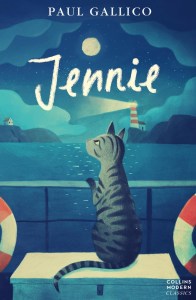
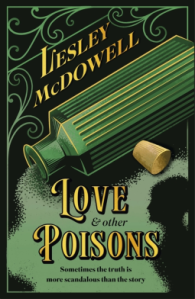
It’s actually easier for me to say which ones I wouldn’t want to swap places with! I certainly wouldn’t want to be Helen Capel from Ethel Lina White’s The Spiral Staircase and have to spend the whole summer locked in a creepy house with a murderer on the loose, nor would I want to live in any of the equally unsettling buildings described in Uketsu’s Strange Houses. Turning into a cat like Peter in Paul Gallico’s Jennie doesn’t appeal either, although it might be fun for a little while – and much as I enjoyed The Rush, the Klondike in the 19th century sounds like a harsh and dangerous place for a woman. I wouldn’t like to be a ghost like Annabel in A Schooling in Murder either, or part of the miserable household in The Stepdaughter. If I chose Love & Other Poisons by Lesley McDowell I would have to be either a murderer or a murder victim and These Wicked Devices by Matthew Plampin would give me the options of a nun, a slave or a scheming noblewoman.

Having ruled everybody else out, I’m left with Miss Marple, so it looks like I’m off to the Caribbean for the summer – with my knitting, of course. Maybe I’ll be able to solve a mystery or two while I’m there!

5. “Plot twist!”: If your summer reading challenge were a book, what unexpected event just happened to shake things up? Or did life get in the way of your reading plans?
This question acknowledges the unpredictable nature of life and reading, and allows you to share any challenges or unexpected joys you’ve encountered.

June was a surprisingly uneventful month for me, with nothing in particular that got in the way of my reading. Of course, that could change over the next two months of the challenge – only in a good way, I hope!

~

Are you taking part in 20 Books of Summer? How did your June reading go?

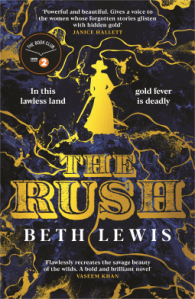
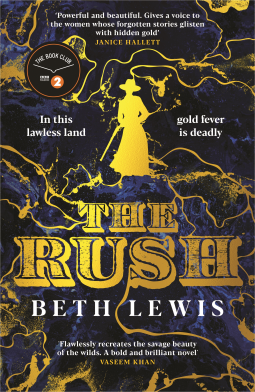
The Rush by Beth Lewis

I loved this! I’ve never read anything by Beth Lewis before, or even come across her, but this is one of my favourite books of the year so far. It’s set in Canada during the Gold Rush and follows the stories of three very different women whose paths cross in Dawson City in the Klondike.

The Rush begins with the arrival of Kate Kelly in Skaguay (now Skagway), Alaska, in 1898. Kate is there to meet up with the guide who is going to take her along the White Pass Trail, the route to Yukon and the Klondike goldfields. She needs to get there as quickly as possible because she has received a desperate plea for help from her sister, Charlotte, in Dawson City: This may be my last letter. He has finally found me and there is nowhere left to run.

In the little Klondike settlement of Boulder Creek, Ellen Rhodes spends her days alone in her cabin, cooking, cleaning and washing, while her husband, Charlie, goes down to the river and digs for gold that never appears. Ellen is sure they’re wasting their time and money, but Charlie refuses to give up on his dream. Finally, we meet Martha, owner of the Dawson Hotel, which doubles as the town’s brothel. Martha is fiercely proud of the business she has built up and is determined to keep it out of the hands of the ruthless Bill Mathers, who seems to be buying up the entire town.

The three women take turns to narrate the story, with the viewpoints rotating throughout the book. They are leading very separate lives at first, but are drawn together when one of Martha’s girls is found murdered. They’re also connected by a mysterious fortune teller who encounters all three of them and seems to have an uncanny ability to truly predict the future. There’s a mystery element to the novel as the women try to find out who the murder victim really is, who has killed her and why, but although this was intriguing and cleverly plotted, what I really loved was the setting and learning what it was like to be a woman in that fascinating but harsh environment where there were any number of natural and man-made disasters – an avalanche, a fire, an outbreak of typhoid – that could change everything in an instant.

I seem to read very few historical novels set in Canada, so I was pleased to have come across one with such a strong sense of place. The vivid descriptions made it easy for me to imagine the cabin by the river where Ellen and Charlie’s marriage falls apart, a victim to the obsessive fever that grabs hold of some human beings when gold is mentioned, and the streets of Dawson City where enterprising men and women like Martha have discovered that the real fortune is to be made not from mining but from the miners. But I particularly enjoyed following Kate’s journey from Alaska into Canada’s Yukon territory, a journey which includes a dramatic, exhilarating adventure crossing the dangerous White Horse Rapids.

I had assumed that the characters were entirely fictional, so I was surprised to read the author’s note at the end of the book and discover that many of them, including Kate, Ellen and Martha, are actually based loosely on real historical figures. This really is a fascinating book, in so many different ways, and I can’t recommend it highly enough.

Thanks to Viper for providing a copy of this book for review via NetGalley.

Book 5/20 for 20 Books of Summer 2025.