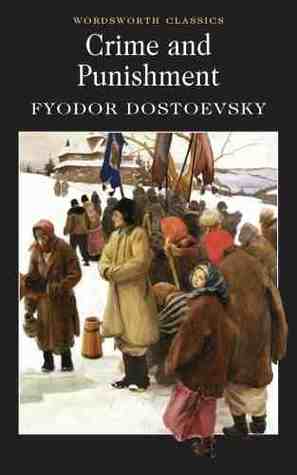
 This is one of my final reads from my Classics Club list and, I have to admit, it wasn’t one that I was looking forward to, having had at least two previous attempts to read it. I did read The Idiot a few years ago (also for the Classics Club) and got on much better with that one, so I was prepared to give Crime and Punishment another chance. I’m glad I did, because I managed to get to the end this time and enjoyed it much more than I thought I would.
Crime and Punishment, Dostoevsky’s 1866 novel, follows the actions and thought processes of Rodion Romanovich Raskolnikov, an impoverished former student living in St Petersburg. In the first chapter we learn that Raskolnikov is planning the murder of an elderly pawnbroker, Alyona Ivanovna, a crime he proceeds to carry out, although it doesn’t go entirely according to plan. At this stage his motives are not completely clear, but it seems that he is simply in need of money: he is struggling to pay the rent, can’t afford to continue with his studies and has discovered that his sister is about to marry a man she doesn’t love for his money.
Nothing in a Dostoevsky novel is simple, however, and other motives soon begin to emerge. At one point Raskolnikov states that the old woman he has killed is just a ‘louse’ and of no use to society. He also explains that he believes in the theory that there are some people who are superior to others and have the right to commit serious crimes such as murder. He considers Napoleon to be one example of such a person and he is keen to test the theory out for himself. Are some men really so great that the law doesn’t apply to them and that they have no need to worry about the consequences of their actions because by committing murder they will have proved their greatness?
Of course, Raskolnikov does not escape the consequences and from the moment he kills the pawnbroker, his emotions are thrown into turmoil. Although he gets away from the scene of the crime presumably undetected, he obsesses over every detail of the murder, becoming feverish and causing his family and friends – who know nothing of what he has done – to worry about him. Despite taking some steps to cover his traces and remove the evidence, there are times when he seems to want to be discovered and goes out of his way to make himself appear suspicious. He becomes more and more tormented as the novel progresses and as Dostoevsky allows us to access Raskolnikov’s innermost thoughts, this is not the most comfortable or pleasant of reads! You wouldn’t really expect a book with the title Crime and Punishment to be comfortable and pleasant, though, would you?
The crime part of the novel is obvious enough, but the punishment takes more than one form. First, there is Raskolnikov’s psychological disarray in the days following the murder, which is a punishment in itself, but there is also the question of whether or not his crime will eventually be found out and he will receive punishment of a different kind. I won’t spoil things by telling you whether he is discovered, betrayed, confesses or escapes justice forever, because once the detective Porfiry Petrovitch gets involved, there is a certain element of suspense which I’m sure you would rather experience for yourself.
Although I don’t think I would describe this book as “one of the most readable novels ever written” as stated on the cover of my edition, once I got into it I found it very compelling and a quicker read than I’d expected it to be. I’m so pleased I gave it another try and that I persevered past Raskolnikov’s nightmare about a horse being thrashed to death, which was where I stopped on my last attempt. And of course, the horse dream, horrible as it may be, is in the story for a reason and its significance starts to become clear later on. I won’t pretend that I fully understood everything that happens in the book, but I can always read it again one day – after I’ve read The Brothers Karamazov, which I think is going to be one of the titles on the second list I put together for the Classics Club.







 She Reads Novels