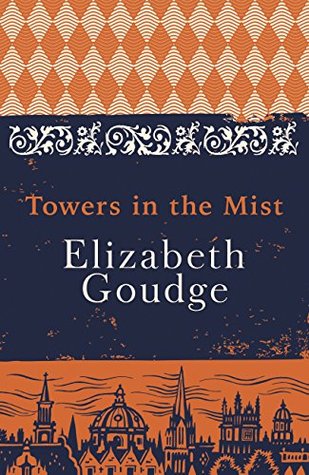
 I have Lory of The Emerald City Book Review to thank for introducing me to the work of Elizabeth Goudge. Last year, for her Elizabeth Goudge Day (hosted on the author’s birthday, 24th April) I read The White Witch, and the year before I read The Child from the Sea. I loved both so there was no question of not taking part again this year – and I had high hopes for my third Goudge novel, Towers in the Mist, which was first published in 1937.
Not all of Goudge’s novels are historical, but it’s the historical ones that I’ve been drawn to first. Towers in the Mist is set in Oxford in the Elizabethan period and, like the other two I’ve read, it’s a truly beautiful novel. It begins on May Day with Faithful Crocker’s first sight of the “fragile city spun out of dreams, so small that he could have held it on the palm of his hand and blown it away into silver mist”. At the age of fourteen, Faithful has found himself alone in the world and has made his way to Oxford where he hopes to achieve his ambition of becoming a scholar and attending university. With no money, no friends and not even any decent clothes to wear, this may seem unlikely, but Faithful’s fortunes improve when he catches the eye of Canon Leigh of Christ Church, who takes him into his household and treats him as one of the family.
Following the death of his wife several years earlier, Canon Leigh has been left to raise his children alone and most of the responsibility has fallen on his eldest daughter, Joyeuce. Joyeuce is devoted to her younger brothers and sisters, but when student Nicolas de Worde enters her life, she will have to decide what is more important to her. We also follow the stories of the domestically-minded Grace, who longs to step out of her sister Joyeuce’s shadow and take control of the Leigh household, and of four-year-old Diccon, who is thought to have been switched at birth as he is so different in looks and temperament to the rest of the family. These are the people with whom Faithful will build his new life, sharing in their small everyday dramas – such as the chaos of the Spring Wash – as well as the larger ones which affect the entire city and university.
I loved getting to know Faithful and the Leighs (and Nicolas, who ended up being one of my favourite characters after undergoing a bit of a transformation which I hadn’t expected at the beginning) but there are also several real historical figures from the Elizabethan age who play a part in the story. The most prominent are the poet Philip Sidney and the poet/explorer Walter Raleigh who, at the time during which the novel is set, are both young men attending university along with Faithful, Nicolas and Giles Leigh. I loved the contrast between the two characters – the flamboyant, daring Raleigh and the quiet, sensitive Sidney – and I enjoyed the little insights we are given into the work of a poet: “The loveliest phrases are winged, and when the poet opens the door of the place where he put them he finds that the tiresome creatures have flown away.”
Each chapter opens with a passage from a poem by Sidney, Raleigh or another 16th century poet and I thought this was a nice touch which helped to set the mood for the story. Goudge admits in her note at the beginning that not everything in the book will be entirely accurate historically, but I think she is very successful at capturing the overall feel of the Elizabethan period even if it may not be correct in every detail.
Towers in the Mist is a lovely book, but it does have a few flaws and could be too sentimental for many modern day readers. Although the descriptions of Oxford are beautiful and Goudge’s own love for the place shines through, sometimes she goes into long digressions on the history of the city and university which add very little to the plot – you either have the patience for that sort of thing or you don’t. As with the other Goudge novels I’ve read, there’s also a strong religious element which won’t be for everyone either (in fact, it’s not really for me, although it didn’t bother me at all when there was so much else to enjoy).
So, that’s three books by Elizabeth Goudge that I’ve read now and three that I’ve loved. Which one should I read next?


 She Reads Novels