Frenchman’s Creek by Daphne du Maurier

frenchmans-creek Daphne du Maurier’s Rebecca has been one of my favourite books since I first read it as a teenager, but it’s only relatively recently that I started to explore the rest of her work. Since 2010, I have now read several of her short story collections and one of her non-fiction books, as well as working through almost all of her novels, saving Frenchman’s Creek until near the end (as it sounded like one that I would particularly enjoy and I wanted to have something to look forward to).

Set in the 17th century, Frenchman’s Creek is the story of Dona St Columb who, at the beginning of the novel, is growing disillusioned with her marriage and bored with life in London. To alleviate her boredom, she has been joining her husband Harry and his friends in some increasingly wild escapades, but as the mother of two young children she has started to feel ashamed of her behaviour. Unable to bear it any longer, she decides that what she needs is to spend some time away from her husband and London society – and so she takes the children and heads for Navron, Harry’s estate in Cornwall.

On arriving at the house, Dona is surprised to find that only one servant is present; his name is William, a quiet but perceptive man with whom Dona forms an immediate bond. Despite signs that suggest someone has been sleeping in her bedroom while the house stood empty, she soon begins to feel relaxed and refreshed in the peaceful surroundings of Navron. Her new neighbours, however, seem to be less at ease and it’s not long before Dona hears tales of a French pirate who is said to be terrorising the coast of Cornwall. On a walk through the woods one day, she discovers a ship resting in a creek and suddenly everything makes sense.

The Frenchman (who, you will have guessed, is the owner of the ship), dispels all of Dona’s – and probably the reader’s – preconceived ideas of what a pirate should be. Polite, cultured and intelligent, he couldn’t be more different from Harry and his friends, and it’s no surprise that Dona falls in love with him. I couldn’t quite believe that a man like the Frenchman would have chosen to be a pirate (the reasons he gives for his way of life didn’t seem very convincing) but I thought he was an intriguing character and I enjoyed watching Dona’s relationship with him develop. And yet I didn’t become fully engaged with the story until halfway through, when Dona and the Frenchman embark on an adventure together and the consequences of this threaten to bring their happiness to an end. From this point on, I found the book unputdownable, right through to its poignant ending.

Du Maurier’s writing is beautifully atmospheric and evocative, more so than almost any other author I can think of. The description of Dona’s first walk along the banks of the creek, where it widens into a pool and she comes upon the pirate ship for the first time, is so vivid I could nearly see the scene laid out in front of me. The whole book has a dreamy, almost hypnotic feel. Although we are told once or twice that our hero’s name is Jean-Benoit Aubéry, he is referred to throughout the novel as simply the Frenchman – it’s little things like these which really add to the air of mystery and haziness.

Although I did enjoy this book very much, particularly the second half, it couldn’t quite equal my top four du Mauriers, Rebecca, My Cousin Rachel, The Scapegoat and The House on the Strand. I’m planning a re-read of Rebecca soon and then I would like to read Castle Dor, the only du Maurier novel I still haven’t read.
Jane Shore: The Merry Mistress

jane-shore Elizabeth Shore, known as Jane, was a mistress of King Edward IV of England and said to be “merry in company, ready and quick of answer”. She often appears in fiction set during the Wars of the Roses as a minor character – depending on the book, either as a bad influence or a comfort to Edward in his declining health, and a possible conspirator against his brother, Richard III – but several novels have also been written specifically about Jane. I have read two recently and am combining my reviews into one post.
The first of the two books is an old one, written in the 19th century by Mary Bennett, a truly ‘forgotten’ author if ever there was one. She’s so forgotten that I’ve struggled to find any biographical information at all about her (the Database of Victorian Fiction has a paragraph) and can’t even find a definite publication date for Jane Shore – I think it could have been 1869. It seems that Bennett had quite a few novels published, though, so she must have had some level of success at the time.

As Jane was a relatively unimportant historical figure, there is still a lot that we don’t know about her today; obviously even less would have been known in Bennett’s day and fewer sources would have been available to her in researching her book.  Bennett refers to Jane as the daughter of Mr Winstead and the wife of Matthew Shore, ‘the goldsmith’,  while most modern novels give Jane’s father’s name as John Lambert and her husband’s as William Shore, not a goldsmith but a mercer.  It’s difficult for me to comment on the historical accuracy of Jane Shore, then, as it depends on which sources the author had to work from – and it could be that what was considered accurate then is not considered accurate now.

Bennett’s Jane is portrayed, in typical Victorian style, as an innocent, virtuous young woman at the mercy of the king, his friend Will Hastings, and several other men who want to steal her away from her father and husband. She is the sort of person who has things happen to her rather than making them happen herself, which means she is not the most interesting of characters to read about. In fact, I didn’t feel that any of the characters in this novel ever came to life on the page or seemed like real people at all.

The book is entertaining in parts – mainly when the action switches to Wales and the story of two fictional characters, Nesta Llewellyn and the musician Leolin – but very tedious in others and certainly wouldn’t be the best introduction to Jane Shore’s life.  Having read it, I understand now why Bennett is a forgotten author!

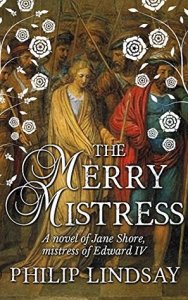
the-merry-mistressAfter reading the Mary Bennett book, I remembered that I had also received The Merry Mistress by Philip Lindsay from NetGalley a while ago, along with another book of his, The Devil and King John. I had mixed feelings about the King John book so was a bit apprehensive about reading this one. I’m determined to get my NetGalley shelf up to date, though, so I decided to give The Merry Mistress a try anyway.
The first thing to say is that this book couldn’t be more different from the Bennett one! Lindsay’s Jane is a much more forceful personality who decides what she wants out of life and then goes and gets it. I expect the fact that this novel was published more recently – in the 1950s – will have something to do with that. But despite Jane making a point of telling us that she expects no rewards or favours from the king in return for becoming his mistress and that she always does her best to help the poor and needy, I didn’t think she was a particularly likeable or sympathetic character. She uses her beauty to get her own way or to manipulate the men around her and I found her quite a shallow, controlling person.

The story is narrated by Jane herself, beginning as she is forced to walk through the streets of London dressed in her kirtle as public penance for her part in the conspiracy between Will Hastings and the Woodvilles. Jane then looks back on her life, starting with her unhappy marriage to the mercer William Shore and then taking us through her romances with Edward IV, Hastings and Thomas Grey, the Marquess of Dorset. Lindsay ignores other possible facets of Jane’s character to focus almost exclusively on her relationships with the men in her life. I appreciate that Jane was a royal mistress, after all, and not famous for much else, but I still felt that this book needed something more.

Things do become more interesting and more compelling in the final third of the novel, when Edward’s death throws the court and the country into disarray once more after several years of relative stability. However, this is very much Jane’s story, so politics are pushed into the background apart from when they touch directly on Jane’s life. Still, I thought The Merry Mistress was a much better novel than Mary Bennett’s Jane Shore. My personal recommendation, though, would be to skip both of these and read Royal Mistress by Anne Easter Smith instead!

The Unseeing by Anna Mazzola

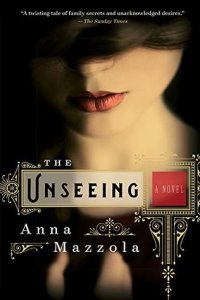
the-unseeingIt’s Christmas 1836 and Hannah Brown is looking forward to her wedding to James Greenacre. However, the marriage will never take place; instead, Hannah is brutally murdered and in the weeks that follow, the parts of her dismembered body are discovered in various locations around London. Her fiancé, Greenacre, is arrested and found guilty – but although he admits to disposing of the body, he claims that Hannah was already dead when he found her. This makes no difference to the judge and jury and Greenacre is sentenced to hang, along with his mistress, Sarah Gale, who is accused of concealing the murder.
Sarah had been living with Greenacre as his housekeeper before being asked to leave so he could marry Hannah. She insists that she knew nothing about the murder and Greenacre also denies that she had any involvement, but this is not enough to save her. As she sits in a cell in Newgate Prison, Sarah’s only hope is the petition she has submitted asking for clemency. The lawyer appointed by the Home Secretary to look again at Sarah’s case is Edmund Fleetwood, young, idealistic and principled. After speaking to Sarah and hearing her talk about her life, Edmund is convinced that she should be freed, but how can he prove it? And is it possible that he is becoming too emotionally involved in the case to be able to see the facts clearly?

Anna Mazzola’s debut novel, The Unseeing, is based on a true crime; the Edgware Road Murder, as it became known, really did take place and James Greenacre really was found guilty and was sentenced to death. Sarah Gale was also arrested, but I won’t tell you what her eventual fate would be. I didn’t know and that meant I was kept in suspense wondering what would happen to her. It’s important to remember, though, that this is fiction and not everything in the book is taken from historical fact – which could explain why some of the developments towards the end of the novel didn’t completely convince me.

Edmund Fleetwood, who plays such a major role in the novel, is a fictional character and the author has created a fictional story for him running alongside Sarah’s. I thought the two stories worked well together – I did like Edmund and I shared his frustration as Sarah repeatedly refused to provide any information which could have helped her defence – but there were times when I felt I was being distracted from the central plot and I just wanted to get back to Sarah in the Newgate. The portrayal of prison life is one of the novel’s strong points and reminded me of other prison-based historical novels such as Antonia Hodgson’s The Devil in the Marshalsea and Sarah Waters’ Affinity.

The most interesting aspect of the book, though, is the exploration of what it meant to be a woman accused of a crime in the 19th century: the unfairness of the law, the way in which evidence against a woman was considered, the possible bias that could arise from a verdict being reached by an all-male jury, and whether the punishments handed out were in proportion to the crime. The fact that many of these women had children – like Sarah’s little boy, George – added another complication. Sarah is lucky enough to have a sister, Rosina, who takes care of George while she is in prison, but what will happen to him if the worst happens and she can never come home?

The Unseeing is an interesting blend of fact and fiction; I did enjoy it, but I felt that there wasn’t enough to make this book stand out from others of its type. I couldn’t quite love it, but I liked it and will be looking out for more from Anna Mazzola.

Thanks to Sourcebooks Landmark for providing a review copy via NetGalley.

East of Eden by John Steinbeck

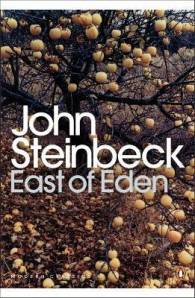
east-of-eden You would think that by now I would be a good judge of which books I would be likely to enjoy or not enjoy, wouldn’t you? Well, apparently not. East of Eden has been on my Classics Club list for years now and I’ve been resisting reading it for all this time, convinced that I wouldn’t like it. I’m not sure why I felt that way – maybe because I have memories of reading Steinbeck’s novella The Pearl at school and being unimpressed. Anyway, none of that matters now, because I have finally read East of Eden and loved it!

The novel opens with a description of the Salinas Valley in California. Right from the beginning, I knew I was going to like Steinbeck’s writing in this book.

The Salinas was only a part-time river. The summer sun drove it underground. It was not a fine river at all, but it was the only one we had and so we boasted about it—how dangerous it was in a wet winter and how dry it was in a dry summer. You can boast about anything if it’s all you have. Maybe the less you have, the more you are required to boast.

Samuel Hamilton, the grandfather of the narrator (whom we can assume to be Steinbeck himself), is an Irish immigrant who settles in the valley with his wife, Liza, and their nine children towards the end of the 19th century. Over the course of the novel we get to know the various members of the Hamilton family – some better than others – but of much more interest to me was the story of another family: the Trasks.

Originally from New England, Adam Trask was once nearly killed by his jealous half-brother, Charles, who believed that their father loved Adam more. With the Biblical title of the book (inspired by the line from Genesis: “And Cain went out from the presence of the Lord, and dwelt in the Land of Nod, on the east of Eden”) it’s easy to equate the characters of Charles and Adam with Cain and Abel, especially as they begin with the same letters.

Although the brothers have since been reconciled, when Adam marries he and his new wife, Cathy, move to the Salinas Valley, leaving Charles behind to take care of the family farm. It is here in California that Cathy gives birth to twins Aron and Cal (A and C again) and history seems to be about to repeat itself.

The characters in East of Eden range from the very good – such as Adam and Aron – to the completely evil, like Cathy:

There was a time when a girl like Cathy would have been called possessed by the devil. She would have been exorcised to cast out the evil spirit, and if after many trials that did not work, she would have been burned as a witch for the good of the community. The one thing that may not be forgiven a witch is her ability to distress people, to make them restless and uneasy and even envious.

Between the two extremes, there are characters like Cal, whose natures are more nuanced and ambiguous. The idea at the heart of the novel is that there is the potential for both good and evil in each of us and that it’s up to the individual person to choose what they want to be:

“But the Hebrew word, the word timshel—’Thou mayest’— that gives a choice. It might be the most important word in the world. That says the way is open. That throws it right back on a man. For if ‘Thou mayest’—it is also true that ‘Thou mayest not.'”

Like Charles before him, Cal desperately wants some love and attention from his father and is envious of his brother Aron, but being a complex human being, we see him struggling against temptation and trying to do what he knows is right, sometimes successfully and sometimes not.

My favourite character, though, is definitely Lee, Adam’s Chinese servant: he’s so wise, so loyal, so patient and uncomplaining. Over the course of the novel he becomes much more than just a servant to the Trask family, helping to raise the children, providing valuable insights and offering advice and friendship.

I found East of Eden a surprisingly compelling read; I honestly hadn’t expected to love it as much as I did or to find myself wanting to turn the pages so quickly. I now feel much more enthusiastic about reading more Steinbeck – not immediately, but soon.

Historical Musings #23: Time Travel

Historical Musings

I have always loved the idea of being able to travel through time so with my interest in history it’s not surprising that I enjoy reading fiction with an element of time travel. My recent read of The Phantom Tree by Nicola Cornick (in which a young woman from Tudor England travels forward to the present day) made me think of other time travel – or time-slip – novels I’ve read over the years. Before I start to list them, let’s see what Wikipedia has to say about the difference between time travel and time-slip:

The difference is that in time slip stories, the protagonist typically has no control and no understanding of the process (which is often never explained at all) and is either left marooned in a past time and must make the best of it, or is eventually returned by a process as unpredictable and uncontrolled.

It would seem, then, that time travel is deliberate and time slip is accidental, but thinking about the books I’ve read, it’s not quite as simple as that – sometimes a book doesn’t fit neatly into either category or is a mixture of both.

The first time travel books I can remember reading as a child were Madeleine L’Engle’s Time Quintet. The one that stands out most in my memory is Many Waters, in which twins Sandy and Dennys travel back to Biblical times – the days of Noah’s Ark – in a world populated by supernatural beings such as the Seraphim and the Nephilim. I also read Tom’s Midnight Garden by Philippa Pearce, probably at around the same age, although I can remember very little about that book now. Most of my time travel reading has been as an adult.

The House on the StrandThe House on the Strand by Daphne du Maurier is one of my favourite time travel novels. Interestingly, I found that with this book it was not so much the historical storyline (14th century Cornwall) which interested me as the method of time travel, the fascinating questions it raised and the impact it had on the life of the person doing the travelling.

Then there’s Anya Seton’s Green Darkness, a book I read years ago, before I started blogging The movement between time periods in this novel takes place not as physical time travel but through reincarnation: a modern day American girl, Celia, relives a previous existence as a servant in Tudor England. Although most of the plot has faded from my mind, I still remember the atmospheric descriptions of the manor house, Ightham Mote.

Lady of Hay by Barbara Erskine is a similar story about a woman from the 1970s who undergoes hypnosis and is regressed to a former life as Matilda de Braose, a 12th century noblewoman. Sleeper’s Castle, published to mark the 30th anniversary of Lady of Hay, is the story of a woman in modern-day Wales who begins to have vivid dreams taking her back to the 1400s and Owain Glyndŵr’s rebellion against the English.  Erskine has written a lot of other time-slip novels, although I haven’t read many of them yet.

MarianaI can’t talk about time-slip novels without mentioning Susanna Kearsley, whose books have impressed me more than Erskine’s. Not all of them involve a form of time travel, but those that do include Mariana (which takes us back to the 17th century), The Rose Garden (18th century Cornwall) and The Firebird (18th century Scotland and Russia). I think Kearsley makes the time travel in her novels feel quite natural and believable; the transitions between one period and another are very smooth.
I have already mentioned The Phantom Tree; I haven’t read Nicola Cornick’s previous novel, House of Shadows, but I’m looking forward to it. I think readers who enjoy Cornick may also be interested in Pamela Hartshorne’s novels. The one I read – The Edge of Dark – follows the story of a present day woman who begins to experience the memories of a woman who lived in the Elizabethan period.

And finally, there’s Diana Gabaldon’s Outlander series in which World War II nurse Claire Randall walks through a circle of standing stones to find herself in 18th century Scotland. There are eight books in the series so far; I loved the earlier ones, but was slightly less enamoured with the last two.  I’ve reviewed the most recent books, An Echo in the Bone and Written in My Own Heart’s Blood, on my blog, but I strongly recommend starting at the beginning and reading the series in order.

~

The titles above are the ones which came instantly to mind when I started to write this post. I was sure I must have read more, so I had a look back through my blog archives and was reminded of a few others:

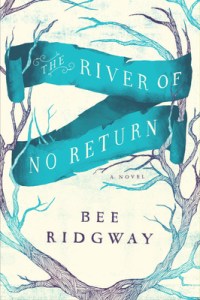
The River of No ReturnThe River of No Return by Bee Ridgway – set partly in the modern day and partly in the Regency period. This would be a good choice for readers who are interested in the actual mechanics of time travel; I noted in my review that this is a novel “where the manipulation of time forms a big part of the plot – jumping forwards in time, jumping backwards in time, freezing time, speeding time up and slowing time down”.

Shadow of Night by Deborah Harkness – the second book in the All Souls Trilogy, in which our two main characters – a witch and a vampire – travel back in time to the year 1590.  I remember finding the time travel aspect a bit confusing in this one.

Kindred by Octavia E. Butler – this is a great novel about a black woman in the 1970s who is pulled into the 19th century and finds herself on a Maryland plantation where she meets one of her ancestors, who happens to be a slave owner.

The Map of Time by Felix Palma – an unusual novel made up of three separate but interlinked stories which pull the reader backwards and forwards in time.  HG Wells, author of The Time Machine, even appears as a character in this book.

Now it’s your turn.

Have you read any of the books I’ve mentioned above?  What are your favourite time travel/time-slip novels?  Which methods of time travel do you find most convincing?  I am particularly interested in hearing about books which involve travel to or from the past, but if you prefer books which take us forward to the future – like The Time Machine – feel free to recommend those too.

The Echo of Twilight by Judith Kinghorn

the-echo-of-twilight It’s 1914 and Pearl Gibson, a young woman in her twenties, is about to take up a new position as lady’s maid. Her new employer, Ottoline Campbell, has estates in Northumberland and Scotland, which means Pearl will have to leave London and move north. She’s prepared to do this, however, because it’s not as if she has much to leave behind – her relationship with her boyfriend, Stanley, already seems to be fizzling out, and she has no other friends or family. Her mother killed herself just after Pearl’s birth and Pearl was raised by a great-aunt who is also now dead.
Spending the summer at Delnasay, the Campbells’ house in the Scottish Highlands, Pearl gradually settles into her new job and her new life. Although the other servants view her as proud and superior at first, she slowly wins them over, and at the same time she starts to form a close friendship with Ottoline. It seems that both Pearl and Ottoline are hiding secrets and as the bond between them strengthens, they begin to confide in each other more and more.

Meanwhile, the trouble which has been brewing in Europe throughout the year has escalated into war and the family return to England, hoping they will be safe at Birling Hall, their other estate in Warkworth, Northumberland. Ottoline’s two sons, Billy and Hugo, both enlist and are soon on their way to France, while Pearl also has someone to pray for: Ralph Stedman, an artist with whom she embarked on a new romance during her time in Scotland and who has also gone to war. All of this takes place just in the first half of the novel; there are plenty of other surprises and revelations to follow as Pearl and Ottoline learn more about each other – and as the war progresses, changing the lives of all of our characters forever.

Pearl, the novel’s narrator, is an interesting and complex character. I was intrigued by her habit of pretending to be other people, introducing herself to strangers as Tess Durbeyfield, Mrs Gaskell and even Ottoline Campbell herself…anybody but Pearl Gibson. I was happy, though, that by the end of the novel we’d had a chance to get to know the real Pearl. Ottoline was also a fascinating character, but I felt that she remained more of an enigma.

The Echo of Twilight is Judith Kinghorn’s fourth novel. I loved her first, The Last Summer, was slightly less impressed by the second, The Memory of Lost Senses, and haven’t yet read her third, The Snow Globe. This one sounded appealing to me as it is set during the same time period as The Last Summer – and although the stories are quite different, the two books do share some similar themes. The impact of war, not just on those who are fighting in it, but also on the people left behind, is an important part of both novels. We see how, with so many young men lost from the British workforce, women had to take on what would previously have been considered ‘jobs for men’, and how, once the war was over, the social structure had changed so much that the running of large estates like Delnasay and Birling tended not to be sustainable.

The Echo of Twilight is an easy read – the sort where the pages seem to fly by effortlessly – and a beautifully written one. Although I wasn’t entirely convinced by the romance at the heart of the novel and didn’t sense a lot of chemistry there, there were enough other aspects that I did like to make up for that. It’s not just a romance; it’s also a lovely, moving story about a young woman trying to find her place in the world.

Thanks to the publisher Canelo for providing a review copy via NetGalley.

Lost Horizon by James Hilton

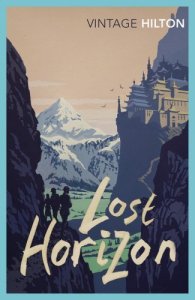
lost-horizon I’m very happy with the way my reading is going so far this year. I’ve read some great books already and this is another one. Published in 1933, Lost Horizon is the novel which introduced into popular culture the idea of Shangri-La as a sort of earthly paradise. It’s a fascinating story and very absorbing – I started it on a Saturday and was finished by Sunday; at just over 200 pages it’s a quick read but also the sort of book that leaves the reader with a lot to think about after the final page is turned.

We begin with a prologue in which the narrator is having dinner with a novelist friend, Rutherford. The two find themselves discussing a mutual acquaintance, Hugh Conway, who had disappeared under unusual circumstances only to be discovered by Rutherford several months later in a hospital in China. Conway has been suffering from amnesia but as his memories start to return, he tells Rutherford a long and remarkable story.

During a revolution in Baskul, Conway, who was the British consul at the time, was evacuated by plane along with three other people. The plane was supposedly heading for Peshawar, but it never arrived and its four passengers were believed to be dead. What Conway tells Rutherfurd, however, is that the plane was hijacked and flown in a different direction, stopping once to refuel and finally crashing to the ground in a mountain valley somewhere in Tibet. The pilot was killed but the passengers survived. Seeking shelter at the nearby lamasery (a monastery for lamas) known as Shangri-La, the group asked for help to continue their journey to Peshawar, but as the days and weeks went by and no help arrived, Conway began to wonder whether their presence at the lamasery was really an accident – and whether they would ever be able to leave.

Shangri-La is a mysterious place; beautiful, but slightly eerie too, I thought. How was such a beautiful building constructed in such a remote location? Who installed the modern western plumbing and who brought the grand piano, the harpsichord and the books for the library, considering that the only way to reach the lamasery (unless you happen to make a crash-landing there) is on foot through the dangerous mountain passes? What is the secret of the lamas, who look so much more youthful than they really are? And where is Shangri-La, exactly? All Conway can deduce is that they have flown “far beyond the western range of the Himalayas towards the less known heights of the Kuen-Lun” and into the shadow of the mountain Karakal, or ‘Blue Moon’.

I found it interesting that Conway’s three companions have such different reactions to their enforced imprisonment in Shangri-La. Mallinson, Conway’s young vice-consul, reacts with anger and frustration, and with every day that passes he becomes more and more desperate to escape; the American businessman, Barnard, is hiding secrets of his own and is content to enjoy the hospitality of the lamasery while looking for money-making opportunities in the valley; and Miss Brinklow, the British missionary, wonders if this is a challenge sent by God and if she has been brought here to carry out His work. The characters (apart from Conway) are thinly drawn, but they serve their purpose in the story – and it could be said that Shangri-La is actually the most important character in the novel anyway.

Conway himself is in no hurry to go anywhere; he is intrigued by the lifestyle of the lamas and the atmosphere of serenity and peace. With his curious, contemplative nature, the philosophy behind the lamasery appeals to him and he becomes captivated by this mystical place where time seems almost to stand still and the pressures of everyday life can be left behind. It is obvious from the framing story set up in the prologue that Conway does, for one reason or another, leave Shangri-La, but it is not at all clear how or why that will happen and this kept me in suspense and kept me turning the pages.

Lost Horizon was another read from my Classics Club list. I am coming to the end of my list now and will soon be putting another one together; I’ll have to think about including one or two more books by James Hilton – probably Random Harvest or Goodbye, Mr Chips. Has anyone read them?