Looking back at February’s reading – in words and pictures.

commonplace book
Definition:
noun
a notebook in which quotations, poems, remarks, etc, that catch the owner’s attention are entered
~
Yes, Memory is a cruel thing. For it knows our struggle to remember, and to forget, and it ignores Time. It whispers or withholds, suggesting more, or less, secure in the knowledge that it will have the final say. Secure in the knowledge that it can – at any time it so wishes – erase, adapt or rewrite our story. Redeeming, damning, it thrusts upon us, altering statements to questions and shrinking our vistas.
The Echo of Twilight by Judith Kinghorn (2017)
~

View of Delft by Johannes Vermeer, 1660–1661
The working day is over and it’s busy on the streets. Maids and workers are heading home, farmers are leaving the city before the gates shut and shopkeepers are fastening the drop-down hatches they’ve been displaying their goods on. Delft isn’t all that much bigger than Alkmaar, and there are similarities, with all their little canals and houses with stepped gables. It gives me a pleasant sense of homecoming.
Midnight Blue by Simone van der Vlugt (2017, English translation)
~
“Why are you a pirate?” she said at last, breaking the silence.
“Why do you ride horses that are too spirited?” he answered.
“Because of the danger, because of the speed, because I might fall,” she said.
“That is why I am a pirate,” he said.
Frenchman’s Creek by Daphne du Maurier (1941)
~
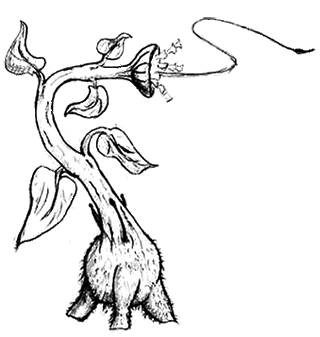
Triffid, as illustrated by John Wyndham
She did not speak for a little while, then she said:
“You know, one of the most shocking things about it is to realise how easily we have lost a world that seemed so safe and certain.”
The Day of the Triffids by John Wyndham (1951)
~
He had said that our lives are steered by uncertainties, many of which are disruptive or even daunting; but that if we persevere and remain generous of heart, we may be granted a moment of supreme lucidity – a moment in which all that has happened to us suddenly comes into focus as a necessary course of events, even as we find ourselves on the threshold of the life that we had been meant to lead all along.
A Gentleman in Moscow by Amor Towles (2016)
~
We paused for a moment to survey the opposite bank and see which was the nearest point to head for, and I suddenly realized that neither Bob nor I had removed our hats. There was something so ludicrous about the sight of Bob splashing about in the dark waters, doggedly doing the breast-stroke, with an elegant green pork-pie hat set at a jaunty angle over one eye, that I got an attack of the giggles.
“What’s the matter?” asked Bob.
I trod water and gasped for breath.
“Intrepid Explorer Swims Lake In Hat,” I spluttered.
Three Singles to Adventure by Gerald Durrell (1954)
~
“What a complete waste of my time,” she complained as we drove through the traffic for home. “If they didn’t like my work, why on earth did they come along to hear me?”
“I think they expected you to read for only a few minutes,” I told her. “And then perhaps to answer some of their questions.”
“The novel is four hundred and thirty-four pages long,” she said, shaking her head. “If they want to understand it, then they must hear the entire thing. Or, preferably, read the entire thing. How can they possibly get a sense of it from a mere ten minutes?”
The Heart’s Invisible Furies by John Boyne (2017)
~
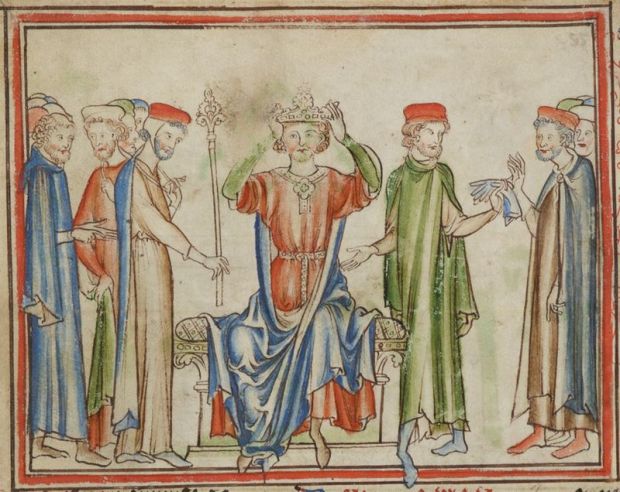
King Harold II
What does a man do when he is suddenly thrust into kingship? No matter how he prepares, when the day finally comes the world is a changed place. Maybe it’s different when one is born in the purple and raised from childhood to be king. My situation couldn’t be more different – as my rivals haven’t hesitated to remind me at every opportunity. Perhaps now, I won’t have to listen to them, though I know what they are thinking.
Fatal Rivalry by Mercedes Rochelle (2017)
~
Like most artists, everything I produced was connected to who I was – and so I suffered according to how my work was received. The idea that anyone might be able to detach their personal value from their public output was revolutionary. I didn’t know if it was possible, even desirable. Surely it would affect the quality of the work?
The Muse by Jessie Burton (2016)
~
The fog was thick, but from her place at the far end of the valley, where the fields and bouldered slopes met the uncleared woodland, she could hear the roar of the river Flesk’s swollen waters. A short distance away from her cabin was the Piper’s Grave, where the fairies dwelt. She nodded respectfully towards the crooked whitethorn, standing ghostlike in the mist in its circle of stone, briars and overgrown grass.
The Good People by Hannah Kent (2016)
~

White-tailed Tropic bird
The ground fell away sharply on each side of the trail, and between the trees we caught glimpses of the spectacular Black River gorges, thickly covered in forests of greens and reds and golds, with waterfalls like feathers trailing down the steep, spectacular cliff faces. At the bottom of the gorges, where the rivers ran bright and shining, or white and thunderous through mossy rock, the air was filled with drifting, wheeling, white crosses that were the White-tailed Tropic birds.
Golden Bats and Pink Pigeons by Gerald Durrell (1977)
~
A person who has not done one half his day’s work by ten o’clock, runs a chance of leaving the other half undone.
Wuthering Heights by Emily Brontë – re-read (1847)
~
“It’s not a temptation you feel, then?” he asked. “You don’t ever want to rise up from your chair, and walk down the stairs, and put on your coat, and step out of the door onto Golden Hill, and just go?”
“Where would I go to?” she said.
“Anywhere,” he said. “You have a whole continent to choose from. Look at it. You could land anywhere on that shore, and just walk away, under the trees.”
Golden Hill by Francis Spufford (2016)
~

Richard III, painted c. 1520
A certain Mr Colyngbourne of Lydyard in Wiltshire had been too clever; had nailed a rhyming couplet on the door of St Paul’s and been caught doing it.
The Cat, the Rat and Lovell our Dog
Ruleth all England under the Hog:
Catesby and Ratcliffe, and himself whose badge the dog was, rulers of grumbling England under the silver boar. Mr Colyngbourne, who had served King Richard’s brother and mother in his time, would make no more couplets.
Under the Hog by Patrick Carleton (1937)
~
Favourite books this month: A Gentleman in Moscow, Golden Hill and Under the Hog. I also enjoyed my re-read of Wuthering Heights!
As usual, I am behind with my reviews, but hope to get caught up soon.
 In 1922, Count Alexander Ilyich Rostov is brought before a Bolshevik tribunal and found guilty of the crime of being an ‘unrepentant aristocrat’. Once a recipient of the Order of Saint Andrew, member of the Jockey Club and Master of the Hunt, the Count is now considered a Former Person and is sentenced to live out the rest of his days under house arrest in his current place of residence, Moscow’s Metropol Hotel. Forced to leave his luxury suite and move his possessions to a tiny room in the attic, the Count refuses to let his spirit be broken and decides to make the best of his situation, continuing with his daily routines as far as he is able without leaving the building.
 A Country Road, A Tree by Jo Baker
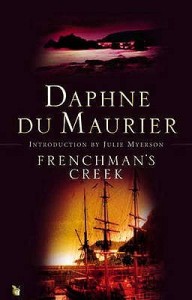 Daphne du Maurier’s Rebecca has been one of my favourite books since I first read it as a teenager, but it’s only relatively recently that I started to explore the rest of her work. Since 2010, I have now read several of her short story collections and one of her non-fiction books, as well as working through almost all of her novels, saving Frenchman’s Creek until near the end (as it sounded like one that I would particularly enjoy and I wanted to have something to look forward to).
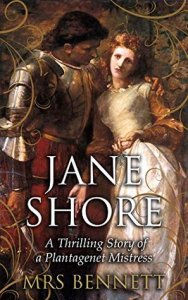 Elizabeth Shore, known as Jane, was a mistress of King Edward IV of England and said to be “merry in company, ready and quick of answer”. She often appears in fiction set during the Wars of the Roses as a minor character – depending on the book, either as a bad influence or a comfort to Edward in his declining health, and a possible conspirator against his brother, Richard III – but several novels have also been written specifically about Jane. I have read two recently and am combining my reviews into one post.
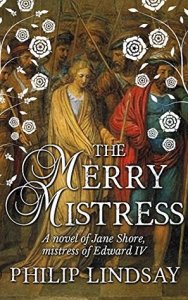 After reading the Mary Bennett book, I remembered that I had also received The Merry Mistress by Philip Lindsay from
 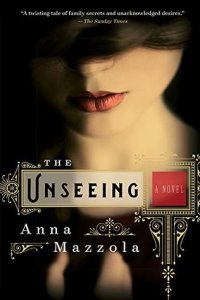 It’s Christmas 1836 and Hannah Brown is looking forward to her wedding to James Greenacre. However, the marriage will never take place; instead, Hannah is brutally murdered and in the weeks that follow, the parts of her dismembered body are discovered in various locations around London. Her fiancé, Greenacre, is arrested and found guilty – but although he admits to disposing of the body, he claims that Hannah was already dead when he found her. This makes no difference to the judge and jury and Greenacre is sentenced to hang, along with his mistress, Sarah Gale, who is accused of concealing the murder.
 She Reads Novels