Carrion Crow by Heather Parry

Freedom always comes at a price, that much she had learned, and a confinement was a small sacrifice for the reward of being able to set the rest of her life exactly as she wanted it.

I’ve never read anything quite like this book and am not sure I’ll be able to describe it adequately, but I’ll do my best! It’s not Heather Parry’s first novel – she has written a previous one, Orpheus Builds a Girl – but it’s the first I’ve read and I didn’t really know what to expect.

Marguerite Périgord, who lives in London with her mother, Cécile, has just become engaged to George Lewis, a man thirty-five years her senior. Although he’s a respectable solicitor and Marguerite is sure he’ll make her happy, Cécile disapproves of the engagement because Mr Lewis comes from a humble background and doesn’t have a lot of money. Telling her that if she really must go ahead with the marriage, she first needs an education on how to be a good wife, Cécile locks Marguerite in a tiny attic room with a sewing machine and a copy of Mrs Beeton’s Book of Household Management. Although it seems obvious to the reader that Cécile’s true intentions are simply to keep her daughter hidden away to prevent the marriage, Marguerite is sure she’ll be released as soon as she has made enough progress.

The rest of the novel follows Marguerite through the period of her confinement in the attic, while also giving us some glimpses into Cécile’s own history and her relationship with the man who was Marguerite’s father. The Cécile sections of the book do help to explain how she became the woman she is and why she so desperately wants to stop her daughter from making the same mistakes she did – but at the same time, her treatment of Marguerite is inhumane and cruel. Even more chilling is the way Marguerite just seems to accept that she has been sent into the attic for her own good and makes no attempt to escape. She tells herself that it will all be worth it in the end when she completes her ‘training’ and can become the perfect wife to Mr Lewis.

If Marguerite already seems mentally unstable when she enters the attic, she becomes even more so as her confinement continues. With little to occupy her mind and only a crow nesting in the roof above for company, she becomes obsessed with her own body and the changes she sees in it as she remains shut away from the fresh air outside and the meals delivered to the attic become smaller and more sporadic. The book gradually becomes stiflingly claustrophobic, as well as increasingly disturbing and uncomfortable to read. It reminded me at times of Charlotte Perkins Gilman’s The Yellow Wallpaper or Virginia Andrews’ Flowers in the Attic, although more gruesome than either. As Marguerite is an unreliable narrator and it’s sometimes difficult to know what’s real and what’s imaginary, the ending of the book both confused and surprised me, and I was left with the overall impression that I’d read something very powerful.

This is not a book that I could really say I ‘enjoyed’, but I do recommend it as long as you’re prepared for something very, very dark and unsettling!

Thanks to Doubleday for providing a copy of this book for review via NetGalley.

The Walter Scott Prize Shortlist 2025

The shortlist for the 2025 Walter Scott Prize for Historical Fiction has been announced today! Thanks to this prize, I have discovered lots of great books and authors over the last few years and always look out for the longlists and shortlists; in fact, trying to read all of the shortlisted titles since the prize began in 2010 is a personal project of mine (you can see my progress here).

There are six books on today’s shortlist, chosen from the longlist of twelve revealed back in February. Here are the six (blurbs all taken from Amazon):

The 2025 Walter Scott Prize Shortlist

The Heart in Winter by Kevin Barry (Canongate)

October, 1891. Butte, Montana. A hard winter approaches across the Rocky Mountains. The city is rich on copper mines and rampant with vice and debauchery among a hard-living crowd of immigrant Irish workers.

Here we find Tom Rourke, a young poet and balladmaker, but also a doper, a drinker and a fearsome degenerate. Just as he feels his life is heading nowhere fast, Polly Gillespie arrives in town as the new bride of the devout mine captain Long Anthony Harrington.

A thunderbolt love affair takes spark between Tom and Polly and they strike out west on a stolen horse, moving through the badlands of Montana and Idaho. Briefly an idyll of wild romance perfects itself. But a posse of deranged Cornish gunsmen are soon in hot pursuit of the lovers, and closing in fast . . .

The Mare by Angharad Hampshire (Northodox Press)

Hermine Braunsteiner was the first person to be extradited from the United States for Nazi war crimes. Hermine was one of a few thousand women to work as a female concentration camp guard. Prisoners nicknamed her ‘the Mare’ because she kicked people to death. When the camps were liberated, Hermine escaped and fled back to Vienna.

Many years later, she met Russell Ryan, an American man holidaying in Austria. They fell in love, married and moved to New York, where she lived a quiet life as an adoring suburban housewife, beloved friend and neighbour. No one, not even her husband, knew the truth of her past, until one day a New York Times journalist knocked on their door, blowing their lives apart.

The Mare tells Hermine and Russell’s story for the first time in fiction. It explores how an ordinary woman could descend so quickly into evil, examining the role played by government propaganda, ideology, fear and cognitive dissonance, and asks why her husband chose to stay with her despite discovering what she had done.

The Book of Days by Francesca Kay (Swift Press)

ANNO DOMINI 1546.

In a manor house in England a young woman feels the walls are closing around her, while her dying husband is obsessed by his vision of a chapel where prayers will be said for his immortal soul.

As the days go by and the chapel takes shape, the outside world starts to intrude. But as the old ways are replaced by the new, the people of the village sense a dangerous freedom.

The Book of Days is a beautifully written novel of lives lived in troubled times and the solace to be found in nature and the turning seasons.

Glorious Exploits by Ferdia Lennon (Fig Tree)

Ancient Sicily. Enter GELON: visionary, dreamer, theatre lover. Enter LAMPO: feckless, jobless, in need of a distraction.

Imprisoned in the quarries of Syracuse, thousands of defeated Athenians hang on by the thinnest of threads.

They’re fading in the baking heat, but not everything is lost: they can still recite lines from Greek tragedy when tempted by Lampo and Gelon with goatskins of wine and scraps of food.

And so an idea is born. Because, after all, you can hate the invaders but still love their poetry. It’s audacious. It might even be dangerous. But like all the best things in life – love, friendship, art itself – it will reveal the very worst, and the very best, of what humans are capable of.

What could possibly go wrong?

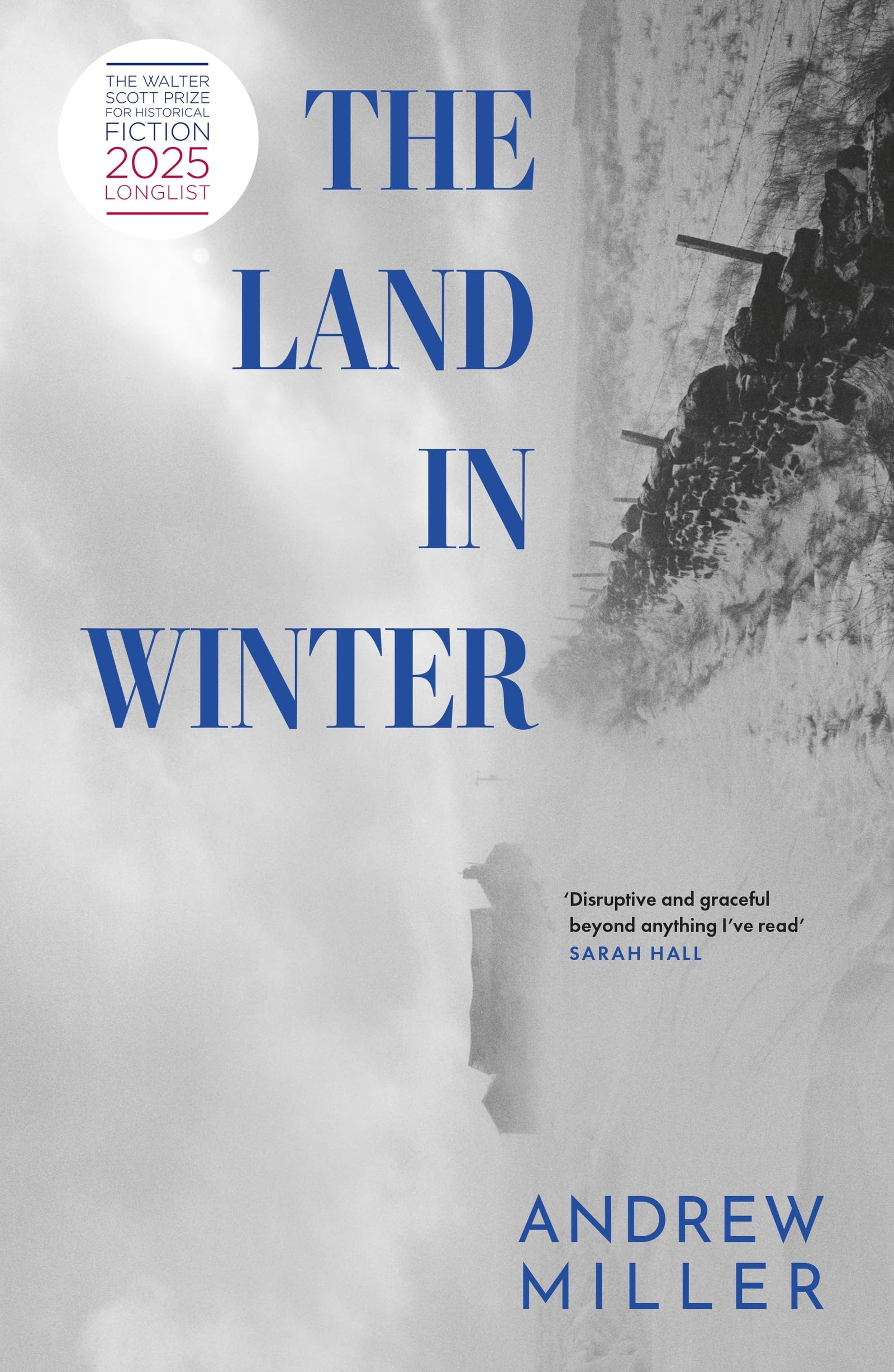
The Land in Winter by Andrew Miller (Sceptre)

December 1962, the West Country.

In the darkness of an old asylum, a young man unscrews the lid from a bottle of sleeping pills. In the nearby village, two couples begin their day. Local doctor, Eric Parry, mulling secrets, sets out on his rounds, while his pregnant wife sleeps on in the warmth of their cottage.

Across the field, in a farmhouse impossible to heat, funny, troubled Rita Simmons is also asleep, her head full of images of a past life her husband prefers to ignore. He’s been up for hours, tending to the needs of the small dairy farm he bought, a place where he hoped to create a new version of himself, a project that’s already faltering.

There is affection – if not always love – in both homes: these are marriages that still hold some promise. But when the ordinary cold of an English December gives way to violent blizzards – a true winter, the harshest in living memory – the two couples find their lives beginning to unravel.

Where do you hide when you can’t leave home? And where, in a frozen world, can you run to?

The Safekeep by Yael van der Wouden (Viking)

It is fifteen years after the Second World War, and Isabel has built herself a solitary life of discipline and strict routine in her late mother’s country home, with not a fork or a word out of place. But all is upended when her brother Louis delivers his graceless new girlfriend, Eva, at Isabel’s doorstep – as a guest, there to stay for the season…

In the sweltering heat of summer, Isabel’s desperate need for control reaches boiling point. What happens between the two women leads to a revelation which threatens to unravel all she has ever known.

~

I’ve only read one of these – The Heart in Winter – and although I didn’t like it much, I’m not at all surprised to see it on the shortlist and won’t be surprised if it’s the overall winner. I’m sorry that the other two books I had read from the longlist, Clear by Carys Davies and Mother Naked by Glen James Brown, didn’t make the shortlist as I enjoyed both of them much more! Glorious Exploits and The Safekeep are already on my TBR. I’m not sure I like the sound of The Mare, but am interested in reading The Land in Winter and The Book of Days.

What do you think? Have you read any of these or would you like to read them?

The winner will be announced at the Borders Book Festival in Melrose in June.

The Versailles Formula by Nancy Bilyeau

Having loved Nancy Bilyeau’s The Blue and The Fugitive Colours, I was excited to read the new book in the Genevieve Planché series. The Versailles Formula is published this week by Joffe Books and I’m pleased to say that I found it as good as the first two. If you’re new to the series, I would recommend reading the books in order if you can, but there’s enough background information in this one to allow you to start here if you wanted to.

The Versailles Formula is set in 1766 and, like the other books, is narrated by Genevieve Planché, a Huguenot woman who grew up in London after her family left France due to religious persecution. She’s also an aspiring artist who is finding it frustratingly difficult to be taken seriously in a field still dominated by men. As the novel opens, Genevieve is teaching watercolours to a group of young ladies while her husband, the chemist Thomas Sturbridge, is away from home working on a new research project with a scientist friend. Several years earlier Thomas had created a formula for a beautiful new shade of blue – an invention that powerful people in both France and Britain would stop at nothing to obtain. The race for the blue led to murder and treason before an agreement was finally reached that both sides would stop attempting to develop the colour.

Genevieve’s painting lesson is interrupted by the arrival of Under-Secretary of State Sir Humphrey Willoughby, husband of her friend, Evelyn. Sir Humphrey’s appearance sets in motion a chain of events that lead Genevieve to Strawberry Hill, home of the author Horace Walpole. Here she and Sir Humphrey make the shocking discovery that someone has begun producing the blue once more. Have the French broken the treaty they agreed to or is this someone acting alone? How did the blue find its way into Walpole’s home? Accompanied by an army officer, Captain Howard, Genevieve travels to Paris in search of answers.

This book definitely lived up to my expectations and was worth the three year wait since the last one! It was good to catch up with Genevieve again and although I would have liked to have seen more of other recurring characters such as Thomas Sturbridge, there’s a wonderful new character to get to know in the form of Captain Howard. Genevieve is wary of Howard at first, disliking him on sight and unsure as to why Sir Humphrey is entrusting him with such an important mission, but her opinion gradually begins to change and I loved watching their relationship develop as they travel across France.

Although many of the characters in the novel are fictional, there are also some who are real historical figures, most notably Horace Walpole, author of The Castle of Otranto. I particularly enjoyed the section of the book where Genevieve visits Strawberry Hill, his Gothic-style mansion in Twickenham and experiences its ‘gloomth’ – a term coined by Walpole himself to describe his home’s atmosphere of gloom and warmth.

The book is well paced, with tension building as Genevieve begins to wonder exactly who can and can’t be trusted – and whether anyone will see through the false identity she has adopted for her return to France. I thoroughly enjoyed this book, but I did feel that some things were left unresolved at the end, so I hope that means there could be a fourth Genevieve Planché book to look forward to. If so, I’ll certainly be reading it.

Thanks to Joffe Books for providing a copy of this book for review via NetGalley.

Marble Hall Murders by Anthony Horowitz

I’ve been waiting for this book for five years and here it is at last: the third (and it seems, final) book in Anthony Horowitz’s Susan Ryeland series. Apparently we have the actress Lesley Manville to thank for the fact that it’s been written at all – after starring as Susan in the recent BBC adaptations of Magpie Murders and Moonflower Murders, she told Horowitz she was desperate for a chance to play the character for a third time! If you haven’t read the previous two books I would recommend at least reading Magpie Murders before this one (there’s a note at the start of the book to warn us that it does contain spoilers).

In Marble Hall Murders, Susan is back in England having separated from Andreas and left him behind in Crete. Now working as a freelance editor, she attends a meeting with the publisher of Causton Books, Michael Flynn, who suggests an exciting new project to her. Three new continuation novels of the Atticus Pünd mystery series have been commissioned and as Susan had worked on the original novels with the late author Alan Conway, she’s the obvious choice to edit the new books as well. She agrees to take the job, but when she hears that Eliot Crace will be writing the novels, she’s less enthusiastic. Eliot’s previous novels were failures and the man himself she remembers as unpleasant and unreliable. That was a long time ago, though, so maybe things have changed.

When Susan receives a manuscript from Eliot containing the first part of the first continuation novel, Pünd’s Last Case, it’s much better than she expected and perfectly captures Alan Conway’s writing style. However, Susan quickly spots another similarity. Like Alan before him, Eliot appears to be putting coded messages into the book: anagrams, characters based on his own family members – and maybe even clues to a twenty-year-old real life crime.

Pünd’s Last Case is set in 1955 in the South of France where private detective Atticus Pünd and his assistant, James Taylor, are investigating the death of Lady Margaret Chalfont, an Englishwoman who drank poisoned tea just before her lawyer was due to arrive to discuss her will. The culprit seems obvious, but Pünd is sure there’s more to the situation than meets the eye. As Susan reads the manuscript and watches Pünd’s Last Case unfold, she becomes convinced that Eliot is drawing parallels with the death of his own grandmother, the world-famous children’s author Miriam Crace. Hoping to find out more, she travels to Miriam’s former home, Marble Hall, now a popular tourist attraction, where she discovers that although Eliot may want the truth about his grandmother made public, everyone else wants it to remain a secret!

I enjoyed this as much as the first two books. As usual, the Pünd story is so good I would have happily read it as a standalone without the framing story around it. I liked Pünd’s relationship with Frédéric Voltaire, the police detective from Paris who is conducting the official investigation, and I loved the French setting – although Susan Ryeland doesn’t and wants Eliot Crace to switch it back to England. She has her reasons for this, as she’s looking at the book from the perspective of an editor as well as a reader (something which gives Horowitz lots of opportunities to explore various aspects of the editing and publishing process). The mystery surrounding Miriam Crace and her family is also fascinating. She’s a fictional character but surely inspired by Enid Blyton – an author whose books (in Miriam’s case a series called The Little People) have delighted generations of children, but who is considered cold and unloving by her own children and grandchildren.

I picked up on some of the clues in both the Atticus Pünd story and the contemporary one before Susan did, but there was still a lot that I didn’t guess and the solutions to both mysteries weren’t quite what I’d expected. I was happy with the way the book ended, but also sorry if this really is the final one! I do love Horowitz’s Daniel Hawthorne series as well, so I hope there’ll at least be more of those on the way. Meanwhile, I’ll look forward to the TV adaptation of Marble Hall Murders, having enjoyed the first two!

Thanks to Century for providing a copy of this book for review via NetGalley.

Mother Naked by Glen James Brown

Durham Cathedral’s records show that the smallest amount paid to an entertainer was the one groat (four pence) received by Modyr Nakett, who performed there in 1433-34. Modyr Nakett – Mother Naked in the Middle English used at the time – was a gleeman, or wandering minstrel, but nothing else is known about him or his performance. In this novel, longlisted for the Walter Scott Prize for Historical Fiction, Glen James Brown imagines Mother Naked’s story.

The whole novel is written in the form of a monologue delivered by Mother Naked in front of an audience of some of Durham’s most powerful men. He begins by promising them the tale of the Fell Wraith, a ghostly monster who laid waste to the village of Segerston (now called Sacriston), destroying the crops, burning down the manor house and killing the villagers. However, it becomes clear that what he really wants to tell is more than just a simple ghost story and that the legend of the Wraith is rooted in reality. He goes off on several tangents and at times it’s not clear to his audience (or to the reader) what significance any of these digressions have. It all comes together in the end, though, and we’re left in no doubt as to the purpose of Mother Naked’s tale!

Most of Mother’s story is set in Segerston in 1396 and deals with a feud between two local families, the Paynes and the Deepsloughs. Both families are villeins – serfs who are able to own land, but are also expected to work on their lord’s land for no payment, which greatly restricts the time they can spend tending their own crops. This is one of several reasons why anger and frustration with the feudal system has been spreading throughout the country, as shown by the Peasants’ Revolt just a few years earlier. The story Mother tells illustrates the unfairness of this system, the various hardships and challenges faced by the different classes of peasant and the privileges held by those higher up such as the reeve, the bailiff and the lord.

As he builds towards the story of the Fell Wraith, Mother talks about other myths and legends, such as the Woodwose (or ‘wild man of the woods’). He also discusses his own childhood and his relationship with a fellow gleeman, Pearl Eye, who starts him on his path to becoming an entertainer. I won’t tell you Mother’s real identity, though, as it would spoil the story!

Those of you who are regular readers of my blog will know that I dislike the way so many modern authors are choosing not to use quotation marks to indicate speech. I’ve said that I always find it irritating, but this book seems to be the exception to the rule. There are no quotation marks, but dialogue is put in italics which at least makes it easier to see that someone is speaking – and as the entire novel is presented as one long speech, it makes sense not to use internal speech marks as well. Brown also writes in a sort of pseudo-medieval language and I thought this would be distracting at first, but it actually works very well.

The combination of the language, the setting and the level of research makes the book feel very authentic and believable. I could easily imagine I was sitting in the hall at Durham Cathedral listening to Mother Naked’s story! This book is a good example of why I like to follow the Walter Scott Prize, as I don’t think I would have come across this one otherwise. The shortlist is due to be announced next week.

The Hymn to Dionysus by Natasha Pulley

I know what you’re thinking: not another Greek mythology book! There have been so many in recent years, it would be easy to dismiss this one as just more of the same. However, I found it completely different from any of the others I’ve read, and despite the marketing it’s nothing like the Greek retellings written by Madeline Miller or Jennifer Saint.

The Hymn to Dionysus is narrated by Phaidros, whom we first meet as a child being trained as a knight in a Greek legion (knight is the term Pulley uses, but it clearly just refers to a mounted soldier rather than our image of a medieval knight). Phaidros doesn’t know who his parents are, but that’s not considered important in the Theban army, where your duty and loyalty is to your commander – in this case, Helios, who provides all the love, guidance and leadership Phaidros needs. He never questions his commander’s orders until the day when, during a trip to Thebes, Phaidros rescues a blue-eyed baby from a fire at the palace and Helios insists on the baby being abandoned at a temple, never to be mentioned again.

Many years later, Phaidros is a commander himself, training new recruits in Thebes. When Pentheus, the crown prince, disappears, desperate to escape an arranged marriage, Phaidros is drawn into the search, something which leads him to an encounter with a blue-eyed witch, Dionysus. The arrival of Dionysus coincides with an outbreak of madness amongst the knights of Thebes and stories of a mysterious new god. Is there a connection between Dionysus and the baby boy rescued by Phaidros all those years ago?

I read Natasha Pulley’s The Bedlam Stacks, set in 19th century England and Peru, when it was published in 2017 and although it was getting glowing reviews from everyone else at the time, I didn’t like it very much, mainly because I found the language irritatingly modern and anachronistic and the magical realism elements were stronger than I expected. I haven’t tried any of her other novels since then, but I loved one of her short stories which appeared in The Winter Spirits, a ghost story anthology, so I thought it would be worth giving her another chance. I’m glad I did, because I found this book a lot more enjoyable. It’s still written in very modern language, but that doesn’t seem to bother me quite as much when a book is set in the ancient world, although I would find it difficult to explain why.

Although I’ve read other Greek mythology novels in which Dionysus and some of the other characters appear, I don’t really have a very extensive knowledge of the myths surrounding them (I haven’t read Euripides’ play, The Bacchae, in which some of this is covered) and I think this was probably actually a good thing, as it meant I could just enjoy the story without having too many preconceived expectations. As I’ve said, it’s not a typical retelling anyway; as far as I can tell, it draws on various aspects of different myths and blends them together to form an original story. There are elements of magic – ivy that suddenly begins to grow when Dionysus is around; masks that bestow new characteristics on the wearers – but the book never quite becomes full-blown fantasy. I loved Pulley’s descriptions of the giant mechanical statues she calls ‘marvels’ and although I doubt they would have existed in the way she describes, there are examples of automata dating back to Ancient Greece so it could have been possible.

The main focus of the book, though, is on Phaidros and his relationships – particularly the one with Dionysus, which develops slowly as Phaidros wonders whether Dionysus is the baby he rescued all those years ago or whether he isn’t, whether he’s the ‘mad god’ everyone is talking about or whether he is just the witch he claims to be. I liked Phaidros and enjoyed the way he narrated his story, so even though this is a long book I felt that the pages went by quite quickly. I would probably consider reading some of Natasha Pulley’s other books, if anyone has any recommendations.

Thanks to Gollancz for providing a copy of this book for review via NetGalley.

Six Degrees of Separation: From Knife to Island Song

It’s the first Saturday of the month which means it’s time for another Six Degrees of Separation, hosted by Kate of Books are my Favourite and Best. The idea is that Kate chooses a book to use as a starting point and then we have to link it to six other books of our choice to form a chain. A book doesn’t have to be connected to all of the others on the list – only to the one next to it in the chain.

This month we’re starting with Knife by Salman Rushdie. Here’s what it’s about:

On the morning of 12 August 2022, Salman Rushdie was standing onstage at the Chautauqua Institution in upstate New York, preparing to give a lecture on the importance of keeping writers safe from harm, when a man in black – black clothes, black mask – rushed down the aisle towards him, wielding a knife. His first thought: So it’s you. Here you are.

What followed was a horrific act of violence that shook the literary world and beyond. Now, for the first time, Rushdie relives the traumatic events of that day and its aftermath, as well as his journey towards physical recovery and the healing that was made possible by the love and support of his wife, Eliza, his family, his army of doctors and physical therapists, and his community of readers worldwide.

I haven’t read Knife, but I’m going to begin my chain by linking to the one book I have read by Salman Rushdie: The Enchantress of Florence (1). This unusual novel takes us to a 16th century India populated with giants and witches, where emperors have imaginary wives and artists hide inside paintings.

I read The Enchantress of Florence for a reading event called A More Diverse Universe hosted by a fellow blogger in 2013. The following year, for the same event, I read another book by an Indian author – The Twentieth Wife by Indu Sundaresan (2). It’s set in 17th century Mughal India and is the first in a trilogy of novels describing the history behind the construction of the Taj Mahal.

From twentieth to tenth now! The Tenth Gift by Jane Johnson (3) is a fictional account of the 1625 raid on Cornwall by Barbary pirates who took sixty men, women and children into captivity to be sold at the slave markets of Morocco. The novel is divided between the past and the modern day, focusing on the story of one of the young women abducted during the raid.

Another author known for her books set in her native Cornwall is Daphne du Maurier. I could have chosen several of her novels for my chain, but I’ve decided on Jamaica Inn (4). This 1936 classic features stormy weather, smugglers, locked rooms, shipwrecks, desolate moors, and a remote, lonely inn – everything you could ask for in a Gothic novel! It isn’t one of my absolute favourites by du Maurier, but I enjoyed it much more on a re-read several years ago.

Using Jamaica as my next link, Small Island by Andrea Levy (5) is about a Jamaican couple who leave their island in the 1940s to come to another island, Britain. The book is narrated by the two Jamaican characters and the British couple whose house they lodge in, giving a range of voices and perspectives.

My final book is linked by a word in the title (island) and also a theme of immigration. Island Song by Pepsi Demacque-Crockett (6) follows the stories of two people from St Lucia who start new lives in London in the 1950s. The book is inspired by the author’s own family history and I enjoyed reading about the experiences of the characters, both good and bad.

~

And that’s my chain for April! The links have included Salman Rushdie books, blogging events, positional numbers, Cornwall, Jamaica and immigration. My chain has taken me from India to St Lucia via Italy, Morocco, England and Jamaica!

Next month we’ll be starting with Rapture by Emily Maguire.