The Glass-Blowers by Daphne du Maurier

A glass blower, remember, breathes life into a vessel, giving it shape and form and sometimes beauty; but he can, with that same breath, shatter and destroy it.
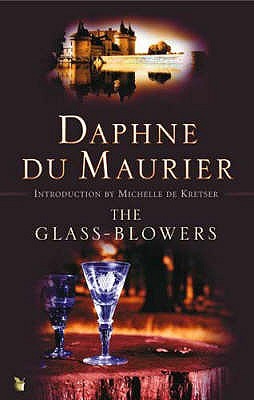
The Glass-Blowers The Glass-Blowers was the book selected for me in the last Classics Spin at the end of August. The deadline for reading our Spin book is this Friday, so I’ve finished just in time! Although it has taken me a while to actually pick this novel up and read it, that’s not because I wasn’t looking forward to it. Daphne du Maurier is one of my favourite authors and I fully expected to love this book as I’ve loved most of her others. That didn’t really happen, unfortunately, but I did still find things to enjoy.

Published in 1963, The Glass-Blowers is historical fiction based on the lives of du Maurier’s own ancestors who lived in France during the Revolution. The story is narrated by Sophie Duval, an elderly woman writing her family history in the form of a letter to send to her nephew. Sophie begins by looking back on her childhood growing up in the Loir-et-Cher region of France as the daughter of master glass-blower Mathurin Busson. Most of her early memories revolve around her eldest brother, Robert, who is constantly getting into debt and finding himself in trouble. It is Robert who will eventually move to England and provide the link to Daphne du Maurier herself.

In France, meanwhile, Sophie and her other siblings – Pierre, Michel and Edmé – become swept up in the drama of the French Revolution. So much of what I’ve read about the Revolution is focused on Paris, so it was fascinating to read about the ways in which it affected the lives of those living in the countryside and in other cities such as Le Mans. The section set during the War in the Vendée is particularly gripping and vivid – probably because Sophie herself is caught up in the uprising and experiences it directly. Other major events happen in the background and Sophie only hears thirdhand accounts, which takes away some of the emotional impact of the story (I kept thinking of The Brethren by Robert Merle, another novel set in France which is written in a similarly passive style).

The distance between narrator and reader meant that I never became fully engaged in the lives of the Bussons and never felt that I had really got to know Sophie. Her brother and sisters were stronger characters, particularly Michel, who becomes a political activist and joins the National Guard, and Robert, who repeatedly reinvents himself as one business venture after another ends in failure. Robert infuriated me at first but he eventually became my favourite character and I found myself looking forward to his scenes as they added a spark of life to what I was beginning to find quite a tedious story.

One of the things I usually love about du Maurier is her descriptive writing and the way she creates a strong sense of time and place – and this is something that I thought was missing from The Glass-Blowers (apart from in the Vendée scenes, as I mentioned above). This hasn’t become a favourite du Maurier book, then, but in my opinion even her weaker novels are still worth reading. Now that I’ve read this one I’m planning to read Mary Anne, another fictional account of one of du Maurier’s ancestors, this time on the English side of the family. After that I’ll only have Frenchman’s Creek and Castle Dor left to read.
Footsteps in the Dark by Georgette Heyer

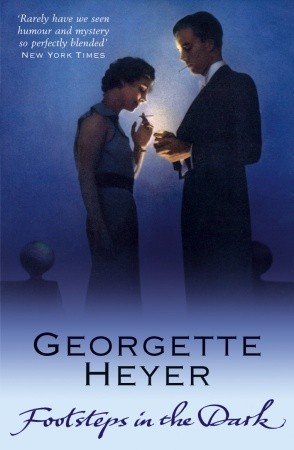
Footsteps in the Dark Georgette Heyer is more famous for her Regency romances, but she also wrote twelve mystery novels. Until now, the only one I had read was Envious Casca, but I decided to try another one for this year’s R.I.P. event. Footsteps in the Dark, published in 1932, turned out to be a good choice. More of a haunted house story than a traditional mystery, there are secret tunnels, underground passages, ghostly happenings and noises in the night. A perfect October read!

Celia Malcolm and her brother and sister, Peter and Margaret Fortescue, have inherited an old Priory from their uncle. When their solicitor warns them that the estate is said to be haunted, the three are intrigued and decide to live in the house together for a while so they can inspect their new property and plan some refurbishments.

Accompanied by their aunt, Mrs Bosanquet, and Celia’s husband, Charles, they move into the Priory and almost immediately hear tales from the neighbours of a mysterious Monk who wanders the grounds at night. At first the family are unconcerned, but it’s not long before they witness the Monk for themselves and are forced to accept that something strange is going on at the Priory. Is their new home really haunted or is someone trying to scare them away?

Footsteps in the Dark was Heyer’s first mystery and while I did enjoy it, I also thought there were one or two weaknesses. The characters felt very wooden – I found the two men almost indistinguishable and Celia and Margaret unbelievably silly (in different ways) – and while I did enjoy any scene featuring Mrs Bosanquet, the dialogue didn’t feel as sparkling and witty as I have come to expect from Heyer. The plot wasn’t particularly complex either and it was too easy to identify the villain. There is a murder, if you’re wondering, but it doesn’t take place until later in the novel so I wouldn’t describe this as a murder mystery like Envious Casca.

It was a lot of fun to read, though! With a plot based around a group of young people exploring a haunted house, I was frequently reminded of Scooby Doo – or maybe one of the Famous Five or Nancy Drew stories I used to love as a child. This is not a book to be taken too seriously, but Heyer does create an atmosphere which is genuinely eerie at times, especially if you’re reading when you’re on your own late at night! I probably won’t want to re-read this one, but I do look forward to reading the rest of Heyer’s mysteries.

The Queen’s Man by Sharon Penman

The Queens Man Having read and loved three of Sharon Penman’s historical fiction novels – The Sunne in Splendour, Here Be Dragons and Falls the Shadow – I’ve been interested in trying her series of historical mysteries set in medieval England. I downloaded the first in the series, The Queen’s Man, when it was offered as the Kindle Daily Deal on Amazon a while ago and have been waiting for the right time to read it.

The Queen’s Man introduces us to Justin de Quincy who, as the novel begins in December 1192, has just discovered that he is the illegitimate son of the Bishop of Chester. Furious that his father will not acknowledge their relationship, Justin sets out on a journey to London where he hopes to start a new life. Before he reaches London, however, he witnesses a murder on a snowy road just outside Winchester. As the killers flee the scene, the dying man – a goldsmith called Gervase Fitz Randolph – gives Justin a letter and makes him promise to deliver it to Queen Eleanor in London.

Eleanor of Aquitaine, widow of Henry II, is anxiously awaiting news of her son, King Richard I, who has disappeared while on crusade. As the weeks go by with no word of the missing king, it’s starting to look likely that he is dead and Eleanor’s youngest son, John, Count of Mortain, is getting ready to claim the throne for himself. Justin de Quincy’s arrival at court in possession of a bloodstained letter gives the Queen a clue as to Richard’s fate – but she still wants to know more.

As Justin was the only witness to the murder and the only person able to identify the killers, the Queen commissions him to investigate. Who was responsible for Gervase’s death? Was it a member of the goldsmith’s own family who wanted him dead or could it have been John who paid the murderers to steal the letter before it could reach Eleanor?

I enjoyed The Queen’s Man; it doesn’t compare with Penman’s straight historical novels – it lacks the depth and the emotional impact – but I didn’t mind that as I knew from the beginning that this would be a different type of book. While the plot and characters (with some obvious exceptions) are fictional, the historical background is as accurate and detailed as you would expect from Penman, with lots of interesting snippets of information that bring the 12th century to life: a visit to both a lazar house (hospital for lepers) and a medieval horse fair are incorporated, for example, and there’s a fascinating description of ‘trial by ordeal’ using hot cauldrons.

As a murder mystery, the plot is quite complex with plenty of suspects and some red herrings – although it’s slightly disappointing that some important information is withheld from the reader until near the end, so it would have been difficult to have guessed the solution before it was revealed.

The Queen’s Man has an interesting variety of supporting characters, ranging from innkeeper’s widow, Nell, and the under-sheriff of Winchester, Luke de Marston, to one of Queen Eleanor’s ladies, the beautiful Claudine. My only concern is that I found Justin de Quincy himself very bland. Based on this first novel, I wouldn’t have thought he was a strong enough character to build a whole series around. I could be wrong about him, though, and I’m still interested enough to want to read the next book, Cruel as the Grave, at some point to see how his story continues.

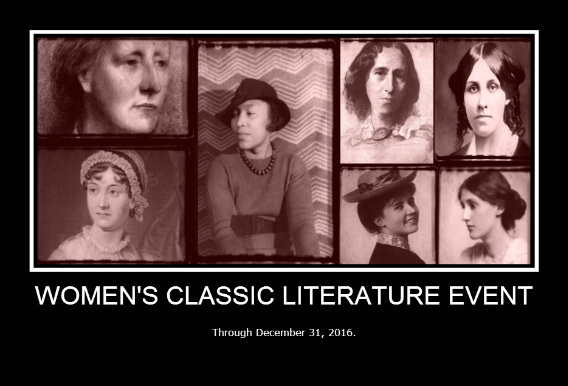
The Women’s Classic Literature Event

Womens Classic Literature Event

The Classics Club have announced an exciting new reading event: The Women’s Classic Literature Event! Between now and December 2016 we will be reading and writing about classic works by female authors. There are no other rules and there’s no upper or lower limit to the number of books we need to read – as long as a book is written by a woman and (preferably) published before 1960, it counts towards this event. By ‘book’ I don’t just mean novels, because letters, poetry, plays, essays, journals, short stories and biographies all count too.

I will definitely be participating, but I’m not sure how I want to approach this event. I still have a lot of classics by women left to read on my Classics Club list, which I’m listing below:

Shirley by Charlotte Brontë
Jane Eyre by Charlotte Brontë (re-read)
Wuthering Heights by Emily Brontë (re-read)
My Antonia by Willa Cather
Rebecca by Daphne du Maurier (re-read)
Frenchman’s Creek by Daphne du Maurier
Mary Anne by Daphne du Maurier
The Mill on the Floss by George Eliot
Wives and Daughters by Elizabeth Gaskell
Excellent Women by Barbara Pym
The Romance of the Forest by Ann Radcliffe
Kristin Lavransdatter by Sigrid Undset
The House of Mirth by Edith Wharton
The Heir of Redclyffe by Charlotte M. Yonge

I’ll take this list as a starting point and read some of these books for the event, but I would like to do more than that. I would like to also read books by women who are not on my list, by women who are new to me, by women I’ve never thought about reading before – and maybe some children’s classics by women too.

The Classics Club have also posted an introductory survey. Here are my answers to the questions:

1. Introduce yourself. Tell us what you are most looking forward to in this event.
I’m Helen and I joined the Classics Club in 2012. I’m looking forward to discovering some new female authors through this event and I’m also hoping it will encourage me to pick up some of the books on my existing list that I’ve been putting off reading.

2. Have you read many classics by women? Why or why not?
Yes, I’ve read quite a lot of classics by women (including some of my absolute favourite classics) – but probably not as many as I’ve read by men.

3. Pick a classic female writer you can’t wait to read for the event, & list her date of birth, her place of birth, and the title of one of her most famous works.
I’m looking forward to finally reading Charlotte M. Yonge. I’ve been meaning to read The Heir of Redclyffe for such a long time, but for some reason have never got round to doing it. Yonge was born in Otterbourne, Hampshire, England on August 11, 1823. As well as the title I’ve already mentioned, her other works include The Daisy Chain and The Clever Woman of the Family.

4. Think of a female character who was represented in classic literature by a male writer. Does she seem to be a whole or complete woman? Why or why not? Tell us about her. (Without spoilers, please!)
I’ve chosen a character from a classic I read earlier this year and who I certainly didn’t consider to be a whole or complete woman: Dora Spenlow from David Copperfield by Charles Dickens. I often find Dickens’ female characters irritating (although there are a few exceptions) and Dora is probably the worst – a woman who is happy to describe herself as ‘a silly little thing’.

5. Favorite classic heroine? (Why? Who wrote her?)
I can think of lots of great heroines in classic literature, but one of my favourites is the wonderful Marian Halcombe from The Woman in White by Wilkie Collins. I know Collins has been criticised for making Marian unattractive and unfeminine while the beautiful but much less interesting Laura Fairlie is the romantic interest of the novel, but I still think it’s great to see a male Victorian author create such a strong, intelligent, courageous heroine.

6. We’d love to help clubbers find great titles by classic female authors. Can you recommend any sources for building a list? (Just skip this question if you don’t have any at this point.)
This list of Virago Modern Classics should be a good place to start (be careful as there are a few male authors on there too).
http://www.librarything.com/wiki/index.php/User:Christiguc

7. Recommend three books by classic female writers to get people started in this event. (Again, skip over this if you prefer not to answer.)
Rebecca by Daphne du Maurier
Pride and Prejudice by Jane Austen
Jane Eyre by Charlotte Brontë

8. Will you be joining us for this event immediately, or will you wait until the new year starts?
I’ll be joining immediately. I’m sure I’ll be reading some classics by women during the remainder of this year and I would like those to count.

9. Do you plan to read as inspiration pulls, or will you make out a preset list?
Apart from reading some of the remaining books on my current Classics Club list, I’m not planning to make any other preset lists. I never stick to them anyway, so I’m just going to read whatever I feel like reading.

10. Are you pulling to any particular genres? (Letters, journals, biographies, short stories, novels, poems, essays, etc?)
I expect that I’ll be reading mostly novels (there’s a reason why I didn’t call my blog She Reads Letters or She Reads Journals) but I would like to be adventurous and read some other formats as well, particularly short stories and poetry.

11. Are you pulling to a particular era or location in literature by women?
No, not really. I’ve already read a lot of classics from the Victorian era, though, so I’m going to try to read more books from the twentieth century for this event.

12. Do you hope to host an event or readalong for the group? No worries if you don’t have details. We’re just curious!
I don’t think so, but I haven’t ruled it out.

13. Is there an author or title you’d love to read with a group or a buddy for this event? Sharing may inspire someone to offer.
Nothing in particular, but I’ll look out for any group reads that interest me.

14. Share a quote you love by a classic female author — even if you haven’t read the book yet.
“And certainly, the mistakes that we male and female mortals make when we have our own way might fairly raise some wonder that we are so fond of it.” – George Eliot, Middlemarch

~

Will you be taking part in the Women’s Classic Literature Event?

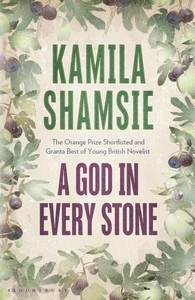
A God in Every Stone by Kamila Shamsie

A God in Every Stone When choosing what to read for this year’s #Diversiverse event, A God in Every Stone was the obvious choice as it also counts towards my Reading the Walter Scott Prize project (it was shortlisted for the 2015 prize). It’s the sixth novel by Pakistani author Kamila Shamsie, but the first one I have read.

The novel opens in July 1914 in Turkey, where twenty-two-year-old Vivian Rose Spencer is working on an archaeological dig led by Tahsin Bey, a friend of her father’s. Vivian is intrigued by tales of Scylax, the ancient Greek explorer who sailed down the Indus River from the city of Caspatyrus (now Peshawar in modern-day Pakistan) and was rewarded by King Darius I with a circlet decorated with figs. As Tahsin Bey tells her of his mission to find the legendary circlet, she finds herself falling in love with him, despite the age difference. Soon, though, she and Tahsin Bey are separated; war has broken out in Europe and Vivian must return home to serve as a VAD nurse in a London hospital.

Another thread of the novel follows a young Pashtun soldier from Peshawar, Qayyum Gul, who has been injured while fighting with the British army at Ypres in 1915. Qayyum is on his way home when he briefly meets Vivian on a train. Having been traumatised by her experiences of wartime nursing, Vivian has decided to travel to Peshawar to continue Tahsin Bey’s search for the Circlet of Scylax. In Peshawar, she gets to know a twelve-year-old boy called Najeeb and awakens in him a passion for archaeology and ancient history.

The stories of these three people – Vivian, Qayyum and Najeeb – come together again fifteen years later in 1930s Peshawar. I think I’ve said enough about the plot now, so I won’t tell you how their characters have developed in the intervening years or the circumstances that lead to their paths crossing again. What I will say, though, is that 1930 is a very significant year in the history of Peshawar, as a group known as the Khudai Khidmatgar campaign to end British rule in India through non-violent means. The novel reaches a dramatic conclusion on the Street of Storytellers during one of the defining moments of the Indian independence movement – and one that I confess to knowing nothing about before reading this book.

A God in Every Stone is an ambitious book, spanning three decades, crossing two continents and tackling some big themes, such as the rise and fall of empires and the loyalties of the people living within those empires. The settings – which include Turkish archaeological sites and the old walled city of Peshawar – are vividly described and I loved the way in which the story of Scylax was worked throughout the novel, its relevance not immediately clear but soon becoming obvious.

Although I found a lot to admire about A God in Every Stone, I still felt that there was something missing: an emotional connection to the characters. I found that the only one I really cared about was Najeeb – his innocence and enthusiasm as a twelve-year-old meant he instantly became my favourite character – but I struggled to feel anything for Qayyum and Vivian, despite the ordeals they both go through. It didn’t help that towards the end of the novel they are pushed into the background as two more characters – Zarina and her sister-in-law, Diwa – are introduced. Choosing to focus on new characters at such a late stage of the book meant that the final scenes set on the Street of Storytellers lacked the impact they should have had.

I did enjoy this book but I couldn’t help feeling that the author had tried to include too much in what is really quite a short novel. I think I would have preferred a longer book giving the characters more emotional depth and exploring the themes in more detail – or maybe a shorter book concentrating on just Vivian’s story or just Qayyum’s. Looking at other reviews of this novel, it was possibly the wrong Kamila Shamsie book for me to have started with; I’m looking forward to trying one of her earlier books and I think Burnt Shadows will be the next one I read.

Historical Musings #7: Exploring Africa

Historical Musings It’s very easy to find historical fiction set in Europe or America. If you’re looking for a book on the wives of Henry VIII, the Italian Renaissance, the US Civil War or the French court, there are literally hundreds of novels to choose from – but historical fiction set in other parts of the world is not as well represented.

I’m participating in A More Diverse Universe at BookLust this month and will have two books to tell you about soon: the first is Kamila Shamsie’s A God in Every Stone, set partly in 1930s Peshawar, and the other is Flood of Fire, the final part of Amitav Ghosh’s Ibis Trilogy set in India and China during the First Opium War. Last year, for the same event, I read The Garden of Evening Mists by Tan Twan Eng, set in Malaya in the 1940s and 1950s, and The Twentieth Wife by Indu Sundaresan, a story of Mughal India. It seems, then, that when I do choose to read more diversely within the historical fiction genre, I tend to pick up books set in Asia (particularly in India and China) rather than in other areas of the world.

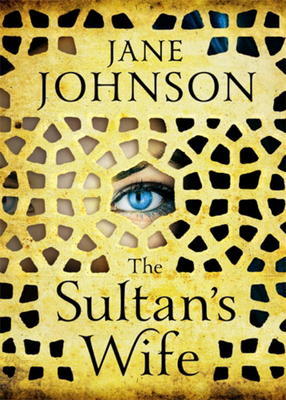
The Sultans Wife A quick look through my blog archives has shown me that I have read a very small number of historical novels set in Africa over the last few years – and even fewer that were actually written by African authors. Several of Dorothy Dunnett’s novels are set partly in Africa (the journey to Timbuktu in Scales of Gold is particularly fascinating), Wendy Wallace’s The Sacred River is set in 19th century Egypt – and of course, there’s Elizabeth Peters’ Amelia Peabody series which is set in Egypt too. I can also recommend three novels set partly or entirely in Morocco: Linda Holeman’s The Saffron Gate (1930s), Jane Johnson’s The Sultan’s Wife (17th century) and Laila Lalami’s The Moor’s Account (16th century).

half of a yellow sun If we can include the 1960s as historical fiction, then I have also read The Memory of Love by Aminatta Forna (Sierra Leone) and Half of a Yellow Sun by Chimamanda Ngozi Adichie (Nigeria) – and Cutting for Stone by Abraham Verghese, which covers the history of Ethiopia from around 1950-1980. I do prefer to stick to Walter Scott’s definition of historical fiction, though, which would rule out anything set less than sixty years before publication! Before I started blogging, I read Roots by Alex Haley and the Ramses series by Christian Jacq, but beyond these I’m struggling to think of anything else.

Can you recommend some good historical fiction novels set in Africa? Which are your favourites?

The Moor’s Account – and a Shiny New Books Q and A

Just a quick post to let you know that Issue 7 of Shiny New Books is out today!

SNB

Shiny New Books is an online magazine for book lovers and is packed with book reviews, news and other features. In this issue, I have provided a Q & A with author Laila Lalami. Below you can read my review of her Man Booker longlisted novel The Moor’s Account.

The Moors Account In 1527, the Spanish conquistador Pánfilo de Narváez embarks on an expedition to the New World. With five ships and six hundred men, there’s every reason to hope that the voyage will be a success and will result in the area now known as the Gulf Coast of the United States being claimed for Spain. Within a year, however, most of the men have succumbed to disease, lack of food, extreme weather and encounters with Native American tribes. Eventually, only four of the original party remain: the treasurer of the expedition, Álvar Núñez Cabeza de Vaca; the nobleman Alonso del Castillo Maldonado; Andrés Dorantes de Carranza, an explorer; and finally, Estebanico, a Moroccan slave in the service of Dorantes.

The story of the disastrous Narváez expedition is told in a chronicle written by Cabeza de Vaca, yet Estebanico – one of de Vaca’s three fellow survivors – is only very briefly mentioned. Laila Lalami’s The Moor’s Account gives Estebanico a voice of his own and an opportunity to tell his side of the story, including details which were omitted from the ‘official’ records.

As well as his account of the expedition, Estebanico also tells us about his early life in Azemmour, Morocco, and how his fortunes rose and fell. Born Mustafa ibn Muhammad ibn Abdussalam al-Zamori, he was once a trader, selling men into slavery – before, ironically, becoming a slave himself. The two threads of Estebanico’s narrative are told in alternating chapters and I found that as I learned more about his background I gained a deeper understanding of the sort of person he was and of the qualities which helped him to survive when so many others did not.

Unlike most of his fellow explorers, Estebanico has not come to the New World in search of fame or fortune; all he wants is to be given his freedom and a chance to return to Azemmour. He is in a unique position, being part of the Castilian party yet not fully accepted as ‘one of them’ – at least until his intelligence and his gift for learning languages make him indispensable to the group and the barriers between slave and master begin to break down. His status as slave means that he offers a different perspective on events and also a more sympathetic view of the tribes of indigenous people they encounter.

Lalami very successfully conveys the strangeness and newness of the world in which Estebanico has found himself; the landscape, the plants and animals, the native tribes and their customs – all of these are described through the eyes of someone to whom everything is fascinating and unfamiliar. It would have been interesting to have been able to trace the progress of the journey on a map. On the other hand, this is a journey into the unknown and Estebanico and his companions only have a very vague idea of where they are headed, so I was happy to wait until I’d finished the novel before looking up more details of the expedition online.

Although Estebanico’s account does not really exist and Lalami is simply imagining how he may have chosen to tell the story, the novel is written in such a way that I could easily believe everything in the book happened exactly as described. I appreciated the author’s efforts to make the novel feel like an authentic sixteenth century manuscript – while it isn’t entirely convincing, it never feels inappropriately modern either and strikes a good balance between readability and historical accuracy. I also liked the names the Spaniards have for the places they pass through: for example, the Land of the Indians, the Ocean of Fog and Darkness, the Island of Misfortune and the Bay of Oysters. A strange reptile discovered near the beginning of the expedition is given the name El Lagarto because it looks like a giant lizard. Names, of course, are very important to Estebanico, having had his own name – and with it part of his identity – taken from him.

Another major theme of the novel is the power of storytelling and the right we all have to tell our own story and make sure our voice is heard. It’s fortunate, then, that Laila Lalami is such a talented storyteller herself. The Moor’s Account is an educational read (unless you’ve read about the Narváez expedition before, you should find, as I did, that there’s something new to learn on almost every page) but it’s also a fascinating travelogue and a gripping adventure novel which kept me turning the pages wondering where Estebanico’s journey would take him next.