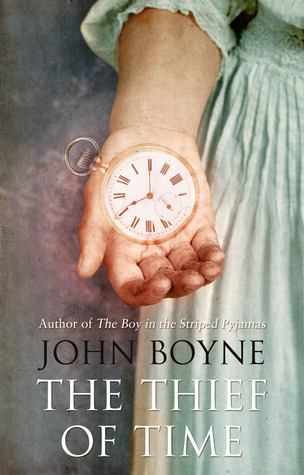
 If you met Matthieu Zela for the first time you would probably think he was just a normal fifty-year-old man. You would be wrong. Matthieu Zela has been alive for more than two hundred and fifty years.
Born in Paris in 1743, he noticed at some point in the 1790s that he had simply stopped growing older and he has looked like a middle-aged man ever since. It’s now 1999 and his neverending existence still shows no sign of coming to an end. As he prepares to enter yet another new century, Matthieu looks back on his life so far (nineteen wives, a variety of different careers, and a series of nephews – nine generations of them – all called Thomas and all dying tragically young) and he discovers that maybe there is something he can do to break the cycle after all.
In The Thief of Time, two stories are told in parallel. One is set in the eighteenth century and follows the teenage Matthieu as he leaves home after losing both of his parents and sets off with his half-brother Tomas in search of a better life. As they board a ship to England, they meet Dominique Sauvet, the girl who will become Matthieu’s first love. The second main thread of the novel takes place in the present day (1999). Matthieu’s current nephew, Tommy – a descendant of Tomas – is an actor in a popular soap opera and is finding it difficult to cope with the pressures of fame. Worried about Tommy’s drug addiction, Matthieu (now a successful television executive) decides that even though he did nothing to help the previous generations of doomed Thomases, he won’t allow this one to die an early death.
Interspersed with these two storylines are a series of chapters looking at significant episodes in Matthieu’s life. During his two hundred and fifty-six years, he has witnessed some of the defining moments of the eighteenth, nineteenth and twentieth centuries including the French Revolution, the Wall Street Crash and the 1896 Olympics, and meets Charlie Chaplin, Pope Pius IX and President Herbert Hoover, to name just a few. I didn’t find it particularly believable that Matthieu could have been so closely involved with all of these famous people and events but as the whole book is based around the idea of a man who never ages I’m not going to worry too much about that!
The Thief of Time was John Boyne’s debut novel and, having read some of his later ones (This House is Haunted, Crippen and A History of Loneliness) this one really does feel like a first book. It’s such an interesting concept but there were too many flaws to make it a satisfying read. I think my biggest problem with the book was the structure; jumping from a chapter set in 1999 to one set in the 1700s and then another set during a random time period just didn’t work. The novel didn’t flow properly, there was no real character development and the historical chapters – which often felt irrelevant and did nothing to move the story forward – lacked a sense of time and place (there were also some historical inaccuracies, such as a mention of telegrams being sent during the French Revolution).
I was also disappointed that the reasons for Matthieu’s immortality are never explored – he never really questions how and why this is happening to him and the people around him don’t ever seem to notice anything unusual! I don’t think we are given a real explanation as to how he progressed from his first job as stable boy to a successful career in media either. There were some aspects of the book I liked, though: I enjoyed the Charlie Chaplin chapter and also the chapter set during the Great Exhibition of 1851, and while I didn’t particularly like Matthieu himself, I was interested in his television work and in his relationship with his latest nephew, Tommy.
If this had been my first John Boyne book I don’t think I would have wanted to read more, but as I loved the other three of his that I’ve read I will continue to work through the rest of his novels. I’m hoping for better luck with the next one I choose!



 She Reads Novels