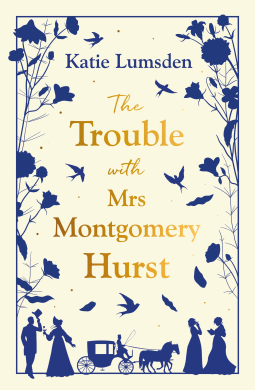
 In a small, close-knit community in 1841, the arrival of a newcomer can really cause a stir – and that’s what happens when Mr Montgomery Hurst brings his new wife home to Wickenshire. Mr Hurst was one of the county’s most eligible bachelors, so everyone is curious to see what sort of woman has tempted him to marry at last. The new Mrs Hurst, however – a widow in her thirties with three small children – is not what they are expecting. It seems to the people of Wickenshire that she is not quite respectable and gossip quickly begins to spread as they speculate about her past and her previous marriage.
One person who doesn’t care too much about the gossip is Amelia Ashpoint. Amelia’s father owns a brewery, making the Ashpoints one of the richest families in Wickenshire, yet they are still not regarded as equals by the older families whose wealth and titles have been passed down through the generations. At twenty-three, Amelia is expected to marry soon, but what she really wants is a career as a writer and the freedom to be with the person she truly loves. Meanwhile, Felicia Elton, ‘the great beauty of Wickenshire’, is also under pressure to find a rich husband. With her looks and accomplishments, it shouldn’t be a difficult task, but for some reason nobody seems interested in marrying Felicia and she’s beginning to think she’ll have to settle for the first man who asks.
In The Trouble with Mrs Montgomery Hurst, Katie Lumsden tells the stories of Amelia Ashpoint, Felicia Elton and the Hursts, as well as several of their other friends and neighbours, all of whom occupy different positions on the social ladder. At the top there’s the Earl and Countess of Wickford and their dissolute son, Lord Salbridge; lower down, the town families who have made their money through trade and industry; and lower still, people such as Mr Lonsdale, the foreman at the Ashpoint brewery, and Monsieur Brisset, Felicia’s piano teacher. With so many unwritten rules of society and boundaries that can’t be crossed, it seems that nobody in Wickenshire is free to live and love as they choose and it’s easy to see why someone who doesn’t conform, like Mrs Hurst, can become the subject of rumour and slander.
Although the book is set in the early 1840s, at the start of the Victorian era, it has the feel of a Regency novel and there’s an obvious Jane Austen influence in both the writing style and the plot. The worldbuilding is strengthened by the inclusion of a map at the beginning and a list of characters giving their age, address and occupation. It was all so immersive that I really didn’t want to have to leave Wickenshire behind when I reached the end of the book! Because it’s a modern novel, though, Lumsden is able to explore topics that an author like Austen couldn’t (or at least not so explicitly). For example, one of the main characters is a lesbian and her story really helped me to appreciate how difficult it must have been to have no romantic interest in men in a world where it seemed that a young woman’s whole purpose in life was to find a husband. However, her story didn’t go quite the way I had predicted – and neither did the stories of several of the other characters. Some got happy endings, some didn’t and others just had to make the best of things, which I found very realistic.
In case you can’t tell, I loved this book and I think I preferred it to Katie Lumsden’s previous one, The Secrets of Hartwood Hall, which borrows from the Brontës rather than Austen. I would like a sequel so we can catch up with the residents of Wickenshire again and see how they are getting on, but I suspect this is probably intended as a standalone. Either way, I’ll be looking out for whatever Katie Lumsden writes next.
Thanks to Michael Joseph for providing a copy of this book for review via NetGalley.

This is book 12/20 of my 20 Books of Summer 2024.

Book 29/50 for the Historical Fiction Reading Challenge 2024




 She Reads Novels