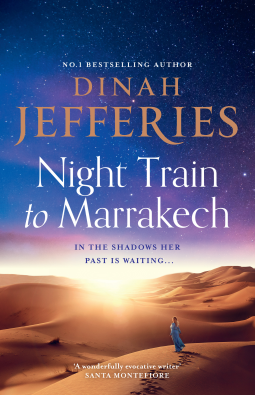
Night Train to Marrakech by Dinah Jefferies

Night Train to Marrakech is the third and final book in Dinah Jefferies’ Daughters of War trilogy, but if you haven’t read the previous two books that shouldn’t be a problem as I think this one would also work well as a standalone. While Daughters of War and The Hidden Palace followed the stories of the three Baudin sisters, Hélène, Élise and Florence, during World War II, this third novel moves forward to the 1960s to focus on Élise’s daughter, Vicky.

In July 1966, Vicky Baudin arrives in Morocco to visit her grandmother for the first time. Having lost her father during the war, Vicky has only recently discovered that his mother, Clemence, is still alive and living in the mountains outside Marrakech. Vicky has just received a diploma in fashion design from a London art college, so this seems like a good time to travel abroad before beginning a postgraduate course in Paris. As her train arrives at Marrakech station, Vicky is looking forward to getting to know Clemence – and is determined to find a way to meet her hero, the French designer Yves Saint Laurent, who also lives in Marrakech.

In her mountain home, the Kasbah du Paradis, Clemence is awaiting her long-lost granddaughter’s arrival with mixed emotions. Vicky will want to know why she played no part in her son’s life and Clemence doesn’t feel ready to explain. However, she’s forced to confront the memories she’s tried so hard to forget when a man from her past reappears, threatening to reveal her secrets. Meanwhile, Vicky and her cousin Bea also stumble into trouble when they become witnesses to a crime.

Night Train to Marrakech has a much stronger thriller element than the previous two books, which I found quite surprising. The novel is set against a backdrop of rising political tensions – a few months before the novel begins, the Moroccan revolutionary Mehdi Ben Barka is abducted in Paris (a real life incident) – and although this doesn’t form a large part of the plot, it does give a sense of the danger for two young women who unintentionally become mixed up in a situation they don’t fully understand. The descriptions of Morocco itself – the scenery, the buildings, the food, the sounds and smells – are also beautifully done.

The three sisters from the first two books (Vicky’s mother, Élise, and her two aunts, Hélène and Florence) do eventually make an appearance in this one, but I was disappointed that we don’t see very much of them. This is very much Vicky’s story and Clemence’s, and although having two completely new characters to get to know so late in the trilogy unsettled me slightly, I did warm to them later in the book. I found Clemence in particular an intriguing character as she seems so cold and secretive at first but as more and more of her story unfolds, the reason for this becomes clear and by the end of the book I had gained a lot of respect and sympathy for her.

I didn’t enjoy this book as much as Daughters of War and The Hidden Palace – as the third in a trilogy I would have preferred it to be more closely linked with the first two books rather than moving on to the next generation – but the gripping plot and evocative setting still made it worthwhile. As for whether or not Vicky achieves her dream of meeting Yves Saint Laurent, you’ll have to read the book to find out!

Thanks to HarperCollins for providing a copy of this book for review via NetGalley.
This is book 40/50 for the 2023 Historical Fiction Reading Challenge.

Top Ten Tuesday: Revisiting my Reading Resolutions

This week’s topic for Top Ten Tuesday (hosted by That Artsy Reader Girl) is “Reading Goals I Still Want to Accomplish Before the End of the Year”.

In January I made a list of some reading resolutions for the year ahead, so I thought I would return to them here and see how I’m progressing. There are only seven, so this is not a full top ten list this week!

~

1. Finish my Classics Club list.
At the start of this year I had sixteen books remaining on my Classics Club list. I had hoped to read all of them during 2023, but as usual I’ve been distracted by other books and so far have only read seven of them, leaving nine still on the list. I’m planning to read at least some of the others before the end of the year, but I think this is one goal that won’t be complete until 2024.

2. Re-read some old favourites.
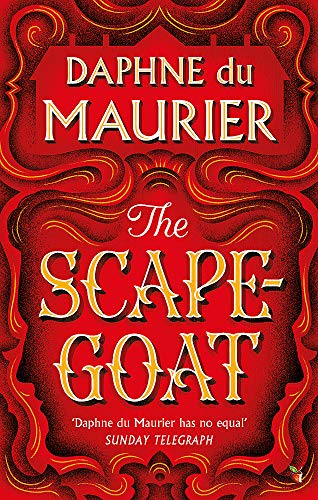
I’ve only managed one re-read this year – The Scapegoat by Daphne du Maurier – but it was one I particularly enjoyed as I wasn’t sure I’d interpreted things correctly the first time I read it. I really need to find time for more re-reads!

3. Resist the temptations of NetGalley.
At the start of January, the number of books I had waiting on my NetGalley shelf was down to single figures for the first time in years. I’ve been making an effort this year to be more restrained and request fewer books, but my reading slowed down for a while in the summer so the number on the shelf has slowly built up again. They are all books I really want to read, though, which is the most important thing.

4. Make some progress with my Reading the Walter Scott Prize project.
Unfortunately, I haven’t made much progress with this at all! I’ve read three books from this year’s Walter Scott Prize shortlist, but there were seven on the list so I still have the others to catch up with. I also still have lots of books to read from the previous years’ shortlists – I haven’t even managed to read last year’s winner yet!

5. Continue with some of the series and trilogies I’ve started and never finished!
I’ve had some success with this goal, finishing Robin Hobb’s Fitz and the Fool Trilogy and picking up the next books in Naomi Novik’s Temeraire series and Patrick O’Brian’s Aubrey/Maturin series. On the other hand, I’ve also started two more trilogies – the Eliot Chronicles by Elizabeth Goudge and the Fionavar Tapestry by Guy Gavriel Kay. Who knows when I’ll get round to finishing them!

6. Take part in the Historical Fiction Reading Challenge and Read Christie 2023.
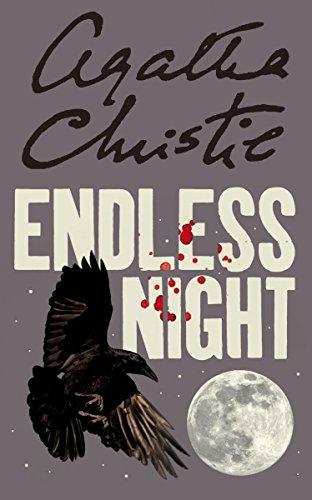
I’m doing very well with the Historical Fiction Challenge, which isn’t surprising as it’s my favourite genre. My target for the year was 50 books (‘Prehistoric’ level) and I’ve read 39 with almost three months still to go. For Read Christie 2023, I joined in with the monthly reads in January, February, April, May, August and September. I’m happy with that as I hadn’t planned to participate every month – I love Christie, but twelve books a year by the same author can be too much. I have Endless Night lined up for November, but not sure yet whether I’ll read anything for October or December.

7. Make every book I read a potential book of the year.
This is always the ultimate goal of every reader, surely? Of course I haven’t achieved it and have been disappointed in some of the books I’ve chosen to read during 2023, but I’ll stay optimistic and hope I find some more books of the year in the remaining three months!

~

Did you make any reading resolutions in January – and if so, are you sticking to them? What are you hoping to accomplish with your reading before the end of the year?

My Commonplace Book: September 2023

A selection of quotes and pictures to represent September’s reading:

commonplace book
noun
a book into which notable extracts from other works are copied for personal use.

~

But it does not do to laugh, however softly, when you are alone. Laughter calls for answering laughter; and when there is none, it is not like silence, but more like a very special kind of sound. A sound that must be listened for, attended to, with every faculty suddenly alert.

Uncle Paul by Celia Fremlin (1959)

~

There’s nothing as exciting as a fresh new start when the page is blank and the future is all for the making!

The Appeal by Janice Hallett (2021)

~

The meeting of Francis I and Henry VIII at the Field of the Cloth of Gold in 1520

It was growing dark now. How the years had flown. He had not always been a prisoner of this unwieldy, diseased body. He had been a golden youth; he had known glory upon glory. The world had celebrated him. He had thought himself immortal. How God makes fools of Man…

Henry VIII: The Heart and the Crown by Alison Weir (2023)

~

“It is only that I dislike the whole notion of subordination. The corporal lurks in almost every bosom, and each man tends to use authority when he has it, thus destroying his natural relationship with his fellows, a disastrous state of affairs for both sides. Do away with subordination and you do away with tyranny…”

The Ionian Mission by Patrick O’Brian (1981)

~

‘But to me the great interest of a case is not in material clues, like a bright little puzzle-box with all the pieces numbered and of a different colour. No! To me it lies in the human mind, the human behaviour: if you like, the human soul.’

He Who Whispers by John Dickson Carr (1946)

~

The Coloured Triclinium, Petra

“The illusion that freedom is the prerogative of one’s own particular race is fairly widespread. Dr Gerard was wiser. He knew that no race, no country and no individual could be described as free. But he also knew that there were different degrees of bondage.”

Appointment with Death by Agatha Christie (1938)

~

We’re all a collection of stories, she had thought afterwards. Some good, some not so good. The question was, how did you allow a new story in, when just one of your stories already took up too much space?

Night Train to Marrakech by Dinah Jefferies (2023)

~

‘The world will be very different,’ said Mr. Femm, slowly, ‘when all the people have been cleared out of it, and not before. Men and women do not change. Their silly antics are always the same. There will always be a few clever ones, who can see a yard or two in front of their noses, and a host of fools who can see nothing, who are all befuddled, who pride themselves on being virtuous because they are incompetent or short-sighted.’

Benighted by J.B. Priestley (1927)

~

Favourite books read in September:

Uncle Paul and Appointment with Death

Authors read for the first time in September:

Celia Fremlin, J.B. Priestley

Places visited in my September reading:

England, Israel, Jordan, Greece, Morocco

~

Reading notes: This was another good month of reading for me, although I didn’t manage to get to everything I had hoped to read. I was pleased to add some different countries to this year’s ‘places visited’ and the two new authors I read this month (Fremlin and Priestley) are both authors I would like to explore further. As we move into October, I’m looking forward to 1962 Club, hosted by Kaggsy’s Bookish Ramblings and Stuck in a Book, but otherwise I’m enjoying just reading whatever I want to read, whenever I want to read it!

How was your September? Do you have any plans for your October reading?

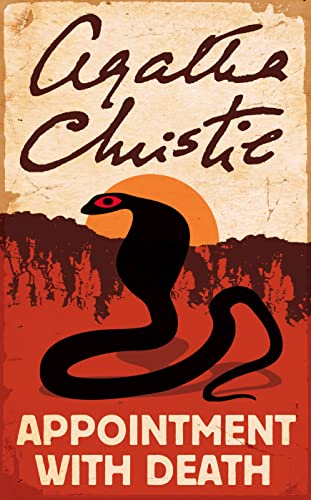
Appointment with Death by Agatha Christie

The September prompt for Read Christie 2023 is a motive: hatred. This is obviously a common motive for murder and there are plenty of Christie novels to fit this month’s theme, but the suggested title is Appointment with Death, a 1938 Poirot mystery set in the Middle East.

Newly qualified doctor Sarah King and French psychologist Dr Gerard are relaxing in the lounge of their Jerusalem hotel when their attention is drawn to an American family who have just entered the room. The head of the family is Mrs Boynton, a monstrous woman who takes a sadistic pleasure in controlling the lives of her adult children. Even her eldest stepson Lennox, who is married, is still completely under her thumb. As Sarah and Dr Gerard learn more about the Boyntons, they each begin to develop a personal interest in the family – Sarah because she has become romantically attracted to Lennox’s brother, Raymond, and Gerard because he thinks he has spotted the early signs of schizophrenia in the youngest Boynton child, Jinny.

When the party moves on to Petra, with the additions of British politician Lady Westholme, her spinster friend Amabel Pierce, and a certain Hercule Poirot, a murder takes place. Nobody has much sympathy for the victim, but the murderer must still be caught – and who better to catch them than Poirot? Insisting that he can solve the mystery in twenty-four hours, he sets out to interview the suspects and sort through the available clues, while remembering a conversation overheard from his hotel window one night: “You do see, don’t you, that she’s got to be killed?”

I always enjoy Christie – even her weaker books are entertaining – but this is a particularly good one! The relationship between the members of the Boynton family is fascinating; Mrs Boynton is a truly horrible woman who has ensured that her children and stepchildren have no friends, no freedom and no independence. Why she has allowed them to come on this trip at all is a mystery in itself and one of the questions Poirot will have to answer.

I loved the Middle East setting (a part of the world Christie knew well due to her travels with her archaeologist husband, Max Mallowan) and although the crime is committed amongst the historic sites of Petra, it almost still has the feel of a typical country house mystery with caves and tents taking the place of rooms. I can’t really claim to have solved the mystery, but I did narrow it down to two suspects and one of them was correct! I missed an important clue which would definitely have pointed me in the right direction earlier on if I had picked up on it, but I think Christie is very fair with the reader in this book and all the clues are there to be seen, as long as you’re paying attention.

I’m not sure yet whether I’ll be taking part in Read Christie next month, but if not I’m looking forward to reading Endless Night in November.

Historical Musings #82: HWA Crown Awards 2023

Welcome to my not-quite-monthly post on all things historical fiction! This month, I want to highlight the HWA Crown Award longlists which were announced last Wednesday by the Historical Writers Association. There are three separate awards – one for debut novels, one for non-fiction and the other (the Gold Crown) for authors who have previously published. The shortlists are announced in October and the winner in November. I have no plans to try to read all of these books, but thought it would be interesting to look at what I’ve read so far from each list.

Gold Crown Award 2023 longlist

River Spirit by Leila Aboulela
Bad Relations by Cressida Connolly
Trust by Hernan Diaz
The Colour Storm by Damien Dibben
The Weather Woman by Sally Gardner
Spear by Nicola Griffith
The Walled Garden by Sarah Hardy
The Dance Tree by Kiran Millwood Hargrave
The Great Reclamation by Rachel Heng
The Chosen by Elizabeth Lowry
A Wild & True Relation by Kim Sherwood
Dark Earth by Rebecca Stott

I’ve only read two of these – The Colour Storm and The Dance Tree – and although I liked them both, neither of them are favourites. Of the others, The Chosen is already on my TBR after it appeared on the Walter Scott Prize shortlist earlier this year, but the rest don’t really appeal.

Non-fiction Crown Award 2023 longlist

The Treasuries: Poetry Anthologies and the Making of British Culture by Clare Bucknell
The Siege of Loyalty House by Jessie Childs
Woman’s Lore: 4,000 Years of Sirens, Serpents and Succubi by Sarah Clegg
Courting India by Nandini Das
The Captain’s Apprentice by Caroline Davison
China After Mao by Frank Dikötter
Command: The Politics of Military Operations from Korea to Ukraine by Lawrence Freedman
The Age of Uncertainty by Tobias Hürter, translated by David Shaw
After the Romanovs by Helen Rappaport
Super-Infinite by Katherine Rundell
The Holocaust: An Unfinished History by Dan Stone
The Dress Diary of Mrs Anne Sykes by Kate Strasdin

I haven’t read any of these – in fact, apart from the Helen Rappaport, I haven’t even heard of them. However, I’ve investigated some of the titles and I like the sound of The Siege of Loyalty House, about a siege during the English Civil War, and The Dress Diary of Mrs Anne Sykes, which traces the life of a Victorian woman through her textile scrapbook.

Debut Crown Award 2023 longlist

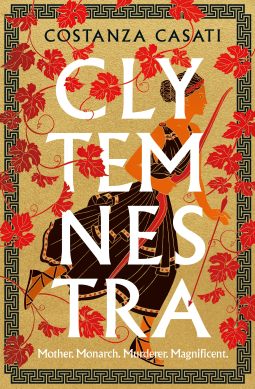
Clytemnestra by Costanza Casati
The New Life by Tom Crewe
Theatre of Marvels by Lianne Dillsworth
Lessons in Chemistry by Bonnie Garmus
Weyward by Emilia Hart
The Lost Diary of Samuel Pepys by Jack Jewers
The Secret Diaries of Charles Ignatius Sancho by Paterson Joseph
The Secrets of Hartwood Hall by Katie Lumsden
Death and the Conjuror by Tom Mead
The Circus Train by Amita Parikh
River Sing Me Home by Eleanor Shearer
Bonny & Read by Julie Walker

I’ve read five of these and particularly enjoyed Clytemnestra and Death and the Conjuror (I’m hoping to read the sequel to that one soon). Again, the Paterson Joseph came to my attention through the Walter Scott Prize and I’m interested in reading The Circus Train and Bonny & Read.

~

Have you read any of these? If not, are there any you would like to read?

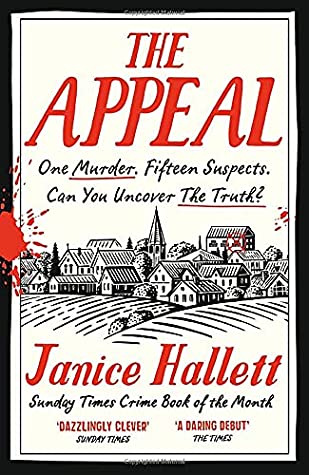
The Appeal by Janice Hallett

I loved Janice Hallett’s most recent novels, The Twyford Code and The Mysterious Case of the Alperton Angels, so I was looking forward to going back and reading her first book, The Appeal. I know Hallett’s style is not one that works for all readers (to be honest, I’m very surprised that it works for me), but if you enjoyed either of those other two novels, I can almost guarantee that you’ll enjoy this one as well.

The Appeal begins in the small English town of Lower Lockwood where the members of an amateur dramatics society, The Fairway Players, are preparing for their upcoming production of All My Sons by Arthur Miller. The Players are led by Martin Hayward and his wife Helen, a couple who also own the local golf club and are highly respected within the community, as well as members of several other prominent Lockwood families. On the fringes of the group and desperate to be accepted into the Haywards’ social circle is Isabel Beck, a young nurse who convinces her new friends Sam and Kel Greenwood to join the Players.

Before the group even begin rehearsals, disaster strikes: Martin and Helen’s two-year-old granddaughter, Poppy, has developed a rare form of brain cancer which is unlikely to be cured with conventional chemotherapy. Poppy’s parents have placed all their hopes in a new experimental treatment which is not yet available in the UK. Determined to obtain this very expensive new drug from America, the Haywards and their friends launch a fundraising appeal, ‘A Cure for Poppy’. At first, everything seems to be going well, but when one of the Fairway Players is found murdered, questions are raised not just regarding the killer but the appeal itself. Does the doctor responsible for obtaining the new treatment really have Poppy’s best interests at heart? Why did Sam leave her last nursing position in Africa so suddenly? And who is the mystery donor who promised a large sum of money then changed his mind?

Roderick Tanner QC has set his two law students, Femi and Charlotte, the task of looking through the documents associated with the Lockwood case. Someone has already been sentenced for the murder, but Tanner believes they are innocent and he wants the students to confirm his opinion as he prepares to appeal the decision. The novel is presented entirely in the form of emails sent to and from the various characters involved in the case, as well as several WhatsApp discussions between Femi and Charlotte as they try to make sense of the evidence. As I’ve said, this is probably something you’ll either love or hate, but for me it’s very effective – I find that the short length of each email makes the book very immersive and compelling as it’s easy to think ‘I’ll just read one more!’ It also allows a lot of misdirection as every character could be considered an unreliable narrator; we can never be sure who they really are or how they really feel because all we see is the way they choose to present themselves in an email or on social media. Some suspension of disbelief is required, though, as most people aren’t sending constant emails to each other all day long!

The weakest aspect of The Appeal for me was actually the murder mystery. The murder doesn’t take place until late in the novel and then we learn that Tanner has been withholding information from us, which makes it very difficult to solve the mystery for ourselves. I also wasn’t sure why he wanted help from Charlotte and Femi, as he already seemed to know everything anyway. Apart from that, I enjoyed following the progress of the Poppy campaign and correctly guessed some of the twists in that storyline! There’s a large cast of characters to get to know, but I found that most of them had their own very distinctive personalities – from needy, eager to please Isabel to practical, no-nonsense professional fundraiser Sarah-Jane – so I had no problem keeping track of them all.

Of the three Janice Hallett books I’ve read, this is my least favourite, but it still kept me entertained from beginning to end. I’m looking forward to reading her new novella, The Christmas Appeal, coming in October!

Top Ten Tuesday: Books on my Autumn TBR

This week’s topic for Top Ten Tuesday (hosted by That Artsy Reader Girl) is “Books on My Fall 2023 To-Read List”.

I have a lot more than ten books I’m hoping to read this autumn, but here’s a selection of them:

For the Read Christie 2023 challenge:

1. Endless Night by Agatha Christie

Some possible reads for the upcoming 1962 Club:

2. The Wolves of Willoughby Chase by Joan Aiken
3. The Nonesuch by Georgette Heyer

Books from my Classics Club list:

4. The Elusive Pimpernel by Baroness Orczy
5. Fire From Heaven by Mary Renault

Some NetGalley review copies:

6. The Winter Spirits: Ghostly Tales for Frosty Nights by various authors
7. The Devil’s Flute Murders by Seishi Yokomizo
8. Tom Lake by Ann Patchett
9. The Fake Wife by Sharon Bolton
10. Water by John Boyne

~

Have you read any of these? Which books are on your autumn/fall TBR?