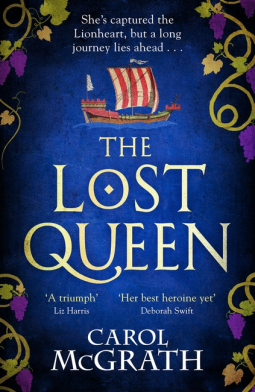
 Berengaria of Navarre is one of the Queens of England I know least about and I’m sure I’m not alone in that as so little has been written about her. I’ve read novels in which she appears briefly as a secondary character, but with the exception of Martha Rofheart’s Lionheart, nothing where she takes a more central role. In The Lost Queen, Carol McGrath builds Berengaria’s story around the small amount of factual information we have about her, taking us through the early days of her marriage to King Richard I and her time spent in the Holy Land, where she accompanied Richard on the Third Crusade.
Like the other McGrath books I’ve read, there’s also a fictional heroine whose story takes place alongside the real historical one. In this case, it’s Lady Avelina of Middleton, whose husband William has disappeared after leaving for Outremer three years earlier to claim his father’s estate. William’s half-brother, Walter, is insisting that William must have become caught up in the Crusades and killed in battle, but Avelina suspects that Walter simply has his eye on herself and Middleton. Avelina is determined to prove that her husband is still alive and sets off to look for him, attaching herself to a party of nuns who are travelling to Jerusalem in search of a religious relic to bring back to their abbey.
During the journey, Avelina’s path crosses with Berengaria’s, who is on her way to her wedding with Richard. Richard’s mother, Eleanor of Aquitaine, escorts Berengaria as far as Sicily, then Eleanor’s daughter Joanna accompanies her from there to Cyprus and then the Holy Land. Avelina and the nuns join them along the way and a friendship forms between Avelina and the new queen.
Berengaria is known as the only English queen never to visit England (although it’s now thought that she may have done after Richard’s death). This means that, apart from a few chapters involving Avelina, most of the novel is set elsewhere in Europe and the Middle East. I particularly enjoyed the descriptions of all the adventures the characters have on the journey: crossing the Alps in the middle of winter; surviving assassination attempts; being shipwrecked off the coast of Cyprus and held prisoner.
As I know so little about Berengaria I can’t really comment on the accuracy of the novel. McGrath does include an author’s note, in which she explains some of her decisions and how she worked with the available information to create the story. We do know that Berengaria never had children, for example, but McGrath suggests that she may have been pregnant with Richard’s child and had a miscarriage. The Avelina chapters of the book obviously allow for a lot more invention and imagination and there are also a few sections here and there narrated by other characters such as Blondel, the troubadour, or Ursula, one of Berengaria’s ladies. I can understand why these perspectives were included, as they fill in some of the gaps, showing us things that Berengaria and Avelina don’t witness for themselves, but I didn’t feel they really added much to the story and we don’t spend enough time with these characters to form any kind of emotional connection.
The book ends before the death of Richard I and I was sorry that we didn’t continue with Berengaria’s later years as it would have been interesting to see how she dealt with being a widow and queen dowager. However, even less is known about that period of Berengaria’s life, so maybe it was the right decision for the book to end when it did. I’ll be looking out for news on which historical figure Carol McGrath is writing about next!
Thanks to Headline Accent for providing a copy of this book for review via NetGalley.

Book 48/50 for the Historical Fiction Reading Challenge 2024


 She Reads Novels