The Reckoning by Sharon Penman – #Dewithon24

My second book for this year’s Reading Wales Month, or Dewithon, hosted by Book Jotter, is not actually by a Welsh author (Sharon Kay Penman – or simply Sharon Penman as she is published here in the UK – was an American historical novelist) but it’s set in Wales and is the third and final part of the Welsh Princes Trilogy, following Here Be Dragons and Falls the Shadow. I loved both of those books, so I expected to love this one too and I wasn’t disappointed.

Although I would recommend reading all three books in order, it’s not essential and it’s been such a long time since I read Falls the Shadow that I had forgotten a lot of the details anyway. I did remember the dramatic descriptions of Simon de Montfort’s defeat at the Battle of Evesham that ended that book; The Reckoning begins more than five years later in January 1271, but the effects of the battle are still being felt. Simon de Montfort’s surviving family members have fled England to take refuge elsewhere in Europe and his daughter Ellen’s planned marriage to Llewelyn ap Gruffydd, Prince of Wales, now seems in doubt. With de Montfort defeated, Henry III of England’s position on the throne is now much more secure and when he dies in 1272 his eldest son, Edward, succeeds him as king.

Meanwhile, the situation across the border in Wales is less stable. Prince Llewelyn is determined to continue the work of his grandfather Llewelyn the Great and keep Wales independent and united, but with his own younger brother Davydd conspiring against him it’s not going to be easy. When England’s new king, Edward I, turns his attentions to bringing Wales under English rule, Llewelyn finds that he can’t rely on the support of Davydd and the other Welsh lords – and to complicate things further, his bride Ellen de Montfort has been captured by Edward on her way to Wales for the wedding.

The Reckoning is a wonderful, thorough account of the final years of an independent Wales. Reading the book from a modern perspective, knowing that Edward will succeed in conquering Wales and that Llewelyn will become known as ‘Llewelyn the Last’, it’s impossible not to feel a sadness as the story approaches its end and it becomes clear even to Llewelyn himself that defeat is inevitable. What makes it particularly sad is that divisions between the Welsh nobility and even within Llewelyn’s own family play such a big part in their defeat and by the time war actually breaks out, Llewelyn has already had to concede so much Welsh territory and political power that he knows there’s little hope of succeeding.

A book of this size – around 600 pages – takes a long time to read when the story is so detailed and needs a lot of concentration, but I thought it was worth every minute. I loved Ellen and Llewelyn (although having read several of Penman’s books now, I’ve found that her brave, honourable heroes all seem to be cast in the same mold) and found the ‘villains’ equally interesting. Some sections of the novel are written from the perspectives of Edward and other members of the English court, which adds some nuance to the story – and I was particularly intrigued by the complex character of Davydd, who spends the entire book switching between supporting his brother and plotting to betray him, but has a personal charm that makes him difficult to actually dislike.
I learned a lot about Wales from this book, and from the first two in the trilogy – not just about Welsh history, but also Welsh laws and customs and how life in medieval Wales differed from life in medieval England. Although I had to read it in small doses due to the length and the small print in my edition, the story held my interest from beginning to end – and the ending, when it came, was heartbreaking, but that was to be expected!

Have you read this or any other books about the English conquest of Wales?

Book 13/50 for the Historical Fiction Reading Challenge 2024

A Marriage of Lions by Elizabeth Chadwick

When I read Carol McGrath’s The Silken Rose last year I remarked on the lack of books about Henry III and Eleanor of Provence, so I was pleased to find that they are also major characters in Elizabeth Chadwick’s new novel, A Marriage of Lions. The main focus of the story, however, is Henry’s younger half-brother, William de Valence, and his wife, Joanna de Munchensy of Swanscombe. Those of you who are avid readers of Chadwick’s novels will know that she has a particular interest in William Marshal, hero of The Greatest Knight, and that many of her recent books have featured various members of the Marshal family. This is another, as Joanna de Munchensy is one of William Marshal’s grandchildren.

The novel opens in 1238 with the eight-year-old Joanna serving as a chamber lady at the court of Henry III and Eleanor of Provence (or Alienor as Chadwick spells the name). With several older male relatives, Joanna is seen as an insignificant member of the Marshal family until a sudden change in circumstances leaves her a very wealthy young woman with lands and titles of her own. In 1247, the King’s half-brothers – the sons of his mother Isabella of Angoulême’s second marriage to Hugh of Lusignan – arrive from France to take up positions at Henry’s court. The King becomes particularly fond of his youngest half-brother, William de Valence, and rewards him with marriage to Joanna, now one of the richest heiresses in England.

Although it’s an arranged marriage, it turns out to be a very happy one – but there are many at court who are not at all pleased with the favour being shown to William and his brothers. The powerful Simon de Montfort and his wife, the King’s sister, believe that part of the Marshal inheritance belongs to them and they set out to make life as difficult for William and Joanna as they possibly can. Meanwhile Queen Eleanor becomes resentful of the influence William and the other Lusignans wield over her young son, Prince Edward, and her previously good relationship with Joanna grows tense and strained. As the atmosphere becomes more and more hostile and the King’s power begins to weaken, Simon de Montfort and his barons see their chance to seize control of the throne and suddenly William and Joanna find themselves driven away from court as the country heads towards civil war.

I always enjoy Elizabeth Chadwick’s novels and this is another great one. Although I found it a bit slow to start with – the first half of the book is devoted mainly to the early days of Joanna’s marriage to William and the domestic details of their lives together – once the tension starts to build between the different factions surrounding the throne and the events leading to the Second Barons’ War get underway, it quickly became difficult to put down. I have read about this war before but only from the points of view of de Montfort and the King and Queen, so it was interesting to see things from the Lusignan/Marshal perspective. Simon de Montfort is very much the villain here (the lack of nuance in his characterisation was one of the few things that disappointed me about this book) and there’s a sense that the Lusignans are unfairly targeted because they are ‘foreign newcomers’ and because of the preferential treatment they are believed to receive from Henry. The King himself is caught in the middle and it’s quite sad to see how weak and ineffective he eventually becomes.

I loved Joanna and William and the way their marriage is depicted. Their relationship is a close and affectionate one, based on trust and love, but the sensible, practical Joanna often finds herself frustrated by her husband’s more impulsive nature which leads him to make mistakes and damage both of their reputations at court. There’s not much information available on the real historical figures, particularly Joanna, but Chadwick’s portrayal feels convincing and believable and I enjoyed getting to know them both.

Among the secondary characters in this book, my favourite was Leonora (Eleanor) of Castile, the young wife of the future Edward I. She’s such a strong and vivid character, I wondered whether Elizabeth Chadwick might have her in mind as the subject of a future novel – and it seems that I was right, so that’s something to look forward to!

Thanks to Sphere for providing a copy of this book for review via NetGalley.

Book 44/50 read for the 2021 Historical Fiction Reading Challenge.

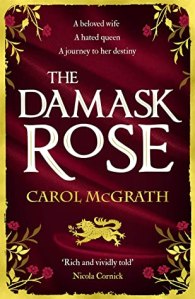
The Damask Rose by Carol McGrath

This is the second book in Carol McGrath’s She-Wolves trilogy, telling the story of three medieval queens of England who have all been given the label ‘she-wolf’ at various times. I enjoyed the first novel, The Silken Rose, about Henry III’s wife, Eleanor of Provence, so I was looking forward to this one, which moves on to Eleanor of Castile, the first wife of Edward I.

I’ve read other books set during Edward I’s reign, so presumably I’ve come across Eleanor of Castile before, but I mustn’t have been paying attention as I couldn’t have told you much about her before reading The Damask Rose (except that she was commemorated by the Eleanor Crosses which were erected in several English towns in her memory). It’s always good when you can learn something new from historical fiction and in this case, almost the entire story was new to me.

The novel begins in 1264 when Henry III is still alive and on the throne of England, but only just – he and his son, Prince Edward, have been captured by the forces of Simon de Montfort at the Battle of Lewes. Edward’s wife, Lady Eleanor, is at Windsor Castle awaiting news of her husband when Gilbert de Clare, one of de Montfort’s supporters, arrives and forces her to relinquish the castle. This traumatic incident instils in Eleanor a lifelong hatred of de Clare as well as a determination that she will never put herself in such a vulnerable position again. Once the threat of Simon de Montfort has been removed at the Battle of Evesham, Edward and Eleanor travel to the Holy Land on crusade. It is during this journey that they learn of the death of Henry III and return to England to take their place as king and queen.

I enjoyed learning more about Eleanor, but although I don’t think she deserved to be described as a ‘she-wolf’ (the term seems to have mainly referred to her unpopular methods of acquiring land and properties, which were seen as greedy and ruthless), she’s not a character I liked or managed to warm to either. It seems that the real Eleanor was also accused of being ‘unmaternal’, which McGrath suggests could be due to the fact that she lost so many children she was afraid to get too close to the ones who survived, but it still irritated me that Eleanor complained constantly about her children’s relationships with other adults while at the same time saying she was far too busy to spend time with them herself.

Part of the novel is written from the perspective of Olwen, a herbalist whom Eleanor introduces into the royal household to provide advice on plants and healing. Olwen is a fictional character but her story complements Eleanor’s very well; in fact, I think I preferred her sections of the book as I found her much easier to like and I enjoyed the different point of view she brings to the novel. I cared about Olwen and wanted her to be happy, whereas I felt that some parts of Eleanor’s story, particularly towards the end, became too factual, too concerned with just describing things that had happened rather than providing any real emotional depth.

The third book in the series is going to be about Isabella of France; I am much more familiar with Isabella than with the previous two queens and I think she will be a fascinating subject to bring the trilogy to an end!

Thanks to Headline for providing a copy of this book for review via NetGalley.

Book 18/50 read for the 2021 Historical Fiction Reading Challenge.

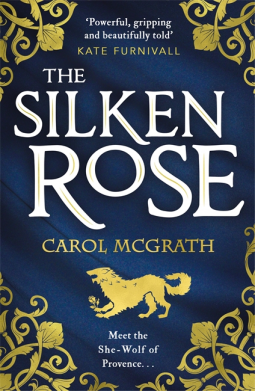
The Silken Rose by Carol McGrath

The Silken Rose is the first in a new trilogy of novels telling the stories of three medieval queens who have been referred to at one time or another as ‘she-wolves’ because of their unpopularity or because they managed to wield power or influence in a period dominated by men. The second and third books in the series are going to focus on Eleanor of Castile and Isabella of France, but this first novel is about Eleanor of Provence. Carol McGrath uses the alternative spelling of Ailenor, so I will do the same throughout the rest of this post.

Ailenor of Provence is not a queen I’ve ever read much about; I think it’s safe to say that she and her husband, King Henry III of England, are not the most popular subjects for historical fiction! They appear in Sharon Penman’s Falls the Shadow, but otherwise I’m struggling to think of other books I’ve read about them and that’s a good thing because it means that the story which unfolds in The Silken Rose feels fresh and different. It begins in 1236 with Ailenor, at the age of only thirteen, arriving in England from France for her wedding to Henry, a man more than twice her age. Although her new husband treats her with kindness and their marriage is not an unhappy one, Ailenor finds it difficult adjusting to life in a strange country and values the friendships she forms with two very different women.

One of these women is Henry’s sister, Eleanor, known as Nell, who has taken a vow of chastity after being widowed. Ailenor quickly discovers that Nell is in love with Simon de Montfort, one of the most powerful noblemen at Henry’s court, and she decides to help her sister-in-law break free from her oath and marry Simon. However, this marriage will eventually have serious repercussions for Henry and for England. The other friend Ailenor makes is Rosalind, a talented embroideress who is brought to court to teach Ailenor and her ladies to embroider intricate new patterns. Unlike most of the other characters in the novel, Rosalind is a fictional character, but she plays an important part in the story, providing a link between the nobility and the merchant classes.

Although Ailenor is the main focus of the novel, there are some sections written from Rosalind’s perspective (and occasionally from Nell’s), which helps to build up a full picture of the events that take place during this period, rather than only being limited to things that Ailenor experiences herself. The story Carol McGrath builds around Rosalind feels believable and fits seamlessly into Ailenor’s story – but despite this, I didn’t find her as interesting or engaging to read about as Ailenor and although I did understand the reasons for her inclusion in the book, I would have preferred it if the novel had stuck solely to the real historical characters. Apart from that, I really enjoyed The Silken Rose; there’s not a huge amount of drama, but I was never bored.

You may be wondering why Ailenor has been described as a ‘she-wolf’; well, it seems that this was partly due to the fact that she brought a large number of her relatives to England with her, where they were given positions of power and were able to influence the king. These included several of her uncles (the ‘Savoyards’), one of whom was made Archbishop of Canterbury, and her sister, Sanchia, who married the king’s younger brother. This and some of the other reasons for Ailenor’s unpopularity are explored in the novel, yet she remains a sympathetic character and one I very much enjoyed getting to know. I am looking forward to reading the other two books in the trilogy.

Thanks to Headline for providing a copy of this book for review via NetGalley.

This is book 3/20 from my 20 Books of Summer list.

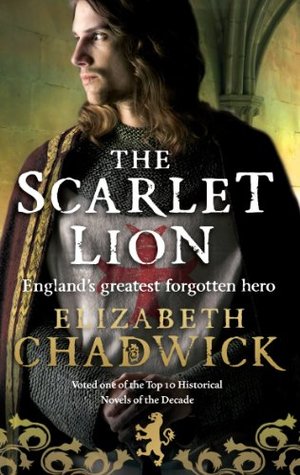
The Scarlet Lion by Elizabeth Chadwick

This is the second of Elizabeth Chadwick’s two novels covering the life of William Marshal, knight, soldier, statesman and adviser to four kings of England. I read the first book, The Greatest Knight, seven years ago but it was only when I discovered that Chadwick’s newest book, Templar Silks, was also about William Marshal that I remembered I still needed to read this one. Despite leaving such a long gap between the two novels, I was pleased to find that, as soon as I opened The Scarlet Lion, I was able to get straight into the story – in fact, if you wanted to read this book without having read the first it wouldn’t be a problem at all, although I would still recommend reading both.

The Scarlet Lion, which is as much the story of William’s wife, Isabelle de Clare, as it is of William himself, covers the period between 1197 and 1219. Early in the novel, King Richard I dies with no legitimate children of his own, leaving the succession to the throne of England in doubt. William supports the claim of Richard’s only surviving brother, John, ahead of Richard’s nephew, Arthur of Brittany, but as soon as John becomes king he begins to repay William’s loyalty with hostility and cruelty.

Tensions increase following negotiations over William’s lands in Normandy, for which he has to pay homage to the King of France. No longer as welcome at court as they once were, William and Isabelle retreat to Leinster in Ireland, only to find that John’s justiciar, Meilyr FitzHenry, has been sent to invade their Irish lands. John also asks for their two eldest sons as hostages and Isabelle is devastated when William agrees, putting their marriage under real strain for the first time.

I enjoyed this book as much as I remembered enjoying the first one and it was nice to finish William’s story at last! Having recently read The Autumn Throne, the third of Chadwick’s Eleanor of Aquitaine trilogy which covers roughly the same period and in which William appears as a secondary character, it was interesting to read about some of the same events again, this time with a focus on William’s family rather than Eleanor’s. The different perspective means that John, who was given a more balanced portrayal in The Autumn Throne, is very much the villain in this book and it’s easy to see why Isabelle is so worried about her sons being sent into his care. The fact that William is willing to let them go provides the first real test for their otherwise happy marriage.

William is a great character, but I already knew that from The Greatest Knight, so I particularly enjoyed getting to know Isabelle in this book. Being much younger than her husband, a lot of her time is taken up with giving birth to their ten children, but we also see her develop into a strong, independent woman who, during William’s absences, is able to make decisions and defend their Irish lands. Despite their disagreement over the hostage situation they have a wonderful partnership and a deep understanding of each other.

The Scarlet Lion takes us right up to final hours of William’s life, which as you can imagine, is a sad and poignant conclusion to the novel, but nobody could say that he hadn’t had an eventful and fulfilling life! I have just started Templar Silks and am looking forward to learning more about William’s pilgrimage to Jerusalem in 1183.

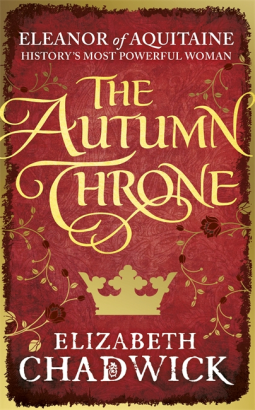
The Autumn Throne by Elizabeth Chadwick

This is the third part of Elizabeth Chadwick’s trilogy telling the story of Eleanor of Aquitaine in fictional form. I love Chadwick’s portrayal of Eleanor (or Alienor, as her name is spelled throughout the trilogy) and having enjoyed both The Summer Queen and The Winter Crown, I was hoping that The Autumn Throne would be just as good. As the title suggests, she is entering the ‘autumn’ of her life in this final novel but remains close to the throne in one way or another.

As well as being Duchess of Aquitaine in her own right, Alienor was also Queen of France through her first marriage to Louis VII and then Queen of England as the wife of Henry II. Following Henry’s death, she would also be mother to two more kings of England: Richard I (the Lionheart) and John. The Autumn Throne, though, begins while Henry is still very much alive and has had Alienor imprisoned at Sarum in Wiltshire as punishment for supporting their sons in a rebellion against him. It’s 1176 and Alienor will remain in captivity for another thirteen years.

I was surprised to find that during the long years of her imprisonment, Alienor actually spends quite a lot of time visiting various castles and palaces, being brought out of confinement whenever it suits Henry to have her present at court celebrations and rituals. She also manages to have some contact with her sons and daughters and with her good friend, Isabel de Warenne, who is married to Henry’s half-brother Hamelin. This means that Alienor is not as cut off from the world as you might imagine and that, as the years go by, she (and through her, the reader) is kept informed of her children’s marriages, Henry’s plans for his kingdom, and important events taking place in Europe and beyond.

Alienor’s feelings towards Henry are portrayed in a way that feels plausible and realistic. There are times when she hates him for what he has done to her and the way he is treating their sons, but also times when she feels sorrow for the husband she once loved and regret that things have turned out this way. Still, it’s hard not to be relieved for Alienor’s sake when Henry finally dies and she is set free at last. After this, Alienor’s relationships with her two surviving sons, Richard and John, come to the forefront of the novel. I have to say, as far as kings of England go, Richard I has never been one of my favourites, partly due to the fact that he spent very little time actually in England. Alienor, though, makes no secret of the fact that he is the son she loves most. She is shown here to have at least some influence over his decision-making and to be trusted with playing a role in the running of the country while Richard is away taking part in the Third Crusade.

The most interesting character in the novel, apart from Alienor herself, is probably John. I have read several fictional portrayals of John, some which cast him as a villain and others which give a more balanced view – this one falls into the second category. He begins the book as an ambitious, calculating boy who does as he pleases without thinking of the consequences; he is much the same as he grows into a man, but his relationships with Alienor and his illegitimate son Richard show he is more complex than that and has enough good qualities to make people care about him.

I have had a lot of sympathy for Alienor throughout this series, but more than ever in this final book as she suffers the loss of one adult son or daughter after another. Of the eight children Alienor has with Henry, only two are still alive by the time of her death. Alienor herself lives into her eighties and it’s sad that she doesn’t have much time to relax in her old age. She is in her seventies when John sends her on the long journey to Castile to select one of his nieces as a bride for the King of France’s heir – and just two or three years before her death, she is being besieged in her castle of Mirebeau by one of her own grandsons!

With this novel covering the last thirty years of Alienor’s life, ending with her death at Fontevraud in April 1204, it does feel very long and drawn out at times. I kept wondering whether there were things that could have been left out to make it a bit shorter, though it’s hard to say which scenes could be omitted without disturbing the course of Alienor’s story. I did enjoy this book just as much as the first two in the trilogy, but I’m glad it’s been a while since I read the last one – I think if I’d read the three books one after the other it would have been too much for me!

In Elizabeth Chadwick’s next book, Templar Silks, she is returning to the story of William Marshal, hero of The Greatest Knight. William made a few appearances in The Autumn Throne where his story overlapped with Alienor’s and I’m looking forward to meeting him again. Templar Silks will be published in 2018, but I also have some of Chadwick’s earlier novels still unread on my TBR.

Thanks to the publisher for providing a copy of this book for review via NetGalley.

The Raven’s Head by Karen Maitland

The Raven’s Head is a dark tale of magic and alchemy, murder and blackmail, set in the early thirteenth century. Earlier this year I read my first Karen Maitland novel, The Vanishing Witch, and loved the combination of history, mystery and the supernatural. This book includes the same elements but the supernatural one is particularly strong, making this a darker and more atmospheric read.

The Ravens Head The story revolves around three young people who are drawn into an alchemist’s search for power. Beginning in France in 1224, we meet seventeen-year-old Vincent, apprentice to a scribe in the service of Philippe, the Comte de Lingones. Bored with life in Philippe’s chateau, Vincent tries to blackmail the Comte, but when his attempt fails he finds himself on the run in possession of a silver raven’s head which seems to have a mind of its own.

In England, meanwhile, a young woman called Gisa is working as an assistant to her uncle, an apothecary, when she comes to the attention of the sinister Lord Sylvain who enlists her help with his secret experiments. Nearby, a group of white-robed priests known as the White Canons are running a small and exclusive school for young boys. One of these boys is five-year-old Wilky, taken from his parents as payment of a debt, and renamed Regulus. When Wilky’s friends start disappearing from their beds in the middle of the night never to return, the boys begin to wonder what is really going on.

I loved the first half of this book and was intrigued by the circumstances of each of our three main characters. I found Vincent’s story particularly gripping, possibly because his chapters were narrated in the first person and this made it easier for me to connect with him. The other two storylines were written in third person present tense and although I’m not really sure why this was necessary, it did help to distinguish Gisa’s and Wilky’s sections from Vincent’s. I was curious to see how the story would develop for each character and how their separate threads of the novel would eventually be woven together.

The book failed to hold my interest right to the end, unfortunately. Somewhere in the second half, I thought the plot started to lose its way and descend into a string of action sequences, alchemical experiments and gruesome secret rituals. I’m sure other readers will enjoy all of this more than I did; I do like historical fiction with a touch of the supernatural, but I prefer it to be more subtle than it is here. After so much build-up and so much care taken in setting the scene and introducing the characters, I was left slightly disappointed at the end.

This is a wonderfully atmospheric and eerie novel, though. The parts of the story told from Wilky’s perspective are particularly effective in that respect – seen through the eyes of a little boy who has no idea what is happening, the world of the White Canons is both bewildering and terrifying. The Gisa and Vincent storylines also have undercurrents of darkness and danger – and Lord Sylvain is a great villain!

Having now read Karen Maitland’s two most recent novels I’m looking forward to going back and reading her earlier ones.

I received a copy of this book for review from NetGalley.