A Distant Mirror: The Calamitous 14th Century by Barbara W Tuchman

I tend not to read non-fiction very often, but Barbara W Tuchman’s 1978 history of the 14th century, A Distant Mirror, is one I’ve been intending to read for years. It looked like such a long book, and I’d heard that it was also a very detailed one, so I knew I would need to pick the right time to read it – and that time came at the beginning of April this year. It took me all of that month to read it, but I actually found it a much easier read than I’d expected, due partly to the style of Tuchman’s writing and partly, of course, to the 14th century being so fascinating!

I couldn’t possibly list everything that this book covers, but here are some of the topics it explores: the Hundred Years’ War, the conflict between England and France usually dated as beginning in 1337 and ending in 1453 and including the Battles of Crecy and Poitiers; the Black Death which ravaged Europe and then reared its head again and again throughout the rest of the century; the Papal Schism which resulted in a split within the Catholic Church; and the Peasants’ Revolt in England and the similar uprising, the Jacquerie, which occurred in France. A lot of destruction, disaster and devastation, but the book is subtitled The Calamitous 14th Century, after all, and – as Tuchman points out – it tends to be the negative rather than the positive which survives in historical records. It is not really necessary to have any prior knowledge of any of these things before you begin, as Tuchman does take the reader through everything you need to know and more.

In an attempt to pull all of these different threads together, Tuchman uses the life of a French nobleman, Enguerrand de Coucy, as a central point of focus. There are a few reasons for her choice of this particular historical figure: not only did he live through most of the major events of the 14th century (being born in 1340 and dying in 1397), but his noble status means that he appears in historical records and sources, and as the husband of Isabella, daughter of Edward III of England, he had close connections with both the English and the French. When I first started reading, I really liked the idea of seeing the century from one man’s perspective, but actually this aspect of the book wasn’t as successful as I’d hoped. There are whole chapters where Enguerrand is barely mentioned, and others where I felt that too much attention was given to him and his actions when other people or incidents might have been more interesting.

Of course, as well as Enguerrand de Coucy, we do hear about lots of other historical figures of the period – such as Charles the Bad of Navarre, whose horrific-sounding death sticks in the mind! I enjoyed reading about some of the notable women of the time, including the poet Christine de Pisan; Marcia Ordelaffi, left to defend the city of Cesena in her husband’s absence; and in particular, Jeanne de Montfort (Joanna of Flanders), who also proved herself more than capable in moments of crisis:

When Charles de Blois besieged Hennebont, she led a heroic defence in full armour astride a war-horse in the streets, exhorting the soldiers under a hail of arrows and ordering women to cut short their skirts and carry stones and pots of boiling pitch to the walls to cast down upon the enemy. During a lull she led a party of knights out a secret gate and galloped a roundabout way to take the enemy camp in the rear, destroyed half their force and defeated the siege.

War is, understandably, a major theme of the book, as is religion, but Tuchman also covers almost every other aspect of 14th century life you can think of, from food, clothing and housing to music, literature and entertainment. She often goes off on a tangent, for example starting with a description of a visit by the Holy Roman Emperor to the French court then digressing to talking about miracle plays and how they were performed. There are interesting discussions of medieval artwork and why there were so few pictures of children, of the decline of chivalry and the changing role of the knight, and all sorts of odd snippets of information – did you know that during one of France’s failed attempts to invade England they tried to transport an entire portable wooden town across the sea to house the invaders in when they landed?

The book’s title, A Distant Mirror, suggests the mirroring of 14th century events by more recent ones, and Tuchman does draw some parallels with her own century, the 20th, particularly with reference to the two World Wars:

For belligerent purposes, the 14th century, like the 20th, commanded a technology more sophisticated than the mental and moral capacity that guided its use.

She also compares World War I and its effect on society with the devastation caused throughout medieval Europe by the plague:

An event of great agony is bearable only in the belief that it will bring about a better world. When it does not, as in the aftermath of another vast calamity in 1914-18, disillusion is deep and moves on to self-doubt and self-disgust.

However, I’m sure links and similarities could be found between any two periods in history if you looked for them, so I would have liked more specific examples and analysis of why the author considered the 14th century in particular to be ‘a distant mirror’.

I know this sort of long, detailed, in-depth account is not for everyone, especially if you’re not as interested in medieval history as I am, but I enjoyed it and felt that I got a lot out of it. If anyone else has read this book, I would love to know what you thought.
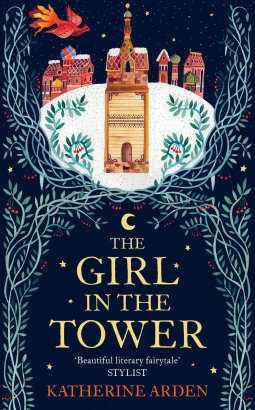
The Girl in the Tower by Katherine Arden

I enjoyed The Bear and the Nightingale when I read it almost exactly a year ago and I remember my excitement on discovering that it was actually the first in a planned trilogy. We haven’t had to wait too long for the second book, The Girl in the Tower, and I’m pleased to say that I loved it even more than the first.

Katherine Arden’s books are a wonderful mixture of history, folklore and fairytales with an atmospheric and wintry Russian setting. If you haven’t read The Bear and the Nightingale yet, I would highly recommend starting with that one – and I should warn you that there may be spoilers for the first book in the rest of this post.

At the beginning of The Girl in the Tower, our heroine Vasilisa Petrovna (Vasya) is fleeing her childhood village of Lesnaya Zemlya. Despite her efforts to rescue the villagers from a great evil, the way in which her father and stepmother died has caused Vasya to be branded a witch, regarded with suspicion and distrust. Accompanied by her magnificent stallion Solovey, Vasya sets off on a journey across northern Rus’ to Moscow, home of her sister Olga – a journey which will be filled with danger as Vasya encounters a group of bandits sweeping across the countryside burning villages and kidnapping children. First, though, she must pay a visit to Morozko, the frost-demon, in his fir-grove deep in the forest…

This novel has a much wider geographical scope than the previous one, in which the action takes place almost entirely in and around Lesnaya Zemlya. I liked this aspect of the book; medieval Moscow is an interesting setting and, with Olga’s family close to the Grand Prince, Dmitrii Ivanovich, we are given some insights into the political situation during this period of Russian history. At the time of the story, the Rus’, as it was known then, is still part of the domain of the Great Khan and the Golden Horde, but with their influence weakening as the Grand Prince grows in power, it seems that things could be about to change.

I was also pleased to see Vasya reunited with her siblings, not just Olga but also their brother Sasha, who is now a priest. Sadly, her relationships with both Olga and Sasha are very strained, partly because of what happened in Lesnaya Zemlya, for which Vasya is unable to give an adequate explanation, and also because of her behaviour on arriving in Moscow, which they consider unladylike and inappropriate. To the modern reader, Vasya is a wonderful character – brave, independent and rebellious – but her refusal to conform to the 14th century ideal of what a woman should be leads her into a great deal of trouble. In contrast, Olga has accepted her place in society and expects her young daughter, Marya, to follow the same course in life. Marya, though, appears to have other ideas!

I’ve said very little so far about the fantasy elements of the novel. We don’t see very much of the household spirits who played such an important part in The Bear and the Nightingale, but there are some appearances by intriguing new figures from Russian myth including the Firebird – and another, more sinister, character whose name I won’t give here so as not to spoil anything! I also enjoyed Vasya’s interactions with her magical horse, Solovey, who has begun to form a personality of his own. Last, but certainly not least, there’s Morozko, frost-demon and god of the dead.

There were hints in the previous book of a possible romance between Vasya and Morozko, and in this book their relationship is developed further. It’s definitely not a conventional love story and because of who Morozko is and the role he has to play in Russian folklore, he has a tendency to come and go throughout the novel. It’s frustrating but it worked for me and I found myself looking forward to the scenes they shared. I loved The Girl in the Tower – and the good news is that the third book in the trilogy, The Winter of the Witch, is expected this August!

Thanks to Ebury Publishing for providing a copy of this book for review via NetGalley.

This book counts towards this year’s What’s in a Name? Challenge: A title containing the word ‘the’ used twice.

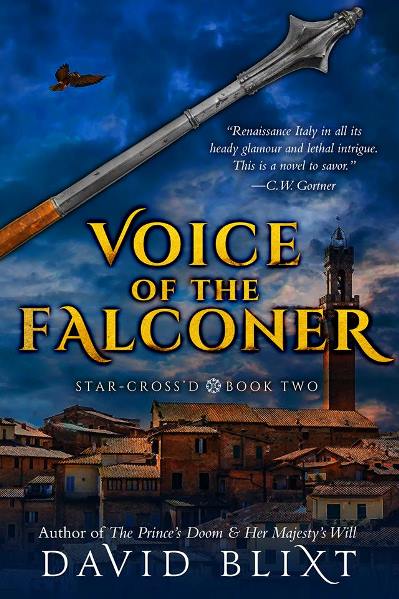
Voice of the Falconer by David Blixt

This is the second volume in David Blixt’s Star Cross’d series, combining the history and politics of 14th century Italy with characters and storylines inspired by Shakespeare. I read the first novel, The Master of Verona, in 2012 and it won a place on my ‘books of the year’ list that year, which gives you an idea of how much I loved it. I really hadn’t meant to let so much time go by before continuing the series, and I worried that I might have trouble picking up the threads of the story again, but as soon as I started to read Voice of the Falconer things fell back into place and I felt as if only five days had passed since reading the first book rather than five years!

Voice of the Falconer opens in 1325, eight years after the events described in The Master of Verona. Pietro Alaghieri, son of the late poet Dante, has been living in exile in Ravenna, entrusted with the guardianship of the illegitimate heir of Cangrande della Scala, the ruler of Verona. The child, Cesco, has already been the target of several assassination attempts so it has been decided that he should be raised in secret, with as few people as possible aware of his location. When news of Cangrande’s death begins to circulate, however, Pietro must hurry back to Verona to ensure that the eleven-year-old Cesco receives his rightful inheritance – but as other members of the della Scala family also have their eyes on the throne of Verona, this won’t be an easy task. And now that Cesco’s existence has been revealed, his life could be in danger again…

Cesco, who was only a baby in the previous novel, has developed into a wonderful character – even if you do need to suspend disbelief to accept that a boy of his age could be so intellectually advanced, quick-witted and talented in every way! I loved the little circle of friends and protectors who surround him, too: Morsicato the doctor, Antonia the nun, Tharwat the Moor and, of course, Pietro himself. The characters in the novel are a mixture of those who are fictitious and those who are based on real historical figures, such as Cangrande and the rest of the Scaligeri family. If you don’t know the history, I would recommend not looking things up until you’ve finished the book; if you just let the story carry you along, there will be one or two surprises in store for you as there were for me.

I won’t say too much more about the plot, then, but I do need to mention another very important aspect of the book…the Shakespearean connection. In The Master of Verona we witnessed the beginnings of a feud between Pietro’s two friends, Mariotto Montecchio and Antonio Capulletto. In this book, we meet Mariotto’s young son Romeo and Antonio’s baby daughter Giulietta (Juliet), as well as Giulietta’s cousin Thibault (Tybalt); obviously there is still a long way to go before the tragedy of the star-cross’d lovers is played out, but the foundations of the story have now been laid. I also had fun spotting other characters from Shakespeare’s plays such as Shalakh (Shylock) from The Merchant of Venice and Petruchio and Kate from The Taming of the Shrew, but if you have no knowledge of Shakespeare I don’t think it would be a problem at all – it’s just another of the novel’s many layers.

In case you can’t tell, I enjoyed this book as much as the first one! I am looking forward to visiting Renaissance Italy again soon with the third in the series, Fortune’s Fool…and certainly won’t be waiting five years this time.

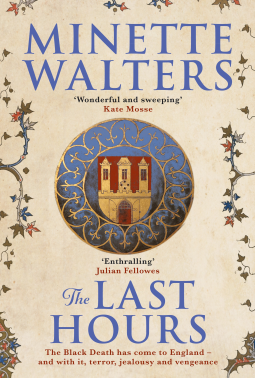
The Last Hours by Minette Walters

Yes, this is the same Minette Walters who is best known for her crime novels which include The Ice House and The Dark Room. I’ve never read any of those (at least I don’t think so – I did used to read a lot more crime than I do now so it’s possible I may have read one of her books and forgotten about it) but when I saw that her new book, The Last Hours, marked a change of direction from crime to historical fiction I was immediately interested!

The Last Hours is set in 1348 on the estate of Develish in Dorsetshire. Those of you who know your 14th century history will know that the Black Death, which had been sweeping its way across Europe, reached England in 1348 – and this forms the heart of Walters’ novel. Sir Richard of Develish falls victim to the plague early in the book, leaving his wife, Lady Anne, responsible for the demesne, the household and the serfs who work the land. Lady Anne gathers everyone inside the boundaries of the moated manor, believing that cutting off contact with the outside world will be the best way to avoid the pestilence.

With so many people forced to live together in a confined space, it is inevitable that problems will arise, old rivalries will resurface and tempers will be lost. The cause of most of the trouble at Develish is Sir Richard’s daughter, Lady Eleanor, a cruel and selfish fourteen-year-old who resents having to live with the serfs. In particular, her hatred is directed at Thaddeus Thurkell, a serf who has just been promoted to the position of Lady Anne’s steward, a move which Eleanor sees as evidence of her mother’s favouritism and unnatural affection for Thaddeus. When supplies at the manor begin to run low, it is Thaddeus who volunteers to venture out into the countryside to find food – but what is the real reason for his departure?

The Last Hours was an interesting read for me as I’ve always found the Black Death a fascinating topic (sorry if that sounds morbid). Walters explores so many different aspects of the disease: the beliefs and superstitions surrounding it; the physical effects it has on the body; the theories people had as to what was causing it; and the limited methods of preventing its spread. However, I knew as soon as I started reading that at some point our protagonists would make the connection with rats and fleas and recognise the importance of hygiene and cleanliness – and I was right. It would have been so much more convincing from a historical point of view if they had continued to think the plague was a punishment from God or that it was caused by breathing bad air.

I did like both Lady Anne and Thaddeus, even if they don’t always feel like believable 14th century people, and they (along with a young maid, Isabella) were certainly the characters I had most sympathy for. Lady Eleanor is the most unpleasant, unlikeable character I’ve come across for some time. She is horrible from her first appearance and remains horrible throughout the entire book – although we do eventually learn a little bit more about her and what possibly made her the way she is, so maybe we’ll see a different side of her in the sequel.

And yes, there is going to be a sequel. I had no idea this was the first in a series until I reached the words ‘to be continued’, so be aware that if you do choose to read this book it doesn’t have a proper conclusion and we are left with lots of loose ends. At the moment I’m not sure whether I will be looking for the second book; I found this one quite slow and unevenly paced – I enjoyed the chapters set in and around Develish, but struggled to stay interested in the adventures of Thaddeus and his companions as they wandered the countryside looking for supplies. I will probably be tempted, though, as I do have lots of questions that haven’t been answered!

Thanks to Atlantic Books for providing a copy of this book for review via NetGalley

The Shadow Queen by Anne O’Brien

Anne O’Brien’s new novel, The Shadow Queen, tells the story of Joan of Kent, wife of the Black Prince and mother of the future King Richard II of England. Although Joan wasn’t actually a queen, she was never far from the throne – as cousin to Edward III, she had Plantagenet blood, and through her husband, Edward’s eldest son Edward of Woodstock (the name ‘the Black Prince’ was given to him later), she was both Princess of Wales and Princess of Aquitaine. When Richard acceded to the throne at the age of only ten, in her position as the king’s mother she was able to have some influence on the early years of his reign. In some ways, then, she could be considered to be a sort of ‘shadow queen’, as the title suggests.

Despite all of this, however, Joan is probably best known for her beauty – she would later become known to history as the Fair Maid of Kent – and for the scandals caused by her three marriages. The novel opens in 1340, with twelve-year-old Joan learning that a marriage has been arranged for her with Will Montagu, heir to the Earl of Salisbury. Joan doesn’t dislike Will and under different circumstances this would have been a good match. Unfortunately, though, Joan is not free to marry anyone – she has already undergone a secret marriage with Thomas Holland, a minor knight who departed shortly after the wedding to fight for the king. Forced to admit the truth, Joan is horrified when her mother insists that her marriage to Will must go ahead anyway. She faces a long and difficult battle if she is ever to prove the validity of her first marriage and to win the right to live with the man she considers her true husband.

Around half of the novel is devoted to Joan’s relationships with Thomas and Will and the challenges involved in disentangling Joan’s first two marriages and deciding who should be her rightful husband. This seemed to go on for a very long time, but I appreciated that it was necessary to give the reader an understanding of the gossip and rumour that surrounded Joan in the early part of her life and how important it was that, when she eventually married the King’s heir, Edward of Woodstock (Ned, as he is called in the novel), her reputation should be clear of any taint.

The other half of the novel follows the years of Joan’s marriage to Ned, their time as Prince and Princess of Aquitaine and, when back in England, Joan’s efforts to ensure that their son Richard will be named successor to the throne. I don’t think it’s a spoiler – as it’s a well-known historical fact – to say that Ned’s life is cut short by illness and as he is outlived by his father, he never has the opportunity to become king himself. I couldn’t help thinking how different things might have been if he had lived and Edward III had been succeeded by a grown man rather than a ten-year-old boy; what we know of the Black Prince suggests that although he was a good soldier he wouldn’t necessarily have made a good king, but still the whole course of history could have been changed. I liked the way Anne O’Brien portrayed him and I enjoyed reading about his relationship with Joan. There was a lot of love between them, but it wasn’t love at first sight – more a love that developed slowly between two people who had known each other from childhood – and, at least on Joan’s part, there was also a certain amount of ambition involved.

Joan herself is portrayed as a strong, proud and courageous person who does her best to take control of her own life, though always within the confines of what it is possible for a medieval woman to do. I’m not sure that I particularly liked her, as she does sometimes come across as a little bit self-absorbed and lacking in judgement, but I did find her a convincing and well-drawn character. I was intrigued by her prickly, hostile interactions with Edward III’s much maligned mistress, Alice Perrers – I know Alice was the subject of one of Anne O’Brien’s earlier novels, The King’s Concubine, which I haven’t read yet, and now I’m curious to see how she approaches Alice’s character in that book.

The Shadow Queen is an interesting, enjoyable novel, if a bit too long and drawn-out in places. I couldn’t help comparing it to the only other novel I’ve read on Joan of Kent – A Triple Knot by Emma Campion – and I think this is definitely the better of the two books.

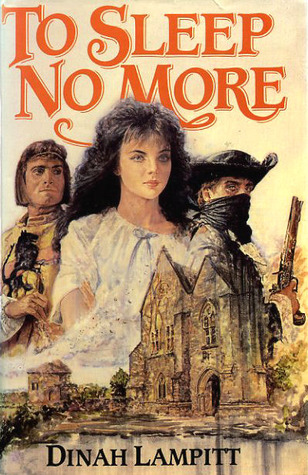
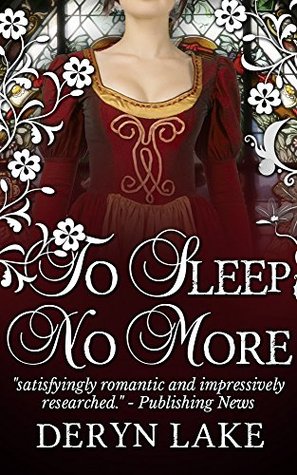
To Sleep No More by Deryn Lake

I had never come across Deryn Lake’s books until recently, but it seems that she has written a large number of historical fiction novels, detective stories and romances, published from the 1980s to the present day. I decided to try To Sleep No More, a book which first appeared in 1987 under the name Dinah Lampitt and has now been reissued by Endeavour Press as a Deryn Lake novel. It’s an unusual book as it feels almost like three separate novels in one, but with some very important links between the three and all set in the same small community – the village of Mayfield in Sussex.

We begin in the 14th century with the story of Oriel de Sharndene, whose father marries her off to the innocent and childlike Colin, brother of Archbishop John de Stratford. As she tries to settle into married life at Maghefeld Palace, Oriel finds that although she is fond of her husband and captivated by his extraordinary musical abilities, their marriage is never going to be a very satisfying one. The man she truly loves is Marcus de Flaviel, a squire from Gascony who has recently arrived in England and has been appointed companion to Colin by the Archbishop. Colin likes Marcus almost as much as Oriel does, and for a while the three are quite happy. Eventually, though, Oriel’s relationship with the Gascon squire leads to tragedy and at that point the first part of the novel ends.

Moving forward to the year 1609, we find ourselves in the village of Mayfield (formerly Maghefeld) again – and with a new set of characters to get to know. This time we follow the story of Jenna Casselowe who decides to resort to magic to win the heart of the man she loves, Benjamin Mist. Jenna needs to be careful – if anyone finds out what she has been doing she risks being accused of witchcraft. Finally, there’s a third story set early in the 18th century, when the roads and beaches of Sussex are alive with illegal activity. Lieutenant Nicholas Grey arrives in Mayfield on the trail of highwayman Jacob Challice and a gang of smugglers – could another chain of events be about to be set in motion which will again have tragic consequences?

Three stories which all seem very different at first, but as you continue to read some of the parallels and connections start to emerge, although others are not clear until the end of the book. I don’t think it’s spoiling anything (as it’s clearly stated in the blurb) to say that reincarnation is involved and that characters we meet in one time period correspond with characters from another. It’s not always clear who is who as they don’t necessarily keep the same appearance, sex or position in society from one life to the other, but if you’re patient there are eventually enough clues to be able to fit the pieces together.

I have to admit, when I first started to read To Sleep No More I didn’t expect to be very impressed by it (maybe it was the cover of the new edition that gave me that impression) but I enjoyed it much more than I thought I would. Although it took me a while to adjust to each new story – as I’ve said, it’s almost like reading three different novels in the same book – and a lot of concentration is needed to keep track of the characters and who they may have been in a previous life, it’s not quite as confusing as it all sounds!

Each section of the book has its own sense of time and place reflecting the different era and the changes in language, culture and attitudes over the centuries. It was obvious that the author had done a lot of research into the local history of the area and into each period in general, although I was not convinced by the work of a doctor who, towards the end of the novel, is carrying out experiments involving hypnosis and regression – his methods were surely too scientific for 1721. On the other hand, without that particular plot development it’s difficult to see how else the various threads of the story could have been pulled together.

Reading Deryn Lake’s author’s note at the end of the book, I was surprised to see how many of the secondary characters and events in the three stories were based on historical fact. For example, Alice Casselowe, Jenna’s aunt in the novel, really was accused of witchcraft and there really was a gang of smugglers operating in Mayfield in the 1720s. The author also incorporates the legend of St Dunstan (allegedly Mayfield’s founder) into the story, with several characters seeing ghostly visions of a monk working at a forge. The supernatural elements of the story are usually quite subtle, though, and are used sparingly to add to the eerie atmosphere of the novel.

Have you read any of Deryn Lake/Dinah Lampitt’s novels? What did you think?

The Bear and the Nightingale by Katherine Arden

the-bear-and-the-nightingale I was drawn to this book first by the cover – and then by the mention of Russian fairy tales and folklore. It seemed a little bit different from the usual books I read and I hoped it would prove to be an enchanting, magical read, perfect for the winter months.

The story is set in the 14th century in Lesnaya Zemlya, a village in northern Rus’.  The village is home to Pyotr Vladimirovich who, since losing his beloved wife in childbirth several years earlier, has lived alone with his five children and their elderly nurse, Dunya. The youngest child, Vasilisa (or Vasya, as she is known), is becoming wild and rebellious and it is partly because of the need to provide a mother figure for her that Pyotr decides to marry again. Unfortunately, though, his new wife – Anna – turns out to be a wicked stepmother who dislikes and distrusts Vasya and believes she can see demons hiding all over the house.

Vasya, who has inherited special abilities from her mother, can also see Anna’s ‘demons’, but she knows that they are not evil spirits – they are household guardians watching over the people of Lesnaya Zemlya. When Father Konstantin arrives in the village, believing he is on a mission from God to stamp out the old traditions and beliefs, the powers of the household spirits begin to fade. Harvests start to fail, winters seem colder and harder than ever before and the evil forces that lurk in the forest grow stronger. Can Vasya find a way to protect her family and restore happiness and prosperity to the village?

The Bear and the Nightingale is a story steeped in Russian myth, legend and fairy tale. Although I loved fairy tales as a child, I seem to have missed out on most of the Russian ones, but that wasn’t a problem at all – and I was surprised to discover how much I was actually familiar with. I particularly enjoyed being reminded of the story of Frost which Dunya is telling the children as the novel opens:

“But what did he look like?” Olga demanded.

Dunya shrugged. “As to that, no two tellers agree. Some say he is naught but a cold, crackling breeze whispering among the firs. Others say he is an old man in a sledge, with bright eyes and cold hands. Others say he is like a warrior in his prime, but robed all in white, with weapons of ice. No one knows.”

Frost, or Morozko to give him his Russian name, is an important presence throughout the whole novel, although he only appears to the characters on a few occasions and we are made to wait until near the end of the book before his true significance becomes clear. Other aspects of the story are slow to unfold too – such as the role of the Bear and Nightingale of the title – which is why I’m not going to say any more about the plot or the characters, even though I would love to! I would prefer to leave some of the novel’s secrets and surprises for you to discover for yourself.

What I will mention is the setting, which I loved. Most of the action takes place in and around Vasya’s village, with lots of vivid descriptions of the harsh living conditions and the bleak, relentless winter weather, but there are also a few sections set in Moscow at the court of the Grand Prince Ivan II. I have very little knowledge of 14th century Russia (or Rus’, as the region was known at that time) so I wasn’t sure how much of this was based on fact, but as this is historical fantasy I tried not to worry too much about that.  I was more interested in the portrayal of the conflict between the old ways and the new, the changing beliefs of the people and the loss of old traditions.

The Bear and the Nightingale is apparently the first in a trilogy – I hadn’t been aware of this when I first started to read, but on reaching the end of the book I was happy to discover that there will be another two and that the next one will take us away from the forests of Rus’ and into medieval Moscow. I hope we won’t have to wait too long for it as I’m looking forward to it already!

Thanks to the publisher Del Rey for providing a copy of this book via NetGalley for review.