Jane Shore: The Merry Mistress

jane-shore Elizabeth Shore, known as Jane, was a mistress of King Edward IV of England and said to be “merry in company, ready and quick of answer”. She often appears in fiction set during the Wars of the Roses as a minor character – depending on the book, either as a bad influence or a comfort to Edward in his declining health, and a possible conspirator against his brother, Richard III – but several novels have also been written specifically about Jane. I have read two recently and am combining my reviews into one post.

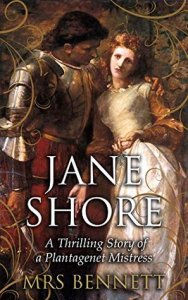
The first of the two books is an old one, written in the 19th century by Mary Bennett, a truly ‘forgotten’ author if ever there was one. She’s so forgotten that I’ve struggled to find any biographical information at all about her (the Database of Victorian Fiction has a paragraph) and can’t even find a definite publication date for Jane Shore – I think it could have been 1869. It seems that Bennett had quite a few novels published, though, so she must have had some level of success at the time.

As Jane was a relatively unimportant historical figure, there is still a lot that we don’t know about her today; obviously even less would have been known in Bennett’s day and fewer sources would have been available to her in researching her book.  Bennett refers to Jane as the daughter of Mr Winstead and the wife of Matthew Shore, ‘the goldsmith’,  while most modern novels give Jane’s father’s name as John Lambert and her husband’s as William Shore, not a goldsmith but a mercer.  It’s difficult for me to comment on the historical accuracy of Jane Shore, then, as it depends on which sources the author had to work from – and it could be that what was considered accurate then is not considered accurate now.

Bennett’s Jane is portrayed, in typical Victorian style, as an innocent, virtuous young woman at the mercy of the king, his friend Will Hastings, and several other men who want to steal her away from her father and husband. She is the sort of person who has things happen to her rather than making them happen herself, which means she is not the most interesting of characters to read about. In fact, I didn’t feel that any of the characters in this novel ever came to life on the page or seemed like real people at all.

The book is entertaining in parts – mainly when the action switches to Wales and the story of two fictional characters, Nesta Llewellyn and the musician Leolin – but very tedious in others and certainly wouldn’t be the best introduction to Jane Shore’s life.  Having read it, I understand now why Bennett is a forgotten author!
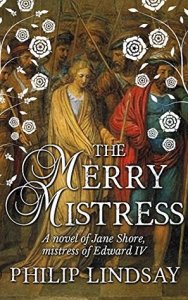
the-merry-mistressAfter reading the Mary Bennett book, I remembered that I had also received The Merry Mistress by Philip Lindsay from NetGalley a while ago, along with another book of his, The Devil and King John. I had mixed feelings about the King John book so was a bit apprehensive about reading this one. I’m determined to get my NetGalley shelf up to date, though, so I decided to give The Merry Mistress a try anyway.

The first thing to say is that this book couldn’t be more different from the Bennett one! Lindsay’s Jane is a much more forceful personality who decides what she wants out of life and then goes and gets it. I expect the fact that this novel was published more recently – in the 1950s – will have something to do with that. But despite Jane making a point of telling us that she expects no rewards or favours from the king in return for becoming his mistress and that she always does her best to help the poor and needy, I didn’t think she was a particularly likeable or sympathetic character. She uses her beauty to get her own way or to manipulate the men around her and I found her quite a shallow, controlling person.

The story is narrated by Jane herself, beginning as she is forced to walk through the streets of London dressed in her kirtle as public penance for her part in the conspiracy between Will Hastings and the Woodvilles. Jane then looks back on her life, starting with her unhappy marriage to the mercer William Shore and then taking us through her romances with Edward IV, Hastings and Thomas Grey, the Marquess of Dorset. Lindsay ignores other possible facets of Jane’s character to focus almost exclusively on her relationships with the men in her life. I appreciate that Jane was a royal mistress, after all, and not famous for much else, but I still felt that this book needed something more.

Things do become more interesting and more compelling in the final third of the novel, when Edward’s death throws the court and the country into disarray once more after several years of relative stability. However, this is very much Jane’s story, so politics are pushed into the background apart from when they touch directly on Jane’s life. Still, I thought The Merry Mistress was a much better novel than Mary Bennett’s Jane Shore. My personal recommendation, though, would be to skip both of these and read Royal Mistress by Anne Easter Smith instead!
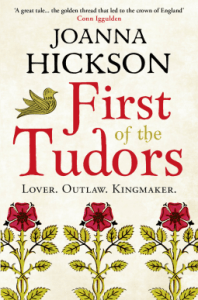
First of the Tudors by Joanna Hickson

first-of-the-tudors Yes, I’ve been reading yet another Wars of the Roses novel! One of the things I’m enjoying about reading so many books set in the same time period is seeing the variety of ways in which different authors choose to approach the same subject as they search for a new angle and some fresh insights. In First of the Tudors, Joanna Hickson takes us right back to the early days of the conflict and the beginnings, more or less, of the Tudor dynasty to tell the story of Jasper Tudor, uncle of the future Henry VII.
As the sons of Welshman Owen Tudor and Henry V’s widow, Catherine of Valois, Jasper and Edmund Tudor are half-brothers to Henry VI, who is King of England as the novel opens in 1451.  Being closely related to royalty but with no real claim to the throne for themselves, Edmund and Jasper are welcomed to court by Henry who rewards them with lands and titles, making Edmund Earl of Richmond and Jasper Earl of Pembroke. Edmund also wins the hand in marriage of Margaret Beaufort, which is seen as a great accomplishment as Margaret, despite being little more than a child, has royal blood and is one of England’s richest heiresses.

When Edmund dies at Carmarthen Castle in 1456, possibly of bubonic plague, he leaves Margaret pregnant with his child. The baby, when it is born, is named Henry and is taken into Jasper’s care (before later being placed in the custody of the Yorkist William Herbert). As the years go by and Henry grows into a man, Jasper is occupied with looking after his estates, trying to keep the peace in Wales and supporting his brother the king as unrest grows and the country heads towards civil war. Based closely on historical fact, we see all of this through Jasper’s eyes, as he narrates his own story in his own words.

But there’s also a fictional story, built around the idea that Jasper had a cousin, Sian (or Jane) Hywel, who became his mistress. There is no historical basis for this, but it is known that Jasper did have illegitimate children, so I have no problem with Joanna Hickson inventing the character of Jane, especially as she makes clear in her author’s note which parts of the novel were factual and which weren’t. However, I felt that too much time was devoted to Jane – she narrates around half of the book – and I would have preferred to concentrate more on Jasper and the other historical figures. This is just my personal opinion, though, and I’m sure other readers will like the domestic scenes and the love story more than I did.

I’ve always found Jasper Tudor intriguing, maybe partly because he tends to be overshadowed in historical fiction by other, more well-known characters. I had been looking forward to seeing him take centre stage for once, but I didn’t really find his portrayal in this novel entirely convincing. I can’t quite explain why, other than to say that his narrative voice was almost identical to Jane’s and that I could never fully believe in him as a 15th century man. I did like the portrayal of Margaret Beaufort, however, which made her seem slightly more endearing than in other fictional portrayals I’ve read! I also enjoyed the focus on Wales, the descriptions of the Welsh castles and the Welsh people who played a part in this fascinating period of history – one secondary character whom I found particularly interesting was the poet Lewys Glyn Cothi.

First of the Tudors ends abruptly, leaving the feeling that there is much more of this story still to come, and the author’s note confirmed what I had already expected: there will be a sequel and Henry Tudor will take more of a central role in that one. If you’ve never read Joanna Hickson before you may also be interested in The Agincourt Bride and The Tudor Bride, which tell the story of Catherine of Valois, or Red Rose, White Rose, the Wars of the Roses from Cicely Neville’s perspective.

Thanks to the publisher HarperCollins for providing a review copy via NetGalley.

Accession by Livi Michael

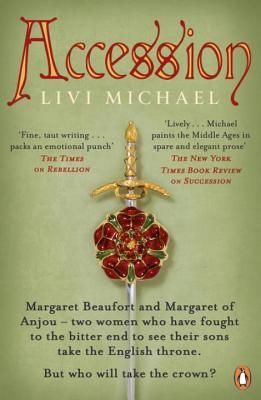
accession Having followed the stories of Margaret Beaufort and Margaret of Anjou throughout the early stages of the Wars of the Roses in Livi Michael’s Succession and Rebellion, we come at last to the third book in the trilogy, Accession, which covers what is, in my opinion, the most interesting part of the period – Edward IV’s final years, the troubled reign of Richard III and Henry Tudor’s victory at the Battle of Bosworth.

The novel opens in 1471, shortly after the Battle of Tewkesbury which has secured the throne of England for the Yorkist king, Edward IV. Despite her best efforts, the Lancastrian queen, Margaret of Anjou, has had to admit failure: her armies have been defeated, her husband – the late King Henry VI – is dead, and her son, the Prince of Wales, on whom all her hopes rested, has been killed. Margaret, whose role in our story is almost over, is placed in the custody of Alice Chaucer, Duchess of Suffolk, where she will remain for the next few years.

For Margaret Beaufort, however, all is not lost. Although her son, Henry, the remaining Lancastrian heir, is still in exile in Britanny with his uncle, Jasper Tudor, Margaret is slowly preparing the ground for his return. The first stage in her plan is to marry again and the husband she has in mind – her fourth – is Thomas Stanley, a man who has become an expert at navigating through dangerous political waters and who has no qualms about changing sides between York and Lancaster whenever he believes the time is right to do so. Just the sort of man, she hopes, who has the power and the influence to help turn her dreams into reality.

I think Accession is probably my favourite of the three books in this trilogy. Although the writing feels a little bit dry on occasions – more like non-fiction than fiction – the story is still compelling, even for someone who has read about these historical figures and events many times before! As in the previous two books, Livi Michael incorporates excerpts from contemporary chronicles of the period to tell part of the story, which is a method I have found both unusual and very effective. The use of the chronicles helps to set these novels apart from others that I’ve read on the Wars of the Roses.

Another thing I appreciate about this trilogy is that Livi Michael has avoided making her characters into heroes or villains, instead giving each of them a mixture of good points and bad points – and that includes her two protagonists, neither of whom are very easy to like. Margaret Beaufort in particular is portrayed as ambitious, scheming and manipulative – but always with the best interests of her son at heart. Almost everyone in this novel appears to be out for what they can get…and yet there are little touches of humanity too: Margaret Beaufort feeling sorrow at the death of Queen Anne, for example, despite having secretly been working against Anne’s husband, Richard; or Henry Tudor recognising the sacrifices made for him over the years by his uncle Jasper.

As for Richard III, he is no more of a hero or a villain than any of the other characters in the novel. Whenever I read a book which covers Richard’s reign, I look forward to seeing how the author will choose to tackle the mystery of the Princes in the Tower, and I’m pleased to say that I was happy with the approach taken in Accession! It wasn’t quite what I’d expected, but I found it convincing and a little bit different from the theories given in other novels I’ve read.

I’ve enjoyed reading all three books in Livi Michael’s trilogy and will continue to read about this period of history as I never seem to get bored with it!

Thanks to Penguin for providing a copy of this book for review.

Succession by Livi Michael

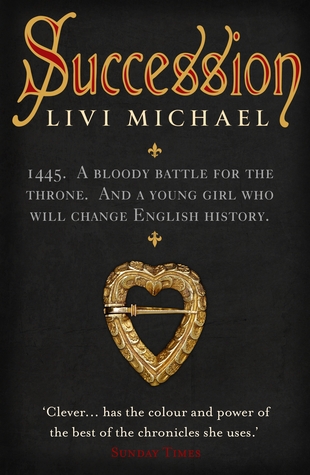
Succession With my interest in the Wars of the Roses, I remember hearing about this book, the first in a trilogy, when it was published a couple of years ago, but for one reason or another I never got round to reading it. Two years later, the third and final novel has just been published, and Penguin have kindly sent me the whole trilogy for review. I’ve now read the first book, Succession, and am sure I’ll be reading the other two very soon.

I know not everyone is familiar with the background to the Wars of the Roses, so I should start by explaining that they were a series of wars fought in the second half of the 15th century between two rival branches of the royal House of Plantagenet. With King Henry VI of England (a descendant of Edward III through the Lancastrian line) suffering from an unspecified mental illness, there were many who considered him unfit to rule, leaving the way open for another claimant to the throne – Richard, Duke of York, another of Edward III’s descendants. From 1455-1487 a number of battles were fought between supporters of Lancaster and supporters of York; Succession covers only the early part of this period.

There are interesting, colourful characters on both sides of this conflict, but if I had to choose, I would say that I’m a Yorkist. This novel, however, is written mainly from the Lancastrian perspective, concentrating on two young women who share the same name – Margaret. The first is Margaret of Anjou, wife of Henry VI, and the second is Margaret Beaufort, mother of the future Henry VII. We do meet plenty of other characters (so many that you may need to make use of the character list and family tree at the beginning of the book to keep track of them all) but the stories of these two women are always the main focus of the novel.

We first meet Margaret Beaufort as a little girl who has become a ward of the Duke of Suffolk following the death of her own father, the 1st Duke of Somerset. A childhood marriage to Suffolk’s son, John de la Pole, is annulled when Henry VI chooses to marry the twelve-year-old Margaret to his half-brother, Edmund Tudor. Within a year, Edmund is dead of the plague, leaving his young widow pregnant with his child and at the mercy of his brother, Jasper (who is portrayed here in a surprisingly negative light).

Margaret of Anjou also has a difficult life, trying to hold the country together during the king’s long spells of illness so that she can keep the throne secure for their baby son, Edward. Neither of the Margarets are very likeable characters, but it would be difficult not to sympathise with the situations in which they find themselves. Some of Margaret of Anjou’s attempts to communicate with her unresponsive husband are very moving, while Margaret Beaufort’s story is sometimes quite disturbing – for example, the trauma suffered by a small thirteen-year-old giving birth is described in detail.

This is a period of history with which I’ve become very familiar over the last few years and, as this novel follows the historical sequence of events very closely, I always knew, more or less, what was going to happen next. There’s nothing very new in terms of plot, but the approach Livi Michael takes to telling the story is quite different from anything I’ve read before. She writes in several styles throughout the novel – sometimes a chapter is written in the first person, sometimes in the third – and from the perspectives of many different characters (a red or a white rose at the start of each chapter gives a useful indication of whether the character’s allegiance is to York or to Lancaster), but the most striking thing about Succession is the use of extracts from contemporary chronicles such as the Crowland Chronicle or John Benet’s Chronicle.

Each chapter starts or finishes with at least one paragraph taken from a chronicle of the time and it’s important to read all of these because they are used to advance the story and to relate events which our characters may not have personally witnessed. The Battle of Blore Heath, for example, is told entirely in the form of chronicles with no original prose at all. I liked the feeling of authenticity that this provided; however, it could also be distracting at times and, together with the very short length of the chapters (many are only one or two pages long), it made me feel that I was constantly being pulled out of the story. There is one much longer chapter in the middle of the book entitled Margaret Beaufort Travels to Wales and this was my favourite part of the novel, as we were finally given an opportunity to spend a decent amount of time getting to know one character with no interruptions.

Although the style and structure of Succession weren’t always a complete success with me, I did still enjoy the creative approach to a story I love and I will certainly be picking up the second book, Rebellion, soon.

Sons of the Blood by Robyn Young

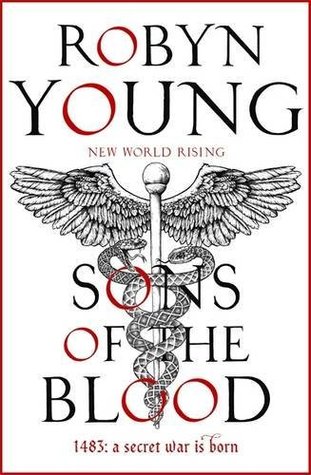
Sons of the Blood Having read Robyn Young’s Robert the Bruce trilogy recently, I was looking forward to reading her new novel, Sons of the Blood. It’s the first in a planned series – New World Rising – set in Renaissance Europe and following the adventures of Jack Wynter, the illegitimate son of royal chamberlain Sir Thomas Vaughan.

As the novel opens in 1483, the unexpected death of Edward IV after several years of stability has plunged England back into turmoil and uncertainty. Just when it seemed that the Wars of the Roses were over, the country now faces the prospect of another child king on the throne, unable to provide the strong leadership required. But as Thomas Vaughan escorts the young Edward, Prince of Wales, to London to be crowned, they are intercepted at Stony Stratford by the prince’s uncle, Richard, Duke of Gloucester.

Accused of treason and fearing for his life, Thomas finds an opportunity to send one of his squires to Seville with an urgent message for his son, Jack, who has been in Spain for several months guarding a mysterious leather scroll case. To Jack, this had seemed like an excuse to remove an inconvenient illegitimate son from the country, but when he learns that his father’s messenger has been attacked on his way to Seville, he realises that the case really does contain secrets of great importance and that men are prepared to kill to get their hands on these secrets.

Returning to England in the hope of learning more, Jack finds himself surrounded by enemies, one of whom is his own half-brother, Harry Vaughan. Desperate to find answers to his questions, Jack decides to seek the help of another boy to whom Sir Thomas had been a father of sorts – the young Edward V, who has now been deposed by his uncle Richard, and has disappeared, along with his brother, into the Tower of London. As rumours of the princes’ deaths begin to spread throughout the city, Jack is drawn into one of history’s greatest mysteries.

I have to say, this wasn’t quite what I expected when I first heard that Robyn Young was writing a series set during the Renaissance; I had thought there would be a wider geographical scope, so I was surprised to find that this first book is set mainly in Richard III’s England. The Wars of the Roses is one of my favourite subjects to read about, though, so I’m not complaining – and I’m sure Jack’s adventures will be taking him to other locations in future books.

I have read a lot of different portrayals of Richard III over the last few years and a range of different theories and opinions on the question of what really happened to the Princes in the Tower. From the beginning, Robyn Young’s depiction of Richard was quite negative – he comes across as ambitious and ruthless (a human being, though, rather than an evil monster) – so I thought I knew which direction the story was going to take. I was wrong, of course! Richard is responsible for a lot of the bad things that happen in the novel, but not all of them, and it’s worth mentioning that Henry Tudor isn’t exactly shown in a very good light either.

As usual with one of Young’s novels, there’s a lot of additional material which all adds to the experience: maps, character lists (clearly showing who is real and who is fictional) and a comprehensive list of sources. Young admits in her author’s note that she had little prior knowledge of the fifteenth century, having been immersed in earlier periods while writing her previous trilogies, but I would never have guessed because, as far as the historical background is concerned, everything in the novel feels fully researched and authentic. I think she does a good job of working Jack Wynter’s fictional story into the historical facts – however, I’m slightly disappointed that the conspiracy/secret society/mysterious document aspect of the novel is so dominant. This period of history is interesting enough as it is!

With Sons of the Blood, the New World Rising series is off to a good start. I did enjoy it, despite having one or two reservations, and now I’m curious to see how the story is going to develop.

The Confession of Richard Plantagenet by Dora Greenwell McChesney

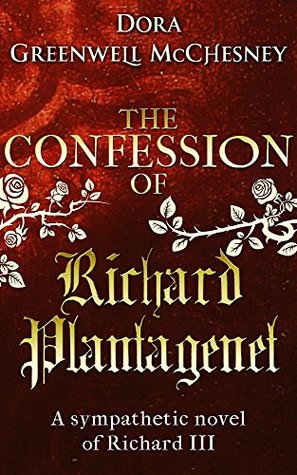
The Confession of Richard Plantagenet With the Wars of the Roses being one of my favourite periods of history, I like to read everything I can find on the subject. This novel by Dora Greenwell McChesney – an author completely new to me – sounded particularly intriguing because it was published in 1913, making it the oldest Wars of the Roses novel I have read, coming sixteen years before even Marjorie Bowen’s Dickon (1929).

The Confession of Richard Plantagenet begins with the Yorkist victory at the Battle of Tewkesbury in 1471 and ends with Richard III’s defeat at Bosworth Field in 1485. Between these two events we are given not so much a confession as a fairly straightforward account of Richard’s life, showing the circumstances which led to him taking the throne following the death of his brother, Edward IV, and then leading us through the key moments of his own brief reign.

As this is described on the front cover as ‘a sympathetic novel of Richard III’, I was interested to see how McChesney was going to tackle the many controversies surrounding Richard, such as the death of Henry VI and, of course, the disappearance of his nephews, the Princes in the Tower. Well, this novel does show Richard either directly or indirectly committing some of the crimes of which he has traditionally been accused, but always for good and noble reasons or because he has been left with no other choice.

I can appreciate that because she was writing what was surely one of the earliest pro-Ricardian novels, McChesney (like Marjorie Bowen with Dickon) was trying to counteract the more widely held view of Richard as an evil, hunchbacked murderer, but I think she went too far the other way, with the effect that Richard comes across as blameless and almost saintly. Still, it was interesting because the approach taken in this novel is slightly different from others I’ve read. This is why I’m happy to keep on reading about the same historical people and events again and again – because each different author offers a different set of opinions, ideas and interpretations.

If you have never read about this time period before, however, I probably wouldn’t recommend starting here. McChesney seems to assume the reader has at least some prior knowledge, so if you’re not already familiar with the background to the Wars of the Roses and the names and relationships involved, you might find the plot difficult to follow, especially in conjunction with the style in which the book is written.

Like a lot of older historical fiction novels, the language McChesney uses is archaic and flowery, particularly in the dialogue. As someone who reads all sorts of historical fiction, from the latest releases to books written hundreds of years ago, I always find it interesting to see how trends in the genre have changed. McChesney’s dialogue feels very outdated today, but personally I liked it once I got used to it and thought it added to the atmosphere of the novel.

Despite the flaws I have mentioned I enjoyed reading this version of Richard’s story and I’m sure it won’t be long before I find myself picking up yet another one!

I received a copy of this book for review via NetGalley.

The Queen’s Choice by Anne O’Brien

Some queens of England are much better known and have been written about much more often than others; I think it’s fair to say that Joanna of Navarre is not one of them.  As Henry IV’s second wife, Joanna (or Joan as she is sometimes known), doesn’t seem to get a lot of attention as far as historical fiction is concerned.  Anne O’Brien’s new novel, The Queen’s Choice, is the first book I’ve read with Joanna as the main character.

As the novel opens in 1396, Joanna is the wife of John, Duke of Brittany.  While she doesn’t love her husband, who is much older than herself, they have had several children together and their marriage is not an unhappy one.  To the court of Brittany comes Henry Bolingbroke, having been banished from England by his cousin Richard II, and Joanna is given a brief taste of the love and passion which has so far been missing from her life.

Three years later, things have changed.  Henry has returned to England, taken the crown from Richard and imprisoned him in Pontefract Castle, while Joanna herself is now a widow and acting as regent of Brittany on behalf of her young son.  When Henry sends one of his men, Thomas de Camoys, to approach Joanna about the possibility of a marriage alliance, she must make the difficult decision to leave her sons and her regency behind and come to England as Henry’s queen.

I won’t say much more about the plot, because I’m sure future readers will prefer to watch the rest of Joanna’s story unfold for themselves.  What I will say is that the marriage between Joanna and Henry takes place fairly early in the novel; after this, the focus is on their attempts to make their relationship work – which is not always an easy task!  Although their marriage is portrayed as a love match (it seems that there could be some historical evidence to support this), they are both proud people and a lack of communication sometimes causes misunderstandings.  After Henry’s death in 1413, Joanna’s life takes a more dramatic turn during the reign of her stepson, Henry V.

I knew almost nothing about Joanna of Navarre before reading this book, but what little I did know was negative.  It seems that she was greatly disliked by the English people because of her strong connections with France and Brittany at a time when hostilities between England and France were ever present.  Her unpopularity and how she felt about it is covered in the novel – and sometimes her pride and unwillingness to take advice are frustrating – but Joanna is also given lots of good qualities and I liked her overall.  There were times when I felt she reacted to certain situations in the way I would expect a modern day woman to react rather than a medieval one, but otherwise I thought she was a believable and strongly drawn character.

I may have had very little prior knowledge of Joanna, but I didn’t know much about Henry IV either and it was good to have the opportunity to learn more about him from this book.  Henry only ruled England for fourteen years but his reign was an unsettled one: as well as the threat from overseas, he faced rebellions in Wales and in Northumberland, and rumours surrounding the death of his cousin Richard II, said to have been starved to death in captivity.  Although The Queen’s Choice is set several decades before the conflict we know as the Wars of the Roses, we can see how it has its beginnings here, with tensions between rival branches of the family of the late King Edward III (Henry’s claim to the throne coming through the Lancaster line).

This is the third book I’ve read by O’Brien – the other two are The Forbidden Queen (the story of Katherine of Valois) and The King’s Sister (Elizabeth of Lancaster) – and I have enjoyed them all.  I’ll look forward to finding out who will be the subject of her next novel.

I received a copy of this book from the publisher via NetGalley for review.