Royal Mistress by Anne Easter Smith

Royal Mistress After reading Marjorie Bowen’s Richard III novel, Dickon, a few weeks ago, my interest in the Wars of the Roses was rekindled and the next book I picked up was Royal Mistress, another novel set in the same period…but from a very different perspective. Anne Easter Smith’s heroine is Jane Shore, famous for being a mistress of Edward IV. Jane is not usually given a lot of attention, so I looked forward to seeing her character fleshed out and brought to life, and to learning more about her beyond her relationship with the king.

Born Elizabeth Lambert, Jane is the daughter of a prosperous London silk merchant (the name ‘Jane’ is thought to have been the invention of a 17th century playwright, but in this novel we are told that Elizabeth has taken the name Jane to distinguish her from an Aunt Elizabeth). Jane is married off at the age of twenty-two to William Shore, another mercer, or dealer in textiles. The marriage is not what she’d hoped it would be and Jane quickly discovers that while her husband is not above using her beauty to advertise his silks and satins, in the privacy of their own home he is cold, distant and has no interest in giving her the children she so desperately wants. To make things worse, Jane is still in love with Thomas Grey, with whom she’d had a brief romance before discovering that not only was he married, he was also the son of Elizabeth Woodville, queen of England.

As she begins to seek an annulment of her marriage, Jane catches the eye of Will Hastings, the king’s chamberlain, and through him she gets to know Edward IV. Royal Mistress follows Jane throughout the years of her relationship with the king, as she becomes an important part of Edward’s life and finds some of the warmth and affection that was missing in her marriage. After Edward’s death, however, Jane finds herself at the mercy of Richard III, who disapproves of her behaviour and wants to have her dismissed from court. Jane turns to Will Hastings for protection…but he is also out of favour with the new king and Jane’s safety cannot be guaranteed.

Royal Mistress is the first book I’ve read by Anne Easter Smith and I’ll be completely honest and say that, based purely on the title and front cover, I didn’t expect much from it. And after reading the first few chapters, I thought I was right. The story is slow to start, concentrating on a purely fictional romance between Jane and Tom Grey (it’s true that Jane was a mistress of Grey’s after Edward’s death, but there is no evidence of an earlier relationship between them) and while I did like Jane – she is portrayed as generous, warm-hearted and down-to-earth – her character didn’t seem to have a lot of depth or a lot of purpose other than being the mistress of various men.

As I got further into the novel, though, more characters are introduced, parts of the story are told from perspectives other than Jane’s, and I was swept away by the retelling of a period of history that I love. Reading the author’s note at the end of the book, I could see how much care had gone into her interpretations of the characters and their actions and motivations (even if I didn’t always agree with these interpretations). It’s interesting that Smith says she is a staunch supporter of Richard III and yet with this novel being written mainly from Jane’s point of view, it was necessary for her to portray Richard in a less than positive light. Where the disappearance of the princes in the tower is concerned, though, I was happy with the theory she puts forward as it’s one I find quite convincing.

I see Anne Easter Smith has written four more novels set during the same period, but while I did end up enjoying this one, I’m not sure yet whether I will want to read any of her others. I would like to read more about Jane Shore, though; I have a copy of Vanora Bennett’s Queen of Silks on my shelf which I hope to read soon, but if you can recommend any other books please let me know. I was interested to see that Jean Plaidy’s 1950 novel on Jane is called The Goldsmith’s Wife, as it was thought until recently that William Shore was a goldsmith rather than a mercer. Proof that history is still evolving!

Master of Shadows by Neil Oliver

Master of Shadows There were several things that drew me to Master of Shadows: the setting (the fall of Constantinople in 1453) was one, and the protagonist (the Scottish engineer, John Grant) was another. Most of all, I was curious to see what Neil Oliver’s fiction would be like. Oliver is best known as a television presenter and historian – he recently presented the BBC series Celts: Blood, Iron and Sacrifice – and although he has previously published some non-fiction, Master of Shadows is his first novel.

I have mentioned Constantinople, but much of the first half of the novel is actually set in Scotland, where the soldier Badr Khassan has come to fulfil a deathbed promise, having sworn to protect the wife and child of his friend, the late Patrick Grant. He finds Jessie Grant and young John just in time to interrupt an attempt on their lives by the men of Patrick’s enemy, Sir Robert Jardine of Hawkshaw. Pursued by the vengeful archer, Angus Armstrong, Badr and John leave Scotland and travel across Europe, making a living by fighting as mercenaries. Along the way they meet a mysterious female warrior called Lena who is also a target of the same group of Scots and who is hiding some important secrets regarding her own identity and John’s.

Eventually John arrives in Constantinople, one of the final strongholds of the Byzantine Empire, now under threat from the mighty Ottoman army. As the Emperor Constantine XI prepares to defend his city and Sultan Mehmet II gathers his forces outside the walls, two more characters come to the forefront of our story: Prince Constantine, the Emperor’s crippled son, and Yaminah, the girl he loves. The lives of John, Yaminah and the Prince come together during the dramatic Siege of Constantinople and the final days of the Byzantine Empire.

Master of Shadows is a combination of history, adventure and romance set against a backdrop of what is surely one of the most fascinating and significant periods in Europe’s history – the collapse of one empire and the expansion of another. I thought the book was generally well written and, knowing that the author is an archaeologist and historian, I also felt confident that it would have been well researched. However, he does take some liberties with certain historical characters; I really disliked Lena’s story, although I can’t explain why without telling you who she really is and that would be a spoiler! There’s also a supernatural aspect to the novel – John Grant is able to feel the Earth moving through space and can sense the people around him without using sight or touch – but this didn’t become such a big part of the story as I’d feared at first.

I had previously encountered John Grant as a character in Dorothy Dunnett’s House of Niccolò series (under the slightly different name of John le Grant) and was quite fond of him, so I was looking forward to seeing how he would be portrayed by another author. Very little is known about the real John Grant; records show that a Johannes Grant was employed as an engineer by the Byzantine Empire and his expertise in counter-tunnelling prevented the Turks from invading Constantinople from under the walls. He was originally thought to have been German but more recent research suggested that he was actually Scottish. This lack of historical information has allowed Neil Oliver to create a whole backstory for John to explain how he came to be in Constantinople. The character is quite different from the one in Dunnett’s novels, but I did still like him (although I found it irritating that he is always given his full name of John Grant, sometimes multiple times in the same paragraph, and is never just referred to as John).

Master of Shadows is an interesting first novel – I particularly liked the Scottish chapters near the beginning and the romance between Prince Constantine and Yaminah – but there were too many little things that didn’t work for me. As well as the Lena storyline and the supernatural element I’ve mentioned above, there’s a lot of jumping around in time which makes it slightly difficult to follow what is happening. I’m not sure whether I’ll read any more of Neil Oliver’s fiction, but I might try one of his non-fiction books instead.

Review copy provided by the publisher via NetGalley.

Romola by George Eliot

Romola I’ll admit that I didn’t feel very enthusiastic about starting to read Romola. I had added it to my Classics Club list because I loved Middlemarch and because the Italian Renaissance setting sounded appealing to me. Then I came across some reviews that said it was very difficult to read, overly detailed and boring, and I began to wonder what I had let myself in for. Luckily, now that I’ve read the book, I can say that none of these things were big problems for me. Yes, it was challenging, and yes, the amount of historical and political detail was overwhelming, but none of that mattered because I was so caught up in the story and the lives of the characters.

Romola is set in Florence in the final years of the 15th century and I wonder if this could be one of the reasons it’s not more widely read as it isn’t what you would typically expect from a Victorian novel. There’s no doubt that Eliot must have thoroughly researched the setting and the historical background, although it sometimes seemed that she had been determined to include every little fact and detail she uncovered during that research. Apparently Anthony Trollope wrote to Eliot after reading the first instalment and praised her for her descriptions of Florence, ‘wonderful in their energy and in their accuracy’, but warned her not to ‘fire too much over the heads of your readers’. Well, a lot of it did go over my head, and although I loved the book overall I won’t pretend that I understood everything I read.

The title character, Romola, is the daughter of an elderly scholar, Bardo de’ Bardi. Romola’s brother has left home to join the church and Romola is doing her best to take his place in helping their father with his classical studies. This work does not really interest Romola, however, so when they are introduced to a young man called Tito Melema who agrees to become Bardi’s assistant, this seems to be the perfect solution.

Tito, a Greek scholar, has just arrived in Florence after surviving a shipwreck and is looking forward to building a new life and career for himself. When he learns that his adoptive father, Baldassarre, has been sold into slavery in Antioch and needs his assistance, Tito must decide whether to put his own comfort above his duty to his father. Meanwhile Romola is beginning to fall in love with Tito, but knows nothing of his relationship with Baldassarre – or of his entanglement with a pretty young Florentine girl called Tessa.

The story of Romola and Tito unfolds against the backdrop of a very important period in Florentine history. Piero de’ Medici has been driven from Florence as the French prepare to invade and religious fervour is sweeping through the city under the leadership of the Dominican preacher, Girolamo Savonarola. Savonarola is an important character in Romola – along with Niccolò Machiavelli he is one of several real historical figures to appear in the novel – and is portrayed here as a complex human being with both good points and bad.

The fictional characters are even more interesting than the historical ones; the villain in this novel is the equal of almost any in Victorian fiction. He is particularly fascinating because when we first meet him he doesn’t appear to be villainous at all; his character undergoes a slow descent into deceit and treachery so that I went from liking him to loathing him. Romola sometimes feels more like a typical virtuous and dutiful Victorian heroine than a 15th century one (she reminded me of Dorothea Brooke from Middlemarch) but I liked her and enjoyed watching her character develop.

I think how much you take away from Romola depends on how much effort you put in. You can look up every reference if you want to, or you can just be swept along by the story – like a lot of classics it works on more than one level. I certainly didn’t understand it all and I got very confused by the political intrigue towards the end of the book but as long as I could keep track of who was on which side, who was being betrayed and who was doing the betraying I was happy.

This hasn’t become a favourite classic but it’s one of the best I’ve read for a while. I was gripped by the plot, fascinated by the characters and loved the portrayal of Florence, its buildings, its art and culture and its people. Having only read Middlemarch, Silas Marner and now Romola so far, I’m looking forward to reading George Eliot’s other novels!

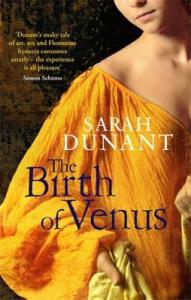
The Birth of Venus by Sarah Dunant

The Birth of Venus I love books set in Renaissance Italy but although Sarah Dunant has written three or four of them, this is the first one I’ve read. I had started to read her novel on the Borgias, Blood and Beauty, a year or two ago and struggled to get into it, so that put me off trying any of her other books for a while. Something keeps drawing me to Dunant’s books on the library shelf, though, so a few weeks ago I decided it was time to give her another try.

The Birth of Venus is not, as I’d originally expected, a novel based on the story behind the Botticelli painting of the same name. What the title does actually refer to could be debated, but it seems to me that it alludes to the ‘birth’ or awakening of the novel’s narrator as she falls in love for the first time. The name of the narrator is Alessandra Cecchi and she is the daughter of a prosperous Florentine cloth merchant.

At the beginning of the novel, Alessandra is not quite fifteen years old. Despite her quick brain and artistic talent, she has had to resign herself to the fact that, due to the conventions of 15th century society, she will have no option but to marry the man her parents have chosen for her. When her father returns from a business trip, bringing with him a young artist whom he has commissioned to paint the walls of the family chapel, Alessandra is fascinated. She is curious to see the painter’s work and to learn more about his methods, but she is even more intrigued by the painter himself. Who is this young man, this ‘orphan brought up in a monastery on the edge of the northern sea’?

As the story of Alessandra and the painter unfolds, so does the story of Florence. Beginning with the death of Lorenzo de’ Medici, the novel takes us through the subsequent disastrous reign of Piero de’ Medici, the rise to power of the Dominican friar Savonarola, and the growing threat of a French invasion. This is always a fascinating time and place to read about and I think Dunant does a particularly good job of bringing the setting to life, not just in describing the sights and sounds, but also in showing us how the mood of Florence changes as the city is gripped by Savonarola’s religious extremism.

For a thick book, this was quite a quick read, the sort where you become so swept along with the story you don’t realise how fast the pages are turning. My only problem was that I found Dunant’s decision to refer to the painter as ‘the painter’ throughout the entire book slightly annoying. I’m not quite sure why there really needed to be a mystery surrounding his identity. I felt that the lack of a name created a distance between the character and the reader – I expect this was probably intentional (maybe it wasn’t supposed to matter who he was; all that mattered was what he represented to Alessandra), but if so, it didn’t work for me.

While I can’t really say that I loved this book, I did enjoy it and am now happy to try Sarah Dunant’s other Renaissance Italy novels, In the Company of the Courtesan and Sacred Hearts (maybe I should even give Blood and Beauty another chance). When I finished The Birth of Venus I didn’t want to leave Medici Florence behind, so the next book I picked up was Romola by George Eliot, which is set in the same period and which I’m thoroughly enjoying.

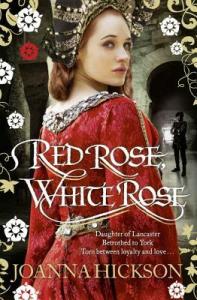
Red Rose, White Rose by Joanna Hickson

Red Rose White Rose A few years ago I read Joanna Hickson’s The Agincourt Bride, the first of two novels on the life of Catherine de Valois. I didn’t enjoy it enough to want to read the sequel, The Tudor Bride, but when I saw that she had written a new novel telling the story of Cicely Neville (the mother of Edward IV and Richard III) I couldn’t wait to read it. The Wars of the Roses is one of my favourite periods of history but I haven’t read very much about Cicely and I was interested in learning more.

The novel begins in 1433 and introduces us to the seventeen-year-old Cicely Neville. As the youngest daughter of the late Earl of Westmorland, Cicely belongs to one of the richest and most powerful families in the north of England. Born at Raby Castle in County Durham, Cicely is known as ‘the Rose of Raby’ – but her brothers have also bestowed on her the less flattering nickname of ‘Proud Cis’. Cicely has never given much thought to the children of her father’s first marriage – a branch of the family who feel they have been pushed aside and disinherited – but when she is briefly held hostage by one of these relatives, Sir John Neville, she discovers just how far they will go to reclaim their lands and titles.

Restored to her own family at Raby, Cicely is married off to Richard, Duke of York, to whom she has been betrothed since she was nine. As a descendant of Edward III, Richard believes his own claim to the throne is stronger than that of the present king, Henry VI, and as his frustrations with Henry’s weak leadership increase, so do his ambitions. Soon the House of York finds itself at war with the King and the House of Lancaster, a particularly traumatic situation for Cicely, with not only her husband in danger but also her two eldest sons, Edward and Edmund, her brother Hal and her nephew, the Earl of Warwick. But even while she fears for the men in her life, Cicely is haunted by memories of another man – Sir John Neville, the man she truly loves.

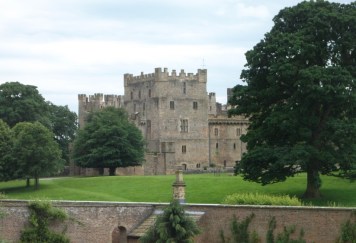
Raby Castle I enjoyed Red Rose, White Rose and thought it was a big improvement on The Agincourt Bride. It was the first half of the book that I found the most interesting, possibly because I’ve read about the Wars of the Roses, the battles and the rise of the House of York many times before, whereas Cicely’s early story was something different (even though it seemed to be largely fictional – Hickson states in her author’s note that there was no historical basis for the affair between Cicely and John Neville). I also loved the fact that these early chapters were set in the north, in an area I’m familiar with; I visited Cicely’s childhood home, Raby Castle, just two years ago so could picture it very clearly (see my photograph above).

Something I haven’t mentioned yet is that while part of the book is narrated by Cicely herself, the rest is narrated by her illegitimate half-brother, Cuthbert. Most of the characters in the novel are based on real people, but Cuthbert is not and I’m not sure that I really liked the inclusion of a fictitious storyline alternating with the historical one. I also thought the two narrative voices felt too similar and if the name of the narrator hadn’t been given in the chapter headings, I would have had difficulty distinguishing between the two. However, I did like Cuthbert as a character and he takes us to places that Cicely isn’t able to go herself, such as onto the battlefield, so he does have an important role to play in the story.

There was a good balance of war, politics, romance and adventure in this novel; there’s also a huge amount of historical detail – if you’re expecting a very light, easy read I think you may be surprised! This is a long, complex story and some concentration is needed to keep track of the relationships between the characters. I found it particularly interesting to read about Cicely’s daughter, Anne, forced into marriage against her will to her father’s ward, Harry Holland, the Duke of Exeter, and finding herself on the Lancastrian side of the conflict – as does Cicely’s sister, another Anne. The way these characters felt about their divided loyalties and how they coped with the tensions it caused within the family was portrayed very well.

Finally, while I think Red Rose, White Rose is the perfect title for a book on the Wars of the Roses, it did bother me slightly that there were so many references to the red rose being a symbol of Lancaster. According to the non-fiction I’ve read on the subject (including most recently The Hollow Crown by Dan Jones), although the red rose had possibly been associated with the House of Lancaster since the 13th century, it wasn’t commonly used as a symbol until Henry Tudor’s victory at Bosworth when he combined it with the white rose of York to form the Tudor rose. I don’t think the Lancastrian army would have been wearing red rose badges as described in the novel, but I’m happy to be corrected if I’m wrong.

Now I’m wondering who and what Joanna Hickson’s next book will be about. The way this one ended leaves plenty of scope to continue the story of the Wars of the Roses!

I received a copy of this book from NetGalley for review

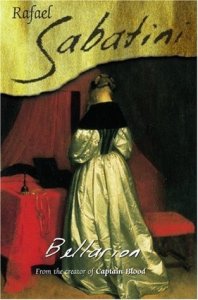
Bellarion by Rafael Sabatini

Bellarion This was the book chosen for me in the Classics Club Spin last November. I was supposed to post my review by the 4th January, but Christmas, other books and life in general got in the way of finishing it on time. Well, better late than never!

Rafael Sabatini is best known as the author of Scaramouche, Captain Blood and The Sea Hawk, but he also wrote more than thirty other books including this one, Bellarion – or Bellarion the Fortunate, to give it its original title. Bellarion was published in 1926 but, like most of Sabatini’s novels, it is set much earlier – in Renaissance Italy, in fact: a world of warring city states, tyrannical dukes and beautiful princesses, of powerful condottieri and bands of mercenary soldiers, of sieges and battles, poisonings and conspiracies.

Our hero, Bellarion, is an intelligent but naïve young man who has been raised in the monastery of Cigliano and believes that there is no such thing as sin. Shocked by his heretical ideas, the abbot sends him off to university in Pavia, hoping that he will learn something about the world while he is there. Almost as soon as Bellarion leaves the abbey, he becomes the victim of a bandit pretending to be a friar. With his money and letter of introduction stolen from him, and wrongly accused of being the bandit’s accomplice, Bellarion flees to the Palace of Casale in Montferrat where the Princess Valeria agrees to protect him.

Montferrat is currently under the rule of Valeria’s uncle Theodore, who is acting as Regent until her brother, Gian Giacomo, is old enough to take his rightful place as Marquis. When Bellarion uncovers a plot by Theodore to destroy his nephew and keep the throne for himself, he becomes entangled in a complex web of conspiracy and intrigue that will lead him to the Duchy of Milan and the court of its cruel and brutal young duke, Gian Maria Visconti.

Under the command of the famous condottiero (mercenary leader), Facino Cane, Bellarion quickly rises to become one of the greatest military captains of his time, finding that brains and quick wit can make up for a lack of physical ability and clever strategies and trickery can often work where strength and force fail. Even as he becomes more and more deeply involved in the affairs of Milan, Bellarion never forgets that everything he does is for the benefit of Montferrat and his beloved Princess Valeria. Unfortunately, Valeria has completely misinterpreted his motives and is convinced that Bellarion is her enemy rather than her friend. It seems that all his efforts could be in vain…

I loved this book, as I expected to, having enjoyed two of Sabatini’s others. Scaramouche is still my favourite, but I think I preferred this one to Captain Blood, mainly because I find stories set on land easier to read than stories set at sea! You do still need to concentrate, though, to be able to untangle the complicated political situations in Milan and Montferrat, to follow the rivalries between the two factions, the Guelphs and the Ghibellines, and to keep track of who is conspiring against whom. Also, because Bellarion is building a career for himself as a military leader, there are lots of battle scenes (large scale battles rather than the more intimate one-on-one sword fighting scenes in Scaramouche). If you’re like me and are often tempted to skip long battles and discussions of military strategies, you can’t do that here – you need to read them all carefully so that you can appreciate Bellarion’s genius!

I did have mixed feelings about Bellarion himself. There’s no doubt that he’s a fascinating character; his rapid transformation from a naive, unworldly young man to a great military commander and political mastermind is great to watch. At the beginning, with his mixture of youthful enthusiasm, innocence and intelligence, he reminded me of d’Artagnan in The Three Musketeers; later, after rising from nowhere to become a trusted leader and master schemer, he reminded me not just of d’Artagnan but also Nicholas de Fleury from Dorothy Dunnett’s House of Niccolo series. (In fact, I wouldn’t be surprised if Dunnett had read this book; there’s a scene with a captured supply train that made me think of The Game of Kings.)

However, there was something about Bellarion that stopped me from really warming to him as a character. I thought he was a little bit too clever and too aware of his own cleverness. You could say the same, I suppose, about Sabatini’s other heroes, Andre-Louis Moreau and Peter Blood, but they also had flaws and vulnerabilities that made them feel more human and more believable. I never felt that I really needed to fear for Bellarion; whatever difficult situation he got himself into I had no doubt that he would come out of it unscathed. I didn’t like Valeria much either – she annoyed me with her total misreading of Bellarion’s motives and the way she always thought the worst of him. To be fair to Valeria, though, she didn’t have the knowledge that we, the reader, had!

Bellarion is a fictional character, but many of the others in the novel are based on real historical figures. Characters such as Theodore of Montferrat, Facino Cane and his wife Beatrice, Gian Maria Visconti of Milan, and Bellarion’s rival condottiero, the Count of Carmagnola, are all people who really existed – although as I don’t know much about this particular period of history I wasn’t sure how much of the story was based on fact and how much on fiction until I did some research after finishing the book!

Despite not really caring for the main characters I did enjoy this book (another Classics Spin success!) and am looking forward to reading the other Sabatini novel on my Classics Club list, The Sea Hawk.

Vlad: The Last Confession by C.C. Humphreys

Vlad the Last Confession I discovered C.C Humphreys in July when I read Plague, a novel about, unsurprisingly, the plague. Looking at the other books he had written, I came across one called Vlad: The Last Confession and thought it might be a good choice for this year’s R.I.P. challenge. Despite my best intentions I didn’t manage to start it in time for R.I.P. but decided to read it anyway.

Vlad, of course, is Vlad Dracula (also known as Vlad Tepes or Vlad the Impaler due to the particularly brutal method of punishment he used to torture his victims) but apart from the name, there are very few similarities with Bram Stoker’s famous vampire. I think it’s important to know, before you decide whether to read Vlad: The Last Confession, that this is not a vampire novel and not a retelling of Dracula. It’s a fascinating and thoroughly researched novel about a fifteenth century Prince of Wallachia (a region of Romania) who devoted most of his life to trying to secure his throne against rival claimants and fighting off the threat of the Ottoman Empire.

Born in 1431 in Transylvania, Vlad is the son of Vlad II, voivode of Wallachia and a member of the Order of the Dragon, hence the name Dracula (son of Dracul, the dragon). Vlad’s hatred of the Ottoman Turks begins at an early age when he and his younger brother, Radu, are held hostage in Edirne for several years. During their time in captivity they are educated in the Turkish language, religion and culture, but while Radu eventually converts to Islam and joins the household of the Sultan Mehmet II, Vlad remains resentful and defiant. Following the murder of his father, he returns to Wallachia to reclaim the throne.

Vlad’s story is told through the recollections of the three people who knew him best: his closest friend, his mistress and his confessor. These three are brought together after Vlad’s death and give evidence to help a jury – and the reader – to make up their minds about Vlad. So who was he, really? A brave leader who fought for what he believed in or a cruel, sadistic tyrant? I think the answer was probably both.

Vlad the Impaler

Vlad the Impaler

One of the things I liked about this novel was the fact that C.C. Humphreys’ depiction of Vlad is fair and unbiased; he doesn’t try to make excuses for his behaviour but at the same time he helps us to understand how and why Vlad came to commit some of the appalling acts he is known for. For example, during Vlad’s time as a Turkish hostage he is taken to a torture chamber and forced to learn some horrific medieval torture techniques. Although he resists at first, he soon adapts and tells himself that “we torture others so they cannot torture us”. While this certainly doesn’t justify any of his later actions, at least we can see some of the early experiences and influences that shaped the man he would become.

I’ve mentioned the torture scenes; I should warn you that there are also a lot of impaling scenes (and they are described in graphic detail) but I think this was necessary to illustrate the darker side of Vlad’s character in a way that makes a real impact. There are a lot of battle scenes too – and fights, jousts and descriptions of falconry. This is quite an action-packed novel, but Humphreys also explores Vlad’s relationships with his childhood friend, Ion Tremblac and his lover, Ilona Ferenc, as well as with enemies such as Mehmet. I have to admit, I would much rather have had more time spent on the personal storylines and less on the fighting and brutality, which I thought started to become very repetitive.

I found some of the history difficult to follow because of my complete lack of knowledge of what was happening in Eastern Europe during this period, but by the time I finished the book I felt I’d learned a lot. And even though my interest started to wane towards the end, I was glad I’d persevered. Vlad III is apparently considered to be a national hero in Romania and although a lot of the shocking things described in Humphreys’ novel are based on fact – he lists them in his author’s note at the end – I was left wondering whether Vlad may in some ways have been unfairly treated by history. As one of the characters in the novel remarks, “What the world knows is the story his conquerors told. And since they controlled so many printing presses, it was their stories that were widely spread”.