The Florentine Emerald by Agustín Bernaldo Palatchi

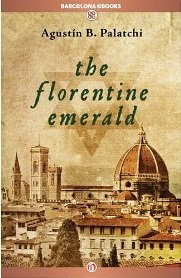
The Florentine Emerald The Florentine Emerald is historical fiction set in Florence during the Renaissance. The story begins in 1478 at Cardona Castle in Spain, where Mauricio Coloma is visiting his father, Pedro, who has been chained in a dungeon after being falsely accused of treason. Knowing that he is facing execution, Pedro reveals to Mauricio the truth that until recently converting to Christianity, their ancestors had been Jews. Before he is put to death he also tells his son of a valuable emerald ring hidden under a tile in the floor of their home in Barcelona and advises him to take it to Florence to sell to the Medici, the powerful Florentine family of bankers.

Arriving in Florence with the priceless jewel, Mauricio finds himself in the right place at the right time to thwart an assassination attempt on Lorenzo de’ Medici, the man who rules the Florentine Republic. As a sign of his gratitude, Lorenzo helps Mauricio establish himself in Florence. But then he meets and falls in love with Lorena Ginori, a girl whose parents are planning a more ambitious marriage for her with a man she dislikes. As the years go by, both Lorena and Mauricio have to confront some secrets from their pasts, while around them Florence is thrown into turmoil by the prophecies of the priest Savonarola and the conspiracies of those who want to cause the downfall of both Mauricio and the Medici.

This is an English translation of a Spanish novel by Agustín Bernaldo Palatchi, published by Barcelona eBooks, who if I’ve understood correctly are a spin-off of the Spanish publisher Roca Editorial and partners of Open Road Media, specialising in digital versions of Spanish and English translations. I was pleased to have the opportunity to read the ebook via Netgalley, but as I know not everyone likes or is able to read ebooks I thought it was only fair to point out that I’m not sure if or when The Florentine Emerald might be available in English in any other format.

Something I really enjoyed about this book was learning more about Renaissance-era Florence. In the fifteenth century, Florence was one of the most important centres of European trade and culture, which makes it an ideal setting for historical fiction. There were so many things happening both within Florence itself and in Europe in general during this period that had an effect on Mauricio’s story: outbreaks of plague; the voyages of Christopher Colombus; and the Spanish Inquisition and the threat to the Jews of expulsion from Florence. The first part of the novel is set during roughly the same period as Dorothy Dunnett’s House of Niccolò series which I read recently and so I was already familiar with some of the characters and events that were covered in the book (the papal alum monopoly, the Medici and Strozzi families, the Duke of Urbino and King Ferrante of Naples). This was useful as I would probably have found some of the historical details much more confusing otherwise!

I did find it a bit hard to believe that Mauricio would have been befriended by Lorenzo de’ Medici and given a position at the Medici bank almost as soon as he arrived in Florence and I had to suspend disbelief again as Mauricio immediately began to associate with Leonardo da Vinci, Christopher Columbus and so many other famous people of the period. However, this was only a small part of the story and overall I did enjoy the inclusion of so many real historical figures, especially as there were some I had previously known little or nothing about, including the philosopher Marcilio Ficino and the Dominican friar and preacher, Girolamo Savonarola who plans to reform Florentine society.

I thought the translation was generally good – the writing flowed well and I didn’t have any problems with it, except that it was maybe slightly lacking in emotion and passion. I enjoyed following the adventures of Mauricio and Lorena but something got in the way of me really being able to connect with them emotionally and whether that was due to the translation or not it’s difficult to say without having read the original. I liked the characterisation of Lorenzo de’ Medici, though, and it was interesting to read about the position of power and influence he held in Florence and the much less successful rule of his son and heir, Piero, who followed him. All of this left me wanting to read a good biography of the Medici family or even another fictional account, so any recommendations are welcome!
Blood Sisters: The Women Behind the Wars of the Roses by Sarah Gristwood

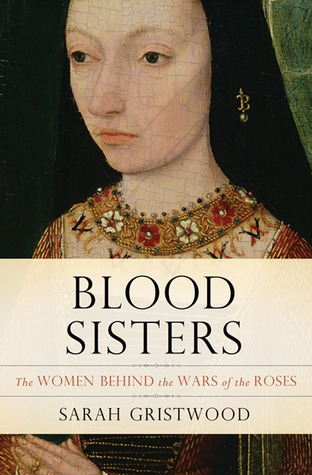
Blood Sisters Blood Sisters is a non-fiction book which looks at the lives of seven women who all played an important part in the period of history known as The Wars of the Roses or the Cousins’ War – the conflict between the House of York and the House of Lancaster, two branches of the English royal family. These seven women are listed below:

* Margaret of Anjou (Marguerite), Queen to Henry VI

* Cecily Neville, the mother of two Kings of England: Edward IV and Richard III

* Elizabeth Woodville, Queen to Edward IV and mother of the ‘Princes in the Tower’.

* Margaret of Burgundy, sister of Edward IV and Richard III and wife to the Duke of Burgundy.

* Anne Neville, wife of Richard III and daughter of the Earl of Warwick (the Kingmaker)

* Margaret Beaufort, mother of Henry Tudor (the future Henry VII).

* Elizabeth of York, Edward IV’s daughter and Henry VII’s wife.

Notice that I’ve defined these seven women by their relationships to the men, the Kings, and it would have been almost impossible not to do that, as their connections to the Plantagenet and Tudor Kings of England are the reasons they are still remembered today. But in this book, Sarah Gristwood shows that each of them also had an interesting story of her own and was historically important in her own right. Rather than devoting one section of the book to each woman and telling their stories separately, she weaves them together which makes sense considering that some of the women were related and several of them did meet or interact with the others in some way.

While Blood Sisters was very compelling and readable non-fiction, I have to admit I didn’t learn much that I didn’t already know about most of the women. The lives of Elizabeth Woodville and Margaret Beaufort were covered in another book I’ve read, The Women of the Cousins’ War, and a lot of the same information appears here too – though I suppose there’s a limit to how much information is actually available. Of the seven featured in this book, Margaret of Burgundy was the one I previously knew the least about and so I was particularly interested in reading about her.

As well as telling us about the major historical events of the period, Gristwood also gives us a lot of information to help us understand what daily life was like for these women: for example, records of household accounts, and descriptions of clothes worn at coronations or pageants and the dishes served at banquets. I also enjoyed reading about the disappearance of the Princes in the Tower and I appreciate the fact that Gristwood presented some of the different theories and possibilities rather than just blaming Richard III! A lot of attention is also given to the stories of the various Yorkist pretenders to the throne who caused so many problems for Henry VII during his reign, especially Perkin Warbeck, who claimed to be the younger son of Edward IV.

It’s frustrating that so much of the information we have about this period comes from the work of Thomas More and others who were writing during the Tudor period and so were likely to be biased, but Gristwood does take care to point out when something may not be completely accurate and when we need to use some caution. She explains which of her sources may have been unreliable or may have had their own reasons for wanting to portray a person or event in a certain way.

I would recommend Blood Sisters to anyone interested in learning more about this period from a female perspective and it’s also an ideal book for readers like myself who don’t often read non-fiction but want to build on the knowledge they’ve already gained through reading historical fiction.

I received a copy of this book for review via Netgalley

Gemini by Dorothy Dunnett

Gemini In June last year, having finished the final book of the Lymond Chronicles in April, I picked up Niccolò Rising and embarked on Dorothy Dunnett’s second historical series, the House of Niccolò. And now here I am, seven months and eight books later, at the end of Gemini and finding it hard to believe that there are no more adventures of either Lymond or Nicholas left for me to discover. There will be re-reads, of course, but it does make me sad that I can’t read any of these books for the first time again.

*Spoilers follow for both the House of Niccolo and the Lymond Chronicles*

Geographically, unlike the last few Niccolò books where the action switched between a variety of different settings, Gemini is focused mainly on one location: Scotland. After causing damage to the Scottish economy in the course of his long-running contest with his wife, Gelis, Nicholas has returned to try to make amends. Soon after his arrival in Scotland, Nicholas finds himself having to contend with a possible inherited illness (porphyria?) afflicting the royal family, trying to handle the King’s wild and unpredictable younger brother, John of Mar, and attempting to thwart a rebellion by the King’s other brother, the Duke of Albany. With Nicholas’s two biggest enemies, his grandfather, Jordan de St Pol of Kilmirren, and his former trading rival, Davie Simpson, also in Scotland, Gelis stays behind for a while in the relative safety of Bruges with their son, Jordan. But it’s not long before she and Jordan are in Edinburgh too and the eighth and final volume of the House of Niccolò starts to head towards its conclusion.

I did love Gemini overall, but I confess to getting a little bit bored with the political aspects of the novel. It’s not that I don’t find this period of history interesting and important, because I do – it’s just that at this late stage in the series, and especially as I began to reach the end of the book, I was too impatient to slow down and concentrate on all the details. I’m sure on a future re-read I’ll be able to appreciate this side of the novel more, but on this first read I was desperate to see how Nicholas’s personal story would be resolved and to have some of my questions answered.

I found Simon’s and Henry’s deaths particularly moving, though not so much for their sakes as for Nicholas’s, though I did feel slightly cheated when I realised that Simon was never going to acknowledge Nicholas as his son, and that neither Simon nor Henry were ever going to find out the truth about Henry’s parentage – I think I had expected there to be a big confrontation at the end of the book where everything would be revealed. I suppose it’s not the first time in a Dunnett novel that things haven’t turned out the way I had been anticipating! I was also a bit disappointed that a true reconciliation between Henry and Nicholas never happened, despite there seeming to be some steps in that direction earlier in the book.

I get the impression that opinion is divided over the Epilogue with some readers finding it unnecessary, but personally I liked it and was pleased to see that some of the links with the Lymond Chronicles were explained at last. Although I’ve been doing my best to avoid spoilers while reading this series I must have picked up somewhere that Rankin was Lymond’s father because I had that at the back of my mind, but I was completely confused as to how Rankin of Berecrofts could possibly be the same person as Francis Crawford, 1st Baron Culter. As for Sybilla’s parents, I had guessed that Jordan was probably her father, though I had no idea about the identity of her mother. I had been coming up with various theories about the significance of Bel of Cuthilgurdy, but not the right one.

Now for one of the most shocking revelations of the novel: Julius. I didn’t like him and had started to suspect there might be more to him than met the eye, but even though his mother’s name was there in the family tree at the front of the book, it had never occurred to me that there was any connection and when it was revealed it took me completely by surprise. When I get around to reading this series again I will certainly be looking for clues about Julius and paying more attention to everything he says and does in the earlier novels!

*End of spoilers*

I’ve really enjoyed working my way through this series, but the House of Niccolò hasn’t had quite the same effect on me as the Lymond Chronicles, mainly because Nicholas himself, to me, is a less appealing character than Lymond – though I know others will disagree. While I was reading the Lymond Chronicles (and sometimes even now, a year later) I was thinking and worrying about Lymond all the time, even when I was away from the books, but I never really connected with Nicholas on the same level. Still, I did love the series as a whole and am looking forward to reading all the books again and looking out for some of the things I know I missed during the first read. I’ve also bought a copy of King Hereafter and will be reading that at some point, but first I’m spending some time catching up on all the non-Dunnett books I’ve been neglecting over the last year!

Caprice and Rondo by Dorothy Dunnett

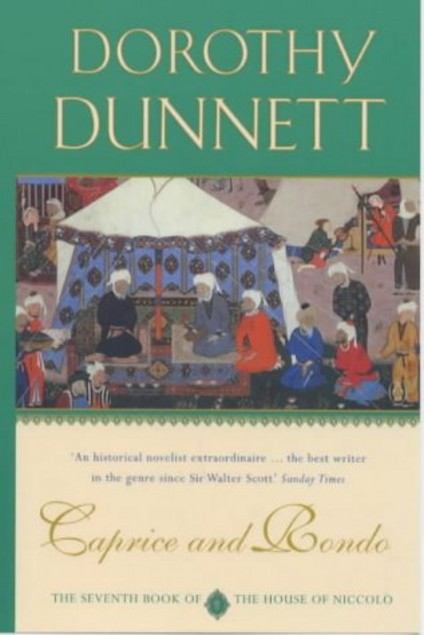
Caprice and Rondo The seventh in the House of Niccolò series and another one I enjoyed, although it was actually one of my least favourites so far. I know other readers will disagree, but in an eight-volume series it’s inevitable that there are going to be some that I don’t love as much as others and this was one of them. Before I try to explain why, I’ll repeat my usual warning that if you have not read the previous six Niccolò novels, you will encounter some spoilers below – it’s impossible to avoid them at this stage in the series!

*

At the beginning of Caprice and Rondo, we find Nicholas in exile following the revelations at the end of the previous book, To Lie with Lions. After allowing his rivalry with his wife, Gelis, to cause financial problems for his bank and almost destroy the nation of Scotland, it seems that his friends and colleagues may not be able to forgive him this time. Spending the winter drinking with the pirate Paúel Benecke in Danzig, Poland, Nicholas appears to be without aim and direction, until the opportunity arises for him to travel to Caffa on the Black Sea in the company of the mysterious Anna von Hanseyck. He is also still searching for the African gold that was stolen from his ship in Scales of Gold, as well as trying to protect Gelis and their son, Jodi, from their numerous enemies who include the former Vatachino agent, David de Salmeton.

I think part of the problem I had with this book was that we are taken to such a lot of different geographical locations and yet none of them really came to life for me as vividly as the settings in the previous books. I realise the cold, subdued atmosphere of the Danzig chapters was probably intended to match Nicholas’s mood and the state of mind he had found himself in, rather as the frozen landscapes of Russia matched Lymond’s in The Ringed Castle, but for me, this was probably the least successful of all the settings in any of the Dunnett novels I’ve read. Caffa is beautifully described, but I couldn’t help thinking the whole section of the book that took place in the Crimea felt a bit irrelevant, though maybe that’s partly because I was finding it difficult to really get interested in the intricacies of Tartar politics. I was much more interested in the other main thread of the story which involved Gelis, with the help of Tobie, visiting Thibault de Fleury and trying to unearth the truth about Nicholas’s parentage. I found myself liking Gelis again in this book after being so frustrated and confused by her since the end of Scales of Gold. I had never doubted that she and Nicholas loved each other and it’s so sad that they had wasted all those years when they could have been together as a family.

We also get a new villain in this book: Julius’s wife, Anna. I was suspicious of Anna from the beginning having learned not to trust characters who seem too good to be true, though I hadn’t guessed who she really was (or not until Adelina’s background was discussed, after which it was quite easy to make the connection) so that was a surprise. I was a bit disappointed though that our established villains, Jordan de Ribérac and Simon de St Pol, never appeared in this book.

While some new questions were raised – the identities of the six children, for example – it also felt as though a lot of things were being tied up in this book in preparation for the final one, such as the death of Nicholai Giorgio de’ Acciajuoli and the end of the mercenary company led by Astorre (I thought Astorre’s death at Nancy was one of the most moving scenes in the book). And of course, the Duchy of Burgundy itself was thrown into disarray with the Duke also losing his life in the battle of Nancy. I also, like Nicholas, finally began to have a better understanding of Ludovico da Bologna who seems to have popped up all over the place in whichever obscure corner of the world Nicholas has been visiting.

“Josaphat Barbaro, speaking of him in Persia, had said, ‘One meets him everywhere, does one not, as one might expect to see the ubiquitous God? But what one meets is not God, but one’s own conscience’.”

Although I started this post by saying this was one of my least favourite Niccolo books, ironically I also found it one of the quickest and easiest to read and I flew through it in a few days over Christmas. I’m reading Gemini now and can’t wait to see how the series concludes!

To Lie with Lions by Dorothy Dunnett

To Lie with Lions To Lie with Lions is the sixth volume in the House of Niccolò series and although I loved it, this is not the place to start if you’re new to Niccolò. To be able to fully appreciate this book, you really need to have read the series from the beginning and, in particular, you need to read the fifth book, The Unicorn Hunt, before this one. To Lie with Lions picks up a lot of the threads from The Unicorn Hunt and in some ways I thought they almost felt like two halves of the same novel, so please be aware that if you haven’t read all of the previous five books yet you will encounter spoilers in the rest of this post.

***

In To Lie with Lions, Nicholas de Fleury returns to Scotland with his wife, Gelis, and son, Jodi. On the surface it may appear that he and Gelis have been reconciled; in reality, the mysterious ‘game’ they are playing is about to enter its final stages. Meanwhile, as Nicholas continues to make himself indispensable to the young King James III of Scotland and his court, he also becomes embroiled in the conflict in Europe between the King of France and the Duke of Burgundy – but which, if either, is he really working for?

Previous books have dealt with the trade of alum, silks, sugar, gold and slaves; this book looks at the trade of another commodity: stockfish (dried, unsalted fish). To find these supplies of fish, Nicholas must embark on a sea voyage to Ultima Thule – Iceland and the Westmann Islands. As usual, he has more than one reason for this trip, and to make things even more interesting, the Bank of Niccolò’s rivals, the Vatachino and Anselm Adorne, as well as Paúel Benecke of the Hanseatic League, are also on their way to Iceland. There were a lot of dramatic scenes and set pieces in this book – a walk through the ducal château of Hesdin where traps and practical jokes lie around every corner; a game of Florentine football on the castle walls in Edinburgh; skating on the frozen Nor’ Loch – but it was this excursion to Iceland in the middle of the novel that I found the most memorable. There’s some beautiful descriptive writing in this section of the book, bringing to life all of Iceland’s distinctive natural features – the glaciers, geysers, hot springs and volcanoes – and the wildlife – the eagles, ‘white bears’ and ptarmigans. The descriptions of the volcanic eruptions are stunning and made me think how much more frightening and awe-inspiring such phenomena must have been in Nicholas’s time.

“The Mouth of Hell opened when they were a long way out to sea, and the glacier over Katla lifted its city of ice into the sky…Now, you could no longer diminish what was happening by translating it into human dimensions. This was not a play. This was the hurling into the sky of thousand-ton blocks of ice, glinting and roseate in the thundering night. This was the discharge of millions of gallons of boiling water, plunging down from the mountain in a wild dashing glitter, outrunning the billows of its own pink-flushed steam.”

As with all of Dunnett’s novels, there are things that seem confusing at the beginning but have taken on new meaning by the end of the book. Among other things, we finally discover, after endless hints about ‘the game’ Nicholas and Gelis were playing, what it was all about and what each of them was hoping to achieve; we learn why Godscalc had been so determined to keep Nicholas from returning to Scotland; and the reason for Nicholas’s reaction to the Nativity Play he had worked so hard on and received so much praise for. After disliking Nicholas throughout most of The Unicorn Hunt, I found him more likeable again in this book, rather like Tobie, who returns to Nicholas’s side filled with hope that perhaps he is not beyond redemption after all. Tobie, with his ever-changing opinion of Nicholas, is someone I can definitely identify with! We do see some evidence of Nicholas’s warmer, more human side again in the relationships he forms with Kathi Sersanders and Robin of Berecrofts (two of my favourite characters) in Iceland and in the effort he makes to bond with Jodi.

It seems, though, that Nicholas often gets so carried away with the intricacies of his elaborate machinations that he forgets, or ignores, the fact that his schemes are affecting real people’s lives. And after feeling so much more sympathetic towards him during this book than I did during the last one, the revelations in the final chapters caused me, like many of his friends and colleagues, to become disillusioned with him again. Still, I was pleased that the contest between Nicholas and Gelis had finally come to an end and I was left with the feeling that one episode is over and a new one is about to begin.

The Unicorn Hunt by Dorothy Dunnett

The Unicorn Hunt is the fifth book in the eight-volume House of Niccolò series which follows the adventures of former dyer’s apprentice Nicholas de Fleury (also known as Nicholas vander Poele or Niccolò) now a successful banker and merchant. I loved all of the previous four books – although it took me a while to really get into the first one, possibly because I read it too soon after finishing the Lymond Chronicles and couldn’t avoid making comparisons – but I think this one has just become my favourite of the series so far, surpassing even the brilliant Scales of Gold.

A warning before I go any further: as followers of my blog will know, I usually make an effort to avoid spoilers in my posts, but I think it’s going to be almost impossible to discuss the fifth book in a series without spoiling anything. Unless you’ve already read the first four instalments, I would suggest starting at the beginning with Niccolò Rising and not reading the rest of this post until you’ve caught up.

In The Unicorn Hunt Nicholas is searching for two things: the gold which was stolen from his ship in the previous book and a child that may or may not be his. The search for both will send Nicholas and his companions on a journey across Europe and North Africa – but before the hunt begins, we are taken to Scotland where Nicholas is setting some elaborate schemes in motion.

Scotland, I suppose, may be a less exotic setting than the Black Sea port of Trebizond, the island of Cyprus or the African city of Timbuktu – but much as I’ve enjoyed learning about the places Nicholas and his entourage have visited in the previous books, it was good to be back on more familiar territory and in one of the few Dunnett locations I have actually visited many times! Later in the book the action returns to Bruges and Venice, incorporating trips to Cairo and Alexandria, the mountains of the Tyrol, and another brief visit to Cyprus, though for once I think I would have preferred the whole book to have been set in one place – after leaving Scotland I thought the story suffered slightly from the lack of geographical focus. There also seemed to be less focus on trade and business in this book than in the others; instead, the driving force of the plot is the conflict between Nicholas and his wife, Gelis.

I think this is the only series I’ve ever read where I feel I’m understanding the main character less with every book rather than more! The warmth and sense of fun he often displayed in the earlier novels is almost completely gone now, which is understandable considering some of the things he has gone through, but even so Dunnett really made me dislike Nicholas in this book, especially in the first half. I couldn’t help comparing his behaviour to Lymond’s in The Ringed Castle – both of them seem to deal with their pain by cutting themselves off emotionally from the people around them and the way Nicholas’s men were trying to keep him away from Scotland reminded me of the way Lymond’s friends were reluctant to let him return to Russia. Anyway, I’m fortunately not a reader who needs to like the characters to be able to enjoy a book – and Nicholas is still as complex and fascinating as ever, even if not very likeable at the moment, so we’ll see how I feel about him in the next book, To Lie with Lions.

Dunnett really excels at writing exciting set pieces and there were some great ones in The Unicorn Hunt, including a dramatic fight at the salt-pans in Scotland and a confrontation during an ascent of Mount Sinai (there were lots of ascents and descents of various types in this book, I noticed). But as usual, in what is otherwise a very dark book, the drama is balanced by some delightfully funny scenes – one involving a parrot, a mirror and a hat, and another with a gum-covered kite and a priest’s beard. The introduction of Anselm Adorne’s niece, Katelijne Sersanders (Kathi), also helps to lighten the mood and I think she’s part of the reason I enjoyed this book so much.

I did have one small problem with this book and that was the fact that we are asked to believe that Nicholas is now a diviner and has the ability to find people and objects by divining. I’m still not sure how I feel about this; I don’t really mind Dunnett adding a paranormal angle to the story (the Dame de Doubtance and her prophecies in the Lymond Chronicles didn’t bother me too much, for example) but I do prefer to see Nicholas solving problems using his own intelligence and powers of logic and reasoning, rather than using what appear to be magical abilities. It just seemed a bit too convenient that he suddenly discovers he is able to use divination to find things in a book where ‘finding things’ is the central plot point.

And hunting, as the title suggests, is a major theme of this book. The dowsing and divining are linked to this, but there are also lots of other ways in which hunting is incorporated into the story: hunting with hounds in Scotland, hunting chamois in the Tyrol, hunting for the stolen gold, and of course, hunting for the baby. The unicorn of the title and who or what it refers to could also be interpreted in several different ways. Like the unicorn, which is a mythical beast, for most of the novel we are never quite sure whether or not the existence of the child is also a myth and I thought it was wonderful that Dunnett was able to keep the reader in suspense so masterfully right until the very end of the book.

For a very different view of The Unicorn Hunt, see Leander’s post from a few weeks ago. I think it’s interesting that each individual reader can have different favourites and least favourites while still agreeing on the overall quality of the series.

Scales of Gold by Dorothy Dunnett

This is the fourth book in the House of Niccolò series and my favourite so far. As always, I have done my best to avoid any major spoilers in this post but would still advise newcomers to the series to start at the beginning with Niccolò Rising and work through the other novels in order.

This book begins as Nicholas vander Poele returns to Venice from Cyprus following the events of Race of Scorpions. Facing financial problems and threatened by powerful new business rivals, he soons departs for Africa in search of a new source of gold. With him on the journey are his kinsman Diniz Vasquez, Bel of Cuthilgurdy (Diniz’s mother’s companion), the priest Godscalc who hopes to bring Christianity to the African tribes and reach the fabled lands of Prester John in distant Ethiopia, and Gelis van Borselen whom we first met as a thirteen-year-old girl in Niccolò Rising and who now blames Nicholas for her sister Katelina’s fate.

With the help and guidance of his friend Loppe, a former slave, Nicholas and the others sail down the African coast, a voyage fraught with danger as they find themselves racing against another rival ship. More trouble awaits them when they arrive in Africa – it’s important for those who know the location of the source of gold to keep it a secret and strangers from Europe are treated with suspicion and distrust. And that’s really all I want to say about the plot. Like all of the other novels in this series, Scales of Gold is very complex and intricately plotted, so I won’t go into any more detail but will leave you to enjoy Niccolò’s adventures for yourself.

One of the things I love about the House of Niccolò (and Dunnett’s other series, The Lymond Chronicles) is the range of unusual and exotic locations the books take us to. The period the Niccolò books cover (the second half of the 15th century) is a period I’m very familiar with in terms of English history, having read quite a lot of books, both fiction and non-fiction, about the Wars of the Roses and the reigns of Henry VI and Edward IV. However, I have to admit that I know almost nothing about what was going on in the rest of the world during the same period and it’s been a delight to be able to fill in some of the gaps in my knowledge – some of the places we’ve visited so far in this series include Bruges, Trebizond and Cyprus, all of which have been wonderful to read about. Although parts of Scales of Gold are set in Europe (the first few chapters take us from Venice and the glassworks of Murano to Portugal, Spain and Madeira) a long section of the story takes place in Africa. Historical fiction novels set in Africa are not very common and I loved learning about all the places Nicholas and his companions passed through on their journey, especially when they arrived in Timbuktu, yet another location I knew absolutely nothing about! I had no idea Timbuktu was once such an important centre of trade, culture and learning.

It’s also good to know that as far as the historical detail is concerned, I can trust that it will all be as accurate as Dorothy Dunnett could make it. In each book Nicholas meets a host of real historical figures and becomes embroiled in a series of real historical events, although his actions are never allowed to directly change the course of history. Scales of Gold, like all good historical fiction novels should, leaves me wanting to do some extra research of my own into some of the fascinating topics covered in the book.

Finally, any discussion of this book can’t be complete without mentioning the shocking cliffhanger ending! I was kicking myself because earlier in the story I had suspected something of that sort might happen but then I decided I had misjudged the character concerned and changed my mind – and so I was completely stunned by the revelations at the end, just as Dunnett had intended us to be. Outwitted yet again! Looking through some other reviews of this book, it seems people either love the ending or feel cheated by it. Personally I fall into the first group: I love it when an author surprises me, making me believe first one thing and then another, especially if the clues were there from the beginning. Anyway, I’m glad I already have a copy of The Unicorn Hunt at hand so I don’t have to wait too long to find out what happens next and how Nicholas will deal with what he has learned!