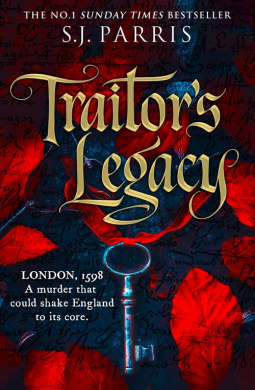
 I know S.J. Parris’s Giordano Bruno historical thrillers, set in Elizabethan England, are very popular, but I’ve only read one of them – Sacrilege – and wasn’t particularly impressed. When I saw that she’d started to write a new series, of which Traitor’s Legacy is the first, I thought it would be a good opportunity to give her another try. As it turned out, this is actually a spin-off featuring some of the same characters (but not Bruno himself, although he is mentioned once or twice).
Traitor’s Legacy is set in the winter of 1598 and follows Sophia de Wolfe, formerly an agent of the Queen’s spymaster, Sir Francis Walsingham. Now Walsingham is dead and Secretary of State Robert Cecil has stepped into his role. It’s Cecil who summons Sophia when a girl’s body is found in the foundations of a building site with a scrap of paper tucked inside her clothing. The paper contains a message written in a cipher used by Sophia during her time as a spy, suggesting that someone is trying to link her to the murder. But who would want to do that and how could the secret cipher have fallen into anyone else’s hands?
The girl is quickly identified as Agnes Lovell, a wealthy heiress and a ward of the powerful nobleman Sir Thomas North, who had been planning to marry her to his son, Edmund. It’s possible that the murder could have been committed for political reasons – North had gained a reputation for corruption during a recent military campaign in Ireland – but there also seems to be a connection with the ambitious Earl of Essex, the Queen’s favourite courtier. However, things take a more personal turn for Sophia when suspicion falls on her own illegitimate son, Tobie. Sophia will do whatever it takes to clear his name, but this is made more difficult by the fact that Tobie himself has no idea that she is his mother!
Having only read one of the Giordano Bruno novels, I’m not sure how much we actually learn about Sophia in that series. I vaguely remember her from Sacrilege and presumably she’s in some of the other books as well. It’s definitely possible to follow what’s happening in this book without any prior knowledge, but I did feel there was a lot of backstory I wasn’t familiar with and had to pick up as I went along. I didn’t find Sophia entirely believable as a 16th century woman, but not wildly anachronistic either and she’s aware of the limitations placed on her by society. I liked her as a character and enjoyed following her investigations. She’s assisted by Anthony Munday, a playwright and another former spy, sometimes working together and sometimes separately which helps the story to move along.
Many of the characters in the book are people who really existed; I’ve already mentioned some of them, but we also meet others including Thomas Phelippes, Cecil’s cryptographer, and Frances Devereux, wife of the Earl of Essex. Through the character of Anthony Munday, the novel also touches on Elizabethan London’s theatrical world and the rival groups of actors, the Lord Chamberlain’s Men and the Admiral’s Men. There’s a lot going on, then, but the plot, although complex, is easy enough to follow and I gradually became gripped by it. I enjoyed this book and am looking forward to meeting Sophia and her friends again as the series progresses.
Thanks to Hemlock Press for providing a copy of this book for review via NetGalley.



 She Reads Novels