The King’s Curse by Philippa Gregory

The Kings Curse This is the sixth and final volume in Philippa Gregory’s Cousins’ War series which explores the Wars of the Roses from a female perspective. The books can be read in any order, although I would recommend reading them in the order of publication. Previous novels in the series have introduced us to Elizabeth Woodville, Margaret Beaufort, Jacquetta of Luxembourg, Anne Neville and Elizabeth of York; this one, The King’s Curse, tells the story of Margaret Pole, another woman with an important part to play in the history of the period.

Margaret is the daughter of George, Duke of Clarence, brother of the last two Plantagenet kings, Edward IV and Richard III. With a new dynasty – the Tudors – now on the throne of England, Margaret’s Plantagenet blood means that she and her family are seen as a threat. At the point when the novel opens, her brother has already been executed on the order of Henry VII and Margaret herself has been married off to a minor knight, Richard Pole – a man she respects but does not love.

When the King and his wife, Margaret’s cousin Elizabeth of York, send their son and heir, Prince Arthur, into Margaret’s care at Ludlow Castle, she becomes a friend and confidante of the Prince’s Spanish bride, Katherine of Aragon. Arthur dies following a sudden illness and Katherine is left a widow – but not for long, as his younger brother, the newly crowned Henry VIII, decides to marry the Princess himself.

Margaret is by Katherine’s side as she tries and fails to give Henry a male heir, losing one baby after another. But when Henry finally tires of Katherine and turns his attention to Anne Boleyn, Margaret discovers that her loyalty to the Queen has cast suspicion on the Plantagenets once again. Can Margaret convince the King that she and her family can be trusted, while still continuing to offer friendship to Katherine and her only surviving child, Princess Mary?

After the disappointment of the previous novel, The White Princess, I was pleased to find that I enjoyed this one much more. I thought the writing was better, the story was more interesting and Margaret was a much stronger character than Elizabeth of York. I got the impression that Gregory herself had enjoyed writing this novel, perhaps more than some of the others in the series.

I’ve read the story of Henry VIII, his marriage to Katherine of Aragon and subsequent divorce many times before, but it was interesting to see familiar events retold from a different point of view. Margaret is perfectly placed to know what is going on, being a cousin to the King’s mother, friend to Katherine and governess to Princess Mary. Through Margaret’s eyes we watch Henry’s transformation into a cruel tyrant unable to tolerate anyone disagreeing with him, we see how the people of England respond to Thomas Cromwell’s dissolution of the monasteries, we witness the public reaction to Anne Boleyn, and we learn how Mary feels about being cast aside and disinherited.

As well as being an observer of the royal court, however, Margaret has her own problems to deal with away from court as she works to keep herself and her children safe. Two of her sons – Lord Montague and Arthur – have positions at court and another, Reginald, is sent to Padua to study and is given the job of researching the theological argument behind the King’s divorce. It’s difficult for Margaret and her children to regain the power and influence they believe is due to them as Plantagenets without making themselves appear a direct threat to the Tudor throne. But unlike her cousin Elizabeth in The White Princess, Margaret is portrayed here as a very capable woman with strength, dignity and spirit. I did sometimes find her annoying, though, especially every time she showed such blatant favouritism to her youngest son, Geoffrey, who did nothing to deserve it as far as I could tell.

I still had a few problems with the book – one of them being Gregory’s insistence on referring to every character by his or her full name, title and relationship to the narrator almost every time they appear in the text. Would a mother having a private conversation with her son really address him as “Son Montague”? Is this really necessary when Montague (Henry Pole) is one of the main characters in the story? We’re not likely to forget that he is Margaret’s son, after all. I also thought the book felt much longer than it really needed to be; some of the scenes started to feel quite repetitive.

I haven’t mentioned the ‘curse’ of the title yet, but I can tell you that it refers to the curse Elizabeth of York and her mother, Elizabeth Woodville, supposedly placed on the Tudor line in the previous novel. The subject of the curse is raised every time a child or heir to the throne dies, but I was pleased to see that it never becomes a major part of the plot. In her author’s note at the end of the book, Gregory offers a scientific alternative to the curse, which I found interesting.

On the whole, then, I found this to be one of the better Cousins’ War novels. It was also the perfect way to end the series, tying in with her previous series of Tudor novels. Now I’m wondering which period of history Philippa Gregory will turn to next.
Fair Helen by Andrew Greig

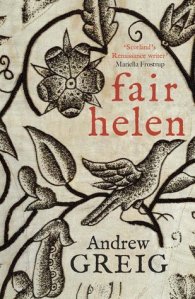
Fair Helen Last year I started a little project of my own – which I don’t think I ever actually blogged about – to work through the titles shortlisted for the Walter Scott Prize for Historical Fiction since it began in 2010. So far I’ve discovered some great books including An Officer and a Spy, Harvest and The Garden of Evening Mists. This book, Fair Helen, is another one that I’ve enjoyed and might never have thought about reading otherwise.

Fair Helen, by Scottish author Andrew Greig, is a beautifully written novel based on the Border ballad, Fair Helen of Kirkconnel Lea which begins:

“O that I were where Helen lies!
Night and day on me she cries;
O that I were where Helen lies,
On fair Kirkconnel Lea.”

The ballad goes on to tell of two rivals for Helen’s love, a shot being fired and Helen falling dead into her lover’s arms. In Fair Helen, Andrew Greig offers one possible interpretation of this ballad, retelling some of its events and expanding on it to include other aspects of Scottish history and Border folklore.

In the late 16th century, when the novel is set, ‘Jamie Saxt’ (King James VI) is on the throne of Scotland, while England’s Queen Elizabeth is approaching old age with no heir of her own. Soon the two thrones will be united under James, bringing some sort of peace and order to the Border region. In the meantime, though, the Borders remain a wild and dangerous place where clans of reivers on both sides of the English-Scottish border fight and feud, steal cattle and conduct raids.

Adam Fleming, whose stepfather is ‘heidsman’ (leader) of the Flemings, has fallen in love with the beautiful Helen Irvine of Annandale. Unfortunately, Helen has already been betrothed to another man, Robert Bell, because the Irvines are keen to form an alliance with the Bell family. Adam has no intention of ending his romance with Helen and summons an old friend from his student days, Harry Langton, to help arrange their secret trysts.

Harry is the narrator of Fair Helen, looking back on the events of the past from several decades into the future, and he is the ideal person to tell the story, being Adam’s best friend and Helen’s cousin. But Harry is also working for another, more powerful patron – someone who has plans of his own for the Borders and will have no sympathy for two young lovers who get in the way of his plans.

I was surprised by how much Andrew Greig managed to pack into the story. I was expecting a tragic romance (according to the cover, the ballad is sometimes described as the Scottish Romeo and Juliet) but it was so much more than that. In fact, the story of Adam and Helen is only one part of the story, no more or less important than the Border politics, the complex feuds and alliances between the clans, and the plotting and scheming going on behind the scenes. There’s a lot happening in this book, yet the pace never feels too rushed.

I always enjoy reading about the Border Reivers, as I live quite close to the Borders (on the English side), but so far I’ve found very few novels that deal with the subject. As I read Fair Helen I kept thinking of Dorothy Dunnett’s The Disorderly Knights – some of the same Borders families appear in both books, such as the Scotts of Buccleuch, and in both there is a dramatic Hot Trod (a lawful pursuit of a raiding party). I wish more authors would choose to write historical fiction based on this fascinating time and place in history – or maybe there are lots of books already and I just haven’t discovered them yet. I do have some non-fiction books on my list for future reading!

I’ve already mentioned how beautiful Andrew Greig’s writing is but I think it deserves to be mentioned again as it really is lovely and poetic, filled with feeling and emotion. The language used is suitable for the 16th century, with no inappropriately modern phrases finding their way into the dialogue to spoil things (one of my pet hates with historical fiction). Harry’s narration is written in the Scots dialect, which also adds to the authenticity. Definitions of unfamiliar words are not given directly in the text – you can usually work them out from the context of the sentence or if not, you can look them up in the glossary at the end of the book. Unless, of course, you’re Scottish in which case it shouldn’t be a problem at all!

Andrew Greig has written six other novels as well as some non-fiction and poetry. If you’ve read any of his other books, please let me know which you would recommend.

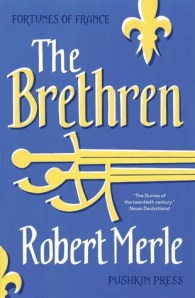
The Brethren by Robert Merle

The Brethren How could I resist a book that has been compared to both Alexandre Dumas and Dorothy Dunnett’s Lymond Chronicles? The Brethren is the first in Robert Merle’s thirteen-volume series, Fortunes of France, and sounded exactly like the sort of book I usually love! I was surprised to find that, despite being hugely successful in France when it was originally published between 1977 and 2003, the series is only now being made available in an English translation for the first time by Pushkin Press.

This first instalment introduces us to the de Siorac family and is set in the 16th century during the French Wars of Religion, a period of conflict between the Catholics and the Huguenots (Protestants). Our narrator is Pierre, the young son of Jean de Siorac, a former soldier who retires to the castle of Mespech in the Périgord region of France and establishes a small Huguenot community there with the help of his friend, Jean de Sauveterre. The two Jeans are such close friends that they formally adopt each other as brothers, becoming the ‘brethren’ of the title, but while they are united in their religious beliefs, they have very different personalities!

The adventures that follow are remembered by an older Pierre, looking back on his life. He tells us of the time the château of Mespech was attacked by a band of gypsies and of an attempt to rescue the family’s former maid from a plague-stricken town, as well as the more mundane tasks of haymaking and harvesting. We also get to know the other members of the household, from Pierre’s Catholic mother (whose refusal to convert is a source of discord within the family) and his wet-nurse’s mischievous daughter, Little Helix, to the superstitious cook, La Maligou, and the three veteran soldiers who have been with the two Jeans since their earliest military campaigns. Most of all, though, we follow the religious struggles taking place between Catholic and Huguenot, both within the walls of Mespech and throughout the whole of France.

I found The Brethren an enjoyable book, although it was not exactly what I had expected. It lacked the humour and flair of Dumas’ novels and the characters didn’t come to life the way Dunnett’s do, but I did still find plenty of things to love. The portrait of 16th century France is vivid and fascinating and I learned a lot about the religious wars, which I’ve never read about in so much detail before.

After finishing the book I was interested to discover that Robert Merle had written the originals using a form of 16th century French. The English edition, you may be relieved to hear, is not written in anything resembling 16th century English, but it does not really seem like an entirely modern translation either. This wasn’t a problem for me, as I do like books to have an old-fashioned feel, especially when I’m reading historical fiction. However, the writing does become quite dry in places and there’s not as much action as I would have hoped for, with a lot of time spent on discussions of religious treaties and detailed descriptions of battle strategies.

As Pierre is a young child throughout most of this novel and still only fifteen, I think, at the end, many of the things he tells us about are things he has not actually witnessed or taken part in personally. Instead, he gives us second-hand accounts of his father’s adventures, often drawing on Jean de Siorac’s journal, the Book of Reason. This has the effect of creating a distance between Pierre and the reader so that I found his narration slightly detached at times. But although Pierre didn’t pull me into the story as quickly as I would have liked, I did eventually become completely absorbed in the lives of the de Siorac family. I’m already looking forward to the second book and I hope Pushkin Press will continue to publish the rest of the series.

I received a copy of this book from the publisher for review.

Bitter Greens by Kate Forsyth

Bitter Greens Since reading Kate Forsyth’s Brothers Grimm-inspired The Wild Girl last year, I have been looking forward to Bitter Greens, another novel with a Grimm connection. I’m sure most of us know, or have at least heard of, the fairy tale Rapunzel. Although this fairy tale was included in the Grimm Brothers’ 1812 collection, Children’s and Household Tales, it was actually based on a much earlier story, Persinette, which was published in 1698 and written by a woman called Charlotte-Rose de Caumont de La Force. In Bitter Greens, Kate Forsyth combines a re-telling of the Rapunzel story with a fascinating account of the life of Charlotte-Rose.

The novel begins in 1697, on the day that Charlotte-Rose is banished from the court of Louis XIV and sent to a convent. With her sharp tongue, sense of humour and spirited personality, it seems that Charlotte-Rose has been the cause of too much scandal for the Sun King’s liking and is now receiving her punishment. After the lively and opulent court of Versailles, Charlotte-Rose finds it very difficult to adapt to life in a strict and austere nunnery. The only thing that makes her days bearable is her friendship with one of the nuns, Soeur Seraphina, who entertains her with a story about a little Italian girl called Margherita…

Accused of stealing a handful of bitter greens from a witch’s garden, Margherita’s parents are forced to make a bargain with the witch: she will not report them for the theft if they agree to hand over their daughter as soon as she reaches the age of seven. And so Margherita finds herself taken from her parents and locked in a high tower by Lake Garda – a tower which can only be accessed when Margherita throws her long red hair from the window to form a ladder.

Margherita’s story unfolds slowly, a few chapters at a time, and alternates with the story of Charlotte-Rose who is looking back on her life, her love affairs and her time at court. There is also a third strand to the novel and in this we learn the history of Selena Leonelli, the witch of the fairy tale, who was once a Venetian courtesan known as ‘La Strega Bella’ and a model for the artist Titian. These three women lead lives which are in some ways very different but in others quite similar. Each has been touched by sadness and tragedy, but each woman proves herself to be strong and resilient in the end.

There’s just so much packed into this novel: the scandals and intrigues of the 17th century French court, a version of Rapunzel much darker and more compelling than the one I remember from my childhood, a vivid depiction of Renaissance Italy, magic and witchcraft, religious persecution, stories within stories, and much more. I was never bored, no matter which of the three women I was reading about. Charlotte-Rose is a wonderful character and I’m surprised that more authors of historical fiction haven’t used her as a subject for their novels. This is the first time I’ve had the pleasure of reading about her and I think it’s sad that she seems to have been largely forgotten by history.

Much as I loved Charlotte-Rose, though, I always found myself looking forward to returning to Margherita in her tower. She and Selena never felt quite as real to me as Charlotte-Rose did (which is maybe not surprising as they are supposed to be fairy tale characters, after all!) but I really enjoyed revisiting the Rapunzel story, which I hadn’t read or even thought about for such a long time. There were elements of fantasy and magical realism within Margherita’s tale that worked well alongside the more realistic narrative of Charlotte-Rose and I thought the balance was perfect. I loved Bitter Greens and would highly recommend both this book and The Wild Girl.

Bitter Greens_Blog Tour Banner_FINALv2 I read Bitter Greens as part of the Historical Fiction Virtual Book Tour. For more reviews, interviews and guest posts please see the tour schedule.

Sisters of Treason by Elizabeth Fremantle

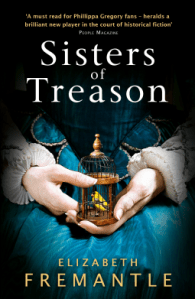
Sisters of Treason This is Elizabeth Fremantle’s second historical fiction novel. I read her first book, Queen’s Gambit, last year and was quite impressed by it, so I’ve been looking forward to reading this one. It didn’t disappoint me – I actually found it a more compelling and enjoyable book than the first. Although Fremantle’s books are set in Tudor England, a very popular choice with historical fiction authors, it would seem that she’s trying to write about some of the lesser known female figures of the period, which is very refreshing. Queen’s Gambit was the story of Henry VIII’s sixth wife, Katherine Parr, who is usually given less attention than some of the other wives, while her next novel – due to be published next year – is going to be about Penelope Devereux and should be really fascinating.

This book, Sisters of Treason, is the story of Katherine and Mary Grey – the two younger sisters of Lady Jane Grey, the ‘nine-day queen’. The novel opens in 1554 with Jane being beheaded, having been deposed by her cousin, Mary Tudor, after only nine days on the throne of England. Jane is dead before our story really begins but she remains a constant presence in the lives of both Katherine and Mary Grey who are unable to escape the taint of treason. Under the reigns of first Queen Mary and then Queen Elizabeth I – neither of whom have a child of their own to name as heir – the Grey sisters have a strong claim to the throne, which means they will never be allowed to live their lives in peace.

Following Jane’s execution, the family of Katherine’s husband, Henry Herbert, decide to distance themselves from the Greys. Katherine is heartbroken when her marriage to Henry is annulled but she does find love again with Edward Seymour, the brother of her best friend Jane (referred to in the novel as Juno to distinguish her from the other Janes in the story). Queen Elizabeth is furious when she learns of their relationship and Katherine soon discovers just how difficult life can be for those who go against the Queen’s wishes.

The youngest Grey sister, Mary, was born with a form of spinal curvature which has affected her growth and as she is unlikely to be able to have children she is seen as less of a threat than Katherine. However, she is forced to undergo degrading experiences such as sitting on Queen Mary’s knee and being treated as a sort of pet or baby. Later, when Elizabeth takes the throne, although Mary is not in as much danger as Katherine, she still finds that the Elizabethan court is not a pleasant place to be.

Sisters of Treason is narrated by both Katherine and Mary (my favourite character) in first person present tense. This is something I don’t usually like but I thought it worked well here. There’s also a third viewpoint character – Levina Teerlinc, a friend of Frances Grey, the girls’ mother. In her position as a portrait painter who produces miniatures of various important court figures, Levina gives us a different perspective on some of the things that happen in the book.

As well as being the story of the Grey sisters, the novel also takes us through some of the major events of Queen Mary’s and Queen Elizabeth’s reigns. While both Queens can be cruel and treat their Grey cousins very badly, they are not just portrayed as complete monsters with no depth to their characters. Instead, the author tries to give some possible reasons for their behaviour and shows us the pressures they are under as female rulers in a male-dominated society.

They sit in silence for a moment, and something occurs to Levina that she had not fully realized until she articulated it – that for Elizabeth politics come before everything. That is how it must be if you are Queen regnant, your passions shut away in a box buried deep beneath the ground. It makes her think of her predecessor Mary Tudor, who struggled so with that concept, and she surprises herself with a pinch of sympathy for these women who have to fashion a cold, hard face to show to the world.

I have read a few other novels about the Grey sisters (The Nine Day Queen by Ella March Chase and Alison Weir’s Innocent Traitor and A Dangerous Inheritance) but I still don’t think they get a lot of coverage in historical fiction compared to other figures from the Tudor period. Many people will have heard of Lady Jane Grey but may not be aware that she had two sisters and something that I liked about this book is that by beginning with Jane’s execution, Elizabeth Fremantle avoids re-telling Jane’s more famous story and instead concentrates on the other Grey sisters. However, Katherine and Mary never forget what happened to Jane and her influence on their lives is still very strong; Katherine inherits Jane’s Greek New Testament in which she has written “it shall teach you to live and learn you to die” and Mary often asks herself what Jane would do in certain situations. As Mary says to Levina near the end of the novel:

“In the scheme of a life, it is not the duration of something but its impact that is important.”

Thanks to the publisher for providing a review copy via NetGalley.

The Second Duchess by Elizabeth Loupas

The Second Duchess The Second Duchess is a fascinating historical novel set in Renaissance Italy and narrated by Barbara of Austria, the second wife of Alfonso d’Este, the Duke of Ferrara. The recent tragic death of the Duke’s first Duchess, Lucrezia de’ Medici, has never been satisfactorily explained and many people think she may have been murdered by the Duke himself. Listening to these rumours, Barbara doesn’t know what to believe. Determined to discover the truth she decides to investigate, but it seems that whoever killed Lucrezia doesn’t like Barbara asking questions. Will Alfonso’s second duchess meet the same fate as his first?

Although the back cover of this book promised “conspiracy, intrigue and murder”, I was still surprised that the story had such a strong mystery element. I have never read anything about Lucrezia de’ Medici’s death before and enjoyed watching Barbara trying to piece the facts together. Despite the gossip suggesting that Lucrezia was poisoned by the Duke, Barbara soon discovers that there are plenty of other people at court and beyond who may also have wanted the first duchess dead. With lots of possible suspects and clues that are only revealed slowly throughout the novel, it’s not easy to guess the truth. Today historians believe Lucrezia probably died of natural causes, but the mystery Elizabeth Loupas weaves around her death feels plausible and makes a great story!

I think another of the things I liked about this book was that the ‘romance’, if you can even call it that, is very subtle and understated. At twenty-six, Barbara has a mature and realistic outlook on life and she is aware that her marriage has been made for political reasons. She doesn’t expect to instantly fall in love with Alfonso and is prepared to work at their relationship, trying to get to know and understand him. Of course, this would be a lot easier if she could just find out whether or not he’s a murderer! Barbara is portrayed as an intelligent and courageous woman, not beautiful like Lucrezia but with a grace and dignity of her own, and never seeming too modern or out of place in a sixteenth century setting.

Alfonso, Duke of Ferrara is an intriguing character and I could never quite decide whether I liked him or not. He commits an act of violence near the beginning of the book that made me think not, but as the story progressed I started to have more respect for him. Both Barbara and the Duke feel like realistic people of their time period and don’t always behave as we might like them to behave, but I actually found that very refreshing as so many authors try to give modern day sensibilities to their historical characters. As for Lucrezia, although she is dead before the novel begins, she is still a very strong presence and we do have the opportunity to hear her point of view – in a very unconventional way. Lucrezia’s passionate, vengeful voice contrasts nicely with the style of Barbara’s narration and gives us a different perspective on the story.

I also loved all the descriptions of the court of Ferrara: the clothes, the food, the interiors of the churches and palazzi, the hunts, banquets and pageants – I particularly liked reading about the Festival delle Stelle with costumes and mechanical devices representing the signs of the Zodiac. Finally, I should mention that this novel is inspired by Robert Browning’s poem, My Last Duchess. The poem is included at the end of the book and I recommend reading it as it adds another layer to the story. I also found it interesting to search for more information and pictures of the main characters in the novel after I finished reading, as they are all historical figures I previously knew nothing about. Portraits of the beautiful young Lucrezia, the dark, enigmatic Duke, and our heroine Barbara can all easily be found online.

I enjoyed The Second Duchess and really liked the way Elizabeth Loupas writes, which is maybe not surprising as she lists two of my favourite authors (Mary Stewart and Dorothy Dunnett) among her influences. This is the first of her books that I’ve read but I’ll certainly be looking out for her others.

I received a copy of this book from the publisher for review.

The Lost Duchess by Jenny Barden

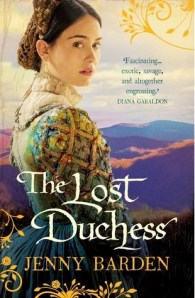
The Lost Duchess With a title like The Lost Duchess and an opening chapter set at the court of Elizabeth I, describing an encounter between one of the Queen’s ladies and Lord Hertford, you may think this sounds like just another Elizabethan court romance – but you would be mistaken. With the arrival of Sir Francis Drake bringing stories of his adventures in the New World comes the first hint of what this book is actually about. And when Emme Fifield, the lady who had that confrontation with Hertford, decides to join Governor John White’s expedition to establish a new colony at Chesapeake, it becomes clear that The Lost Duchess is going to be something fresh and different.

Emme is desperate to leave England and sail to the New World so that she can avoid the disgrace she knows she will face when her involvement with Lord Hertford is made public. In order to convince the Queen to let her go, she promises to return with reports on the colonies for Elizabeth and her spymaster, Sir Francis Walsingham, but Emme’s real intention is to stay in Chesapeake and build a new life there…especially when she begins to fall in love with one of her fellow travellers, the mariner Kit Doonan. But while Emme is trying to keep the truth about her past hidden from Kit, we learn that Kit also has some secrets of his own.

Emme and Kit are great characters and I enjoyed getting to know both of them, but the aspect of this book that I found the most interesting was the fate of the lost colony of Roanoke – the English settlement established by Sir Walter Raleigh in the 1580s before being abandoned with no trace of the colonists. The explanation for the colony’s disappearance is still a mystery today, but Jenny Barden suggests one possible theory which I thought was very convincing. And if you’re wondering why all of this is significant to the story told in The Lost Duchess, although the ship on which Kit and Emme set out from England is originally heading for Chesapeake, Roanoke is where they end up.

The voyage itself provides lots of exciting action as Emme and the other colonists face dangerous seas and the loss of their supplies, while finding themselves at the mercy of their Portuguese navigator, Simon Ferdinando, who may or may not be trying to betray them. Life becomes no easier when they land at Roanoke – poisonous fruit being one hazard and conflicts with the native people another. Having befriended Chief Manteo of the Croatoans, the settlers are hopeful that they can negotiate with the Native Americans but it seems that things have happened in the past which will make it difficult for them to live peacefully alongside each other.

Roanoke and its mysteries is a fascinating, unusual setting and I’m sure you’ll agree that it makes a change from the majority of Tudor/Elizabethan novels which tend to focus on royalty and life at court. Jenny Barden’s previous novel, Mistress of the Sea, sounds wonderful too and is linked with this one through the character of Kit Doonan’s brother, Will. I’m looking forward to reading it.

The Lost Duchess_Tour Banner_FINAL

I read The Lost Duchess as part of a blog tour. For more reviews, interviews and giveaways please see the tour schedule at Historical Fiction Virtual Book Tours.