The Ashes of London by Andrew Taylor

The Ashes of London I always look forward to new books by Andrew Taylor, having enjoyed several of his others in the past. His last two novels, The Scent of Death and The Silent Boy, both featured the same characters (Edward Savill, an 18th century London clerk, and his family) and I had expected there to be more books in that series. However, The Ashes of London is something different: it’s set more than a century earlier – during the Great Fire of London of 1666 – and introduces us to a completely new set of characters.

Our narrator, James Marwood, is the son of a Fifth Monarchist who has recently been released from the Tower of London. All Marwood wants is a quiet life and the opportunity to escape the taint of his father’s disgrace – but as the flames begin to rage across London, it seems that fate has something else in store for him. While he watches St Paul’s Cathedral burn, a young woman runs past towards the fire, taking Marwood’s cloak with her. Later, a dead body is found in the ashes: a man with his thumbs tied behind his back. Marwood, who works for the government, is given the job of investigating the death.

Running parallel with his story is that of Catherine (Cat) Lovett, daughter of a regicide who was involved in the execution of King Charles I and who has been on the run since the restoration of the monarchy. As more dead bodies are discovered in the aftermath of the fire, it seems that Cat must be connected to the deaths in some way…and it’s up to Marwood to find out how.

I don’t think The Ashes of London is one of Andrew Taylor’s best books (my favourite is still The American Boy), but I did enjoy reading it. While I didn’t find it quite as atmospheric as some of his other novels, the setting was certainly a fascinating one. Not only do we witness the destruction of a city by fire and share the sense of loss felt by those who lived there, we are also given the chance to learn something about the political situation in London at that time. I previously knew almost nothing about the Fifth Monarchists, a religious sect who even during the Restoration were plotting to overthrow the monarchy and prepare for the coming of King Jesus, so I found that aspect of the story very interesting.

I enjoyed getting to know both of our main characters, James Marwood and Cat Lovett. Marwood is not a particularly memorable character in himself, but he interested me due to his background and ties with the Fifth Monarchists and regicides. Cat is a strong, independent person who knows how to look after herself, and while I couldn’t quite believe in her as a realistic 17th century woman, her actions do help to drive the plot forward. Apparently this book is the first in a new series, so I expect – and hope – that we will meet both James and Cat again.

Overall, I found The Ashes of London a good Andrew Taylor novel, if not a great one. I’m looking forward to reading the next book in this series, but while I’m waiting for it I would like to go back and read Bleeding Heart Square, the only one of his historical novels I still haven’t read yet.
Lorna Doone by R.D. Blackmore

A clan of murderous outlaws, a dashing highwayman, stolen jewels, family feuds, political intrigue, lots of beautiful scenery and a tender love story: R.D. Blackmore’s 1869 classic, Lorna Doone: A Romance of Exmoor, has all of these things and more. Set in the south west of England in the seventeenth century, it tells the story of John Ridd, a yeoman farmer, and his love for the beautiful Lorna Doone.

Lorna Doone John is twelve years old when his father is attacked and killed by a gang of Doones, a once noble family who fell out of favour at court and fled to an isolated Exmoor valley where they have since been leading wild and lawless lives. Being a child, there is no immediate action John can take, so he puts his desire for revenge aside and settles back into life at Plover’s Barrows farm with his mother and two younger sisters, Annie and Lizzie.

At fourteen, John has his first encounter with the eight-year-old Lorna after climbing a hill behind a steep waterfall and unexpectedly finding himself in the Doone Valley. Several years later they meet again as adults and fall in love, but there are many obstacles which must be overcome before they can have any chance of happiness. First there are John’s own feelings towards the Doones, and the fact that as granddaughter of Sir Ensor Doone, head of the family, Lorna’s social status is much higher than that of a humble farmer like John. To complicate things further, the brutal and violent Carver Doone intends to marry Lorna himself and will let nothing stand in his way.

I could tell from the beginning that I was going to enjoy Lorna Doone. It’s just the sort of classic I love! I suppose this could technically be classed as a re-read as I did own an abridged version of the book as a child, but I can barely remember reading it and huge chunks of the original must have been missing anyway (the full, unabridged version has more than 700 pages). I can only regret that it has taken me so long to decide to try it again as an adult.

Lorna Doone takes place during the final years of the reign of Charles II, the Monmouth Rebellion of 1685 and the Bloody Assizes which followed. If you don’t know much about this period of history it might be worth briefly reading up on it first, to gain an understanding of the novel’s historical context, but don’t worry – it’s easy enough to follow the story of John and Lorna even without this knowledge. As our narrator, John is the character we get to know best, following him as he grows from a child into a man. His narrative voice is honest, down-to-earth and often humorous. Lorna, though, is a typical Victorian heroine – beautiful, delicate, gentle, passive, and with a tendency to faint and swoon. I didn’t dislike her, but I preferred John’s two sisters: Annie, who has a romance of her own with the highwayman Tom Faggus (who is based on a real person, and whose horse, Winnie, is a great character in her own right), and the intelligent, sharp-tongued Lizzie.

There are lots of other characters, of course, all of whom play an important role in the story. These include Reuben Huckaback and his granddaughter, Ruth, who wants John to marry her; Lorna’s maid Gwenny Carfax, daughter of a Cornish miner; Counsellor Doone, the clever, scheming father of Carver; and Jeremy Stickles, the King’s messenger, who provides a link with London and the court. I should warn you that some of the characters speak in a strong dialect (for example, “there be a dale of faighting avore thee. Best wai to begin gude taime laike. Wull the geatman latt me in, to zee as thee hast vair plai, lad?”) but this is restricted mainly to one or two of the Ridds’ servants – as in many Victorian novels, dialect is used as an indication of class.

Blackmore devotes a lot of time to telling us about daily life at Plover’s Barrows and the things that are important to John and to his family, such as bringing in the harvest, fishing for loaches in the river and surviving a bad winter. I couldn’t help being reminded of Thomas Hardy – another author with a lot of affection for the countryside and country life. Doing a bit of research online, I was interested to discover that Hardy had read Lorna Doone in 1875 and wrote a letter to Blackmore, mentioning “the kindred sentiment between us in so many things”. Lorna Doone is set in Somerset and Devon and there are lots of vivid descriptions of the beautiful landscapes. I particularly loved reading about John Ridd’s adventures in the secluded, hidden valley of the Doones; every time he enters it in search of Lorna, whether through the waterfall or the forbidding Doone Gate, it’s almost as if the reader is being pulled into another world.

I thoroughly enjoyed reading Lorna Doone and now I’m curious as to why it seems to be the only one of Blackmore’s many novels that has stood the test of time and is still in print. His others are available as ebooks and on Project Gutenberg, but before I investigate further I would love to know if any of you have read them and if so, did you find them worth reading?

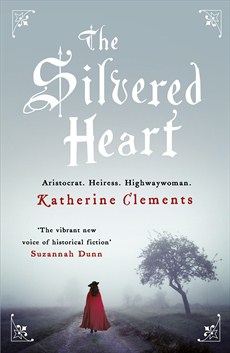
The Silvered Heart by Katherine Clements

The Silvered Heart This is Katherine Clements’ second novel, following her debut The Crimson Ribbon, which I read last year. Both books are set during the English Civil War, but while The Crimson Ribbon is written from a Parliamentarian perspective (the main character is a servant in the household of Oliver Cromwell), The Silvered Heart takes us into the Hertfordshire countryside and shows us what life was like for the Royalists after they found themselves on the losing side. Our heroine this time is Katherine Ferrers, a legendary seventeenth century highwaywoman, known as “the Wicked Lady”.

The story begins in 1648 in an England divided by war – a war which seems to be entering its final stages following a series of Royalist defeats and the imprisonment of the King at Carisbrooke Castle. Orphaned heiress Lady Katherine Ferrers is on her way to Ware Park, home of Thomas Fanshawe to whom she is being married off, when her carriage is attacked by a band of highwaymen. She survives this encounter, but what she experiences that day will go on to shape the course of her life.

Katherine’s marriage to Thomas is not a happy one, even after the war ends. Her husband spends most of his time in London plotting with his friends and dreaming of the day the monarchy will be restored, while Katherine struggles to get by at Ware Park, now impoverished and neglected, like many of the once great Royalist estates. With her own inheritance – her childhood home, Markyate Cell – lost to her, Katherine’s future looks bleak, especially as she is unable to give Thomas the child he so desperately wants. It’s only after meeting Rafe Chaplin, brother of her maid Rachel, and learning about his way of life, that Katherine discovers another option is open to her…if she chooses to take it.

I enjoyed The Silvered Heart – I thought it was a better book than The Crimson Ribbon – but it wasn’t quite what I’d expected. I had imagined lots of scenes involving moonlit roads, coaches appearing out of the mist, and shouts of “stand and deliver”. There was a little bit of that, but not as much as I was hoping for. I was disappointed that I was almost two hundred pages into the book before there was any hint of Katherine’s new career as a highwaywoman – and when it did happen, I wasn’t entirely convinced that the woman I had been getting to know in the first half of the novel would have chosen to turn to a life of crime.

Where The Silvered Heart does excel is in its portrayal of England in the aftermath of civil war, during the period known as the Interregnum: a time when those who had been loyal to their king find that they have their homes taken from them or are so heavily taxed and fined they can no longer afford to live in the manner they are used to; a time when men with Royalist sympathies risk exile or imprisonment in the Tower of London, and when networks of spies and double agents are formed as loyalties shift and allegiances change. This is the world in which Katherine finds herself and the backdrop against which her story is played out.

While the highway robbery aspect of the novel isn’t given as much attention as I would have liked, there is a lot of focus on Katherine’s romantic entanglements and relationships with the other main characters in the novel. I have already mentioned her unhappy marriage to Thomas Fanshawe and her partnership with Rafe Chaplin, but there are two more characters whom I found particularly interesting: Rachel, Katherine’s maid, whose relationship with her mistress is much more complex than it appeared to be at first, and Richard Willis, a scheming Royalist officer who knows more about Katherine than she is comfortable with.

I enjoyed reading the author’s note at the end of the book in which Clements tells us about the real life Lady Katherine Ferrers and shares with us a picture of the only known portrait of our heroine. It seems that there is a lack of actual evidence to link the real woman with the Wicked Lady of legend – Clements has drawn on both the historical facts and the details of the legend to create her version of events – but it’s interesting to consider the circumstances that may have led to these stories springing up around Katherine.

It appears that Katherine Ferrers has inspired a number of other novels (Deborah Swift’s recent young adult novel, Shadow on the Highway, is one) and also some films, including a 1945 adaptation starring James Mason and Margaret Lockwood. I’m surprised that I had never heard of her before reading The Silvered Heart, but I’m pleased to have been introduced to this fascinating woman at last!

The Vicomte de Bragelonne by Alexandre Dumas

The Vicomte de Bragelonne This is the third Dumas novel to feature d’Artagnan and his three friends, Athos, Porthos and Aramis. Originally published in serial form as part of a much longer book, it is now usually split into three volumes of which The Vicomte de Bragelonne is the first and Louise de la Vallière and The Man in the Iron Mask are the others. As Dumas is one of my favourite authors I was fully expecting to love this book – and I did, although it was not quite as satisfying as the first two d’Artagnan novels – The Three Musketeers and Twenty Years After.

The first thing to say about The Vicomte de Bragelonne is that it is not really about the Vicomte de Bragelonne! He does appear near the beginning and again near the end, but his role in the story is not really any more significant than any number of other characters. The next thing I should say is that any reader hoping to find the four friends working together again in the spirit of “all for one and one for all” will be disappointed; we do see quite a lot of Athos, but Porthos and Aramis only come into the story very briefly towards the end.

So, what is this book about, then? Well, possibly because this is only one section of a longer work, it’s difficult to give a summary of the plot. The first half of the novel concentrates mainly on d’Artagnan and Athos who are working on two separate schemes both designed to restore Charles II to the throne of England. History tells us that the restoration would be accomplished – though not quite in the way described in this book, which is much more fun than what actually happened!

Later in the book we learn that Aramis and Porthos seem to be helping the Superintendent of Finances, Monsieur Fouquet, to build fortifications on the island of Belle-Île. We don’t find out exactly what they are up to, however, and this part of the story is left shrouded in mystery, presumably to be developed in the next two novels. Finally, there’s the storyline involving the title character, Raoul (the Vicomte), and his love for Louise de la Vallière.

The gaps between these three subplots are filled with lots of chapters detailing the political situation in France in the 1660s (particularly the death of Cardinal Mazarin and the rivalry between Fouquet and Louis XIV’s new Minister of Finance, Colbert) and the romantic intrigues of the French court (revolving around the King’s marriage and also his brother’s marriage to Charles II’s sister, Henrietta). All of this makes The Vicomte de Bragelonne a heavier, slower read than the previous two novels, but I didn’t find it boring at all – I love the way Dumas writes and I love French history, so I didn’t really mind the fact that there was less swashbuckling action and that we don’t see as much of d’Artagnan’s friends.

Of course, where history (or even geography) is concerned it can’t always be assumed that everything in a Dumas novel is completely accurate. I was amazed to find that in Dumas’ world the city of Newcastle had suddenly been transported from the River Tyne to the banks of the River Tweed sixty miles to the north! Dumas also tends to change dates or rearrange the sequence of events whenever the story calls for it as well, though I’m sure I wouldn’t have even noticed most of these alterations if I hadn’t been referring to the notes at the back of the book. I’m pleased to say, by the way, that the notes in the Oxford World’s Classics edition didn’t spoil any of the story – although I avoided the introduction just in case.

As The Vicomte de Bragelonne doesn’t stand alone as a complete novel and wasn’t originally intended to, there are a lot of things left unresolved at the end of the book, as you would expect. I’m looking forward to continuing the story soon with Louise de la Vallière!

The Child from the Sea by Elizabeth Goudge

The Child from the Sea “To show you Roch would be such happiness,” she said. “I would show you the bay where the seals come, and perhaps they would sing to you, and the Valley of Roses at St Davids, where the stream is so cool. We would stand on the cliffs when the wind was blowing and hear the gulls screaming and the waves roaring all along the coast.”

“You love the sea?”

“I belong to it.”

Elizabeth Goudge is an author I would probably never have thought about trying if it hadn’t been for Lory of The Emerald City Book Review who is hosting a reading week devoted to Goudge’s work this week. Not knowing much about Elizabeth Goudge’s novels, I read the descriptions of some of them and The Child from the Sea sounded the most appealing to me. Although it seems to be out of print at the moment, I was able to borrow a copy from Open Library.

Goudge wrote a mixture of contemporary novels, short stories, children’s books and historical fiction; The Child from the Sea, published in 1970, is one of her historical fiction novels. It tells the story of Lucy Walter, a mistress – and possibly secret wife – of King Charles II and mother of his eldest son, the Duke of Monmouth.

The novel begins in Wales and introduces us to a young Lucy who is growing up at Roch Castle, the home of the Walter family near the Pembrokeshire coast. The story gets off to a slow start, with lots of descriptions of the scenery and countryside, Welsh customs and traditions, and some of the old myths and legends Lucy learns as a child. We also meet some of the people who live in and around Roch Castle: Lucy’s brothers, the handsome, aloof Richard and the loyal, warm-hearted Justus; her beloved nurse Nan-Nan; and Old Parson and his friend, the mysterious Sin Eater.

This first section of the book could probably have been cut a lot shorter without losing anything important, but it does all add to our understanding of who Lucy is and what a 17th century Welsh childhood may have been like. The story really picks up, though, when the action switches to London on the eve of Civil War and Lucy has her first encounter with the young Charles. Fate brings Lucy and Charles together again several years later and they fall in love, marrying secretly, but it’s not long before they are separated once more by the war raging around them.

The rest of the novel is set during Charles’s period of exile in The Hague following the Parliamentarian victory and the execution of his father, Charles I. We follow Lucy as she travels around Europe awaiting the restoration of the monarchy and hoping that one day she will be acknowledged as Charles’s wife.

Lucy Walter is a woman who really existed and really was one of Charles II’s mistresses, but very little is known about her and there doesn’t appear to be any evidence to prove whether or not she and Charles were legally married. Doing some quick research after finishing this book, it seems that the real Lucy is generally considered by historians to be a very different type of character to the gentle, loving woman portrayed in the novel. But even if this is a romanticised version of her life and her relationship with Charles, and even if it isn’t accurate in every detail, I still found it a very moving, emotional story.

Not knowing anything about Lucy before I read this book meant that I was kept in suspense wondering how the story would play out and what her eventual fate would be. I had a feeling this wasn’t going to be a book with a happy ending, and I was right. There were some heartbreaking moments in the final chapters of Lucy’s story and I had tears in my eyes at the end of the book.

I’m pleased that I gave myself plenty of time to finish this book in time for the reading week! The writing is lovely but the pace of the story is very slow and this is not a book you can rush through in a few days. You need to take your time to be able to appreciate the beauty of the writing and the insights the author is giving us into history and life in general. For this reason, and because it is quite a romantic, sentimental story, The Child from the Sea probably isn’t a book I would recommend to everyone. There’s also a spiritual aspect to the book that grows stronger as the story progresses and may not be to every reader’s taste.

I loved The Child from the Sea, though, and am pleased I chose this one as my first Elizabeth Goudge book. I will definitely be reading more!

Rebellion by Peter Ackroyd

Rebellion Rebellion, subtitled The History of England from James I to the Glorious Revolution, is the third volume in Peter Ackroyd’s History of England series. I haven’t read the first one, but I did read the second – which covered the Tudor period – and enjoyed it, so I was looking forward to seeing how Ackroyd would tackle the Stuarts in this latest volume. Before I go any further I should point out that Rebellion is the US title, which I’m using here as this is the edition I received for review via NetGalley; the UK title is Civil War.

The book opens with the reign of the first Stuart king of England, James I, who acceded to the throne after the death of Queen Elizabeth I in 1603. He was, of course, also James VI of Scotland and united the two countries under one crown. James was followed by his son, Charles I, and most of the book is devoted to discussing the Civil War which ended in Charles’ execution. After several years of rule by the Lord Protector, Oliver Cromwell, the Stuart monarchy was restored under Charles II and the Restoration period is also covered in this volume. Finally, Ackroyd looks at the reign of James II and finishes with the Glorious Revolution which marked the arrival of William of Orange and his wife, Mary.

I have condensed eighty-five years of history into one paragraph here, but the book itself goes into a huge amount of detail, describing the life of each Stuart monarch and the key events of their reign. It’s a fascinating read, especially if you have a particular interest in this period of English history, and like the previous volume, Tudors, it’s written in a style that is factual without being too academic for the general reader. While the lives of kings and queens are interesting to read about, I also like to know how ordinary people lived, so I was pleased to find that Ackroyd gives some attention to the social history of the period and includes some chapters on literature, science, music and drama.

The only problem I had with this book was that I felt too much time was spent on the Civil War while the reigns of Charles II and James II had been squeezed in at the end. The chapters describing the events leading to the Civil War and the religious and political reasons for it seemed to go on forever, and although I can certainly understand why Ackroyd chose to make this the focus of the book I did start to get bored and found myself looking forward to moving on to the Restoration period.

While I didn’t enjoy this book as much as Tudors, I do feel that I’ve learned a lot from it. I am definitely not an expert on seventeenth century history but having finished this book, I now know much more than I did before I started. I haven’t heard anything about the fourth book in this series yet, but I expect it will continue to move forward chronologically into the eighteenth century. While I’m waiting maybe I should find a copy of the first volume, Foundation, which I still haven’t read…or I could try one of Peter Ackroyd’s other books. He has written more than thirty non-fiction books and a large number of novels too, so there would be plenty to choose from!

The Royalist by S.J. Deas

The Royalist As someone who loves both historical fiction and mysteries, it’s not surprising that I also enjoy historical mysteries! If the book has an interesting and unusual setting, as this one has, even better.

The Royalist is the first in a planned series featuring the character of William Falkland. Falkland, as the title suggests, is a Royalist and has been fighting for King Charles in the English Civil War. As the novel begins in 1645, he has been captured by Parliamentarians and is in Newgate Prison awaiting his fate. When after several months of imprisonment a guard comes to take him from his cell, he is convinced that the day of his execution has arrived at last. To his surprise, though, he is taken instead to a meeting with Oliver Cromwell, the man with whom Parliament’s hopes of victory lie.

It seems that Cromwell has learned of a previous occasion on which Falkland stood up to his King to see that a criminal was brought to justice – and he is now hoping that Falkland will be able to solve a second crime, this time within Cromwell’s own New Model Army. Large, well-trained and highly disciplined, the New Model Army has been created with the aim of bringing a rapid end to the war. However, with men being pressed into the army regardless of their religious or political beliefs, discontent, disloyalty, fear and resentment are widespread. At the army’s winter camp in the town of Crediton in Devon, three young soldiers appear to have committed suicide – but why? This is what Falkland must agree to find out, in return for his own life.

I enjoyed The Royalist; it’s a very atmospheric book, taking us from a dark, cramped prison cell right into the heart of an army camp in the middle of a cold, harsh winter. This is the unusual setting I mentioned earlier; I’ve read other novels set during the Civil War, but none that focus specifically on the New Model Army. I knew almost nothing about the army before starting this book, and I found it fascinating, particularly the fact that even former Royalists were recruited, often against their will. It was also interesting to read about the ways in which the people of Crediton were affected by the army moving into their town and forcing them out of their homes.

This is not a book about an army on the move so there are (fortunately, in my opinion) no long battle scenes or discussions of military tactics; this is a book about an army that is stationary, based in one place, biding its time. That doesn’t mean there’s no action, of course! As Falkland continues to investigate and begins to uncover the truth about the young men who have died, he finds that he himself is in danger. There’s a lot of suspense as he explores the camp and its buildings in the dead of night, examines the tree where the three soldiers allegedly took their own lives, and tries to decide who can and cannot be trusted.

As the novel’s narrator, Falkland is the character we get to know best, but I still felt that there was plenty of information about his past that he was withholding from us and could reveal in a future novel. There are other interesting characters too: Thomas Fairfax, for example, the commander of the New Model Army and known as ‘Black Tom’ – one of the few real historical figures to appear in the book. There’s also Kate Cain, a woman who has refused to leave Crediton, and with whom Falkland lodges during his time in the town. And I was particularly intrigued by the character of Henry Warbeck, the man given the job of escorting Falkland to the army camp, as I discovered that there was more to him than met the eye at first.

I’m now looking forward to reading the second William Falkland novel, The Protector, which will be out later this year.