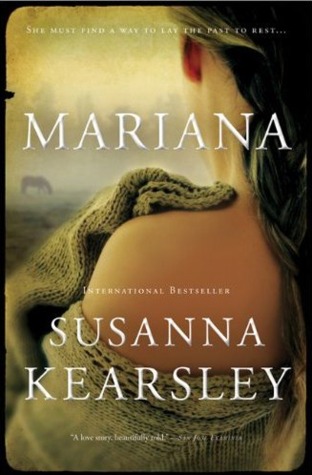
Mariana by Susanna Kearsley

From the moment Julia Beckett first sees Greywethers as a five-year-old, she knows there’s something special about the lonely farmhouse, but it’s not until she’s an adult and a successful illustrator of children’s books that she gets the chance to buy it. As she settles into her new home, Julia gets to know her new neighbours, including the gardener Iain Sumner, Geoffrey de Mornay, the owner of nearby Crofton Hall (which is said to be haunted), and Freda Hutherson, who somehow seems to know a lot about Julia without being told.

Soon Julia’s life becomes mysteriously linked with the life of Mariana Farr, a young woman who lived at Greywethers with her uncle in the 17th century. As Julia spends more and more time in the 1600s she grows increasingly obsessed with Mariana’s story and starts finding it difficult to keep the past separate from the present.

There are some books that feel like they could almost have been written specifically for me and Mariana is one of them – it had all the things I love in a book and I really have nothing negative to say about it. The time period for the historical sections is one that I always find interesting to read about (the Restoration era, the plague and the aftermath of the English Civil War), the characters are easy to like and the relationships between them feel believable, and I also loved the atmosphere – although this is not actually a ghost story, it does have quite a ghostly, haunting feel.

I’ve mentioned before that novels with dual time frames don’t often work for me as I usually find myself enjoying the historical storyline more than the modern day one. That was not a problem with this book because the events that took place in the two time periods were very closely connected and the transitions between the two were so smooth I hardly noticed when one changed to the other. The other Susanna Kearsley book I’ve read, The Rose Garden, has a time travel element too but in Mariana a different method is used and the way Julia moves between the centuries really felt convincing.

The ending was unexpected and really surprised me because I certainly hadn’t guessed what was going to happen. It was maybe a bit abrupt and left a few things unresolved, but I liked it. Susanna Kearsley’s writing reminds me of two other authors whose novels I love – Daphne du Maurier and Mary Stewart. Having enjoyed this one and The Rose Garden so much I’m looking forward to reading more of her books.

I received a copy of Mariana through Netgalley

Samuel Pepys: The Unequalled Self by Claire Tomalin

As you may have noticed, I don’t often read non-fiction (a big clue can be found in my blog name) but this is something I’d like to change. I have heard a lot of praise for Claire Tomalin’s biographies, so I had high hopes for this one.

Samuel Pepys: The Unequalled Self is a long and comprehensive biography of an important historical figure, most famous for the diaries he kept during the 17th century. I haven’t actually read the diaries of Samuel Pepys yet but would certainly like to read them at some point in the future. I wasn’t sure whether not having read the diaries would cause problems with my understanding of the biography, but luckily it didn’t seem to matter – in fact, it might actually be best to read the biography first as it helps to put the diaries in context.

The first few chapters deal with Pepys’ childhood and early life (pre-diary) and understandably we don’t have a lot of information regarding this period of his life – we can only speculate about what Pepys may or may not have done. I found these chapters quite boring in comparison to the rest of the book, although I did enjoy learning about a typical day in a 17th century school – and I was fascinated by the description of the operation Pepys had to remove a stone from his bladder. I’ve always had an interest in the history of medicine and it never ceases to amaze me how anybody ever survived at all!

Tomalin explains that what makes Pepys’ diary so interesting and noteworthy is that he records a mixture of both public events and personal experiences. Pepys lived through a fascinating and eventful period of English history and his famous diary covers such events as the Restoration of Charles II, the plague of 1665 and the Great Fire of London in 1666. I was slightly disappointed that more attention wasn’t given to the plague as it’s a topic I find fascinating to read about (I hope that doesn’t sound too morbid!) but as Tomalin explains it was something that didn’t affect Pepys personally and so he doesn’t spend a lot of time talking about it.

The most interesting parts of the book for me were the descriptions of daily life. While I confess to struggling to get through some of the chapters about Pepys’ political and business activities, I found the more personal sections completely gripping. I thought Tomalin stayed very objective throughout the biography, drawing attention to both the good and the bad aspects of Pepys’ character (and to be honest, he didn’t seem to be the most pleasant of people). But I can tell that even though Tomalin doesn’t shy away from discussing his negative points, she has a lot of enthusiasm and liking for her subject. She also fleshes out the characters of other important people in Pepys’ life including his wife Elizabeth, with whom he had a very complex and volatile relationship. He could be very cruel to her and both physically and verbally abusive, but they did appear to have some genuine affection for each other and Tomalin describes some of the happy times they had together as well as the bad.

For someone like myself who doesn’t often read this type of literary biography, this was quite a challenging book but worth the effort. If I had tried to read this book straight through from beginning to end I probably wouldn’t have managed to finish it, but reading it over the course of a month, a few chapters at a time between reading my usual fiction books, worked perfectly for me.

Have you read any of Claire Tomalin’s biographies? Which ones would you recommend?

The Lost Book of Salem by Katherine Howe

Note: This book was also published under the title The Physick Book of Deliverance Dane.

This book got a lot of attention when it was first published a couple of years ago and I couldn’t wait to read it as I thought it sounded like something I would really enjoy. But after seeing quite a few negative reviews I wasn’t so sure and decided that maybe I wasn’t in such a hurry to read it after all. I finally picked it up in the library last month and thought I’d give it a try.

The Lost Book of Salem (I’m not sure why it was necessary to change the title) is a dual time-frame novel, with part of the story set during the Salem witch trials in the 17th century and the rest of the story taking place in 1991. The modern day storyline follows Connie Goodwin, a history graduate who is attempting to track down a spell book belonging to Deliverance Dane, one of the Salem women accused of witchcraft in 1692. Connie believes the book has been passed down through the generations and could still be in existence. Through a number of flashbacks we meet Deliverance Dane herself and some interesting questions begin to arise: could she really be a witch – and does magic really exist?

I wish I could say I had enjoyed this book, but I didn’t. I had trouble with Katherine Howe’s writing style, which was overly descriptive and made the story drag in places. I also found the plot too predictable – it was interesting enough to keep me turning the pages, but there were no real surprises.

As the main character, I found Connie very irritating. Considering she was a PhD student and supposedly an expert in colonial American history she was very slow to pick up on clues that were obvious even to me. She didn’t appear to have much knowledge of the period she was studying either – I’d have thought she would have known that ‘receipt’ used to mean ‘recipe’, for example, and she seemed to be mystified by the word ‘bottel’ before it finally dawned on her that it was just the phonetic spelling for ‘bottle’. Deliverance Dane was a more interesting character and I would have preferred to have spent longer in the 17th century, rather than just the brief interludes that we were given.

There were still a lot of things to like about this book, though. The historical sections were atmospheric and appeared to have been well-researched. And for anyone with an interest in the Salem witches, the book goes into a lot of detail about the trials and the events that lead up to them. So, although I was disappointed by it, I’m sure other people would enjoy it more than I did.

The Wilding by Maria McCann

The Wilding is set in England in 1672, just after the end of the Civil War. Our narrator is Jonathan Dymond, a young man who works as a cider-maker. Jonathan lives with his loving parents and leads a quiet, happy life, travelling around the neighbouring villages with his mobile cider-press. But when Jonathan’s father receives a mysterious letter from his dying brother, Jonathan grows suspicious and decides to visit his uncle’s widow to investigate. At his Aunt Harriet’s house he meets Tamar, one of his aunt’s servants, and begins to unravel the circumstances surrounding his uncle’s death.

Due to the fast pace and the plot twists, I would recommend reading this book in as few sittings as possible. I had started off reading it in small portions alongside another book and found it difficult to get into the story; when I decided to put my other book to one side for a while and concentrate solely on this one, I found that I flew through the rest of the novel. The story was entertaining, very compelling and kept me turning the pages.

McCann evokes the period very well. I liked the way she portrayed a small rural community in 17th century England. I also learned more than I could ever wish to know about cider-making and apples…

What does Solomon say? ‘Comfort me with apples.’ Everything about them is kind and comforting: the mild eating apple, the sharp or bitter fruit that crushes to a miraculous sweetness, the homely apples, like tried and trusted friends, that serve all purposes.

But to me, the difference between a good book and a great book is having strong characters that I can connect with – and unfortunately I felt that most of the characters in The Wilding had very little depth. As the narrator, Jonathan was boring and not very engaging. Tamar and her mother were both interesting, well-drawn characters, but as we only saw them through Jonathan’s eyes, I didn’t get to know them as well as I would have liked to. It would have been nice to have had part of the story told from Tamar’s perspective, because Jonathan was just too weak and I felt no emotional involvement with him at all.

So, I thought The Wilding was a good book but not a great one. I would recommend it to people who like well-written, fast moving historical fiction with plenty of twists and revelations.

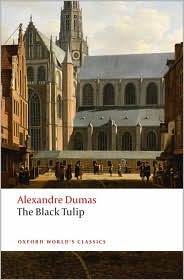
Review: The Black Tulip by Alexandre Dumas

Who would have thought that a book about growing tulips could be so exciting? And yet Alexandre Dumas managed to write a compelling page turner based on that very subject. Dumas became one of my favourite authors a few years ago when I read The Count of Monte Cristo and The Three Musketeers but I had not read any of his lesser-known works until now. I regret not reading The Black Tulip sooner because I enjoyed it almost as much as the two books I’ve just mentioned.

The book is set in seventeenth century Holland and begins with the violent murders of John and Cornelius De Witt, suspected of conspiring against the young Stadtholder, William of Orange. Our hero is the fictional godson of Cornelius De Witt, who is also called Cornelius. Cornelius Van Baerle is a keen tulip-fancier whose biggest goal in life is to produce the world’s first black tulip. However, Van Baerle is not the only tulip-grower in the race for the Grand Black Tulip – and his rival Isaac Boxtel will stop at nothing to get there first!

The first few chapters put the novel in historical context and will be slightly challenging to anyone like myself, who doesn’t have much knowledge of Dutch history, but if you read carefully and refer to the notes it’s easy enough to follow. As soon as Dumas finishes setting the scene, the story explodes into action and never stops until the final page, taking us on a journey through the full range of human emotions – love, hatred, greed, loyalty, jealousy and obsession.

Rosa, the only female character in the book, is a jailer’s daughter who falls in love with Cornelius and finds herself having to compete with the tulip for his affections. Despite making a few remarks of the “I am but a woman” variety she is otherwise a strong and quick-thinking character who does what she knows is right, even if it means going against the wishes of Cornelius or her father. The starring role in the story, though, goes to the elusive black tulip itself.

As you might have guessed, I really loved this book. If you enjoyed The Count of Monte Cristo there’s a good chance that you’ll like this one too, as it’s very similar in writing style, pace and even several plot elements. It could almost be described as a shorter, less epic, less complex version of The Count.

Highly recommended

Publisher: OUP (Oxford World’s Classics)/Year: 2008 (originally published 1850)/Pages: 258/Source: Library book