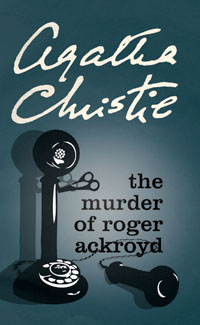
The Murder of Roger Ackroyd by Agatha Christie

2011, among other things, was the year I discovered that I do actually like Agatha Christie, having read a few of her books in the past which I didn’t enjoy very much. I think I had obviously just been choosing the wrong books because I read five in 2011 and loved all but one of them (The Mystery of the Blue Train).

This one, The Murder of Roger Ackroyd, is set in the fictional village of King’s Abbott, home to our narrator, Dr James Sheppard, and the retired detective Hercule Poirot. When Roger Ackroyd is found stabbed to death in his study, Poirot comes out of retirement to investigate the murder. The suspects include Ackroyd’s stepson, his secretary and butler, a big-game hunter and one of the parlourmaids. With Dr Sheppard’s assistance, Poirot begins to piece together the evidence to solve the mystery.

I loved this book and it might even have become my favourite Christie novel so far, if not for one little problem: I guessed the solution to the mystery very early in the story. Now, this is not something that usually happens – I’m normally completely mystified by Agatha Christie’s novels and don’t even bother trying to solve them. This is the first one I’ve ever figured out correctly, but it did mean that in some ways the book was spoiled for me. Not completely spoiled – it was still fun watching for more clues that would confirm whether I was right or not – but it would have been nice to have been surprised when the solution was finally revealed, as the author had intended.

As most Poirot novels are written either in the third person or narrated by Captain Hastings (who does not appear in this book) it took me a while to get used to the new narrator. It gave this book a slightly different feel to the other Poirots I’ve read. I also thought the characters had a bit more depth than usual and I loved the scenes with the doctor’s irritating gossip-loving sister, Caroline, who added some humour to the story. And even though the ending of the story didn’t have quite the impact for me that I would have liked it to have done, I could still appreciate how cleverly constructed the mystery was. There were plenty of suspects, all hiding secrets of their own, lots of red herrings and some plot twists. I’m looking forward to reading more Poirot throughout the year ahead!
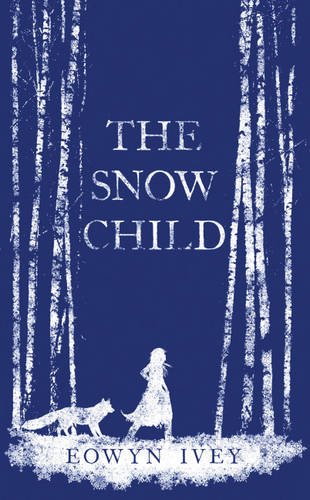
The Snow Child by Eowyn Ivey

Eowyn Ivey’s first novel, The Snow Child, is set in 1920s Alaska, where Mabel and her husband Jack are planning to start a new life. Mabel is still grieving for her still-born child and sees the move to Alaska as a chance to come to terms with the fact that she’s never going to be a mother. But things are proving to be a lot harder than she expected – clearing the land for farming is too much work for Jack, food is becoming scarce, and Mabel is beginning to feel lonely and desperate.

When the first snow of the winter arrives, Mabel and Jack decide to build a child from snow. By morning the snow child has gone and Jack catches a glimpse of a little girl running through the trees. But as Faina slowly becomes a part of Jack and Mabel’s lives, they begin to wonder: is she a real child or has she been created from two people’s hope and love?

If this story sounds familiar, that’s because it’s inspired by an old Russian fairy tale, Snegurochka, or The Snow Maiden. The story has been retold many times over the years but this book takes a fresh approach by combining the feel of a timeless fairy tale with the harsh realities of life as a homesteader in early 20th century Alaska.

The novel has a very small number of characters, which is to be expected considering that the area of Alaska in which Mabel and Jack lived was very sparsely populated. Something I thought the author managed to convey very well was the complete isolation Jack and Mabel experienced during their early days in Alaska and the many dangers they faced, including starvation, ‘cabin fever’, and the risks of injury or sickness in a place where even the closest town is too small to have a doctor.

Among the few other people we do meet are a neighbouring family, George and Esther Benson and their three sons. I particularly loved the character of Esther: a woman who knew what had to be done to survive in the wilderness and was prepared to do it. And as for Faina herself, I thought she was a fascinating character, mysterious and otherworldly but with a charm and vulnerability that made it easy to understand why a lonely middle-aged couple would welcome her into their lives.

But my favourite thing about The Snow Child is the stunning setting Eowyn Ivey has chosen for her story. Her knowledge and love of Alaska comes through in the beautifully written descriptions of the snowy landscapes, complete with frozen rivers, swirling snowflakes and icy mountain ridges. It’s all very atmospheric and the perfect backdrop for such an enchanting and magical story.

The Snow Child will be published in February 2012 and I can promise you it’s worth waiting for. It really is a lovely story and a very impressive debut novel from Eowyn Ivey.

Thanks to Headline for sending me a review copy of this book.

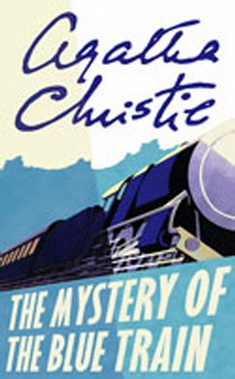
The Mystery of the Blue Train by Agatha Christie

Ruth Kettering is an American heiress who receives a set of valuable rubies as a gift from her father. Despite his warnings to keep them somewhere safe, Ruth takes the jewels with her on a trip to Nice. During her journey through France on the famous Blue Train, Ruth is found strangled to death in her compartment – and the case containing the rubies has disappeared. Hercule Poirot, who also happens to be travelling on the same train, promises to help Ruth’s father solve the crime and identify the killer. Suspicion falls first on Ruth’s husband, Derek Kettering, whom she had been about to divorce, and then on the mysterious Comte de la Roche. Is one of them the murderer?

I grabbed The Mystery of the Blue Train from the library shelf without really knowing anything about it. A bit of research now tells me it’s one of Agatha Christie’s less popular Poirot novels and now that I’ve read it I think I can see why. It was written quite early in her career and at a troubled time in her personal life, and apparently the author herself was unhappy with it. The book does have all the elements that should have added up to a classic Christie novel (a rich heiress, a journey on a luxury train, jewel thieves, the South of France – and Hercule Poirot himself, of course) but while I did enjoy it, I still felt there was something missing.

Compared to the other Agatha Christie books I’ve read, which admittedly isn’t all that many, this one was much longer and seemed to take a while to really get started (the actual crime doesn’t take place until about 100 pages into the book). There was a very long wait before Poirot made his first appearance and instead we spend a lot of time being introduced to other characters, which would have been okay had I liked these characters, but I found them a bit stereotypical, from the American millionaire to the French count to the old antiques dealer.

There were also a few sub-plots that I felt didn’t really add much to the story, although I did enjoy the dialogue between Poirot and Katherine Grey, a young woman he meets on the train who becomes involved in the murder investigation. The mystery itself kept me guessing, though I think there were probably enough clues to be able to work out at least part of the solution, if you were paying more attention than I was! The Mystery of the Blue Train was entertaining in places but is probably my least favourite Christie novel so far.

The Return of Captain John Emmett by Elizabeth Speller

When Captain John Emmett returns from France at the end of World War I, his mother and sister are worried about his mental condition. John is suffering from shell-shock, which is causing him to become aggressive and violent. After spending some time in a nursing home, John escapes and is later found dead in a nearby wood. It is assumed that he committed suicide.

John’s sister, Mary, contacts one of her brother’s old school friends, Laurence Bartram, in the hope that he can help her discover what really happened to her brother. Why would a man who had survived the horrors of the war shoot himself two years later? As Laurence starts to investigate, he begins to wonder whether someone else was behind John’s death.

The Return of Captain John Emmett is a fascinating story. It works well as a historical fiction novel, with its portrayal of the people of 1920s Britain coming to terms with the aftermath of World War I. But it’s also a gripping psychological mystery in which Laurence Bartram reluctantly takes on the role of detective to investigate the circumstances surrounding his friend’s death. There are clues, suspects, red herrings and all the other elements that make up a compelling and well-structured detective story.

The book is also an interesting and poignant study into the effects, both long-term and short-term, that the war had on individuals and their families. How people came back from the war an entirely different person to when they went away. How men dealt with the memories of the atrocities they witnessed. How their wives felt about the part of their husbands’ lives that they had been unable to share. How people were left with physical disabilities and had to learn to adjust.

We are given insights into the thoughts and emotions of a First World War soldier and we learn what it was like to be part of a firing squad. The War Poets are also touched upon, and so are the loyalties and friendships formed in British public schools.

Due to the subject and setting, the book had a sombre and depressing feel, yet I found myself really enjoying it. As the mystery surrounding John Emmett’s death became more and more complex and involved, I was completely drawn into Laurence Bartram’s investigations. The plot relies quite heavily on coincidences in places, but not so much that it spoiled the story for me at all. I loved it and will definitely be looking out for more novels from Elizabeth Speller!

I received a review copy of this book from NetGalley courtesy of Houghton Mifflin Harcourt.