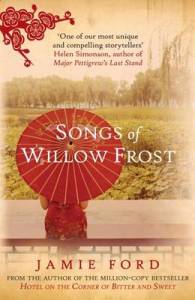
Songs of Willow Frost by Jamie Ford

Songs of Willow Frost William Eng has spent the last five years of his life in the care of the nuns at Seattle’s Sacred Heart Orphanage. It’s 1934 and living conditions at the orphanage are very poor, particularly for William who is Chinese-American and considered inferior to most of the other children. But William is not at all sure that he is actually an orphan – although he has never known his father, the last time he saw his mother she was being carried out of their apartment by a doctor, promising that she’d be coming back soon.

On William’s twelfth birthday he and the other boys are taken to see a film as a special treat and William becomes convinced that one of the actresses he sees on the screen, Willow Frost, is his mother. With the help of his best friend, a blind girl called Charlotte, he sets out to find Willow Frost in the hope that she can answer the question that has been troubling him for five years – what can lead a mother to abandon her child?

Having loved Jamie Ford’s previous novel, Hotel on the Corner of Bitter and Sweet, I was looking forward to reading this one. If anything, this book was even more ‘bitter and sweet’ than the first! At times it was so sad that I wasn’t sure if I could bear to continue reading, but even while my heart was breaking for William and his mother it was obvious that they loved each other and that gave me a glimmer of hope. I wanted them to find the happiness they deserved and that was what kept me turning the pages.

Although we begin in 1934 with William in search of Willow Frost, at least half of the novel is actually set several years earlier in 1921 and follows the story of the young Willow – or Liu Song as she was originally known. It was the 1921 section of the story that I found particularly upsetting to read; being Chinese, a woman and unmarried, life is not easy for Liu Song and it seems that every bad thing that could possibly happen to her does happen. While her stepfather, Uncle Leo, is the villain of the book, I was equally furious with the attitude of a social worker who supposedly had William’s best interests at heart but was clearly only concerned with punishing his mother for what she claimed was immoral behaviour.

Despite the overwhelming sadness, I enjoyed Songs of Willow Frost. There are some great descriptions of Seattle in the 1920s and 1930s and we are given some fascinating insights into the city’s Chinese community and the lives of people struggling to survive during the Depression. I didn’t find this book quite as satisfying as Hotel on the Corner of Bitter and Sweet and there were one or two aspects of the plot that didn’t resolve the way I would have liked them to but overall I thought this was a wonderfully poignant and moving story.

Thanks to Lovereading for the review copy

Little Man, What Now? by Hans Fallada

Little Man What Now I know it’s only the middle of January and it’s ridiculously early to start talking about books of the year but I’ll be very surprised if this one is not on my list in December! I loved every minute of this funny and charming yet dark and poignant German novel from 1932.

Johannes Pinneberg (Sonny) and Emma Morschel (Lammchen) are a young German couple in their early twenties. After discovering that Lammchen is pregnant they get married and move into their first rented home together in the town of Ducherow. As they await the birth of their child (who they think of as The Shrimp), Sonny and Lammchen struggle to get by in the harsh economic conditions of 1930s Germany.

When Sonny loses his job (because his employer has discovered that he is married and no longer free to marry his daughter), he and Lammchen are forced to move to Berlin in search of work and cheaper accommodation. The trouble is, in times of high unemployment and widespread poverty, jobs are not easy to find and rents are high (and the situation isn’t helped by Sonny’s impulsive decision to surprise Lammchen with the expensive dressing-table she’d set her heart on, or Lammchen, suffering from cravings, eating all the salmon on her way home with the shopping). But while others around them lie, cheat and think only of themselves, the honest, hard-working Pinnebergs are determined to survive and to create a happy, safe environment for their new baby.

It was such a relief to find that I loved this book, as I’ve had mixed experiences with Hans Fallada’s novels in the past. Alone in Berlin, which I read in 2011, remains one of my favourite books that I’ve read since I started blogging, but the next one I picked up, A Small Circus, was a huge disappointment and put me off wanting to try any more of his books. I was hesitant to start reading Little Man, What Now? but I’m so glad I did because the problems I had with A Small Circus – the translation, the unlikeable characters, the unfamiliar politics and the fact that most of the novel was written in the form of dialogue – were not problems at all with this book. I was happy with the translation (though I wish I was able to read it in its original German), the Pinnebergs were both lovely, the politics stayed in the background and there was a good mixture of dialogue, action and description.

The book was originally published in 1932 in German as Kleiner Mann, was nun? and a successful film version followed. It’s easy to see why it was so popular, as according to the Afterword, 42% of German workers were unemployed in 1932 (compared with 22% in Britain) and many people would have been able to identify with Lammchen and Sonny. The book still feels relevant today, with many countries around the world suffering high unemployment in recent years. In 1930s Germany, the resulting poverty opened the way for the National Socialist and Communist parties. Yet the novel is far less political and far more domestic than I thought it would be at first.

As Sonny moves from job to job he meets people from a range of different backgrounds and religious or political beliefs, but he doesn’t side with or against any of them; his biggest concerns are for his wife and unborn child. This is not a story that deals with the bigger issues of the time, but about the immediate day to day struggles that ordinary people faced. Sonny is the ‘little man’ of the title, aware that he is only one of millions in the same position, but what sustains him throughout his ordeals is his love for Lammchen and his knowledge that however hard things may be he is still lucky in so many ways.

I liked both of the Pinnebergs from the beginning. I couldn’t help thinking how rare it is that we actually get to read a book about the daily lives of a couple who are happily married, rather than a book that deals with the breakdown of a marriage or one that ends with the wedding rather than beginning with it, as this one does. Sonny and Lammchen are a husband and wife who really love each other, who discuss things together and make decisions as equals. Their story feels completely realistic and the problems they face are the same problems that many young married couples will face: managing their money, finding somewhere to live, worrying about their jobs and preparing for the arrival of their first child. There’s an innocence about Lammchen and Sonny that makes them completely endearing and I think it would be almost impossible to read this book and not fall in love with them both!

While this book is available for Kindle, it seems that paperback and hardback copies of this particular Fallada title are harder to find. If you do have the opportunity to read it I hope you’ll enjoy this glimpse of 1930s German life as much as I did.

Coming Up for Air by George Orwell

Coming Up for Air I think I need to start this post with an apology to George Orwell because like many people, I read Animal Farm and Nineteen Eighty-Four as a teenager and assumed I’d read everything by Orwell that was worth reading. I was obviously wrong because Coming Up for Air is a great book, though very different from his two most famous novels. In a way, though, I’m glad I’ve waited until now to read it because I’m not sure I would have appreciated it as much when I was younger.

Coming Up for Air was published in 1939 and tells the story of George Bowling, a forty-five-year-old insurance salesman who is bored with his dreary, middle-class existence. Married with two children, George’s biggest worries are his mortgage, his weight and the risk of losing his job, but with Europe on the brink of war he knows that the monotony of his life could be about to change. On the day that he receives a new set of false teeth, George takes a trip into London where he sees a poster that triggers memories of his childhood and Lower Binfield, the small, peaceful town where he grew up. George is tempted to return to Lower Binfield for the first time in years, but if he goes back now, what will he find?

Based on the other two books I’ve read, this is not really the type of book I would have expected from George Orwell. However, there are some similarities with Nineteen Eighty-Four in Orwell’s surprisingly accurate predictions of the future. Reading this book gave me an eerie feeling, knowing that it was being written just before the beginning of the Second World War, when the author could have had no real knowledge of what was to come, yet anticipating the changes that would soon be upon the nation.

“I can feel it happening. I can see the war that’s coming and I can see the after-war, the food-queues and the secret police and the loudspeakers telling you what to think. And I’m not even exceptional in this. There are millions of others like me.”

My favourite part of the book was the long section in the middle where George looks back on his childhood in Lower Binfield at the turn of the century. This whole section is a lovely nostalgic portrait of an England that is now gone forever…that had already gone by 1939, destroyed by the First World War.

“1913! My God! 1913! The stillness, the green water, the rushing of the weir! It’ll never come again. I don’t mean that 1913 will never come again. I mean the feeling inside you, the feeling of not being in a hurry and not being frightened, the feeling you’ve either had and don’t need to be told about, or haven’t had and won’t ever have the chance to learn.”

The novel doesn’t have a lot of plot, but that wasn’t a problem; I didn’t find it slow at all. There’s not much dialogue either, as we spend the whole book inside George’s head with his thoughts and memories. Despite this, I found the book completely engrossing. The only time I got bored was with George’s long and enthusiastic description of fishing, his favourite hobby until the age of fifteen. But even this was steeped in nostalgia:

“The very idea of sitting all day under a willow tree beside a quiet pool — and being able to find a quiet pool to sit beside — belongs to the time before the war, before the radio, before aeroplanes, before Hitler.”

George’s actions and opinions are not always very admirable and his views on the women in his life leave a lot to be desired, but despite his flaws, I couldn’t actually dislike him. He’s so ordinary; not a hero, but a real human being with good points and bad points. He has a wryly funny, self-deprecating narrative style which saves the book from becoming too depressing, though overall I found this a sad and poignant story rather than a humorous one. I don’t know much about Orwell’s own life, but I’m sure this book must have been autobiographical to some extent.

I loved Coming Up for Air and will certainly consider trying another of Orwell’s books.

The Herbalist by Niamh Boyce

The Herbalist by Niamh Boyce The Herbalist is set in a small unnamed town in Ireland in the 1930s and tells the story of four women whose lives are affected by the arrival of a stranger – a travelling herbalist who appears from nowhere one day and begins selling his lotions and tonics in the marketplace. Nobody knows anything about the herbalist or his history and initially they are suspicious, but slowly he starts to cast a spell over the women of the town, including sixteen-year-old Emily. Lonely and vulnerable after losing her mother, Emily convinces herself that she and the herbalist are in love, but when she makes a shocking discovery she finds herself with a difficult decision to make.

Another of our main characters is Carmel, who runs a small shop in the town. Having suffered a recent tragedy, Carmel is depressed and insecure and she feels that the only person who understands is the herbalist. Her brother, a teacher, suggests she should find an assistant to help her in the shop and recommends a former student, Sarah, for the job – but how will Carmel react to Sarah’s arrival?

We also follow Sarah, who is having problems of her own. The night before she leaves home to start her new job, her beloved aunt Mai throws a party for her and something that happens at that party will have a big impact on Sarah’s future. Finally, there’s Aggie, a ‘woman of ill repute’ and a fortune-teller. Aggie is an outsider, but through watching and listening to what is going on around her she seems to know more about the herbalist than anyone else in the town. The stories of Emily, Carmel and Sarah are told in alternating chapters, with occasional contributions from Aggie, and gradually the truth about the herbalist is revealed.

I was very impressed with this book and found it hard to believe that it’s Niamh Boyce’s first novel! The writing is beautiful, the setting and the characters feel completely believable and the story itself is fascinating – inspired by true events, according to the author’s note at the front of the book.

Something I found particularly intriguing was the fact that two of the women’s stories are told in the third person (Carmel’s and Sarah’s) and two in the first person (Emily’s and – in question and answer format – Aggie’s). The only problem with this was that while Emily and Aggie both have distinctive narrative voices of their own, the other two feel very similar. One way in which the use of multiple viewpoints works very well in this novel, though, is that it allows us an opportunity to see things from the perspectives of women from different social backgrounds whose lives are confined by the class system of their small, narrow-minded community.

The herbalist himself remains a mysterious, shadowy figure and although he is at the centre of everything that is happening throughout the novel, the focus is always on the female characters and the various ordeals they are going through. I should mention that this is not a happy story and really delves deeply into the darker side of life in 1930s Ireland. I would like to be able to tell you more about some of the issues the book raises, but then I would be giving away the herbalist’s secrets!

I loved The Herbalist and hope there will be more books from Niamh Boyce in the future.

I received a copy of this book from Penguin Ireland for review.

Three nurses, a ghost and a computer genius

The Nightingale Girls by Donna Douglas / For One More Tomorrow by Elizabeth Bailey / Goodbye for Now by Laurie Frankel

Happy New Year! With a backlog of books read near the end of 2012 still to write about, I am starting 2013 with reviews of not just one book but three. Apologies in advance for the length of this post…I thought these were going to be mini-reviews but they turned out to be longer than I expected!
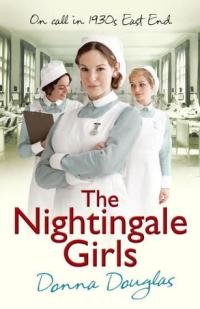
The Nightingale Girls The Nightingale Girls by Donna Douglas

The Nightingale Girls is set in the 1930s and follows the stories of three student nurses at one of London’s top teaching hospitals, the Nightingale.

Life is not easy for Dora Doyle, who comes from a poor, working class family from the East End of London. Dora sometimes feels out of place among the other, richer girls at the Nightingale and is struggling to find money to buy the books she needs, but she is determined to succeed, partly because she’s passionate about nursing but also because she’s desperate to get away from her abusive stepfather. The aristocratic Lady Amelia Benedict, known as Millie, is from a very different social background to Dora, with whom she shares a room. Millie wants to build a life for herself away from her luxurious home and glamorous friends, but as she is constantly finding herself in trouble and has already failed her preliminary training exams once, it’s going to be difficult to prove that she’s serious about her nursing. The third girl we meet is Helen Tremayne, a second year student. Her domineering mother is on the hospital’s board of trustees and her brother is a doctor, so expectations are high. Helen works hard, but has trouble making friends, especially as the other girls don’t trust her because of her mother.

At first it seems that Dora, Helen and Millie have nothing in common but as they get to know each other during their long, hard days at the Nightingale, a bond begins to form between the three of them. I didn’t feel I got to know Helen as well as the other two but I loved both Dora and Millie. Dora was completely inspirational and a perfect example of someone managing to fulfil her dreams through sheer determination and hard work. And the rebellious but warm-hearted Millie was so endearing. Through her story we see that money and possessions are not everything and that true happiness can come through doing something that we love. There are some great secondary characters too, including the spiteful and snobby but bitterly unhappy Lucy Lane, and the Doyles’ neighbour, Nick, who is desperately trying to make enough money to take his little brother to America. Dora’s grandmother, Nanna Winnie, was another favourite.

It was so interesting to see what was involved in being a trainee nurse in the 1930s. The book shows us the hardships of nursing, but there are also lots of moments of fun and humour, including one hilarious scene involving false teeth. As a historical novel, the setting of 1930s London is wonderful, whether we’re reading about the streets in the East End where the Doyle family live or an afternoon eating cakes and drinking tea at Lyons’ Corner House! The Nightingale Girls is the first in a series of novels about the Nightingale Hospital and I will look forward to reading the others.

Thanks to Random House for sending me a review copy of The Nightingale Girls

For One More Tomorrow For One More Tomorrow by Elizabeth Bailey

For One More Tomorrow, currently available as an ebook, tells the story of Sadie Grey, who is directing a production of Shakespeare’s play, Macbeth. Growing frustrated and disillusioned with some of the actors in the play and their inability to inject real passion into their roles, Sadie is stunned when she meets the ghost of Macbeth himself. Soon Mac, as Sadie calls him, seems to be invading her thoughts and taking over her life, and as her relationship with the ghost develops there are some surprises in store for both Sadie and the reader!

At first Sadie wonders whether Macbeth’s ghost has been produced from her own imagination – he looks and sounds exactly as she had pictured him in her mind, even wearing tartan like the characters in Sadie’s play despite the fact that she knows the real Macbeth would not have done so. And yet it seems that Mac does have an existence of his own outside of her imagination, and some sections of the story are seen from his point of view, as he roams the streets alone or watches rehearsals from the shadows at the side of the stage. Through his own thoughts and his conversations with Sadie, we see that he is not very pleased at the way the story of his life has been distorted by Shakespeare; he’s angry and hurt that his reputation has been damaged and history has been altered in the name of entertainment.

I haven’t read all of Shakespeare’s plays but I have read Macbeth more than once and it’s probably the play I’m most familiar with. I could sympathise with Sadie, who clearly has a real understanding and love of the play; she knows how she wants the actors and actresses to play their roles and it annoys her when they do not portray their characters as she wants to see them portrayed…especially Curtis, the man who is playing Macbeth. I did enjoy the parts of the book that deal with the rehearsals for the play and the problems Sadie encounters as director, but my favourite scenes were those in which Sadie is interacting with the ghost. For One More Tomorrow was an unusual and imaginative story and I’m sure the next time I read Macbeth I’ll remember Mac and how he felt about Shakespeare’s words.

Thanks to the author for sending me a review copy of this book
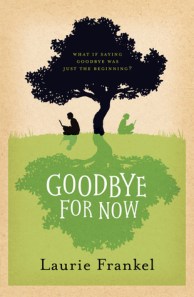
Goodbye for Now Goodbye for Now by Laurie Frankel

Sam Elling is a computer software engineer who works for an online dating company based in Seattle. Sam has created a new computer algorithm to help people find their perfect partner, but it proves to be too successful as people are meeting their soulmates too quickly and don’t need to use the dating agency anymore. As a result he loses his job but it’s not long before he comes up with another invention.

When Sam’s girlfriend Meredith loses her beloved grandmother, Livvie, she tells him she wishes she could speak to Livvie one more time. Wanting to help in any way he can, Sam creates a computer program based on the online presence Livvie has left behind, including emails, texts and videos. Meredith is shocked but overjoyed to discover that she can now continue to chat to Livvie and exchange emails just as she used to when her grandmother was alive. Soon Sam and Meredith decide to give other bereaved people the same opportunity to communicate with loved ones who are no longer with them, but they are not prepared for the number of moral issues they will have to face.

Different people have different ways of dealing with grief and what works for one person will not necessarily work for everyone. I can’t imagine ever wanting to use this type of technology myself and I tend to agree with the characters in the story who found the whole idea creepy and disturbing. However, I still thought it was fascinating to read about. There’s nothing paranormal involved and the software Sam invents sounds completely believable from a scientific point of view.

With death and grief forming such a big part of this book I had expected something very sad and emotional, but the story was actually not as moving as I had thought it might be. That could be because the main characters – Sam, Meredith, her cousin Dashiell and their clients – are all so ‘nice’ that I had difficulty believing in them as real people and didn’t manage to fully connect with them. What I did love about this novel was the number of thought-provoking questions it raises by showing us how the world reacts to Sam’s controversial new technology and telling the stories of the people who decide to use it.

Is chatting to a computer generated image of a friend or relative who has died really a good idea or is it better to let the grieving process take its natural course? Can social media actually be isolating rather than social? Are there things that our loved ones may have said or done online that we would be better off not knowing about? What about privacy? Nobody seemed to have any problems with allowing Sam to access their family member’s emails, blog, internet browsing history or Facebook and Twitter accounts, but I know I wouldn’t feel comfortable with that. Goodbye for Now may not have been a perfect novel but has left me musing on all of these questions and more.

Thanks to Headline for the review copy of Goodbye for Now
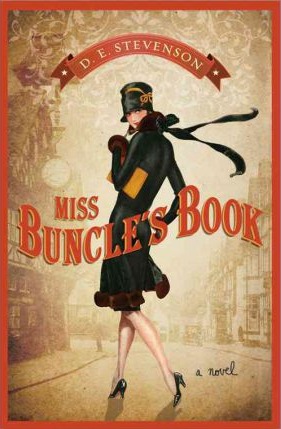
Miss Buncle’s Book by D.E. Stevenson

When Barbara Buncle finds herself short of money she dismisses the idea of keeping hens and decides to write a book instead. Not having much imagination she finds she can only write about people and places that she knows. Drawing her inspiration from her friends and neighbours in the village of Silverstream, she writes her first novel and has it published under the pseudonym of John Smith. When Disturber of the Peace turns out to be much more successful than Miss Buncle could ever have dreamed, it’s inevitable that the residents of Silverstream will eventually read it and recognise themselves within its pages. But how will they feel about the way they are represented in the book and what will happen if they discover who John Smith really is?

Delightful, charming, warm, cosy – those are the type of words I would use to describe Miss Buncle’s Book. Written in the 1930s, D.E. Stevenson captures perfectly the atmosphere of life in a small English village at that time – a place where everybody knows everybody else, where freshly baked breakfast rolls are delivered to the villagers every morning, where people meet for tea parties or musical evenings and gossip with the neighbours over the garden fence. The book is filled with a variety of interesting characters, all with their own quirks and eccentricities. Some of the most memorable include the formidable Mrs Featherstone Hogg, who is enraged by the unflattering way she is depicted in Miss Buncle’s book and leads the campaign against John Smith; Mr Hathaway the vicar and the scheming Vivian Greensleeves who has her eyes on his money; and the retired and lonely Colonel Weatherhead who faces a yearly battle with the Bishop.

Most of the inhabitants of Silverstream make an appearance in Disturber of the Peace and although Barbara Buncle takes the precaution of changing their names (Weatherhead becomes Waterfoot, for example, Miss King and Miss Pretty are renamed Miss Earle and Miss Darling, and Mr Fortnum becomes Mr Mason), she describes their personalities so accurately it’s not surprising that they were able to work out who the book was about! It was fun to see how they each reacted to discovering themselves in Miss Buncle’s story and having all their flaws exposed to the world.

I sent a copy of Miss Buncle’s Book to another blogger as a Secret Santa gift a couple of years ago because I thought it sounded wonderful, and when I saw that it was available through Netgalley I couldn’t wait to finally read it for myself. But although I did like it, I didn’t love it as much as I had hoped I would and as much as most other readers seem to have done. It was an enjoyable, relaxing read with lots of gentle humour and old-fashioned charm, but it lacked that special spark that would have lifted it from being a very good book to a great one. For me, this is a book that sounded better than it actually was, though I would still recommend it as a great way to escape from the stress of life for a while!

I received a review copy from Sourcebooks via Netgalley

The Loving Spirit by Daphne du Maurier

If you’ve been following my blog for a while you’ll know that Daphne du Maurier is one of my favourite authors, so when I saw that Simon of Savidge Reads and Polly of Novel Insights were hosting a Discovering Daphne event throughout October I knew I’d have to read at least one du Maurier book this month. There are still plenty of her books that I haven’t read yet, but I decided I wanted to go back to the start of her career and read her first novel from 1931, The Loving Spirit.

The Loving Spirit is a family saga spanning four generations of the Coombe family. It begins in 1830 with the story of Janet Coombe, a passionate young woman who is forced to abandon her dreams of going to sea when she marries and settles down to start a family with her husband, a boat builder. We then move forward through the decades, ending one hundred years later in the 1930s. Along the way we meet Janet’s son, Joseph, her grandson, Christopher, and finally her great-granddaughter, Jennifer. The book is divided into four parts, one devoted to each of the main characters, but I won’t go into any plot details here as each story has its own set of dramas and surprises which I’ll leave you to discover for yourself.

Although this is a family story and doesn’t have the gothic feel of some of du Maurier’s other books, there are hints of the supernatural in the way the stories of the four Coombes are connected, particularly Janet’s and Joseph’s. The link between the four sections of the novel is the ‘loving spirit’ of Janet Coombe which seems to be watching over each successive generation. And this is probably a good place to mention the Emily Brontë poem, Self-Interrogation, which inspired the title of this novel:

“Alas! The countless links are strong
That bind us to our clay;
The loving spirit lingers long,
And would not pass away!”

Du Maurier had a real talent for giving her novels atmosphere and a strong sense of place, and this book is no exception. The Coombe family live in Plyn, a fictional shipbuilding town on the coast of Cornwall, and you can expect some beautiful, vivid descriptions of the Cornish coastline, the sea and Plyn itself. I’m really not a fan of books about boats and sailing, but luckily the actual seafaring action and terminology is kept to a minimum here. Instead, the focus is on the passion Janet, Joseph and other members of the Coombe family feel for the sea – and the ways in which sailing and the shipping industry become an intrinsic part of their lives.

There are some interesting supporting characters too, including one of my favourites, Jennifer’s grandmother. Du Maurier’s wonderful sense of humour comes through here in some of the dialogue in which the grandmother, who is starting to lose her hearing, constantly misinterprets what Jennifer is saying. For this reason, and also because Jennifer was the character who felt the most real to me, this final section of the novel was probably my favourite.

The Loving Spirit is not one of the better du Maurier novels I’ve read, but as a debut novel published when she was only twenty-four years old I did still find it quite impressive. It’s interesting to be able to compare it with her later novels and see how her writing developed throughout her career.